An article by Richard James Rogers, award-winning author of The Quick Guide to Classroom Management: 45 Secrets That All High School Teachers Need to Know and The Power of Praise: Empowering Students Through Positive Feedback
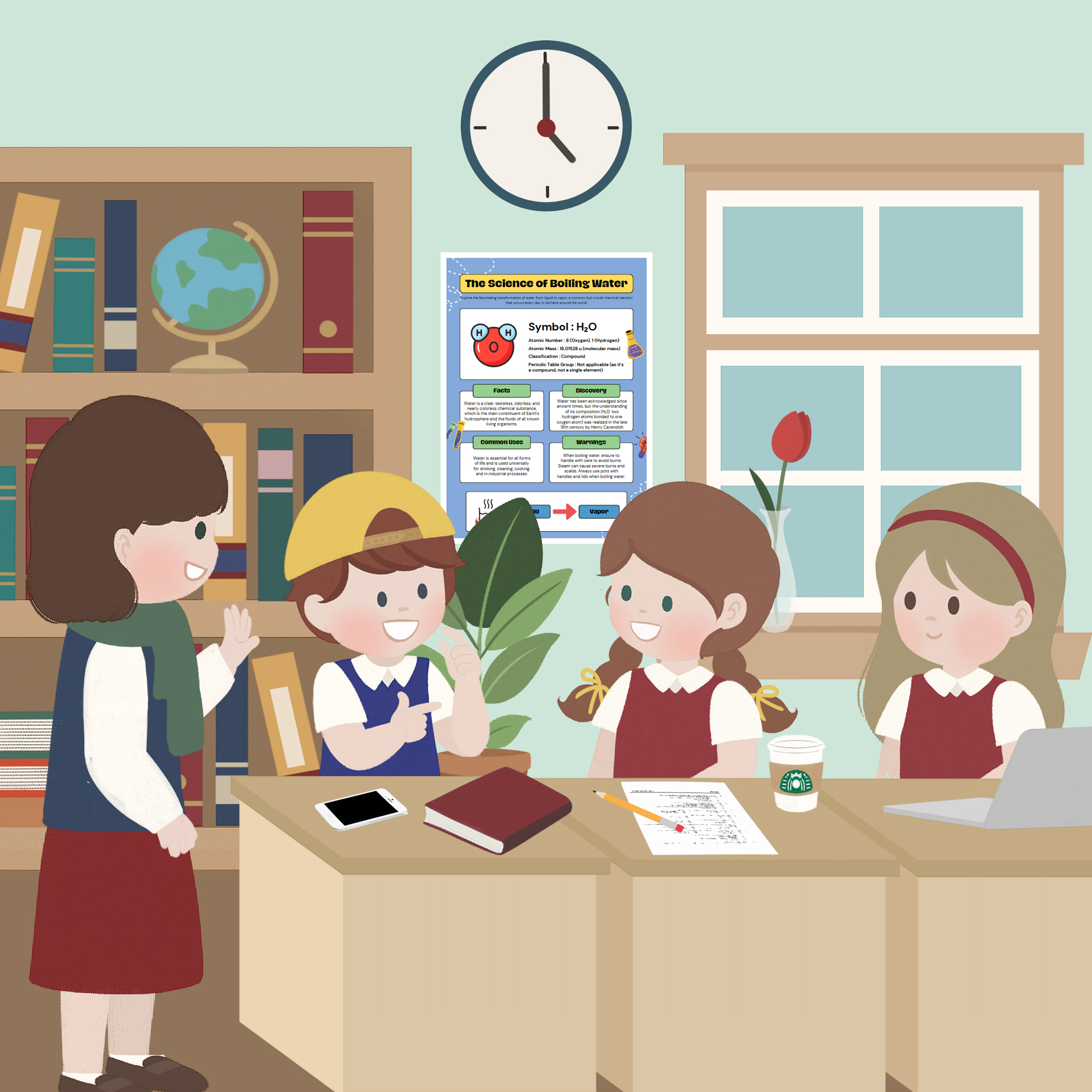
This blog post has been beautifully illustrated by Pop Sutthiya Lertyongphati
Accompanying podcast episode:
I’ll admit it: I was skeptical at first. When I first heard about teachers using AI like ChatGPT to help in the classroom, I imagined some robotic voice taking over my lessons while I stood awkwardly in the corner. But after giving it a try for a while, I can honestly say this: Generative AI has become one of my most useful classroom assistants, and I don’t even need to buy it coffee.
In this post, I’ll walk you through how I’ve been using AI to support my teaching, lighten my workload, and, most importantly, improve learning outcomes for my students.
The Game-Changer I Didn’t Know I Needed
Let’s face it. Teaching is an all-consuming profession. Lesson planning, grading, differentiation, parent communication, and admin responsibilities seem never-ending. That’s why, when I first experimented with ChatGPT, it felt like I had stumbled upon some kind of educational superpower.

I started small. I asked it to generate example questions for a maths lesson. Within seconds, I had five beautifully structured, appropriately scaffolded problems tailored to the topic I was teaching. Then I asked it to rephrase a tricky scientific explanation for my ESL students. It gave me three versions at different reading levels. I was hooked.
Supporting Differentiation Like a Pro
Differentiation has always been both crucial and time-consuming. Now, AI helps me tweak worksheets and task instructions for students of varying abilities with minimal effort.
For example, when teaching a unit on exponential growth, I asked the AI to generate three real-world examples: one for beginners (bacteria multiplying), one for intermediates (compound interest), and one for advanced learners (population modeling using e functions). It was done in under a minute.
This doesn’t replace my professional judgement. It enhances it. I choose what is suitable and make the final call, but AI saves me from reinventing the wheel.
Feedback That’s Fast and Focused
One of the areas where I’ve seen the biggest time savings is in providing formative feedback. Using AI, teachers can input a student’s short essay or paragraph and get a summary of strengths, areas for improvement, and even suggested sentence rephrasings. As a mathematics’ teacher this isn’t something that I tend to use, but a number of my colleagues in schools all over the world have reported to me personally that this is fast becoming their favourite way to use AI: particularly for work that students are submitting online, through platforms like Google Classroom, Moodle and Managebac.

Of course, I would always recommend that you cross-check the feedback before sharing. It’s important to keep the human touch. But it has helped many educators provide more timely feedback to more students. Research shows this is key to learning progression (Hattie, 2009).
Making Planning and Admin Less Painful
Here’s something I didn’t expect: AI is amazing for lesson planning. If I know the learning objective and the topic, I can ask ChatGPT to suggest a lesson structure, key questions, differentiated activities, and even potential misconceptions. It’s like brainstorming with a colleague who never gets tired.
Teachers who I communicate with around the world have also used it to draft:
- Rubrics for creative projects
- Parent letters
- Report comments
- Learning objectives written in student-friendly language
These tasks used to take hours. Now teachers are telling me that these jobs can be done in minutes, and they can get back to actually teaching.
Student Use: A Double-Edged Sword?
Like any tool, AI can be misused by students and teachers alike. I make it a point to teach AI literacy in my classes. My students learn that it’s fine to use ChatGPT to brainstorm ideas or check understanding. However, it is not okay to copy and paste whole essays.
We talk a lot about academic honesty, critical evaluation of AI outputs, and how to verify information. The goal is not to ban the technology. It is to guide its responsible use, just as we do with calculators, the internet, or even textbooks.
As Selwyn (2023) notes: “Schools are no longer gatekeepers of knowledge, but navigators of abundant (and often overwhelming) information.”
Your Personal Therapist
I recently went through a major setback in life, which I can’t describe in detail here (sorry). It was a very emotionally trying time for me, but one thing that really got me through it was ChatGPT. I was able to vent all of my feelings and thoughts to the system, and it provided me with excellent advice and encouragement. Since the AI pulls information from multiple, verifiable sources, it made the advice it gave seem all the more trustworthy. It remembered my previous inputs and iterated accordingly, providing me with a highly personalised and effective therapy experience.

I recently learned that I was far from from alone in using generative AI in this way. A simple Google search reveals multiple articles describing the many ways in which people are using AI chatbots as personal ‘friends’ and counsellors. My favourite article (and one that I recommend) is this one by Eleanor Lawrie from the BBC describing how Al can be an alternative to human help.
The Human Touch Still Matters
Despite all this excitement, I remind myself often that AI is a tool, not a teacher. My job is still to motivate, to connect, and to inspire. No algorithm can replace the relationships we build, the trust we earn, or the “aha” moments we create. But AI can help us make more time for those moments.
Final Thoughts
If you’re an educator and haven’t yet explored how generative AI can support your teaching, I encourage you to give it a try. You don’t need to be a tech expert. You just need to be open-minded and willing to experiment. Like me, you might just find yourself wondering how you ever managed without it.
References
Hattie, J. (2009). Visible Learning: A Synthesis of Over 800 Meta-Analyses Relating to Achievement. Routledge.
Selwyn, N. (2023). Should Robots Replace Teachers? AI and the Future of Education. Polity Press.
BBC News (2025) My AI therapist got me through dark times. Available at: https://www.bbc.com/news/articles/ced2ywg7246o (Accessed: 25 May 2025).


We welcome you to join the Richard Rogers online community. Like our Facebook page and follow us on X for daily updates.