Would you like the opportunity to appear in my next book?
After the unprecedented success of The Quick Guide to Classroom Management, I’m asking teachers all over the world to write a few paragraphs that would help out a total teaching newbie.
You’ll be helping new teachers, you’ll receive full acknowledgement in my book and I’ll even give away five free books to five lucky contributors!
This is something super cool that you would be able to show to your colleagues and future employers too!
I want to know what advice you would give to a new teacher who’s getting stressed out because they’re marking too much work. What advice would you give to help them reduce their workload, improve their marking efficiency and reduce stress when marking? Do you have a story from your own experience that you would like to share?
Please e-mail your advice to richard_science@hotmail.co.uk, along with your name and any other info you’d like to share about yourself (especially the country you’re writing from). Alternatively, you can comment on this blog post too (please write at least two paragraphs).
I look forward to receiving your replies!
Click on the picture below to find out about this great new book
How often do you find yourself grappling with challenging students in your teaching practice? Does your behaviour as a teacher serve to escalate, or alleviate, confrontations?
If you’re having problems with a particular student, or even a group of students, then you may wish to consider making subtle changes to your body language on a regular basis. Our mannerisms and actions serve to act as subliminal cues and primers for student responses and reactions, and experienced teachers will tell you that they capitalise on this to a great extent.
The following extracts come from my debut book, The Quick Guide to Classroom Management, and offer some easy-to-implement strategies for using subliminal cues that promote good student cooperation. I would welcome any comments on this, as there may be tactics that you use which are not mentioned here.
Every good lesson should end with some form of plenary. A plenary offers the chance to review the concepts, information and skills covered in your lesson, as well as providing a fun way for students to end a session of learning.
Let’s take a look at some of the best plenaries out there – all of which have been tried and tested and have been found to work with any lesson and any subject area. I’ve tried to include those activities that draw out the most cognitive output from the students, and therefore have the greatest benefits. However, if you’re looking for hundreds of quick ideas, then both the University of Southampton and the University of Essex have published documents outlining, briefly, some great plenaries that you can try.
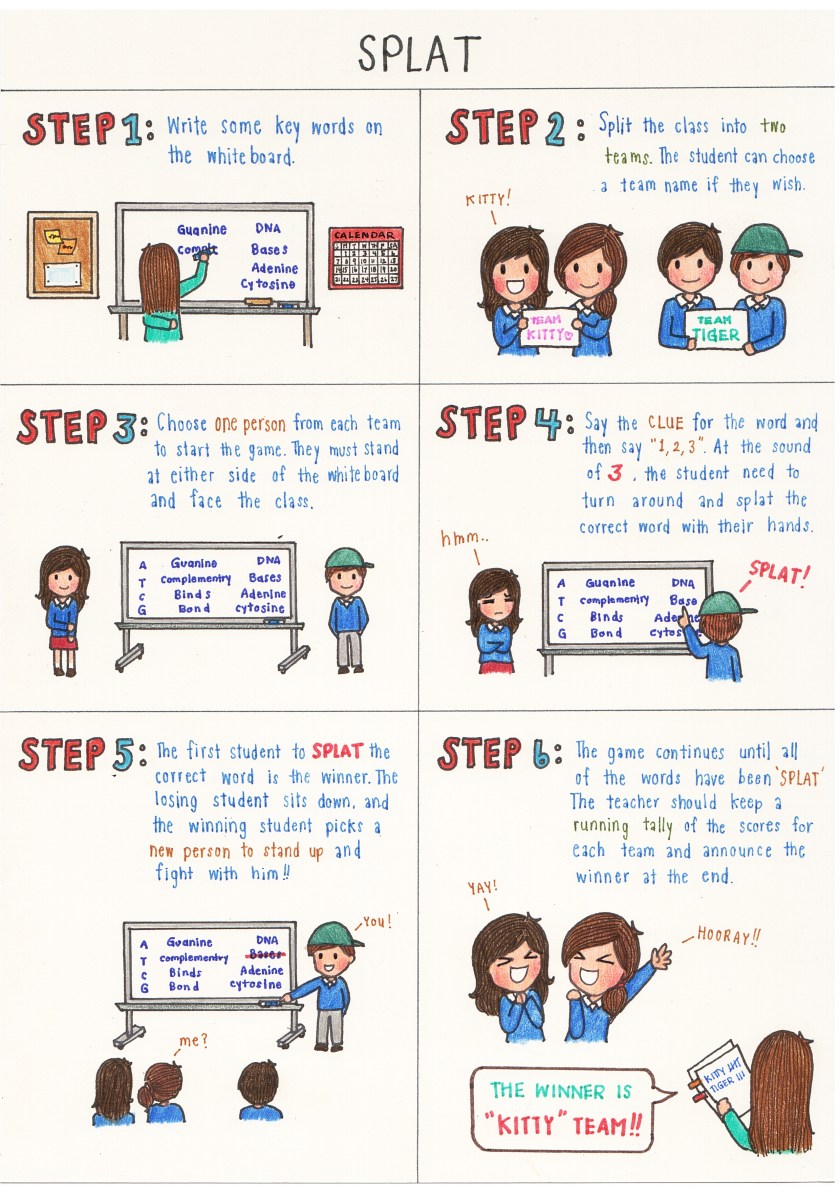
#1 ‘Splat’
This is such a simple game and it’s tons of fun! Any lesson you teach, no matter if it’s playing football in P.E. or writing sonnets in English, will involve the use of specialist vocabulary. Why not review this vocabulary with a fun game at the end of your lesson? It’ll provide your students with a short break and will help them to link concepts together.
#2: Use graphic organizers
Do you know what graphic organizers are? They are becoming increasingly popular in schools and offer a great way for students to link ideas, concepts, information, skills and background thinking in a visual way. Take a look at these examples below, kindly shared by Doug and Melissa over at Write Design. How could you use these (or others – please check the website!) to provide meaningful conclusions to your lessons?
Examples of Graphic Organisers
#3: Play ‘corners’
This is so much fun that you often have to calm the students down half-way through! It’s a very competitive game, and lends itself well to both closed and open questioning. When you couple it with your schools rewards system (e.g. merits or house points) it can really get your kids motivated and thinking. Perfect for a Friday afternoon (trust me – I know).
#4: Cartoon strip
Students create a cartoon strip that goes through what they learnt that lesson. You can even print out a three or six-box grid for the kids if you like. Really gets the creative juices flowing! Students can do this by hand, or can even create comic strips online. The one below was created at http://www.makebeliefscomix.com/ and it only took five minutes!
#5: Bingo
Can be used with words or numbers. Takes some setting up, but is great fun and really helps the students to learn a lot!
#6: Mystery Word
Another simple game. Fun and takes minutes to set up. Kids love it!
#7: Who am I?
A fun and childish game. Kids of all ages love this (even at 18 years old!). Again, simple, easy, fun and productive.
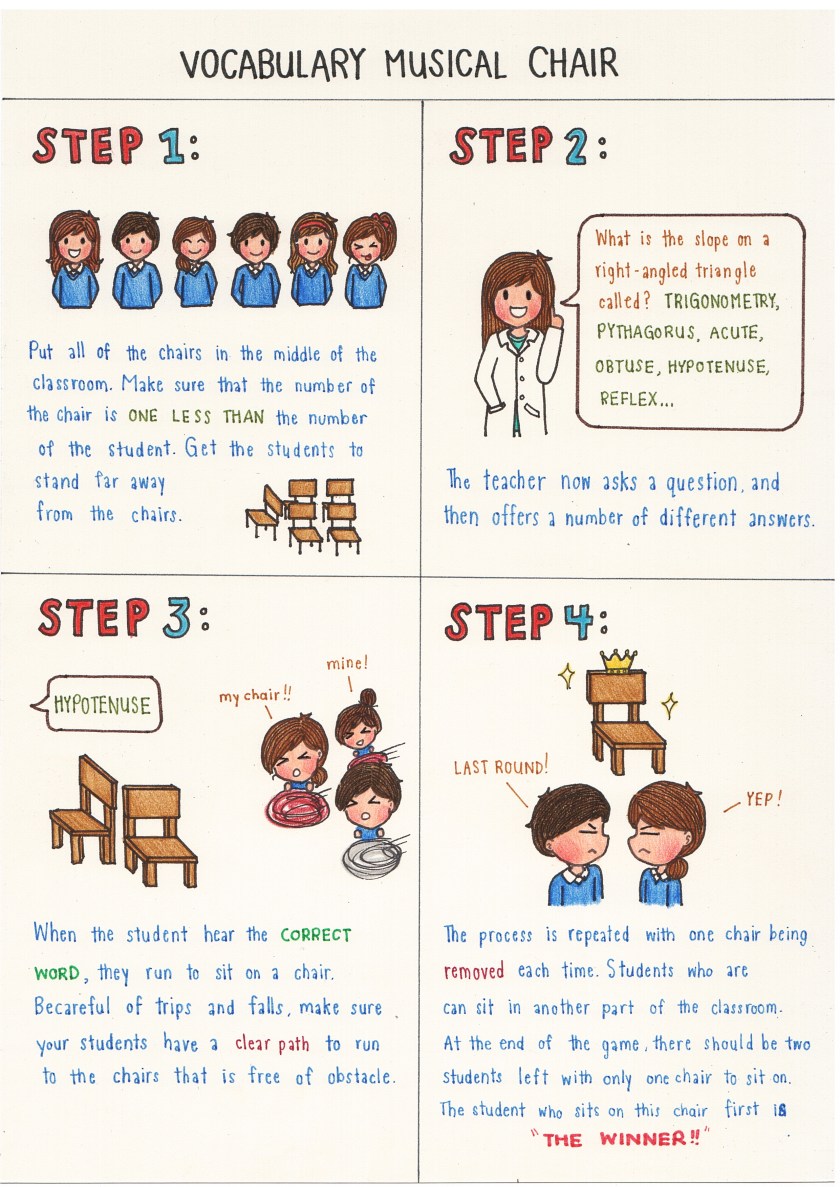
#8: Musical chairs
Can be used with maths problems, vocabulary, concepts or actions. Be careful that students don’t trip up or fall! They need lots of room to run!
#9: Mystery Picture
This is probably the most cognitively challenging plenary that I’ll mention today. It really encourages deep learning, but requires the teacher to have a good control over the class. Worth the effort! Give it a go!
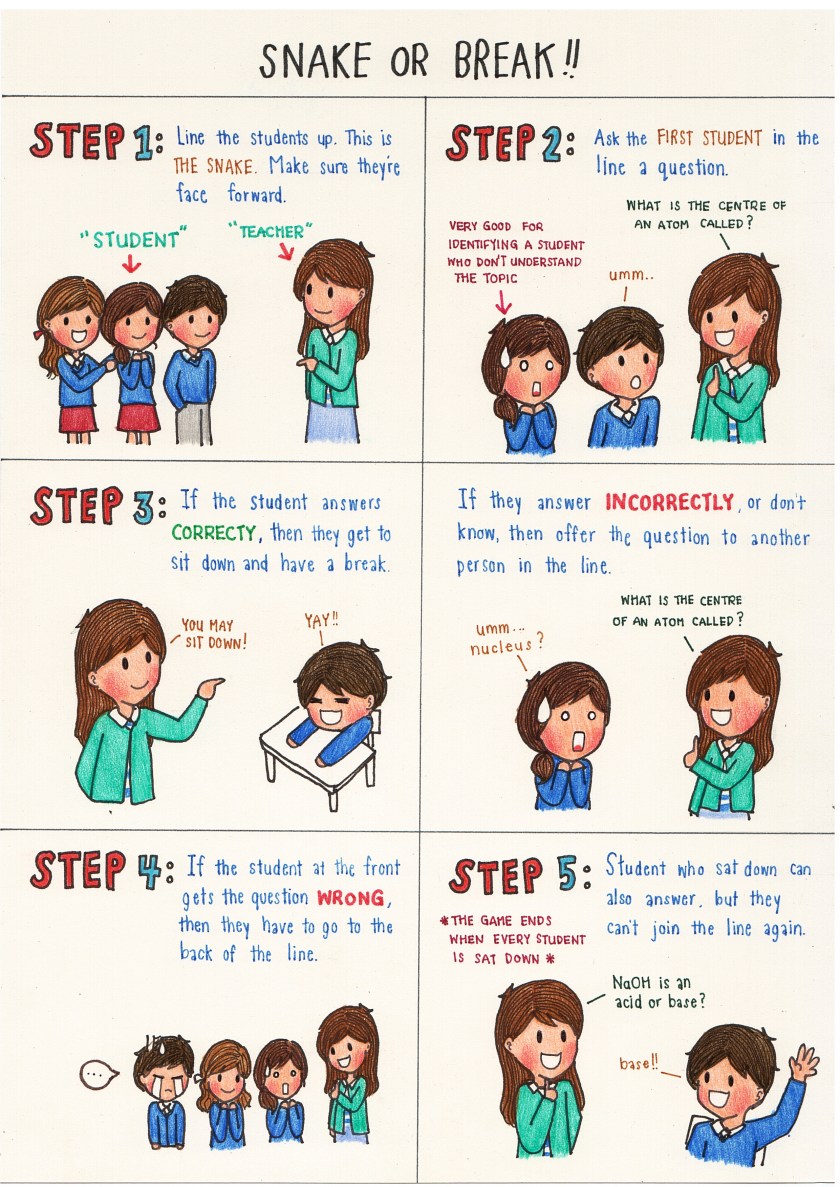
#10: Snake or Break
You’ll need space for this, but it’s simple and fun. Again, can be adapted to suit vocabulary, maths problems, concept questions, etc.
Did you enjoy this article? Why not check out Richard’s book? Now at a discounted price until July 14th!
To celebrate the birthday and life of Arnold Lobel(Born 22nd May 1933), The Quick Guide to Classroom Managementwill be offered at a 40% discounted price for 54 days (representing the 54 years of Arnold’s Life).
Arnold Lobelwas a famous writer who contributed greatly to the education of so many children through delightful books and stories such as Frog and Toad are Friends and Prince Bertram the Bad (which appeared on the famous Jackanory TV series).
He sadly passed away on December 4th 1987, aged 54 years.
Click on the image below to enjoy Richard’s book at this special, limited time price.
N.B.: Thank you so much for coming to my website! You’re amazing! Please comment on this post with your experiences and the methods you’ve used when everything seemed to just ‘go wrong’. I really want this page to be a sanctuary where newbie teachers can come and get some great tips about how to overcome their struggles (and to know that they are not alone!)
All teachers can make innocent, but devastating mistakes at work. As a new teacher, you’re bound to mess up a lot in your first year. So what do you do when everything goes South?
Illustrations byPop Sutthiya Lertyongphati. You can contact her atpopslittlespace@gmail.comif you would like her to do some beautiful illustration work for you too.
Being told off by your line manager when you’re just crossing the threshold of your new career can be an upsetting and stressful experience. You’re bound to make mistakes as a Newly Qualified Teacher, and you’re bound to be told off for them too. It happens to even the very best educators, and if it hasn’t happened to you yet, then don’t be complacent, because everyone can mess up at some point.
What follows next are some tips to get you through those tough times in a way that actually makes you look mature and professional at the same time.
#1: Admit when you’re wrong
Always apologise quickly and sincerely when you slip up. This could be for something relatively minor like forgetting to mark a student’s book, or something more silly like forgetting to turn up for a lesson.
Don’t be afraid of apologizing to students too. If you’re sincere, and you rectify things quickly, you’ll actually come across as being a genuine, human and approachable person. An example might be “Ah yes, Mark, you are right. I did agree to bring that textbook in for you today. It completely slipped my mind. I’ll make sure I pack it tonight for you and I’ll bring it in tomorrow.”
If you are genuinely to blame for what went wrong, then covering up your mistake can be the worst decision you make. When the real truth is uncovered later on down the road you’ll be seen as untrustworthy, deceitful and immature – the exact opposite of how you want to come across.
#2 Sleep on it
I know many teachers who have received aggressively toned, accusatory e-mails from bosses and line managers whilst in their early years of teaching, and later on too. It’s happened to me as well, and it can cause a wave of emotions to flood your thoughts and perceptions. Anger, fear, hatred, panic, worry and, of course, the desire to justify yourself.
When this happens, the best thing you can do is take a deep breath and relax. If possible, wait until the next day to send your response or to speak to the person in question. You’ll be in a better frame of mind, and your brain will have had the chance to process the information and think about solutions, subconsciously and unconsciously, whilst you were asleep (and make sure you do sleep: Tomorrow will deal with itself. Don’t toss and turn in a fit of worry the night before. Life is too short.).
This approach can be phrased as being ‘proactive, not reactive‘.
The worst thing you can do when you receive a flame (the technical name for an angry or aggressive e-mail) is to react instinctively by sending an equally aggressive reply. You’ll be acting on the basis of emotion, probably with a high desire to prove yourself right, and you could end up really annoying your boss in the process.
#3 Focus on solutions, not on justifying yourself
I once worked with a colleague who was in a right fit of worry. He was a trembling wreck, and was convinced he was going to lose his job.
The previous week, he had been leading a really fun activity with his class which involved singing, dancing and making wall art. The class loved it, but one student decided to covertly record part of that lesson on his mobile phone. The video later appeared on YouTube, and was brought to the attention of my friend’s line manager.
“What the hell am I going to do Richard? This is it, I know it. I’m finished. My career is in the toilet now”
I calmed him down and told him that nothing was ever that final in life. I told him that the very first thing he should say to his boss was not “I’m sorry, it’ll never happen again”, or “I asked all the kids for their mobile phones and he hid his” or any other justification. The damage had been done. The first thing he should say to his boss is “How can we solve this?”.
He took my advice and later reported that the conversation with his boss went a lot better than he thought it would. As soon as he shifted his focus towards solutions, his boss agreed to ask that student to delete the video off YouTube and to ask him (the student) to apologise to his teacher, which he later did. The whole situation was forgotten about that same day, and life went on as normal.
My colleague was wise that day. He realised that justifying yourself when being accused of something by your boss, especially when you’re in the wrong, only leads to conflict and argumentation. By making the focus of the conversation squarely on solutions, my colleague came across as being mature, in control of his emotions and committed to the greater good of the school.
#4 Speak with your line manager
There will be times when things happen, and you just won’t know what to do to solve the situation. Whether this is because you’ve made a mistake or not, you should always speak with your line manager, or someone with more experience than you.
A classic example of this scenario happened to me in my first year of teaching practice. I was walking along the corridor on a free period when I saw a student, who was supposed to be in class, just walking about aimlessly.
I stopped him, and asked him if he was okay and if he needed some help, when suddenly his teacher popped her head out of the classroom door and looked at me as if I was the most evil man in the world. She ushered the boy into her room (she’d sent him out of class, but I didn’t know that).
After class that teacher saw me in the science prep room and gave me a right telling off. “Richard, don’t you ever talk to my students again. I am well-capable of dealing with behavior issues. I don’t need your help”. Woah!! Now where did that come from?
I was fuming. I was doing my job and being told off for it. Ridiculous, I thought. What an arrogant, silly old bat she is. I was really mad. I asked to speak with my head of department, because I’d rather he heard my side of the story before he received a complaint next week.
We sat down together and I told him the story I just told you. He calmed me down and said “Don’t worry Richard”. He explained how that teacher had a very disruptive and challenging class that Friday afternoon, and she’s probably a bit stressed out. He advised me to just let it go and have a good weekend.
I took his advice and I’m glad I did. The situation was never brought up again. It was totally forgotten about by everyone.
Oftentimes, as teachers, we worry too much about silly things. If you ever find yourself worrying about a situation, then you have nothing to lose by talking it over with a more experienced colleague. I’ve used this principle many times in my career with great affect.
#5 Listen first, then explain
If you genuinely haven’t done anything wrong, or if you’ve been misunderstood, then you’ll need to explain your side of the story. Failure to do this may cost you your job.
Your line manager or principal might be angry with you about something. Let them vent first. Don’t get tense. Relax, and listen. Don’t react to the bubbling up of your negative emotions.
When the chance arises, calmly and politely explain your case. You’ll be surprised in the change of mood this will generate in your once angry boss. You’ll come across as mature and level-headed.
#6 Keep people updated
I was once accused of allowing my tutor group to graffiti on the tables in the Science lab. Of course, it wasn’t my kids. I knew this because we only had ten minutes together each morning and my eyes were on them throughout this. But how could I be proactive in ensuring that my name was cleared?
I set up a ‘graffiti log book’, and every morning at registration I would get my students to tell me if they saw any new graffiti on the desks. I also diligently went around the class and checked the desks myself, to really make sure that it wasn’t my kids that were making the mess.
After two weeks I presented my log book to the line manager that had accused me originally. I politely suggested that the graffiti was probably happening in the main lessons of the day, when students have up to an hour per session to scribble something on a desk.
My line manager appreciated my diligence, and we set up a monitoring system to ensure that kids who graffiti’d were identified quickly and made to clean up their mess. We even had special ‘graffiti cleaning kits’ set up in the prep room.
#7 Seek Advice
There will be times when you don’t know what to do. Instead of stewing around and worrying about things, or even plodding along and just ‘getting by’, use your inexperience as a chance to grow and develop.
A story from my own life journey comes to mind here. I was an NQT (Newly Qualified Teacher) at a school in northern England and I was having problems with Behaviour in one of my Year 9 classes. I tried sanctions, tellings off, rewards for good effort and even bringing in chocolate to give to the students if they worked hard. Each strategy worked to some degree, but collectively things were still not perfect .
I spoke with a senior colleague of mine in the Science department and he gave me one tip that had an almost instantaneous transformative effect on my classroom management. He advised me to focus my attention on the work being done and not on the student who was being disruptive. “Instead of saying something like ‘John, why aren’t you working?, or ‘John, you’re not concentrating’, try ‘John, how’s that work coming along? Are you finished yet?” Wow. Such a simple piece of advice but it helped me a lot. I would later write a whole chapter about behaviour management in my debut book, in which this technique played a significant part.
Speaking with your colleagues about your problems presents another benefit too. The people from whom you seek counsel will feel flattered that you consider them in such high esteem and will, consequently, be happy to help you out. By seeking help you also show that you are mature enough to realize that you don’t know everything, and when you share your problems you’ll often find that other people are going through similar problems in their lives too.
Did you find this post useful? Why not check out Richard’s books? Rated 5 stars on Amazon, and enjoyed by thousands of teachers globally, Richard’s work has earned a place in the global pedagogical hall of fame.
Book trailer: The Quick Guide to Classroom Management
The follwing extract is taken from chapter 1 of my book: The Quick Guide to Classroom Management: 45 Secrets That All High School Teachers Need to Know (available at http://www.amazon.com/dp/B016ZG1IX0)
I wanted a front cover showing happy, stimulated students.
Secret number 1: Take a genuine interest in the life of your students
Youth is a time when so many things are happening: both positive and negative. Young people at high school are involved in a range of human-relationship dynamics which involve family, school, friends and the people associated with their hobbies or interests. Humans are full of energy at this time, and the interconnections between the life of a student both inside and outside of the classroom create opportunities for us to channel this energy positively and:
Build trust
Use humour within lessons
Create a sense of importance and empowerment in our students
Offer guidance and support to students with difficulties
Create an environment of cooperation and compliance
Encourage our students to formulate their own learning goals
Personalise our lessons
Becky was an experienced and well-liked teacher of secondary science. She got on very well with her students, and parents would often mention that they appreciated her ‘special attention’ to their children. She was liked by her colleagues, and she enjoyed her work. One day, her physics student came to school with a broken arm in a plaster cast. Josh, a keen gymnast, mentioned that he had fallen very hard in a training session two days ago. Becky immediately knew that this was golden information for her lesson planning.
In Josh’s next physics lesson, Becky was teaching the class about forces and motion. As Josh entered the class, she presented him with a starter activity revolving around the forces that act upon a gymnast when taking off and landing on a springboard. She also asked Josh how he was doing (and she was sincere in asking). He said he was healing well, and Ms Becky mentioned that “We can use your experience to help the class today, would that be okay?”. Josh said “sure”. After completing and peer assessing the starter worksheet, Ms Becky asked for Josh to tell the class what had happened to his arm. He gladly told his story, and Ms Becky asked for everyone to clap after he had finished. Using humour and good teaching practice, she said “So using Josh’s story to help you, what do you think one of today’s objectives could be”? One student mentioned a funny comment about how you should always land on your feet and not on your arm like Josh did, which Ms Becky responded to with a smile and a giggle. After this, and with some prompting from their teacher, some students spoke about the importance of gravity in determining the force upon impact, and the speed of free fall. At the end of a very interesting and varied lesson, Becky allowed her students the opportunity to sign Josh’s plaster cast, if they hadn’t done so already.
This example demonstrates the power that taking an interest in your students can have on the quality of a lesson. Let’s examine what Becky did that made this lesson (and her rapport, or relationship with her students, so special):
Becky used the hobby of her student to generate a lesson activity (the starter worksheet)
Becky shows a sincere care and concern for her student
Becky was genuinely interested in the life of her student outside of the classroom (as she was with all of her students)
Becky uses student experiences and ‘expertise’ to enhance the lesson content (she asks Josh to talk to the class about what had happened)
Becky is tasteful in her humour, and she makes sure that Josh is happy to share his story before she asks him to do so.
Becky rewarded the class for their good work by allowing them a few minutes at the end to sign Josh’s plaster cast. Not only did this subtly reveal her caring and ‘human’ nature, but it also bonded the class together as a whole.
Phew! Well there was light at the end of the long tunnel after all, and it wasn’t an oncoming train!
My book, ‘The Quick Guide to Classroom Management: 45 Secrets That All High School Teachers Need to Know’ is now available on the Kindle store at http://www.amazon.com/dp/B016ZG1IX0, and will be available as a paperback, physical copy in about seven days time.
It’s been a long, but enjoyable journey to get here!
It has been a very long and arduous journey to get here. The book stands at 52,000 words and is heavily illustrated with elaborate charts, infographics, diagrams, illustrations, examples of student work and screenshots. The amount of research that went into this book was absolutely astronomical, and I have become a better teacher in the process of producing this work.
I wanted a front cover showing happy, stimulated students.
I never knew that writing a book was such a huge process until I embarked on this journey. From purchasing and registering an ISBN number, to designing a front cover and requesting permission from outside publications (to use their material), this whole project has been a wonderful journey and I have only become a better person because of it.
I have really tried to make the whole dynamic of classroom management clear and direct (with no ‘nonsense’ attached) so that, finally, high school teachers around the world will wake up from the illusion that you need some quick tricks and techniques to improve poor teacher-student rapport. Unfortunately, this mindset is very commonplace, and I really tried to show (in my book) how our interactions with colleagues, parents and our students all feed into each other to create a ‘composite practitioner’ that’s truly able to foster positive interactions and implement outstanding classroom management on a daily basis.
I probably should have called this book ‘The Complete Guide to Classroom Management’, as it is 259 pages long and 16MB in size (which is massive for a Kindle file). However, I’ve deliberately omitted references to traditional (and obscure) overviews of pedagogical literature (such as that of Piaget, De Bono and Bloom’s) and have, instead, produced a practical, no-nonsense guide to real, effective, classroom management.
My new ISBN number and barcode
Some of the truths in my book will be unpalatable for some people – the real truth behind effective classroom management involves hard work on the part of the teacher, and there are no ‘quick fixes’. However, I can guarantee that any teacher who reads my book to completion, and implements all of the points I’ve raised, will drammatically increase their effectiveness as an educator.
Happy Saturday, and keep teaching! (we never really stop!)
Which is best? A smart phone or a tablet? If you’re planning for a lesson and wondering whether or not to book your school’s iPad set, then this list might give you some food for thought.
Should you book your school’s iPad set for that excellent lesson you’ve planned, or should you just get the kids to use their smart phones? Some things to think about:
Tablets do provide a larger screen and greater accessibility to some programs and simulations, and this is a big advantage for students who like large text and who have issues with manual dexterity
Always test the software first: Unfortunately, many programs and simulations that work on a Windows™ PC do not function properly on tablets and smart phones that use other operating systems. It’s really embarrassing and frustrating to set a wonderful ICT-based learning task only to discover that it isn’t compatible with the kids’ devices.
If you’re planning on getting students to submit docs, PowerPoints or pdf files through Dropbox, or if you want students to download a file of this type, then tablets are typically better than smart phones. The larger screen means that more readable text can be displayed on the screen, and this also makes it much easier to edit files.
Cost is an important factor when considering ICT orders in schools. Tablets generally cost two to three times less than their smart phone counterparts, and often allow for greater functionality. The other advantage is that school tablets will have been set up consistently by an ICT administrator, and will often not have SIM cards that connect them to a cellular network. This means that kids are much less likely to be playing around on social media when using school tablets, since sites like Facebook™, Instagram™ and others are much more difficult to access without their corresponding apps. Schools can also put controls in place to prevent access to such platforms.
One downside of tablets is that they can be slow, especially if multiple students are using them to access the internet via the school’s Wi-Fi system all at the same time. Smartphones can offer a quicker alternative in these cases.
Students are much more likely to share school tablets with each other, rather than sharing their highly personalized smart phones with their peers. This has obvious ramifications for group work
One big advantage of tablets is that their battery life tends to be much longer than that of smart phones. Your school’s set should also be regularly charged by the ICT administrator.
As a very keen and determined PGCE student at Bangor University’s outstanding School of Education, I was introduced very quickly to the importance of making my students fully aware of the learning outcomes (sometimes referred to as ‘aims’ or ‘objectives’), every single lesson. On a very fresh summer morning at the beautiful science labs at Bangor’s ‘Normal Site’, I and the rest of the science students were given a deck of playing cards. We were then asked to shuffle them and play poker, but keep any diamonds that were dealt to us, indefinitely. When this was finished, we repeated the game, but this time we kept any multiples of three. Once this was over, we were each given a set of coins and asked to toss each one in turn. If we got a head, we could keep the coin; whereas a tails meant that we had to dispose of that coin and place it into a big tub in the middle of the room. After about 30 minutes of doing this, we started to look at each other with rather puzzled and bemused faces. Some of my friends started to utter “What’s the point in this?” and “Why the hell are we doing this?” At this stage, our instructor stopped the activities and asked us all a very simple question: “How was that?”
A fun activity, but why were we doing it?
The replies came slowly at first, but as soon as a few people had mustered enough nerve to reply, more answers soon followed.”It was okay, but I wasn’t sure why we were playing those games”, “It was good at first, but I lost focus after a while” and “The whole lesson just seemed completely pointless”. After the exchange of a few giggles, we could all see that this was part of the instructor’s plan all along (he was always very shrewd in the way that he introduced us to key concepts). He then asked “What do you think the purpose of this lesson was?”. Again, the replies came in thick and fast “Something to do with data and numbers”, “Learning how to use games to entertain students” and, finally, one student hit the proverbial nail on the head – “To understand that if the students don’t know why they are doing something, then they’ll lose focus”. This final reply was correct, but incomplete. For this particular session, the instructor was trying to teach us two things. The first objective was to learn that it is easy to ‘cherry-pick’ data in scientific experiments (hence the collection of the ‘diamond cards’ and disposing of each coin that had yielded a tails). The second was the one that’s most important to me and you: that learning is only productive and effective if the students know what the mission/objective of each lesson is.
After learning this crucial lesson, I quickly put it into practice during my first year of teaching. I would always write the lesson objectives on the whiteboard (or project them on a screen), straight after I had given my starter activity. My lessons always started promptly, and my students always knew what my mission was. However, despite this, something was still missing. The problem was that almost every teacher in my school had been trained in a similar methodology, and were all doing the same thing. Each lesson to my students seemed like, in the words of one Year 9 boy, “different versions of a computer game with the same exact layout, just different colours and different bad guys to fight” (I thought that was quite a profound conclusion, actually. I gave that boy a house point for his linguistic creativity).
So what was missing? Why, despite following best practice, were some of my students still losing focus? Why was it that at the end of each lesson some students couldn’t even remember the objectives I’d shown them 45 minutes earlier? Well, the answer, as I discovered much later than I probably should have, was found in that unusual session back at Bangor University. The reason that I can remember that particular lesson so well is because it contained a sense of mystery, and because I and my peers had to figure out the lesson objectives for ourselves. But how did we figure out those objectives? Answer: The activities of the lesson aroused within us a sense of curiosity about its purpose.
We all remember things better if we’ve had to discover them by ourselves, as opposed to being ‘spoon-fed’ the information. More often than not, we are also more proud of those things that we’ve had to overcome, adapt to and solve by ourselves, than those things we’ve attained easily, and this principle feeds directly into this very effective methodology for beginning a lesson:
Begin each lesson by assigning work, analysing it and then getting the students to generate the learning outcomes for the lesson
By using this methodology you will not only capture your students attention as soon as the lesson starts, but you will also be encouraging them to use ‘higher order thinking skills’, especially if the students do the following:
Build models or construct some kind of concept illustration
Solve an open-ended problem (e.g. “You have five minutes to build a useful object out of the drinking straws on your desk”)
Include emotion in their work (e.g. “Imagine you are Neil Armstrong on the day he landed on the moon. Write a quick diary entry for him on that day. How did he feel?”)
Solve a logic problem (e.g. breaking a code, or answering a series of questions in sequence which lead the students to a final conclusion)
Use their physiology in an unusual way (e.g. “You have five minutes to build a tower out of the objects on your desks. One person in your group needs to balance the objects on their head. Who will create the tallest, most balanced tower?”)
Have a choice over whether to tackle the problem using a left or right-brain approach (e.g. “Sarah needs to buy food and drink for a birthday party. In front of you is a price list for every item at Partylicious candy store. Sarah only has 45 pounds to spend, so help her out! Maybe you could write some selected shopping lists for her, or draw a collection of items that she could buy.”)
Conclusion: Start your lessons promptly by assigning a good-quality starter activity, analyzing it thereafter and then asking the students to consider what the objectives of the lesson might be. I assure you, by starting your lesson in this way your students will benefit far more than if your lesson has an unfocussed start, directed solely by the teacher.