Starter activities have long been a cornerstone of effective classroom management as they get students focused and on task as soon as they enter the classroom, and they can be a great way to ‘prime’ the kids to learn complex concepts. What follows now is a list of my top seven starter activities that are quick, simple, require minimal equipment and are fun.
“An AMAZING book! A must-read for all teachers!”
#1: Splat
This quick game is so easy: all you need is a whiteboard, whiteboard markers and class of kids. It’s a great game for consolidating key vocabulary, and is perfect for E.A.L. learners.
Here’s a short video showing a quick clip of me playing ‘Splat’ with my students (I will include some more lengthy clips soon, but this is a good start):
#2 Mystery Word
Another easy game. This time, students randomly pick out written words from a hat (or cup, beaker, container, etc.), and then they have to explain their word to the class (without saying the word). The students who are listening have to guess what the word is.
#3 The Poster Game
Possibly the most fun and competitive game I’ve ever invented for teaching new content. You’ll need space for the kids to walk/run, and the game does take some prep. However, once you (and your students) become used to playing this game you’ll find that it’s a doddle to set up in no time at all.
#4 Who am I?
A very simple game. All you need are post-it notes and a class full of energized students! Great fun. Perfect for reinforcing key vocabulary and concepts.
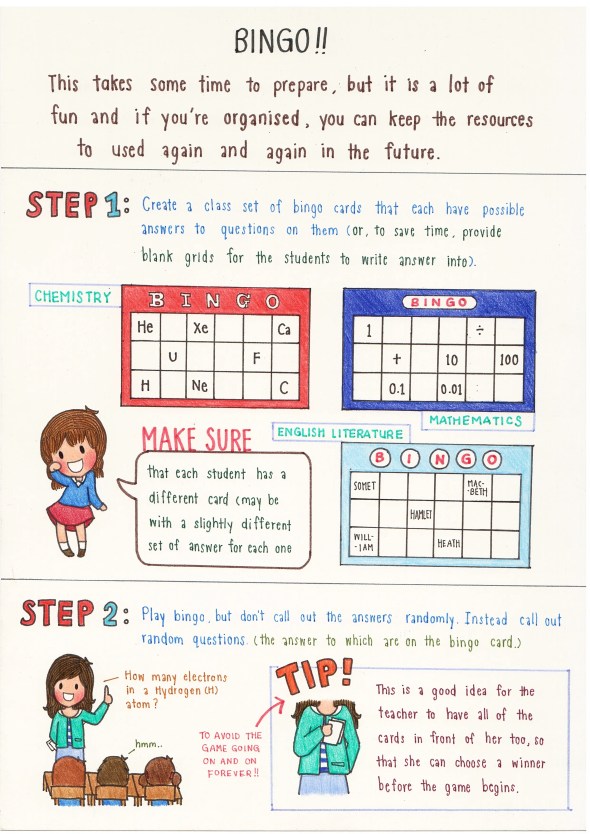
# 5 Bingo
Got some equation symbols or mathematical problems to teach your kids? Perhaps the symbols of the periodic table is more your thing? Whatever it is, this simple game can be adapted to suit any subject.
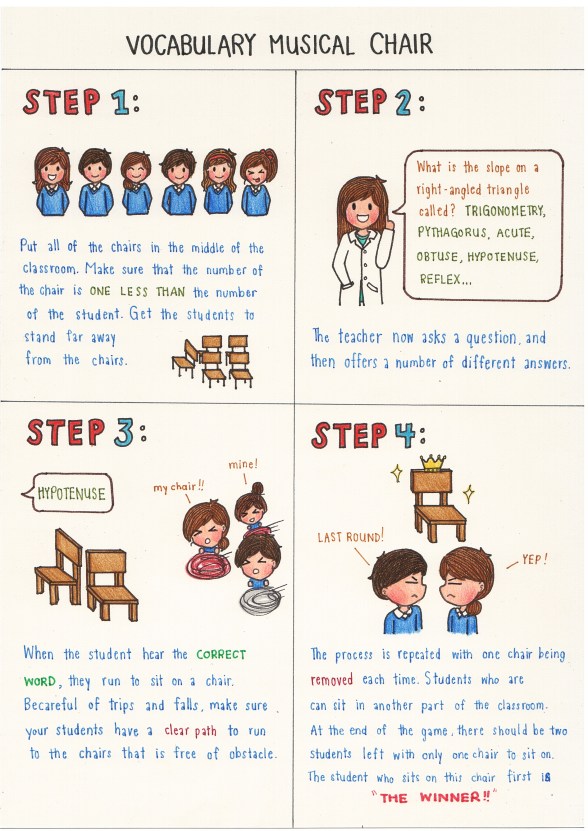
# 6 Vocabulary Musical Chairs
You’ll need a good rapport with you kids to use this one, as it needs to be controlled really well by the teacher (e.g. to avoid kids bumping into each other). However, it is simple, fun and worth the effort!
# 7 Mystery Picture
This one takes some imagination on the part of the teacher, and some training of the kids beforehand. However, it’s really, really good for encouraging higher order thinking skills.
We welcome you to join the Richard Rogers online community. Like ourFacebook page and follow us on Twitter for daily updates.
This week an article by the BBC gathered quite some interest in education circles in the UK. The news broke that schools in England will no longer be ranked by GCSE results: putting an end to league tables in their current format.
This news was greeted with applause by those who have been campaigning for a broader ‘progress-based’ league table system for a long time. For example, Malcolm Trobe (Deputy General Secretary of the Association of School and College Leaders) responded to this news with the following:
Malcolm makes a good point: after all, a school’s performance should be based upon the amount of improvement each student has made over some course of time (relative to some baseline/starting point), shouldn’t it? Maybe Angela Constance, the Scottish Education Secretary, can answer this question. On Thursday the Glasgow Evening Times ran a report on how Scotland will be introducing new national standardised tests for school pupils in their third year of secondary school (sounds a little reminiscent of the old days of SATs tests, doesn’t it?), as well as in the primary years one, four and seven. Ms Contance is a supporter of the new tests, and she, like Malcolm, recognizes the importance of measuring and reporting on student progress:
Have the Scots got it right?
How can a school measure progress without reporting on attainment at the same time? Surely you need to know a student’s start and end points, in terms of attainment, before you can report on the progress that child has made. For example, if a student begins Year 7 having attained an level 3 on a National Curriculum SATs test, progresses to Year 9 and gets a level 5 and then goes on to achieve 5 grade C’s at GCSE, then that particular student has made great progress (and that progress has been monitored along the way).
But is progress enough?
Last month, the UK Office for National Statistics released a shocking Statistical Bulletin showing that youth unemployment now stands at two and half times the national average. To add insult to injury, this damning revelation comes amid the fact that around 750,000 jobs remained unfilled. The problem is so bad, that the UK’s own Jobcentre Plus will now be working more closely with schools than ever before, offering careers advice under a new scheme being launched by the government.
The tertiary disjunction
Perhaps this is the million (pound?) question then: When offering jobs to young people, do employers really care about the progress these kids have made in school, or do they want highly skilled and capable employees who can contribute to effective productivity?
David Cameron didn’t hold back from addressing this question at a speech in Islington, North London, last week:
Okay, that’s my last jazzed-up/beautified quote for this article (I promise), but perhaps we have an answer from the esteemed Etonite after all. It would appear that knowledgehelps “infuse” the qualities employers want, and surely the only way to measure knowledge is to measure attainment. Wouldn’t you agree? After all, don’t students pick up the skills of innovation, creativity and problem-solving automatically when they are motivated by inspiring teachers to achieve the highest grades they can?
Is there a disjunction between what schools expect of their pupils, and what employers need in the workforce? How much ‘school progress’ is enough to convince an employer that you’re the person to be hired?
But they can just use their smartphones anyway, can’t they?
Christine Blower, Head of the National Union of Teachers, wasted no time in stirring up controversy this week when she stated (in response to government proposals to force all primary school children to learn their times tables by the end of Year 6) that “Looking up your times tables is very easy to do. So the other thing we have to do is to make sure that children and young people use the computing ability on their mobile phones so they can get that at their finger tips. Recall is not the only way to make sure you understand mathematical concepts.”
How did you learn your times tables?
How does the whole issue of building up your ICT skills by using smartphones for research feed into the whole progress vs attainment debate? That’s a topic I’ll leave for another week!
Did you enjoy this post? Then why not check out a great book that will help you to maximize the progress and attainment of your students? The Quick Guide to Classroom Management is available as a paperback or on Kindle, and is enrolled in the Kindle Unlimited programme. Just click on the picture below:
The Quick Guide to Classroom Management: 45 Secrets That All High Teachers Need to Know
The follwing extract is taken from chapter 1 of my book: The Quick Guide to Classroom Management: 45 Secrets That All High School Teachers Need to Know (available at http://www.amazon.com/dp/B016ZG1IX0)
I wanted a front cover showing happy, stimulated students.
Secret number 1: Take a genuine interest in the life of your students
Youth is a time when so many things are happening: both positive and negative. Young people at high school are involved in a range of human-relationship dynamics which involve family, school, friends and the people associated with their hobbies or interests. Humans are full of energy at this time, and the interconnections between the life of a student both inside and outside of the classroom create opportunities for us to channel this energy positively and:
Build trust
Use humour within lessons
Create a sense of importance and empowerment in our students
Offer guidance and support to students with difficulties
Create an environment of cooperation and compliance
Encourage our students to formulate their own learning goals
Personalise our lessons
Becky was an experienced and well-liked teacher of secondary science. She got on very well with her students, and parents would often mention that they appreciated her ‘special attention’ to their children. She was liked by her colleagues, and she enjoyed her work. One day, her physics student came to school with a broken arm in a plaster cast. Josh, a keen gymnast, mentioned that he had fallen very hard in a training session two days ago. Becky immediately knew that this was golden information for her lesson planning.
In Josh’s next physics lesson, Becky was teaching the class about forces and motion. As Josh entered the class, she presented him with a starter activity revolving around the forces that act upon a gymnast when taking off and landing on a springboard. She also asked Josh how he was doing (and she was sincere in asking). He said he was healing well, and Ms Becky mentioned that “We can use your experience to help the class today, would that be okay?”. Josh said “sure”. After completing and peer assessing the starter worksheet, Ms Becky asked for Josh to tell the class what had happened to his arm. He gladly told his story, and Ms Becky asked for everyone to clap after he had finished. Using humour and good teaching practice, she said “So using Josh’s story to help you, what do you think one of today’s objectives could be”? One student mentioned a funny comment about how you should always land on your feet and not on your arm like Josh did, which Ms Becky responded to with a smile and a giggle. After this, and with some prompting from their teacher, some students spoke about the importance of gravity in determining the force upon impact, and the speed of free fall. At the end of a very interesting and varied lesson, Becky allowed her students the opportunity to sign Josh’s plaster cast, if they hadn’t done so already.
This example demonstrates the power that taking an interest in your students can have on the quality of a lesson. Let’s examine what Becky did that made this lesson (and her rapport, or relationship with her students, so special):
Becky used the hobby of her student to generate a lesson activity (the starter worksheet)
Becky shows a sincere care and concern for her student
Becky was genuinely interested in the life of her student outside of the classroom (as she was with all of her students)
Becky uses student experiences and ‘expertise’ to enhance the lesson content (she asks Josh to talk to the class about what had happened)
Becky is tasteful in her humour, and she makes sure that Josh is happy to share his story before she asks him to do so.
Becky rewarded the class for their good work by allowing them a few minutes at the end to sign Josh’s plaster cast. Not only did this subtly reveal her caring and ‘human’ nature, but it also bonded the class together as a whole.
Phew! Well there was light at the end of the long tunnel after all, and it wasn’t an oncoming train!
My book, ‘The Quick Guide to Classroom Management: 45 Secrets That All High School Teachers Need to Know’ is now available on the Kindle store at http://www.amazon.com/dp/B016ZG1IX0, and will be available as a paperback, physical copy in about seven days time.
It’s been a long, but enjoyable journey to get here!
It has been a very long and arduous journey to get here. The book stands at 52,000 words and is heavily illustrated with elaborate charts, infographics, diagrams, illustrations, examples of student work and screenshots. The amount of research that went into this book was absolutely astronomical, and I have become a better teacher in the process of producing this work.
I wanted a front cover showing happy, stimulated students.
I never knew that writing a book was such a huge process until I embarked on this journey. From purchasing and registering an ISBN number, to designing a front cover and requesting permission from outside publications (to use their material), this whole project has been a wonderful journey and I have only become a better person because of it.
I have really tried to make the whole dynamic of classroom management clear and direct (with no ‘nonsense’ attached) so that, finally, high school teachers around the world will wake up from the illusion that you need some quick tricks and techniques to improve poor teacher-student rapport. Unfortunately, this mindset is very commonplace, and I really tried to show (in my book) how our interactions with colleagues, parents and our students all feed into each other to create a ‘composite practitioner’ that’s truly able to foster positive interactions and implement outstanding classroom management on a daily basis.
I probably should have called this book ‘The Complete Guide to Classroom Management’, as it is 259 pages long and 16MB in size (which is massive for a Kindle file). However, I’ve deliberately omitted references to traditional (and obscure) overviews of pedagogical literature (such as that of Piaget, De Bono and Bloom’s) and have, instead, produced a practical, no-nonsense guide to real, effective, classroom management.
My new ISBN number and barcode
Some of the truths in my book will be unpalatable for some people – the real truth behind effective classroom management involves hard work on the part of the teacher, and there are no ‘quick fixes’. However, I can guarantee that any teacher who reads my book to completion, and implements all of the points I’ve raised, will drammatically increase their effectiveness as an educator.
Happy Saturday, and keep teaching! (we never really stop!)
Which is best? A smart phone or a tablet? If you’re planning for a lesson and wondering whether or not to book your school’s iPad set, then this list might give you some food for thought.
Should you book your school’s iPad set for that excellent lesson you’ve planned, or should you just get the kids to use their smart phones? Some things to think about:
Tablets do provide a larger screen and greater accessibility to some programs and simulations, and this is a big advantage for students who like large text and who have issues with manual dexterity
Always test the software first: Unfortunately, many programs and simulations that work on a Windows™ PC do not function properly on tablets and smart phones that use other operating systems. It’s really embarrassing and frustrating to set a wonderful ICT-based learning task only to discover that it isn’t compatible with the kids’ devices.
If you’re planning on getting students to submit docs, PowerPoints or pdf files through Dropbox, or if you want students to download a file of this type, then tablets are typically better than smart phones. The larger screen means that more readable text can be displayed on the screen, and this also makes it much easier to edit files.
Cost is an important factor when considering ICT orders in schools. Tablets generally cost two to three times less than their smart phone counterparts, and often allow for greater functionality. The other advantage is that school tablets will have been set up consistently by an ICT administrator, and will often not have SIM cards that connect them to a cellular network. This means that kids are much less likely to be playing around on social media when using school tablets, since sites like Facebook™, Instagram™ and others are much more difficult to access without their corresponding apps. Schools can also put controls in place to prevent access to such platforms.
One downside of tablets is that they can be slow, especially if multiple students are using them to access the internet via the school’s Wi-Fi system all at the same time. Smartphones can offer a quicker alternative in these cases.
Students are much more likely to share school tablets with each other, rather than sharing their highly personalized smart phones with their peers. This has obvious ramifications for group work
One big advantage of tablets is that their battery life tends to be much longer than that of smart phones. Your school’s set should also be regularly charged by the ICT administrator.
As a very keen and determined PGCE student at Bangor University’s outstanding School of Education, I was introduced very quickly to the importance of making my students fully aware of the learning outcomes (sometimes referred to as ‘aims’ or ‘objectives’), every single lesson. On a very fresh summer morning at the beautiful science labs at Bangor’s ‘Normal Site’, I and the rest of the science students were given a deck of playing cards. We were then asked to shuffle them and play poker, but keep any diamonds that were dealt to us, indefinitely. When this was finished, we repeated the game, but this time we kept any multiples of three. Once this was over, we were each given a set of coins and asked to toss each one in turn. If we got a head, we could keep the coin; whereas a tails meant that we had to dispose of that coin and place it into a big tub in the middle of the room. After about 30 minutes of doing this, we started to look at each other with rather puzzled and bemused faces. Some of my friends started to utter “What’s the point in this?” and “Why the hell are we doing this?” At this stage, our instructor stopped the activities and asked us all a very simple question: “How was that?”
A fun activity, but why were we doing it?
The replies came slowly at first, but as soon as a few people had mustered enough nerve to reply, more answers soon followed.”It was okay, but I wasn’t sure why we were playing those games”, “It was good at first, but I lost focus after a while” and “The whole lesson just seemed completely pointless”. After the exchange of a few giggles, we could all see that this was part of the instructor’s plan all along (he was always very shrewd in the way that he introduced us to key concepts). He then asked “What do you think the purpose of this lesson was?”. Again, the replies came in thick and fast “Something to do with data and numbers”, “Learning how to use games to entertain students” and, finally, one student hit the proverbial nail on the head – “To understand that if the students don’t know why they are doing something, then they’ll lose focus”. This final reply was correct, but incomplete. For this particular session, the instructor was trying to teach us two things. The first objective was to learn that it is easy to ‘cherry-pick’ data in scientific experiments (hence the collection of the ‘diamond cards’ and disposing of each coin that had yielded a tails). The second was the one that’s most important to me and you: that learning is only productive and effective if the students know what the mission/objective of each lesson is.
After learning this crucial lesson, I quickly put it into practice during my first year of teaching. I would always write the lesson objectives on the whiteboard (or project them on a screen), straight after I had given my starter activity. My lessons always started promptly, and my students always knew what my mission was. However, despite this, something was still missing. The problem was that almost every teacher in my school had been trained in a similar methodology, and were all doing the same thing. Each lesson to my students seemed like, in the words of one Year 9 boy, “different versions of a computer game with the same exact layout, just different colours and different bad guys to fight” (I thought that was quite a profound conclusion, actually. I gave that boy a house point for his linguistic creativity).
So what was missing? Why, despite following best practice, were some of my students still losing focus? Why was it that at the end of each lesson some students couldn’t even remember the objectives I’d shown them 45 minutes earlier? Well, the answer, as I discovered much later than I probably should have, was found in that unusual session back at Bangor University. The reason that I can remember that particular lesson so well is because it contained a sense of mystery, and because I and my peers had to figure out the lesson objectives for ourselves. But how did we figure out those objectives? Answer: The activities of the lesson aroused within us a sense of curiosity about its purpose.
We all remember things better if we’ve had to discover them by ourselves, as opposed to being ‘spoon-fed’ the information. More often than not, we are also more proud of those things that we’ve had to overcome, adapt to and solve by ourselves, than those things we’ve attained easily, and this principle feeds directly into this very effective methodology for beginning a lesson:
Begin each lesson by assigning work, analysing it and then getting the students to generate the learning outcomes for the lesson
By using this methodology you will not only capture your students attention as soon as the lesson starts, but you will also be encouraging them to use ‘higher order thinking skills’, especially if the students do the following:
Build models or construct some kind of concept illustration
Solve an open-ended problem (e.g. “You have five minutes to build a useful object out of the drinking straws on your desk”)
Include emotion in their work (e.g. “Imagine you are Neil Armstrong on the day he landed on the moon. Write a quick diary entry for him on that day. How did he feel?”)
Solve a logic problem (e.g. breaking a code, or answering a series of questions in sequence which lead the students to a final conclusion)
Use their physiology in an unusual way (e.g. “You have five minutes to build a tower out of the objects on your desks. One person in your group needs to balance the objects on their head. Who will create the tallest, most balanced tower?”)
Have a choice over whether to tackle the problem using a left or right-brain approach (e.g. “Sarah needs to buy food and drink for a birthday party. In front of you is a price list for every item at Partylicious candy store. Sarah only has 45 pounds to spend, so help her out! Maybe you could write some selected shopping lists for her, or draw a collection of items that she could buy.”)
Conclusion: Start your lessons promptly by assigning a good-quality starter activity, analyzing it thereafter and then asking the students to consider what the objectives of the lesson might be. I assure you, by starting your lesson in this way your students will benefit far more than if your lesson has an unfocussed start, directed solely by the teacher.
You and I could walk into any school staff room at morning break time and, after about five minutes, we could easily distinguish between the ‘Chatty Cathys’ and the ‘Reserved Richards’. Gossips love to espouse whatever is on their mind, even if nobody else wants to hear it. They’ll tell you one funny anecdote after another, ranging from which salon they went to last week to how difficult they find the new pupil assessment software the school’s made them use. There’s also one other thing that gossips are really good at, and that’s dishing out the dirt on anyone who happens to be the topic of the current conversation.
Gossiping at work? Not a good idea.
Gossips, without fail, are people to completely avoid at all costs (where possible). One of the reasons why gossips are famously passed over for promotion is because they can’t be trusted with the sensitive information they’d be exposed to in a managerial role. They generate distrust, and you should be very cautious with what you say when around anyone who is a famous gossip – you don’t want to give them fuel for a fire that they can burn behind your back! Additionally, if you happen to be sat with a gossip who starts to speak negatively about a colleague or the school in general, then don’t be afraid to get up and walk away. What’s more important: having a laugh or having a job? Besides, do you really want to be sat there when everyone’s complaining about the principal and that awkward moment happens when the deputy head walks into the staffroom? If you’re sat with gossips, or if you’re seen to be hanging around with them and chatting with them frequently, then you’ll be associated with them in the minds of senior management. If you plan on having a long and fruitful career in teaching, then remember this golden rule: don’t gossip, and don’t associate with gossips.
Another point to note is that, if you feel bold enough, you should oppose gossip whenever you hear it (but try not to come over as being bossy or intimidating). If you’re planning on entering middle or senior management in your school, then it’s in your best interest to shut down the gossip mill before you get promoted; the same people who are gossiping about the leadership style of the Lower Secondary Head will one day be gossiping about you, guaranteed. If you hear gossip that puts anyone in a negative light, then feel free to comment with a “Wow, I would really hate it if someone said something like that about me” or even “I don’t think it’s right for me to take part in this conversation”. Trust me when I say this: gossip is toxic, and you can never be guaranteed anonymity when you spit venom! It’s not uncommon for gossip to filter up to management, and if you’re name is mentioned when this happens, you may have to endure quite an unpleasant conversation with someone who is rightly annoyed with you.
I have a friend who is a massive lover of dogs. He owns a fine collection of beautiful breeds including Cavalier King Charles Spaniels, Shetland Sheepdogs and of course, everyone’s favourite: Golden Retrievers. He also runs a training centre for dogs, where he and his staff teach the animals how to sit, fetch and how to let you know when they need to take a call of nature. Another section of his business involves training different breeds for various dog shows, including the world famous Crufts show in England, which is held annually. He and his team have amassed an array of medals and trophies, all finely displayed at his home, by getting his dogs to look pretty and perform various tricks and tasks. His dogs jump through hoops, climb up platforms, run through tunnels, catch tennis balls, jump over hurdles and meander speedily around obstacles to get those shiny objects of recognition that are finely displayed for all and sundry to see. Needless to say, my friend was very proud of his dogs and what he saw as his achievements.
A happy dog, but what does it take to make people jump through hoops like this?
As I was preparing to write this post, I was thinking about the dynamic that my friend represents. He was incredibly proud of all of those trophies and medals that were glistening brightly in the many display cabinets at his home. However, his dogs couldn’t give two hoots about those trophies and medals; all they wanted was food, water and some attention to make them happy.
This short description of my friend’s activities demonstrates an essential facet of the human condition, which I have found to be true for adults and children alike: we all want to feel important. This is a feature unique to humans, and it’s a characteristic that distinguishes us from animals.
Every high school student you will encounter, no matter what their domestic situation is or how much peer pressure they are under, craves a sense of personal importance just like you and I do. It’s the reason why we wear posh designer labels, why we brag about our new car or house on social media and why we beautify images of ourselves using various apps on our smart phones. It’s also the reason why a lot of young people turn to drugs, join gangs and get involved in thug culture. The trick with students is to make sure that they are receiving their validation; their sense of importance, from positive sources.
For our students, the best way that we can make them feel empowered and important in a positive way is by enacting the following steps:
Find out what the strengths, hobbies and interests of each of your students are: This can be daunting, as you’ve probably got a whole gaggle of students that you teach and it’s hard to remember everything about everyone. If you have too, buy a special notebook and write down snippets of information that you pick up. Is Thomas exhibiting his artwork at a local gallery this weekend? Write it down. Does Cassandra love fashion design and magazines like Cosmopolitan? Write it down. Did Jason score a goal at lunchtime football? Write it down.
Act on the information you have gathered: Use the information to engage your students in their lessons. If the output of a task or project is open to negotiation, then suggest a way for a particular student to produce that output in a way that is personal to them. Does Damon like boxing? Get him to create an animation or movie of a boxing match in which each boxer represents one side of the debate. They can say counter phrases whilst they box, and the winner will represent the argument that Damon agrees with the most. When doing group work, assign roles to each student based on their strengths, and make it clear why you have chosen each student for each role. I once had a student who was famous for being confrontational, and he was the figment of every teacher’s worst nightmare in that school. However, I noticed quickly that he was very good at art, so I made him the class ‘art director’, where his job was to check each student’s presentation. He loved the positive attention, and he became my most compliant and hard-working student. I also took a special interest in him by going along to the art room to look at his work, and view his pieces in a local art gallery. This extra effort on my part really paid off, and other subject teachers were amazed at the change they saw in him.
Always turn a negative into a positive: Have you just taught a student who ‘played up’ or had a ‘tantrum’? Has one of your students just had a ‘bad day’? Make a special note of this, sit down with the student, and offer your help and guidance. Focus on the positives of this situation, and what the student did well. Perhaps this time the student didn’t swear – now that’s a positive and a step in the right direction. Maybe your student was frustrated because they couldn’t quite make their work ‘perfect’ – brilliant, this shows a desire to do well and try your best. Tell the student how pleased you are that they care about their work so much, and offer more time to get it done if needs be. Maybe another student annoyed the kid who played up – offer a number of solutions to the student such as a seating plan and the chance to have a ‘time out’. Get the student to reflect on solutions, and praise them for being reflective and proactive in wanting to move forwards, and not backwards.
Focus on the long-term goals of the student: Some students are completely unsure of what they want to do in life right the way up to age 18, when they’re about to start out at university. Others take time to develop their goals as they mature through high school and still others are very sure what they want from life since their first day in Year 7. Whatever the situation may be, you must remind your students that there’s a bright and happy light at the end of the tunnel, and it’s not an oncoming train! Talk regularly with your students about their goals, ambitions and strengths, and constantly make them feel like they can achieve those goals by being supportive and enthusiastic for them. When students can see that there is a real purpose to school life; that all of these ‘pointless lessons’ can actually make your dreams come true, they tend to work harder. However, you, as a teacher, need to constantly reinforce this and it can take some time and effort before positive progression is seen. Stay strong, have faith, and I guarantee that your efforts will pay massive dividends!
Use rewards more than sanctions, and make them sincere: When a student accomplishes something, and is then rewarded for this accomplishment, this reinforces the positive behaviour/process that lead to the outcome. However, the extent to which this reinforcement is maximized depends upon the depth, relevance and sincerity of the feedback given to the student. We’re all so very busy, and it can really tempting to just sign that house point box in the student’s planner, or hand out that merit sticker, with little conversation afterwards. However; if we’re going to be effective behaviour managers, then we need to spend more time giving sincere and relevant feedback to our students that focuses on the effort/process that went into the work or action that was produced. Always sit down with your students, especially those who have a reputation for being disruptive, and talk with them about their accomplishments. Tell the student how happy you are, and give a good reason (e.g. “I was so pleased that you took the time to draw large, labeled diagrams in this work. You also asked lots of questions, and you tried your best to avoid distractions”). This is actually quite simple when we think about it: all we’re trying to do is reinforce the behaviour that we want to see repeated again in the future.
When your students are made to feel important, or empowered, they are much more likely to enjoy the learning process. This has positive implications for behaviour too.
Making your students feel important, or valued, is probably the most important factor in ensuring that you have a positive relationship with them (and, hence, lessons in which behaviour is good). One of the most memorable examples of this takes me back to first teaching post in Thailand, when I was teaching Personal, Social and Health Education (PSHE) to a group of Year 8 students. At that time, I was taking the students through the Expect Respect™ programme, and we were covering themes that centred around domestic abuse and neglect. At the end of my first lesson with this group, a very shy and withdrawn young girl spoke with me privately and said that she enjoyed the lesson because it made her reflect on what was happening in her home environment. She then revealed to me something which almost shocked me to a frail state of nervousness as a young teacher – she told me she was self-harming, and she shown me the scars on her arms.
The first thing I did at that moment was talk about the positives of this situation, and I praised her for having the courage to speak to someone. I asked her what she thought of the lesson, and she said that she could empathise with the people involved in the scenarios we had discussed. I said that that was a brilliant quality to have, and that she could use this in her career when she leaves school. She left with a very bright smile on her face, and I could tell that she felt empowered. I saw her domestic situation as a positive, because it gave her the experience she needed to help other people in similar situations.
After our conversation, I referred her to our school counselor who worked with her twice a week to talk about what she was going through and how to move forward. She told her counselor how she felt so refreshed by her conversation with me, and how she felt that she could be a counselor too!
As time went by, I constantly reinforced my belief and professional interest in this student. When we covered career clusters in later PSHE lessons, she was keen to talk about how she wanted to be a person who cared for, and helped, others. She talked boldly about her plans to make people happy, and she would allude to her life experiences as being valuable in making her a strong person. Prior to this transformation, this young lady was famous for crying in class, andwould often not take part in group activities. My belief in her, along with the help provided by other staff members, transformed her into a self-confident, determined person.
I am not ashamed to say that I was rather tearful when she got accepted into university to study occupational therapy five years later. She is now a professional, mature and empowered young woman who has a dream and a mission to help the people she comes across in her day-to-day life. I must admit, I can’t take all of the credit for this, as many individuals in the school worked with her to empower her to be bold enough to face life’s setbacks and move forward. However, I like to think that that first conversation she had with me all of those years ago was the spark that set the forest fire of her ambition raging through the wilderness of her life.
The end result. Happy and empowered individuals who are ready to make a positive contribution to society.
Yes! My book is finally finished at 42,346 words. A little more tweeking tomorrow and it’s over to the marketing and graphic design tasks! The effort was well worth it!
My book is basically a quick guide to classroom management in the high school. It should be available on Amazon in the next two weeks.
Have you ever noticed that there are some teachers in your school who never seem to have behaviour management issues? They just seem to be able to teach their classes with no disruption whatsoever; or, at the very least, they deal with disruption or poor behaviour quickly, fairly and consistently. These people are positive deviants; they should have the same problems as you do, but they don’t. These are people you can learn from, and who you should consult with regularly.
Be open enough to admit when you have a problem, and seek help from your colleagues.
In many schools around the world teachers are made to feel inferior if they admit to having a problem. I have experienced this kind of culture first hand, and it can be very disempowering. You speak up and you say “I’m having problems with ‘student x’, he just never seems to listen”, and one of your colleagues pipes in with a “Really, well he’s fine for me”. The person who dishes out this quick and smarmy reply is either a positive deviant, who you can learn from, or they’re lying so that they can make themselves look good in public. If these kinds of conversation are commonplace in your school, then it can be difficult to have the courage to speak up when you have a problem. However, it is absolutely essential that you do speak up because you’ll probably find someone who can help you when the problem is in its infancy, allowing you to deal with it before it becomes really bad.
Key steps to take when seeking help from colleagues
Speak up and admit when you have a problem: You can speak with a line manager or even another colleague you trust. If it’s a whole-class issue in which you’re having problems with disruption from multiple students, then try to find other teachers who teach that same class. Ask for their advice. The same rule applies if you’re having a problem with an individual student – find out who his or her other teachers are, and talk with them.
Identify positive deviants: Find all of those teachers who have a positive relationship with the student, or group of students, you’re having problems with.
Ask those positive deviants to observe your lessons: This can be hard to do, because most teachers absolutely hate lesson observations. However, you must see this as a massive opportunity to learn from the positive deviant who’s observing you. Besides, by just asking this person to observe your class you’ll be making them feel important, and they’ll probably like you all the more for it. Make sure you seek feedback from the observer, and be sure to record everything that he or she says about your lesson.
Observe the positive deviants: Book a time when you can see the positive deviant ‘in action’. Try to observe them whilst they’re teaching the same students, and make lots of notes (or even ask for permission to video the lesson). Try to think of all of things that this person is doing to reinforce and promote positive behaviour, and then try to model this in your lessons. You may even ask the positive deviant to observe you again at this point, if you wish, just so that you can ‘fine tune’ the new techniques that you have learned.
Be sure to sincerely thank the positive deviants when they have helped, and don’t forget to sing their praises to senior management and your colleagues too. For most people this seems silly – after all, why would you want to praise someone else’s teaching? I assure you: doing this will help you to build a strong professional relationship base that will really help if times get tough, or if you need help in the future. You’ll also be contributing to a whole-school ethos of mutual respect and openness, which can only serve to create a positive culture for everyone. You’ll also make a lot friends in the process!
This seems so obvious, doesn’t it? – Find your positive deviants and then model their behaviour. However; in most schools this never happens, and it’s mostly because our pride gets in the way. We don’t want to seem inferior to others by admitting we have a problem, and the rigour of school appraisal processes have turned lesson observations into an apprehensive, stressful part of a teacher’s life. This is incredibly regrettable and we must overcome this closed-mindedness and fear of being judged if we are to really learn from our colleagues and become the champion teachers we can be.


 An article by Richard James Rogers (Author of The Quick Guide to Classroom Management and The Power of Praise: Empowering Students Through Positive Feedback)