Accelerated Learning refers to a series of simple techniques that any teacher can incorporate into any lesson to ensure that a maximum amount of learning takes place. It works on the premise that time spent in class must be efficiently used, implying that sound lesson planning forms the foundational framework.
Let’s take a look at five simple, but highly effective techniques you can use to accelerate learning.
Technique Number 1: Practice and Application
A lecture or talk is usually not enough to make content stick. Students need to know how to use it in order to understand it.
In short, this means that students need to complete lots of questions or tasks on the content and, crucially, receive feedback on their work.
Most school textbooks have cottoned-on to this by providing lots of questions within the pages themselves. However, you should look into extra ways to supplement these in-text questions with workbooks, past-paper questions, worksheets, puzzles, and games. On top of creating and keeping my own resources, I personally source extra materials from the following places:
Workbooks: Letts, CGP,andBarron’sprovide amazing workbooks which goalongside many American and British school courses.
Past paper questions: Your exam board will be able to provide these for you. At the moment I’m teaching CIE courses and past papers are available on theirteacher-supportsite. I often group these past-paper questions by topic, and many courses like theIBDPeven provide easy-to-use question banks.
Worksheets, puzzles, and games: TheTESandUKEdChatare great places to go for these. You can even sell some resources you’ve made on TES too. For games, I like touse mypersonal choice of seven,which are very effective.
Technique Number 2: Break Content Down into Achievable Goals
It was the famous Anthony Robbins himself who said that “If it’s believable, it’s achievable”. Students need to know where they are going, and how they are going to get there. Break down their progression into a series of simple, believable stages, or targets, that they must achieve.
Use level ladders, progression charts, and even your own tailor-made tables. These can be stuck into student notebooks so that they constantly have a reference guide. Also, use student self-assessment checklists regularly so they can assess their own progress. An teacher example is given below. You would probably adjust this for students to make it more encouraging:
Technique Number 3: Use the 80:20 Principle
Have you ever heard of the Pareto principle? It’s a golden rule that says that 80% of your results will come from 20% of your work. It’s used widely in business (80% of sales, for example, coming from 20% of marketing campaigns).
The Pareto principle can be applied to anything.
In English, 20% of words make up 80% of written scripts. In music, 20% of chord progressions make up 80% of all pop songs. Accelerated learning requires that you focus on the vital 20% and avoid wasting time on the less vital 80% of the task.
Try breaking your subject down into the vital 20% of skills and knowledge students will need, and practice these regularly. To do that, you’ll need to know what the 20% is, to begin with. You’ll need to scour through your syllabuses and Course Guides, use your own knowledge and experience, and experimentation.
Apply the Pareto principle to all of your teachings, from foreign language vocabulary to cookery, and your students will learn faster than ever.
Technique Number 4: Block Out Distractions
I once gave a stern lecture to the entire final year cohort of a previous school. I had noticed that many of the students were getting distracted by the internet, chat, apps, gaming and smartphones. Some parents were complaining that their children were not getting enough sleep because they were staying up too late chatting through Skype with their friends.
It’s really important to educate students on the dangers of distractions. Technology can be a transformational tool in the learning process, but it can also be a dramatic procrastination tool. Watch your students closely when they are using technology in the classroom, and constantly create an atmosphere of urgency – that things must be done quickly and on-time.
Technique Number 5: Teach Students How to Revise
Too often we assume that students already know how to revise properly for exams, and many receive no formal education on the process of learning itself.
This is cause for regret.
Hold special study skills classes with your students as the terminal exams approach, perhaps through some kind of school mentoring program. Teach your students about mind-mapping, cue-cards, recording audio notes and other revision techniques. ThisGuardianarticle offers a great place to start.
We welcome you to join the Richard Rogers online community. Like ourFacebookpage and follow us onTwitterfor daily updates.
Fostering creativity in the classroom is more important now than ever before. In fact, Ofsted’s own inspection handbook for schools states, under section 133, that the spiritual development of students is shown by their “use of imagination and creativity in their learning.” I talk about the importance and excitement of encouraging creativity in the classroom, along with some practical tips, in this week’s UKEdChat podcast here.
Allowing students to ‘build’ something is a great way to encourage creativity
As service-based and online businesses become more numerous, the need for effective skills in marketing, social media marketing, branding and sales in the workforce will naturally increase too. In addition, the need to solve problems in a new ‘robotic era’ places increased demands on new graduates to be creative thinkers. And that’s one thing robots cannot replace: Human creativity and ingenuity.
Pop: A True Story of Creative Genius
Pop: The Best Illustrator in the World!
When I reflect on my 12 years of teaching experience, one very obvious example of the benefits of encouraging creativity in school comes to mind.
Back in 2008, Sutthiya Lertyongphati (or ‘Pop’, for short), was my IGCSE Chemistry student at Traill International School. She was always very hard working in Chemistry – considered to be a left-brain, analytical subject; but at the same time, she was also very artistic and creative. She would spend lots and lots of time making beautiful, elaborate drawings in her notes. Take a look at these beautiful Chemistry notes of hers, from way back when she was 16, for example:
When Pop left school after finishing her ‘A’ – Levels, she went on to study Electronic and Computer Engineering at the University of Nottingham. During her third year, back in 2015, I was busy writing my debut book, The Quick Guide to Classroom Management. I needed someone to illustrate my book in a way that would catch the excitement, childish wonder and essence of different parts of the text. Images needed to be attractive and stimulating, so that readers would not only learn from my book but enjoy it too.
So who do you think was the first person to come to mind? The amazing and wonderful student who created those beautiful chemistry notes all those years ago of course: Pop.
Pop agreed to illustrate my book, along with another very creative former student of mine, and Pop’s friend, Khim Pisessith. Just look at these beautiful images they created, now enjoyed by thousands of readers all over the world:
Pop and Khim’s beautiful images were well-received by the readers of the book, who described it as “beautifully illustrated” and “Playfully decorated with tactful drawings that really bring the techniques into context”.
I was so honored and thankful for Pop and Khim’s work, and so happy that I could actually show my readers that my 45 secrets to classroom management actually worked. Pop and Khim were both very hard-working students and were a living testament to what effects personal determination, a nurturing school environment (and Traill International School is certainly that!) and good parental guidance can have on the outcomes of students’ lives.
I’ve been teaching long enough to now to be able to see the end result. I’m still in touch with many of my first students I taught back in 2006 in the UK, and I’m proud to say that they are now all mature, professional, inspiring young men and women in their early to mid-twenties. I see the output that results from encouraging students to fully express themselves through their schoolwork by being creative, and the results are always profound and positive, even after decades have passed.
Pop: The Greatest Illustrator in the World
As well as working full time and doing a regular day job, Pop is now my regular illustrator and a key factor in the success of this well-loved blog you’re reading now. Most notably, she drew up the plans for the 7 Starter activities blog, which is my most popular article ever. The beautiful images on creativity that color today’s article were also created by her.
Who else could I assign this role too? Pop has her own unique style of expressing herself through her art, which my readers absolutely love. Additionally, having known her many years, I know that she is determined and trustworthy. Her reputation speaks for itself.
Creating the Pops of this world
So, how do regular teachers create more Pops – students who are successful, creative, confident and turn out well in life. Well, one of the main ways is to encourage exploration, which is really just another word for creativity. Here are my top tips for encouraging creativity in the classroom:
Get the students to decide on the success criteria or output. Once your learning objectives have been made clear to the students, (e.g. Describe the stages of cell division), ask them to decide how they can show you what they have learned. Students are nearly always very creative with this kind of task, and Pop always loved using her creative juices with this kind of work in class.Song is just one way through which students can creatively express themselves
To assist, you can even give them the world-renowned Osborne-Parnes model to work with, which has six stages:
Mass-finding: Identify a goal or objective
Fact-finding: Gathering data
Problem-finding: Clarifying the problem
Idea-finding: Generating ideas
Solution-finding: Strengthening and evaluating ideas
Acceptance-finding: Plan of action for implementing ideas
If you’re doing group work with the kids then you could assign these stages to different students in each group. And that’s another point to remember about creativity: it tends to be fostered brilliantly in groups, especially when a technological output is required. I’ll never forget when I asked my IBDP Biology students to create a summary of DNA replication using technology. One group produced a website, one produced a stop-motion animation, one produced a Prezi and one produced a really funny song about the process. Try using the age-old differentiation technique of heterogeneous grouping: that is to make sure that each group contains a real mix of abilities and skill sets. Doing this, you’ll find yourself rather surprised at the quality and creativity of each group’s output.
Art is not just for art class. Students can express any concept through art.
Also, try using the technique of Student Teachers. This is one of my all-time favorites. In this activity, you give students responsibility for teaching part of a lesson. You’ll need to give basic instructions regarding the topic, the length of time and essential points to cover. Leave the structure and delivery to them – students are nearly always incredibly creative with this!
Try this list
Allow students to express themselves and the output of a task through:
It was a cold December night at Kinmel Park Training Camp. I was all done up in camouflage: sticks and twigs even stuck out of my epaulettes. It was pitch black, and my seniors had L.S.W. rifles pointed diligently in the perceived direction of the enemy. A helicopter flew overhead. I really felt like I was a soldier, even though I was only a 13 year old Army Cadet recruit. This was awesome!
One of my first experiences as a teacher: A 14-year old Lance Corporal instructor in the Army Cadets
I was really fortunate to have a childhood that literally depended on the outdoor environment. I grew up in the town of Flint, North Wales: A place that’s surrounded with some of the most amazing countryside in the world. As a kid, I would roll down the old moat like a sausage at Flint Castle and I’d go walking and running in the mountains, forests and on the beaches that literally surround this ancient town. I wasn’t afraid to get dirty either – riding my mountain bike down Cornist Hallhill and tumbling over in the mud, building dams in streams and digging holes to bury toy soldiers. All of this was a normal part of my childhood, and I loved it. It toughened me up and taught me skills that I’d use later in life when I would live in big cities like Bangkok and Chongqing.
Joining the Army Cadetsreally changed my life, and I don’t think I’d be here writing this blog post as a seasoned educator now if I hadn’t have joined. What did the Army Cadets give me? That’s easy to recall: Confidence in my abilities (tons of it), the best friends in the world, a mentality of pushing through when life gets tough and a sense that being a layabout was never a good, or satisfying, way to live one’s life. I would never have been adventurous enough to leave the comfortable climes of North Wales and work abroad, for example, if it wasn’t for the tenacious spirit that the Army Cadets instilled in me.
I was lucky, and I talk about my childhood experiences with the outdoor environment in this amazing UKEdChat podcast about Outdoor Learning (highly recommended) at 30:06 here:
The modern problem
With increasing urbanization happening globally, many schoolchildren these days are not lucky enough to have the intense outdoor immersion that I had as a child. However, there are multiple, daily opportunities for outdoor learning that teachers can work into into their lessons that we will explore now.
The misconception
In my opinion, Outdoor Learning doesn’t just have to be achieved through a field trip, residential or a visit to a special place. Outdoor learning can happen within the immediate environment of the school, and this can be worked into many curriculum areas. Let’s explore some practical strategies.
#1 Use the school’s plants and foliage
Even in the most built up of environments, schools will have some plants on site. I once worked at a school in Bangkok that had an astro-turf football pitch (so no grass) and the only accessible outdoor plants were some climbers on a back wall.
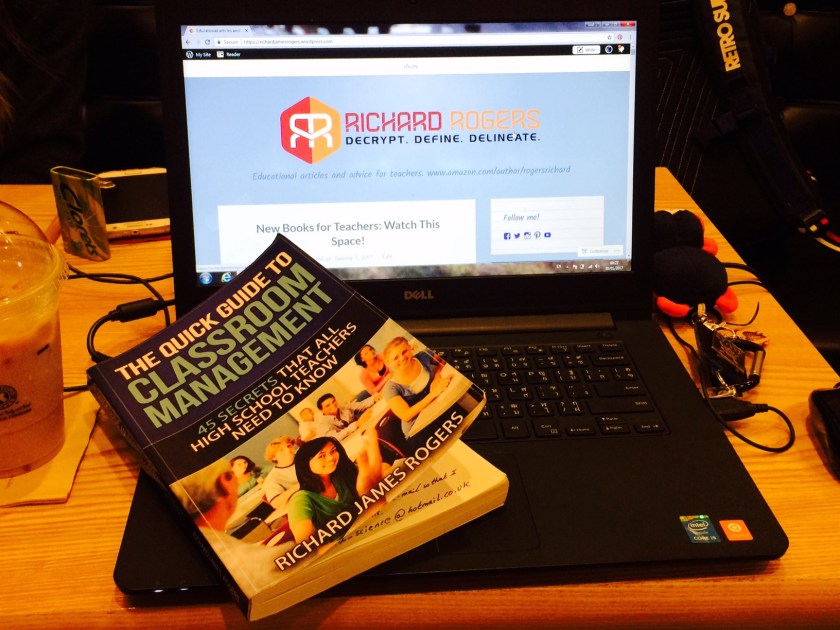
“An AMAZING book! Essential reading for all teachers!”
But at least it was something.
A funny thing happened one day at that school. I was teaching my Year 9 students about biodiversity and we all went down to those creeper plants with pooters and sweep nets. I thought we wouldn’t find anything, but to my amazement the students collected loads of crickets! I was befuddled, but rather pleased at the same time! We took them back to class and took a look at them.
I later learned that day that my Science colleague had been using crickets in his lab the lesson before, and had just released them onto those creepers minutes before my kids came down swinging their sweep nets! Poor crickets – they’d been prodded and poked and released and recaptured and prodded and poked some more! We had a good laugh about it that afternoon!
This short story teaches us that there are always benefits to using the school’s plant life, even if it’s skimpy. You never know what might come of it, even if a weird coincidence like the one just mentioned doesn’t happen. In addition, students will learn to appreciate their school environment even more than they did before.
#2 Make use of the unexpected
You never know what might happen, but when it does happen, use it!
A classic example was at another school I worked at in Bangkok when a snake slithered into the grounds! It was long and green and had a fat part in the middle: as though it had just eaten a rat. What a memorable experience! It’s a shame my school didn’t use this fully. Just think what could have been achieved:
Photos of the snake could have been taken and sent to all teachers
Teachers could show the students the photo and link it to curriculum areas.
For example – The serpent in the garden that tempted Eve (Religious Education), an analysis of this snake species and it’s global distribution (Biology and Geography), adjectives used to describe this snake, such as ‘slithering’, ‘creeping’, ‘demonic’ and ‘scaly’ (English language).
After the snake had been captured by the professionals who were sent in, it could have been contained in a glass tank and students could be allowed to visit the snake safely for a few days before it was taken to it’s new home. Great for primary kids!
Where were you when 9/11 happened? I bet you remember – of course you do (if you were alive and conscious then). Unexpected events etch their engravings deep into the subconscious memory, allowing recall to take place decades after the event has happened. Surely, then, it is foolish not to make the most of the unexpected, if safe and practical to do so.
#3 – Outdoor Learning is not just for Science teachers
As we’ve already seen, many curriculum areas can be supported in the outdoor school environment.
Are you teaching IGCSE German? Take a walk around the school and get your students to identify key items, such as leaves, bricks, walls, grass and trees, in German. Maybe you’re teaching a History lesson about Offa’s Dyke path – why not get your kids to build a mini-dyke on the school field? How about mathematics? – Well geometry and shapes burst to life in both the built and natural environments.
In short, there are always ways to use the school environment in your subject area. Build opportunities into your Schemes of Work and planning documents, book spaces in advance (e.g. the school field) to avoid clashes and be creative!
#4 Your school environment provides space
Many of the learning games I use frequently in class, such as corners and vocabulary musical chairs (shown below), require lots of space. Why not take the kids outside to play these games from time to time? It’ll make the content more memorable and you’ll avoid problems such as trips and falls, which can sometimes happen in a cluttered classroom.
#5: Embrace the opportunities offered by field trips and residentials
Sometimes the best way to benefit from the great outdoors is to completely leave the confines of the school premises with your students. If you’re asked to go on a residential or field trip, or are responsible for planning one, see this as a tremendous opportunity to enrich various curriculum areas.
With this kind of event, individual subject teachers are almost never consulted on what kinds of activities they would like to see happen. This is unfortunate. Try to involve all members of the teaching team in the planning process, so that maximum benefit can be made. Field trips and residentials often provide the perfect environment to get coursework done, for example, and are great for project-based work.
Conclusion
Outdoor learning does not have be outdoors, in terms of being outside school. Find opportunities to use the school environment to enrich various curriculum areas
Use the unexpected: Caught in a downpour? – go and collect some rainwater and test the pH, or use it as a symbol of cleansing in Religious Education, or talk about precipitation in Geography. The unexpected can often offer opportunities for serious long-term knowledge retention.
Use the vast space that your school environment provides to play learning games and explore the richness offered within the school grounds.
Plan field trips and residentials fully, so that key curriculum areas are enriched.
We welcome you to join the Richard Rogers online community. Like our Facebookpage and follow usonTwitterfor daily updates.
As an author for the Times Educational Supplement teacher resources site, I was very excited to receive this month’s Author Newsletter. In it was a breakdown (the first of its kind), of all of the resources that are in the highest demand at different points in the year. For April, SPaG (meaning Spelling, Punctuation and Grammar) resources were listed as being bestsellers, indicating that demand for SPaG tips is high at this time of the year. I thought, therefore, it would be helpful to begin May with some great SPaG review tips and tricks.
For those readers who are teaching a non-British curriculum, you may not be aware that SPaG tests are now compulsory in England at the end of Key Stage 1 (Ages 6-7) and Key Stage 2 (Ages 8-11).
However, as a teacher who’s teaching Science and Mathematics through the medium of English, I vehemently believe that good SPaG teaching is the responsibility of all educators, whether you’re teaching small children, teens or adults. SPaG can be effectively reinforced in any subject area, and I’ve come to the realisation that I’ve actually been doing this for years, without calling it SPaG!
Here are my top tips for teaching and reviewing SPaG, which are all tried and tested and highly effective.
Play vocabulary games
The following vocabulary games are awesome! I’ve used them for years, and my mostpopular blog post everprovides 7 of the very best games you can play with your students. Try these for SPaG specific benefits:
Splat
This quick game is so easy: all you need is a whiteboard, whiteboard markers and class of kids. It’s a great game for consolidating key vocabulary, and is perfect for E.A.L. learners.
Here’s a short video showing a quick clip of me playing ‘Splat’ with my students (I will include some more lengthy clips soon, but this is a good start):
Mystery Word
Another easy game. This time, students randomly pick out written words from a hat (or cup, beaker, container, etc.), and then they have to explain their word to the class (without saying the word). The students who are listening have to guess what the word is.
Who am I?
A very simple game. All you need are post-it notes and a class full of energized students! Great fun. Perfect for reinforcing key vocabulary and concepts. I just played this last week with an AS-Biology class and they loved it!
Corners
I love this one! It gets very competitive so be prepared for a noisy lesson!
Use vocabulary journals
These are very powerful learning tools, but they are so underused in the teaching profession!
Take two weeks ago for example. My AS-Level Biology students had just finished their mock exams and I sat down with one young lady to provide feedback to her. She had great subject knowledge, but had used incorrect adjectives in some of her answers. For example:
Any AS-Level examiner will tell you that this is a common way in which international students lose marks in exams. So, how can I help this student now?
The solution is simple and effective: she’ll have a special notebook in which she writes down all of the model answers to questions she gets incorrect in the intense past-paper practice we’ll be doing for the next month and a half. She’ll be keeping a ‘vocabulary journal’, and I’ll be checking it and sitting with her to discuss it each week.
Journals are a great way for students to constantly review their understanding and knowledge of key vocabulary. With students who have very low English proficiency, you may wish to use journals from day one. With others, such as my AS-Biology student who only needs some ‘fine-tuning’, they can be used at specific points in the academic year.
Elocution, elocution
Elocution simply means modelling good speech.
Speak your key words and key vocabulary clearly, and get your students to repeat them! I used this technique only three days ago in a KS3 Science class. One of the key words was ‘species’. The dialogue went something like this:
Teacher: “Say spee-shees”
Students:“spay-shees”
Teacher:‘One more time. Listen carefully: ‘speeeeeeee-shees”
Students:“Speeee-shees”
Teacher:“Perfect, ‘Speee-shees’ Well done.”
Elocution might seem like a silly way to review concepts that will be tested in a written exam paper. However, many studies have shown the remarkable benefits that elocution can have on spelling proficiency, as well as conceptual understanding.
Differentiate texts
Many school subjects require students to read and analyse paragraphs of text. Whether it’s a description of freeze-thaw action in geography, or a synopsis of the rise of crypto currencies in ICT or economics: blurbs, descriptions and essays confront our students with unique challenges.
Sometimes our students don’t yet have the reading level to cope with the text. Sometimes they just simply get switched-off or disinterested, and this may or may not be related to their English language proficiency.
Have you ever stopped reading a book, or a short article, because it just didn’t interest you enough? I know I have, many times.
I can read but if I’m not interested, I’ll switch off.
Thankfully, there are a number of methods we can use to make texts more digestible for children and young adults. I’ve written a separate blog post outlining these strategieshere.
Follow Me cards
This is a classic technique, which can be applied to many subject areas. Share a large number of cards around your class (e.g. 32). Ask one child to read the definition on their card. The child who has that definition then has to read their word and also the definition on their card. This continues until all 32 words and definitions have been shared.
If you complete it correctly, the game should end with the person who started it!
More SPaG resources
For tailor-made made SPaG tips and resources, try these links:
Times Educational Supplement SPaG site
Just filled to the brim with superb resources! Check it out!
It was a typical INSET/teacher-training day at my school, or at least it started out that way.
I was up early at the ring of three alarm clocks, and a few snooze buttons worth of ‘sneaky sleep’ time for each (a habit which I have now, thankfully, changed. Side note: Check out a book called The Miracle Morning if you want your life to change immediately!).
It was a long summer vacation, and now it was back to the daily momentum of the first semester.
The morning was fairly standard: new staff introductions, receiving our timetables and talks from the principal and deputies about our school’s focus and aims for this academic year. A complimentary lunch of Pad Thai and iced tea followed. So far, so good.
And then came the afternoon slot. First session on the agenda: Supporting EAL students in mainstream classes. We all eagerly walked in, took our seats and got out our pens and notepads ready to take notes. One of our popular and friendly American colleagues was leading the session, so we were we’re all excited.
The session began with a ‘Bonjour……, sava?” and that’s all the vocabulary I can remember from then on in. I had no idea that my American friend was a fluent French speaker, and I couldn’t speak even a string of three words in French: I dropped it at age 14.
This went on for about 15 minutes. The spoken language was French, the PowerPoint was in French and the handouts were in French. And then, oh no, the teacher asked me a question!
I did what all of my EAL students habitually do at this point, I turned and asked my friends for help, in my native language (English). Big mistake! My American friend turned into a ruthless foe as she launched a vicious and aggressive verbal attack on me (which I didn’t understand). Even though I knew this was a teacher-training session, and I was ‘supposed’ to make this mistake, I still felt humiliated.
I later learned that she said “Speak in French only”, in French.
If you’ve never took part in an activity like this before, then try it. It is a very blunt and merciless reminder of the challenges our EAL and ESL students face when they are taught through the medium of English.
Over the past 11 years I have had the privilege of working with thousands of EAL and ESL students. It started when I was in the UK teaching the children of eastern European migrants, and then progressed on to a wide-spectrum of international students in the ensuing 8 years in Thailand, and my current year in China. I’ve learnt that some techniques work really well almost every time, and some can be a bit hit-and-miss (sorry for the colloquialism: that’s something you should avoid, by the way!).
Let me share with you the best techniques that will take your EAL and ESL teaching to the next level of excellence.
Have sympathy and patience
Don’t forget that EAL students need time to process whatever you’ve said, or the task or information they’ve been given, in their native language before they can give you a response in English.
Allow students time to think. Pause a while, let the student discuss their answer with a friend who speaks their language if necessary. Listen carefully to the response you get. Praise the parts that were correct. Model good grammar and execution.
Pause and allow your students time to process information. Praise them when they provide a good response. Have patience, and watch your students flourish!
Take a look at this short dialogue:
Teacher:“So, James, what does the word ‘Species’ mean?”
James:(Has a short talk with his friend in Chinese. Teacher pauses.)“Species mean when animal are like the same.’
Teacher:“Wow! Great answer James. A species can be a group of animals or plants that have similar characteristics. Well done for using the word ‘same’, but I think that ‘similar’ is a better word. Can anyone else tell me something about the word ‘species’?”
Focus on the long-term goals of improving your EAL students’ comprehension gradually. Don’t expect miraculous results overnight, but at the same time don’t limit your beliefs in these students’ abilities.
Speak slowly and watch your accent
As soon as I landed in Thailand I discovered this important secret: EAL students need to hear a clear speaker when being taught through the medium of English, so that they can model good practice.
Slow your voice down, and speak loudly and clearly (but don’t shout). If you have a thick localised accent, try to make it more classical and concise.
I come from Flint in North Wales: a small town with its very own unique accent that’s different to anywhere else in the UK! When my wife, who is Thai, comes with me to the UK to meet my family, she often cannot understand what we are all saying when we use the local dialect (including me, her husband!).
My wife has a master’s degree from the UK, so what hope would my high school kids have in understanding me if I tried speaking in ‘Flint’ to them?
I have learned to slow my voice down and speak in a more neutral/classical dialect when I’m teaching. You may have to do the same. Make a video recording of one of your lessons and watch yourself teach. You’ll be surprised at how many slip-ups you make, and there may even be times when you can’t understand yourself!
Elocution, elocution
Elocution simply means modelling good speech.
Speak your key words and key vocabulary clearly, and get your students to repeat them! I used this technique only three days ago in a KS3 Science class. One of the key words was ‘species’. The dialogue went something like this:
Teacher:“Say spee-shees”
Students:“spay-shees”
Teacher:‘One more time. Listen carefully: ‘speeeeeeee-shees”
Students:“Speeee-shees”
Teacher:“Perfect, ‘Speee-shees’ Well done.”
Be vocal. Use elocution as a way to reinforce concepts, vocabulary and inflections
Don’t forget that written delineation is not enough to enable students to understand words and contexts. Visual and auditory outputs are essential too, and that’s why we must spend time on correct elocution.
Prompting
This is a classic technique that is very simple to implement. Prompting is when you say the initial sound of the word, allowing space and time for the students to complete it. Take a look at this example:
Teacher: “The force that pulls objects towards the Earth is called grr, grr, grr…….”
Students:“Gravity!”
Teacher:“Yes! Gravity. Well done!”
Use prompting often, even with written language. Point to words on your presentations, and make students say them.
Do you prompt your students to use key vocabulary?
Use vocabulary journals
These are very powerful learning tools, but they are so underused in the teaching profession!
Take this week for example. My AS-Level Biology students had just finished their mock exams and I sat down with one young lady to provide feedback to her. She had great subject knowledge, but had used incorrect adjectives in some of her answers. For example:
Model answer: ‘The nuclear membrane disintegrates’
Any AS-Level examiner will tell you that this is a common way in which international students lose marks in exams. So, how can I help this student now?
The solution is simple and effective: she’ll have a special notebook in which she writes down all of the model answers to questions she gets incorrect in the intense past-paper practice we’ll be doing for the next month and a half. She’ll be keeping a ‘vocabulary journal’, and I’ll be checking it and sitting with her to discuss it each week.
Journals are a great way for students to constantly review their understanding and knowledge of key vocabulary. With students who have very low English proficiency, you may wish to use journals from day one. With others, such as my AS-Biology student who only needs some ‘fine-tuning’, they can be used at specific points in the academic year.
Make full use of dictionaries and translators
Many international students carry electronic or paper-based dictionaries with them to class. Personally, I think that all international schools should make this a requirement for all of their students, even native English speakers.
Why? Because they’re powerful learning tools.
Students can use dictionaries in many ways, but the most common and effective are:
Translating key words in their textbooks into their native language, allowing full understanding of terms and permannet record that’s all in one place
To support learning journals, where key words and adjectives can be written bilingually and checked regularly. Get parents and language teachers involved in this for extra credibility and scrutinizing
Some electronic dictionaries can ‘speak’ the word being researched, allowing good verbal modelling and repetition by the student
Creating bilingual displays in class (e.g. posters and infographics)
Use vocabulary games
I write about this extensively in mybook, and my blog post here has some very clearinstructions and ideas for using vocabulary games in class. My personal favourites are ‘splat’, ‘mystery word’, ‘corners’ and ‘bingo’ which I’ve included below. These are great fun, but they do take time to implement in class. It’s worth it though!
Never demonize the native language of the students
I had the unfortunate experience of working in a school that had an ‘English only’ policy, which was strictly and rather bizarrely enforced. As a British teacher in Thailand, I was expected by the management of my school to tell students not to speak Thai.
I thought we’d left this archaic ideology behind with the abolition of the ‘Welsh Not’ necklaces in 1888. I guess I was wrong.
Don’t forget: our EAL students will be using their native language to cognitively process facts and information. Try these strategies:
Allow students some time to discuss answers with a friend who speaks the same native language as they do
Pause, and allow the student to verbalise the answer in their native language before expressing it in English
Instead of saying “Don’t speak Thai” or “Don’t use German”, say something like “Try your best to use English please”, or ” I really want you to improve your English, so could you please try to talk in English?”.
Posters and displays around school that promote English can be effective. Choose upbeat, modern graphics that show students why English is important. One school I worked at had a poster in every classroom that said “In this school, we try our best to express our ideas in English, so that we can get good grades in our exams”.
Use groups strategically
You’ll come across two scenarios when using group work with international students:
Groups where every students speaks the same native language
Groups were some or many students speak different native languages
Do you assign roles in groups?
Where possible, it’s a good idea to group together those students who do not speak the same native language, This forces them to use English in their group work (though, most probably, you’ll have clusters of two or three students per group who can speak the same native language).
How you assign groups will depend on the age and emotional maturity of the students too. For example, you don’t want to group together students who you know will just chat aimlessly with each other, and you also don’t want to group together students of completely different nationalities who all have very poor English language proficiency – that would be a very quiet group!
Also, don’t forget to assign roles to each student in a group. Who will be the spokesperson? Who’s drawing the diagram? Who’s doing the research using the iPad? Who’s collecting the data? If you don’t assign roles, then you may find that the group work is slow, unproductive and chaotic.
Differentiate your resources
This is a classic and vast area of pedagogy which is often made more complicated than it needs to be.
Basically, make sure your worksheets, tasks and materials are neither too easy or too difficult for individual students.This websitehereprovides some links to detailed strategies for this, but the most common ones that I’ve used include:
Breaking down prose into sentences, bullet points or ‘blanks’ to fill in.
Using pictures, lots of them! When student asks “What does ‘tripod’ mean”, are yougoing to give a lengthy explanation? Show the student! Type the word in on a search engine and show them an image of the object.
Writing out step-by-step instructions for any kinaesthetic task, such as doing an experiment or building a model
Changing your verbal questions to match the fluency of each student. Do you ask a student to ‘describe the electromagnetic spectrum’, or “Name the parts of the electromagnetic spectrum. For example, gamma rays, radio waves, and……… (prompting again)”
Differentiate the resources and tasks in your teaching to meet the needs and abilities of your learners
Conclusion
We all have a duty to help our EAL and ESL students in the best ways that we can. Our efforts need not be time-consuming nor difficult, just a few easy-to-implement strategies like the ones mentioned above are needed. Be consistent, have patience, never lose hope. Previous EAL and ESL students of mine have gone on to study bachelor’s and master’s degrees at UK and American universities and now have flourishing careers.
Patience always pays dividends, so make sure you are patient with your EAL and ESL learners.
We welcome you to join the Richard Rogers online community. Like our Facebook page and follow us on Twitter for daily updates.
Let’s face it: Marking piles of student work each week can be an onerous task, even for seasoned educators. From tests and assessments to coursework, homework and classwork: the paper-mountain never seems to stop growing!
Thankfully, there is hope for every eager red (or should it be green?) ink consumer.
What follows next are my top four strategies for making marking quick, fun and time-effective.
#1: Live marking saves you time and builds rapport
Do you know what ‘live-marking’ is? It’s really simple: The teacher (you) walks around the classroom with a pen in hand and marks the students’ work as they are doing a task. The benefits of this simple technique are numerous, and include:
Quick identification of misconceptions
Opportunities to speak face-to-face with each student, which strengthens your professional relationship with them
Time saved, as you don’t have to take home the work you’ve already ‘live-marked’
Walk around the classroom and meet each student. Mark their work as you walk around, and make sure you provide guidance and praise at the same time. Image by Khim Pisessith (should_you_wonder@hotmail.com)
#2: Google forms are a great peer assessment tool
If you haven’t used Google forms for assessment before, then you’re missing out one of the most powerful and modern tools in the teaching profession.
You’ll need to learn how to set them up (see the pictures below, and this guide is worth a peek too), but as soon as you’ve used this tool you’ll find that it’s a doddle to work with. Now you have every reason to regain that Saturday morning snooze you’ve been sacrificing!
Your Google form should be set up similar to this:
#3: Mark scheme your way to happiness
Probably the dumbest thing I used to do as an N.Q.T. was to give students questions to complete for homework, without having good, published model answers from which to mark the questions with!
Teachers all over the world are wasting time writing their own mark schemes. A little more time spent considering the kinds of questions you set can save you tons of time! You can also get the students to use these model answers in a peer-assessment exercise, such as a Google forms activity.
#4: Verbal Feedback is effective and saves you ink!
Professor John Hattie describes feedback as “one of the most powerful influences on learning and achievement”.
One of the best ways that me and you can give good feedback is to just simply sit down and talk with our students, face-to-face. Once this is done, you can simply write “Verbal feedback given” on the piece of work, and then get the student to make corrections in a different colour. This saves time and forces the student to process the feedback given.
Make sure you always check up on the corrections.
Providing verbal feedback saves marking time and forces the students to process the comments you give them.
Did you enjoy this article? Why not check out Richard’s book?
We welcome you to join the Richard Rogers online community. Like ourFacebook page and follow us on Twitter for daily updates.