While applying for University of Regina, I had to answer this question. I recently found my answer to this, and found that despite having wrote this well over a year ago today (in November of 2014), my answer then is nearly identical to my answer now. So, What Makes a Good […]
Wakey, wakey! It’s a bright new morning! Are you feeling ready to seize the day? If you’re like most people (and like me in a former life), then the word ‘zombified’ is probably the best adjective to describe your condition.
Fear not! Help is here. Follow these tips to start your day refreshed and full of life!
#1 Wake up early
Okay. Thanks. Tell me something I don’t know, right? Well, give me few minutes to explain first.
It’s amazing how many people find it hard to get up at a sensible time each morning. One survey even found that more than a third of American adults hit the snooze button at least three times each morning, and more than 50% of people of ages 25 to 34 press the snooze button daily. Do we want to rush around like crazy and gulp down our breakfast in a manic frenzy before we dart to work? Of course not. We know that some extra time in the morning would really help us get things sorted at our pace. Try the following:
Take baby steps. Most people try to do too much at once, and fail. Take it easy. Aim to wake up five minutes earlier for one week. Then move to ten minutes the next week. Then try fifteen.
It’s useful to have a reward in place for waking up early. This will motivate you. Maybe you can have the coffee pot ready and hot, or get everything set up in the kitchen the night before so that making a cup of tea is quick and easy.
#2 Do some form of simple exercise
You might be so tired first thing in the morning that the thought of doing some exercise seems worse than boot camp with the S.A.S.
Don’t fret.
If you really don’t feel like dong any exercise, then have a quick, warm rinse in the shower or splash some warm water on your face. You’ll be amazed at the wakening effect this has on you. After this, you can do some simple morning exercises (and you only need to do a few minutes if you’re a total beginner). Try easy things such a push ups, jogging, stretching, simple yoga or even martial arts routines (there are tons of videos that demo these for you – you don’t even need to be trained by a instructor).
But why? What are the benefits of some morning cardio? Check this out:
You’ll be more focussed when you reach school
Endorphins (pleasure inducing hormones) are released into the bloodstream in response to exercise. You’ll feel great!
If you can make this a regular thing, then you’ll be keeping your heart healthy, reducing stress and keeping your body strong and fit for daily life
Exercising in the morning makes sense from a time perspective – this is much better than hitting the gym at the end of a long day at work, when you’re weary and you’ve just tried to race through rush-hour traffic
#3 – Hydrate yourself as soon you wake up
You’ve been asleep all night, and your body has not had a drink. As soon as you wake up, drink a big glass of water (and squirt some lemon or lime juice in there too, if you can). The benefits of this practice are very well documented:
Your metabolism gets boosted. Drinking a large, cool glass of water after you wake up has been shown to fire up your metabolism by an amazing 24% for 90 minutes.
Your body gets rehydrated. You just slept for 7-8 hours (or, at least, you should have done) without drinking any water! Even if your body isn’t screaming at you that it’s thirsty, it probably is.
Water helps your body to detox. Getting fluids into your body as soon as you wake up will help your body flush out toxins that have accumulated overnight.
Your brain becomes activated. When you’re not properly hydrated you can feel drained or experience fatigue or mood variations. Dry brains don’t work well, period.
#4 – Read and reflect on your lesson plans for the day ahead
I learnt the importance of this much later than I should have. It goes without saying – all of your lessons should be planned before you start the teaching day.
Use your morning to either create or, even better, read over the lesson plans you’ve already created for that day. This will prime your mind for what you will expect that day, and you’ll be able to perform better in the classroom because of it. You may also think of some very useful last minute adjustments too!
#5 Develop a morning ritual
As soon as you’ve got the basics in place (waking up early, drinking a glass of water as soon as you get out of bed, doing some form of exercise and going through your planning), you’ll be ready to develop a more advanced morning ritual that meets a variety of your personal needs.
Many of the world’s most famous celebrities, sports people and business titans have developed morning rituals that empower them for the day ahead. You can find some examples of these here.
For tips on how to create your own morning ritual this website is amazing.
—————————————————————–
Did you enjoy this article? Why not check out Richard’s book?
We welcome you to join the Richard Rogers online community. Like ourFacebook page and follow us on Twitter for daily updates.
Your first year in the classroom is here and you’re excited and maybe apprehensive at the same time. You’ve done some placements and teacher training, and now you’re being given full autonomy. The keys have been handed over, and you don’t even know how to brake, steer or accelerate yet.
We’ve all been there, and we’ve all survived to tell our story. You will come out of this a stronger, better teacher. Your first year is when you’ll learn the most, so buckle up your seat belt and get ready – it’s gonna be a bumpy ride!
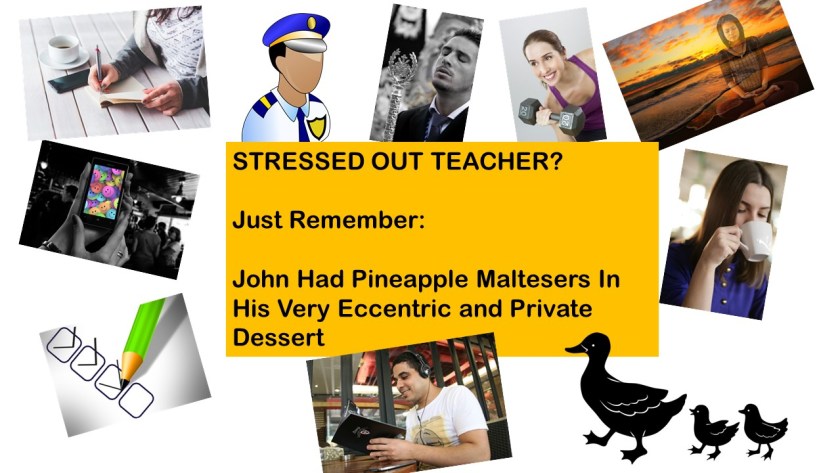
The New Teachers Stress-Busting Formula: John Had Pineapple Maltesers In His Very Eccentric (and) Private Dessert
#1 – Journalise!
Get a special notebook. This is going to be your ‘screw-up record book’. In this book, you should write down every mistake you make along the way (and you will make lots, trust me!). Read through your book on a regular basis. Even better, do this process as a group or with a friend and have a good ‘ol laugh about it together! Reflect regularly on what went wrong – this will stop you from making the same mistakes repeatedly.
#2 – Humourise
I‘m going to warn you – in your first year there will be times when you just wanna cry, or worse, give up completely and walk out. At these times, treat yourself to a few minutes of humour. Watch a comedy show on your phone and get some giggle therapy! My favourites include Just for Laughs – Gags, Trigger Happy TV and Little Britain.
#3 – Prioritise
Everything takes longer when you’re a new teacher. Your colleague who’s been in the game for ten years can mark 30 notebooks in 30 minutes, whilst you’ve only done 5 in the same time. For this reason, you need to really plan what you do with your time very strictly. Use your ‘free periods’ to effectively do your admin, and make sure, crucially, that you plan what to do in advance of your free time. Build up routines. Maybe you can do 30 mins of marking every morning before you start, or maybe Thursday evening is your planning time. Get a schedule together, and modify it when it doesn’t work. Stick to it when it does work.
#4 – Musicise
We all have songs that are dear to us and that uplift us. A good session of ‘Eye of the Tiger’ or ‘Billie Jean’ is enough to get me going in the morning! Which songs motivate you? You may find that when you’re down in the dumps a good song or two can really change your mindset. If you can’t think of any that do, then just type ‘inspirational uplifting music‘ into YouTube and you’ll soon be up-spirited with loads of great playlists.
#5 – Idolize
Idolize is probably too strong a word to use (but it ends with ‘ize’ and keeps the coolness of this blog post flowing ;-D). Look at what your colleagues do well, and find out how they do it. Model their behaviours. If the Head of Science can engage and work well with class 11G, then you can too. You just need to find out what she is doing that you’re not, and then make attempts to copy that behaviour (and add your own spin to it too).
#6 – Herbalise
When the Nazi’s were bombing London in the Blitz, a common phrase kept people going: A cup of tea can solve anything. It’s true. If possible, go for chamomile or peppermint teas as they are very relaxing, but any hot drink will do. If coffee is more your thing then treat yourself to a hot cappuccino. Bring tea bags and coffee sachets into work for those moments when the work never seems to stop. A good 30 minute break with a hot drink can really help to calm you down and give you a fresh focus.
#7 – Visualize
Remember why you’re doing this job. Thing of all of the young lives you’re improving in your work. Focus on how it’s not all about you – it’s about something bigger than you. You are a very important person. You can inspire hundreds of young people each day. Visualize your lessons before they happen. Spend a few minutes each morning or evening visualizing the next few lessons you’ll teach. Visualization, when done frequently, leads to actualisation. Make sure you actualise the best lessons you can possibly teach by first visualizing the ideal outcome.
#8 – Exercise
Haha! ;-D We all knew this ‘ise’ was coming. A healthy body lifts your mood. I’m not talking about being a marathon runner or even going to the gym. You don’t need to be super fit, but please stay active. Even a 10 minute jog or some push ups in the morning before work can really get the blood flowing and make you feel great. Don’t be intimidated by gym enthusiasts if you’re not that type of person – regular, decent exercise that’s not too overbearing is all you need to stay happy and healthy.
#9 – Prayerise
Prayer power is magnificent and should be a part of your daily routine. Whatever your religion, offloading your worries and fears to a divine presence can only bring more calmness and relaxation into your life. In addition, integrity is important to the human heart and most religions offer a way to maintain and improve upon your personal values on a daily basis.
#10 – Deputise
You’re probably juggling too many things at once as a new teacher. You can give some duties to your students. This will build up a sense of responsibility in them, and it will make your lessons more efficient. Are you always scrambling to hand out student notebooks at the start of a lesson? Choose one student to be in charge of notebooks for your class. Make it a special responsibility for being a mature student. He or she can hand out the books, collect them in and be in charge of storing them away and keeping them tidy. Think of other areas in which you can use this principle too, but don’t go too far! Assigning a student to hand out and collect the coloured pens each lesson is great, but asking students to do your photocopying for you is not cool.
Did you enjoy this blog post? Why not check out Richard’s book? It’s available as a paperback and a Kindle file.
All character names in this article are fictional.
I’ll always remember my first day in the classroom as an eager PGCE student. I thought I knew it all, and that teaching a class of hyperactive teenagers was a piece of cake. How wrong I was!
Starting out in the classroom can be a daunting experience for any newbie. From chatting to graffitiing, to refusal to do work and outright rebellion – some schools around the world really do provide the new teacher with a ‘full-house’ of interesting characters to deal with.
I wrote a whole chapter about behaviour management in my debut book. Mastery is a long-term thing, and requires an investment of teacher time spent in building rapport with students. However, there are a few techniques that many teaching Olympiads use consistently in their practice, and they work like a treat!
If you’re totally new to teaching, then don’t expect too much at first. It takes time to learn how to use these techniques correctly. Play with them. Get used to trying them out – it won’t be long before you’ve discovered the correct contexts in which to use them.
#1 – The ‘Look’
Maybe you’re writing something on the whiteboard and you can hear some chatter behind you. Perhaps you’re trying to explain a concept and two boys are playing around with each other. Whatever it might be, ‘localised’ disruption can often be tackled as follows:
Stop talking. Don’t say a thing.
Look at the disruptive student or student for a few moments in a serious manner
You can enhance the Look by saying something like “We’re all waiting for you” or “Thank you to those who are listening. I’m just waiting for one person”
Do you have the ‘Look’?# 2 – Are you focussing on the behaviour or the work being done?
It’s important to create a sense of urgency about any work the students are doing. Instead of balling a loud “Why aren’t you doing your work, Sam?” (which would only lead to a confrontation, and probably make matters worse), ask something like “How’s that work going, Sam?” or “Sam, have you finished?”. This puts the focus squarely on the work being done. Always follow up with a “I really need that to be done today. I know you can do it” or some other phrase that conveys urgency and the fact that you believe in the ability of the student.
Focus on the work that needs to be done
#3 – You don’t need to punish everything
Everyone deserves a second chance. We all screw up. Unfortunately, however, overly-draconian sanctions systems, especially when implemented in a strict ‘no-compromise’ way, don’t take this human condition into account.
This can prove to be a delicate balancing act. You need to be consistent and fair to all of your students, but you also need to know when repealing a sanction might be necessary.
Michael was a student who was famous for being confrontational. If he felt he was being unfairly treated, or even being ‘told what to do’, he would waste no time in arguing his point. He was constantly on detention, and school had become quite a negative environment for him.
On one particular Tuesday morning, Michael had had quite a rough time. His mum had been away from home for two days, and he had his mates stayed over at his house. It later emerged that they had drank alcohol together and had partied quite hard. After missing school for one day, Michael decided that he wasn’t going to miss school today (he was afraid of the school calling his mum about it). On this particular morning he had skipped breakfast after waking up late, had missed the school bus and had to walk to school.
He arrived at his science class visibly exhausted, and just walked in without even a knock on the door. He then proceeded to take out a can of cola and start drinking it. This is an absolute no-no in a science lab – no eating or drinking whatsoever, and our departmental policy was to issue a detention on the spot. “Michael, it’s good to see you, but you know that you can’t drink in here. That’s an automatic detention”.
Well, that was the fuse that really set him off! “Are you (insert expletive here) kidding me! I’ve only just come into school and I’m on one detention already! For (insert second expletive here) sake!”. Now, most new teachers (and some experienced ones too) would probably respond to this in a gut, emotional way, by enacting whichever sanction they felt was necessary. Not only had Michael broken a class rule by drinking in the lab, but he’d also answered back to a teacher and had used swear words! Surely he needed to be hung, drawn and quartered, right?
His teacher knew better. He knew that raising the level of confrontation would only serve to make matters worse, and would help absolutely no one.
“Okay, Michael, now how do you think I should respond to what you just did?”
“I dunno sir, but I swear down I ain’t done nothing wrong and I’m now on detention”
“Okay, I’m willing to listen to you Michael. I respect you as a person, but I think we both know that you did do something a little bit wrong this morning. Do you agree?”
“Okay, yeah I swore and I had a drink. I haven’t had a drink since I woke up, I’m thirsty. I can’t learn if I’m thirsty”
“Okay, Michael, I’ll tell you what. I’m supposed to automatically give you a detention for your actions this morning, but I’m going be fair with you. I realise that you’ve probably had a rough morning today, so I’m willing to do a deal with you. How about I give you a few minutes to finish your drink outside, and then I’d like you to come inside and produce your best work for me. I know that you can do this Michael, because you’ve produced some brilliant work for me in the past. If you can give me a good piece of work by the end of the lesson, then I’ll probably forget about the detention.”
“Okay. That sounds fair”
“Thank you, Michael. I really appreciate your understanding”
What was the result of this? Michael did indeed try his best to complete the work, and he was let off with the detention. If Michael had decided not to do what we had agreed, then he would have been given that detention (and he knew that).
#4 – Use signals
This works best when implemented on a whole school level, but individuals teachers can sue them too. It’s really simple – you basically train your students to respond to a prompt. Examples that I have witnessed (and used) are as follows:
The teacher claps her hands 5 times (two slow claps followed by three quick claps). The students all respond by copying the action
The teacher says “if you’re happy and you know it clap your hands” and all of the students clap twice
The teacher raises his hand, and all of the other students raise their hands too
All of the above techniques are great for dealing with whole-class disruption.
#5 – Stay active!
Our jobs as teachers have evolved to the point where many of us are spending more time sat in front of computers, and less time teaching our students. This has forced many educators to spend at least some time within each lesson checking e-mails and preparing electronic resources, whilst the students are working on a task. In some schools this doesn’t cause a problem (particularly when a whole-school ethos of high achievement is prevalent), but when this becomes a regular pattern of behaviour it can cause some kids to lose motivation.
Get up, walk around, and check that your students are on task. Use live-marking, and talk with each child. This not only improves your behaviour management, but also builds up a lasting rapport with you and your students over time.
Did you find this article helpful? Why not check out Richard’s book?
Let’s face it: Marking piles of student work each week can be an onerous task, even for seasoned educators. From tests and assessments to coursework, homework and classwork: the paper-mountain never seems to stop growing!
Thankfully, there is hope for every eager red (or should it be green?) ink consumer.
What follows next are my top four strategies for making marking quick, fun and time-effective.
#1: Live marking saves you time and builds rapport
Do you know what ‘live-marking’ is? It’s really simple: The teacher (you) walks around the classroom with a pen in hand and marks the students’ work as they are doing a task. The benefits of this simple technique are numerous, and include:
Quick identification of misconceptions
Opportunities to speak face-to-face with each student, which strengthens your professional relationship with them
Time saved, as you don’t have to take home the work you’ve already ‘live-marked’
Walk around the classroom and meet each student. Mark their work as you walk around, and make sure you provide guidance and praise at the same time. Image by Khim Pisessith (should_you_wonder@hotmail.com)
#2: Google forms are a great peer assessment tool
If you haven’t used Google forms for assessment before, then you’re missing out one of the most powerful and modern tools in the teaching profession.
You’ll need to learn how to set them up (see the pictures below, and this guide is worth a peek too), but as soon as you’ve used this tool you’ll find that it’s a doddle to work with. Now you have every reason to regain that Saturday morning snooze you’ve been sacrificing!
Your Google form should be set up similar to this:
#3: Mark scheme your way to happiness
Probably the dumbest thing I used to do as an N.Q.T. was to give students questions to complete for homework, without having good, published model answers from which to mark the questions with!
Teachers all over the world are wasting time writing their own mark schemes. A little more time spent considering the kinds of questions you set can save you tons of time! You can also get the students to use these model answers in a peer-assessment exercise, such as a Google forms activity.
#4: Verbal Feedback is effective and saves you ink!
Professor John Hattie describes feedback as “one of the most powerful influences on learning and achievement”.
One of the best ways that me and you can give good feedback is to just simply sit down and talk with our students, face-to-face. Once this is done, you can simply write “Verbal feedback given” on the piece of work, and then get the student to make corrections in a different colour. This saves time and forces the student to process the feedback given.
Make sure you always check up on the corrections.
Providing verbal feedback saves marking time and forces the students to process the comments you give them.
Did you enjoy this article? Why not check out Richard’s book?
We welcome you to join the Richard Rogers online community. Like ourFacebook page and follow us on Twitter for daily updates.
Phew! Well there was light at the end of the long tunnel after all, and it wasn’t an oncoming train!
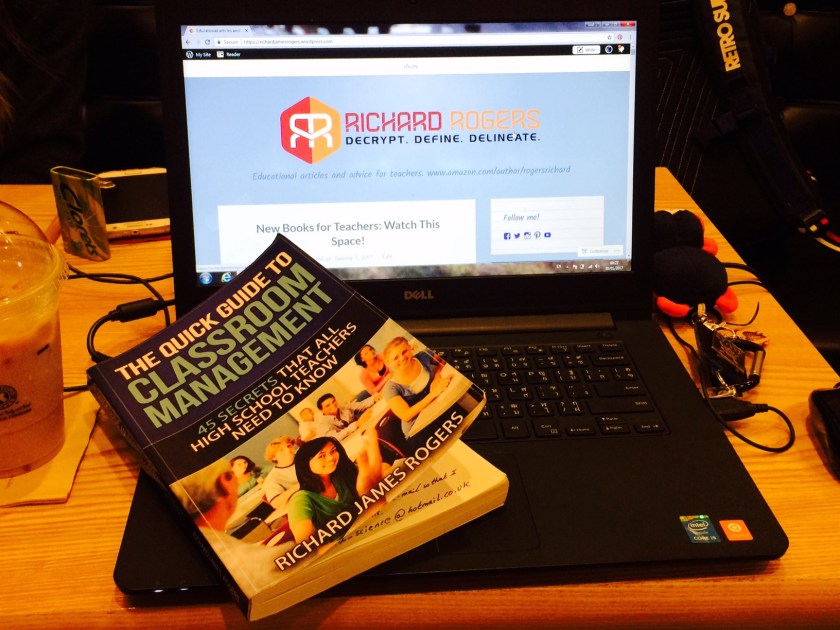
My book, ‘The Quick Guide to Classroom Management: 45 Secrets That All High School Teachers Need to Know’ is now available on the Kindle store at http://www.amazon.com/dp/B016ZG1IX0, and will be available as a paperback, physical copy in about seven days time.
It’s been a long, but enjoyable journey to get here!
It has been a very long and arduous journey to get here. The book stands at 52,000 words and is heavily illustrated with elaborate charts, infographics, diagrams, illustrations, examples of student work and screenshots. The amount of research that went into this book was absolutely astronomical, and I have become a better teacher in the process of producing this work.
I wanted a front cover showing happy, stimulated students.
I never knew that writing a book was such a huge process until I embarked on this journey. From purchasing and registering an ISBN number, to designing a front cover and requesting permission from outside publications (to use their material), this whole project has been a wonderful journey and I have only become a better person because of it.
I have really tried to make the whole dynamic of classroom management clear and direct (with no ‘nonsense’ attached) so that, finally, high school teachers around the world will wake up from the illusion that you need some quick tricks and techniques to improve poor teacher-student rapport. Unfortunately, this mindset is very commonplace, and I really tried to show (in my book) how our interactions with colleagues, parents and our students all feed into each other to create a ‘composite practitioner’ that’s truly able to foster positive interactions and implement outstanding classroom management on a daily basis.
I probably should have called this book ‘The Complete Guide to Classroom Management’, as it is 259 pages long and 16MB in size (which is massive for a Kindle file). However, I’ve deliberately omitted references to traditional (and obscure) overviews of pedagogical literature (such as that of Piaget, De Bono and Bloom’s) and have, instead, produced a practical, no-nonsense guide to real, effective, classroom management.
My new ISBN number and barcode
Some of the truths in my book will be unpalatable for some people – the real truth behind effective classroom management involves hard work on the part of the teacher, and there are no ‘quick fixes’. However, I can guarantee that any teacher who reads my book to completion, and implements all of the points I’ve raised, will drammatically increase their effectiveness as an educator.
Happy Saturday, and keep teaching! (we never really stop!)
Which is best? A smart phone or a tablet? If you’re planning for a lesson and wondering whether or not to book your school’s iPad set, then this list might give you some food for thought.
Should you book your school’s iPad set for that excellent lesson you’ve planned, or should you just get the kids to use their smart phones? Some things to think about:
Tablets do provide a larger screen and greater accessibility to some programs and simulations, and this is a big advantage for students who like large text and who have issues with manual dexterity
Always test the software first: Unfortunately, many programs and simulations that work on a Windows™ PC do not function properly on tablets and smart phones that use other operating systems. It’s really embarrassing and frustrating to set a wonderful ICT-based learning task only to discover that it isn’t compatible with the kids’ devices.
If you’re planning on getting students to submit docs, PowerPoints or pdf files through Dropbox, or if you want students to download a file of this type, then tablets are typically better than smart phones. The larger screen means that more readable text can be displayed on the screen, and this also makes it much easier to edit files.
Cost is an important factor when considering ICT orders in schools. Tablets generally cost two to three times less than their smart phone counterparts, and often allow for greater functionality. The other advantage is that school tablets will have been set up consistently by an ICT administrator, and will often not have SIM cards that connect them to a cellular network. This means that kids are much less likely to be playing around on social media when using school tablets, since sites like Facebook™, Instagram™ and others are much more difficult to access without their corresponding apps. Schools can also put controls in place to prevent access to such platforms.
One downside of tablets is that they can be slow, especially if multiple students are using them to access the internet via the school’s Wi-Fi system all at the same time. Smartphones can offer a quicker alternative in these cases.
Students are much more likely to share school tablets with each other, rather than sharing their highly personalized smart phones with their peers. This has obvious ramifications for group work
One big advantage of tablets is that their battery life tends to be much longer than that of smart phones. Your school’s set should also be regularly charged by the ICT administrator.
As a very keen and determined PGCE student at Bangor University’s outstanding School of Education, I was introduced very quickly to the importance of making my students fully aware of the learning outcomes (sometimes referred to as ‘aims’ or ‘objectives’), every single lesson. On a very fresh summer morning at the beautiful science labs at Bangor’s ‘Normal Site’, I and the rest of the science students were given a deck of playing cards. We were then asked to shuffle them and play poker, but keep any diamonds that were dealt to us, indefinitely. When this was finished, we repeated the game, but this time we kept any multiples of three. Once this was over, we were each given a set of coins and asked to toss each one in turn. If we got a head, we could keep the coin; whereas a tails meant that we had to dispose of that coin and place it into a big tub in the middle of the room. After about 30 minutes of doing this, we started to look at each other with rather puzzled and bemused faces. Some of my friends started to utter “What’s the point in this?” and “Why the hell are we doing this?” At this stage, our instructor stopped the activities and asked us all a very simple question: “How was that?”
A fun activity, but why were we doing it?
The replies came slowly at first, but as soon as a few people had mustered enough nerve to reply, more answers soon followed.”It was okay, but I wasn’t sure why we were playing those games”, “It was good at first, but I lost focus after a while” and “The whole lesson just seemed completely pointless”. After the exchange of a few giggles, we could all see that this was part of the instructor’s plan all along (he was always very shrewd in the way that he introduced us to key concepts). He then asked “What do you think the purpose of this lesson was?”. Again, the replies came in thick and fast “Something to do with data and numbers”, “Learning how to use games to entertain students” and, finally, one student hit the proverbial nail on the head – “To understand that if the students don’t know why they are doing something, then they’ll lose focus”. This final reply was correct, but incomplete. For this particular session, the instructor was trying to teach us two things. The first objective was to learn that it is easy to ‘cherry-pick’ data in scientific experiments (hence the collection of the ‘diamond cards’ and disposing of each coin that had yielded a tails). The second was the one that’s most important to me and you: that learning is only productive and effective if the students know what the mission/objective of each lesson is.
After learning this crucial lesson, I quickly put it into practice during my first year of teaching. I would always write the lesson objectives on the whiteboard (or project them on a screen), straight after I had given my starter activity. My lessons always started promptly, and my students always knew what my mission was. However, despite this, something was still missing. The problem was that almost every teacher in my school had been trained in a similar methodology, and were all doing the same thing. Each lesson to my students seemed like, in the words of one Year 9 boy, “different versions of a computer game with the same exact layout, just different colours and different bad guys to fight” (I thought that was quite a profound conclusion, actually. I gave that boy a house point for his linguistic creativity).
So what was missing? Why, despite following best practice, were some of my students still losing focus? Why was it that at the end of each lesson some students couldn’t even remember the objectives I’d shown them 45 minutes earlier? Well, the answer, as I discovered much later than I probably should have, was found in that unusual session back at Bangor University. The reason that I can remember that particular lesson so well is because it contained a sense of mystery, and because I and my peers had to figure out the lesson objectives for ourselves. But how did we figure out those objectives? Answer: The activities of the lesson aroused within us a sense of curiosity about its purpose.
We all remember things better if we’ve had to discover them by ourselves, as opposed to being ‘spoon-fed’ the information. More often than not, we are also more proud of those things that we’ve had to overcome, adapt to and solve by ourselves, than those things we’ve attained easily, and this principle feeds directly into this very effective methodology for beginning a lesson:
Begin each lesson by assigning work, analysing it and then getting the students to generate the learning outcomes for the lesson
By using this methodology you will not only capture your students attention as soon as the lesson starts, but you will also be encouraging them to use ‘higher order thinking skills’, especially if the students do the following:
Build models or construct some kind of concept illustration
Solve an open-ended problem (e.g. “You have five minutes to build a useful object out of the drinking straws on your desk”)
Include emotion in their work (e.g. “Imagine you are Neil Armstrong on the day he landed on the moon. Write a quick diary entry for him on that day. How did he feel?”)
Solve a logic problem (e.g. breaking a code, or answering a series of questions in sequence which lead the students to a final conclusion)
Use their physiology in an unusual way (e.g. “You have five minutes to build a tower out of the objects on your desks. One person in your group needs to balance the objects on their head. Who will create the tallest, most balanced tower?”)
Have a choice over whether to tackle the problem using a left or right-brain approach (e.g. “Sarah needs to buy food and drink for a birthday party. In front of you is a price list for every item at Partylicious candy store. Sarah only has 45 pounds to spend, so help her out! Maybe you could write some selected shopping lists for her, or draw a collection of items that she could buy.”)
Conclusion: Start your lessons promptly by assigning a good-quality starter activity, analyzing it thereafter and then asking the students to consider what the objectives of the lesson might be. I assure you, by starting your lesson in this way your students will benefit far more than if your lesson has an unfocussed start, directed solely by the teacher.
You and I could walk into any school staff room at morning break time and, after about five minutes, we could easily distinguish between the ‘Chatty Cathys’ and the ‘Reserved Richards’. Gossips love to espouse whatever is on their mind, even if nobody else wants to hear it. They’ll tell you one funny anecdote after another, ranging from which salon they went to last week to how difficult they find the new pupil assessment software the school’s made them use. There’s also one other thing that gossips are really good at, and that’s dishing out the dirt on anyone who happens to be the topic of the current conversation.
Gossiping at work? Not a good idea.
Gossips, without fail, are people to completely avoid at all costs (where possible). One of the reasons why gossips are famously passed over for promotion is because they can’t be trusted with the sensitive information they’d be exposed to in a managerial role. They generate distrust, and you should be very cautious with what you say when around anyone who is a famous gossip – you don’t want to give them fuel for a fire that they can burn behind your back! Additionally, if you happen to be sat with a gossip who starts to speak negatively about a colleague or the school in general, then don’t be afraid to get up and walk away. What’s more important: having a laugh or having a job? Besides, do you really want to be sat there when everyone’s complaining about the principal and that awkward moment happens when the deputy head walks into the staffroom? If you’re sat with gossips, or if you’re seen to be hanging around with them and chatting with them frequently, then you’ll be associated with them in the minds of senior management. If you plan on having a long and fruitful career in teaching, then remember this golden rule: don’t gossip, and don’t associate with gossips.
Another point to note is that, if you feel bold enough, you should oppose gossip whenever you hear it (but try not to come over as being bossy or intimidating). If you’re planning on entering middle or senior management in your school, then it’s in your best interest to shut down the gossip mill before you get promoted; the same people who are gossiping about the leadership style of the Lower Secondary Head will one day be gossiping about you, guaranteed. If you hear gossip that puts anyone in a negative light, then feel free to comment with a “Wow, I would really hate it if someone said something like that about me” or even “I don’t think it’s right for me to take part in this conversation”. Trust me when I say this: gossip is toxic, and you can never be guaranteed anonymity when you spit venom! It’s not uncommon for gossip to filter up to management, and if you’re name is mentioned when this happens, you may have to endure quite an unpleasant conversation with someone who is rightly annoyed with you.
I have a friend who is a massive lover of dogs. He owns a fine collection of beautiful breeds including Cavalier King Charles Spaniels, Shetland Sheepdogs and of course, everyone’s favourite: Golden Retrievers. He also runs a training centre for dogs, where he and his staff teach the animals how to sit, fetch and how to let you know when they need to take a call of nature. Another section of his business involves training different breeds for various dog shows, including the world famous Crufts show in England, which is held annually. He and his team have amassed an array of medals and trophies, all finely displayed at his home, by getting his dogs to look pretty and perform various tricks and tasks. His dogs jump through hoops, climb up platforms, run through tunnels, catch tennis balls, jump over hurdles and meander speedily around obstacles to get those shiny objects of recognition that are finely displayed for all and sundry to see. Needless to say, my friend was very proud of his dogs and what he saw as his achievements.
A happy dog, but what does it take to make people jump through hoops like this?
As I was preparing to write this post, I was thinking about the dynamic that my friend represents. He was incredibly proud of all of those trophies and medals that were glistening brightly in the many display cabinets at his home. However, his dogs couldn’t give two hoots about those trophies and medals; all they wanted was food, water and some attention to make them happy.
This short description of my friend’s activities demonstrates an essential facet of the human condition, which I have found to be true for adults and children alike: we all want to feel important. This is a feature unique to humans, and it’s a characteristic that distinguishes us from animals.
Every high school student you will encounter, no matter what their domestic situation is or how much peer pressure they are under, craves a sense of personal importance just like you and I do. It’s the reason why we wear posh designer labels, why we brag about our new car or house on social media and why we beautify images of ourselves using various apps on our smart phones. It’s also the reason why a lot of young people turn to drugs, join gangs and get involved in thug culture. The trick with students is to make sure that they are receiving their validation; their sense of importance, from positive sources.
For our students, the best way that we can make them feel empowered and important in a positive way is by enacting the following steps:
Find out what the strengths, hobbies and interests of each of your students are: This can be daunting, as you’ve probably got a whole gaggle of students that you teach and it’s hard to remember everything about everyone. If you have too, buy a special notebook and write down snippets of information that you pick up. Is Thomas exhibiting his artwork at a local gallery this weekend? Write it down. Does Cassandra love fashion design and magazines like Cosmopolitan? Write it down. Did Jason score a goal at lunchtime football? Write it down.
Act on the information you have gathered: Use the information to engage your students in their lessons. If the output of a task or project is open to negotiation, then suggest a way for a particular student to produce that output in a way that is personal to them. Does Damon like boxing? Get him to create an animation or movie of a boxing match in which each boxer represents one side of the debate. They can say counter phrases whilst they box, and the winner will represent the argument that Damon agrees with the most. When doing group work, assign roles to each student based on their strengths, and make it clear why you have chosen each student for each role. I once had a student who was famous for being confrontational, and he was the figment of every teacher’s worst nightmare in that school. However, I noticed quickly that he was very good at art, so I made him the class ‘art director’, where his job was to check each student’s presentation. He loved the positive attention, and he became my most compliant and hard-working student. I also took a special interest in him by going along to the art room to look at his work, and view his pieces in a local art gallery. This extra effort on my part really paid off, and other subject teachers were amazed at the change they saw in him.
Always turn a negative into a positive: Have you just taught a student who ‘played up’ or had a ‘tantrum’? Has one of your students just had a ‘bad day’? Make a special note of this, sit down with the student, and offer your help and guidance. Focus on the positives of this situation, and what the student did well. Perhaps this time the student didn’t swear – now that’s a positive and a step in the right direction. Maybe your student was frustrated because they couldn’t quite make their work ‘perfect’ – brilliant, this shows a desire to do well and try your best. Tell the student how pleased you are that they care about their work so much, and offer more time to get it done if needs be. Maybe another student annoyed the kid who played up – offer a number of solutions to the student such as a seating plan and the chance to have a ‘time out’. Get the student to reflect on solutions, and praise them for being reflective and proactive in wanting to move forwards, and not backwards.
Focus on the long-term goals of the student: Some students are completely unsure of what they want to do in life right the way up to age 18, when they’re about to start out at university. Others take time to develop their goals as they mature through high school and still others are very sure what they want from life since their first day in Year 7. Whatever the situation may be, you must remind your students that there’s a bright and happy light at the end of the tunnel, and it’s not an oncoming train! Talk regularly with your students about their goals, ambitions and strengths, and constantly make them feel like they can achieve those goals by being supportive and enthusiastic for them. When students can see that there is a real purpose to school life; that all of these ‘pointless lessons’ can actually make your dreams come true, they tend to work harder. However, you, as a teacher, need to constantly reinforce this and it can take some time and effort before positive progression is seen. Stay strong, have faith, and I guarantee that your efforts will pay massive dividends!
Use rewards more than sanctions, and make them sincere: When a student accomplishes something, and is then rewarded for this accomplishment, this reinforces the positive behaviour/process that lead to the outcome. However, the extent to which this reinforcement is maximized depends upon the depth, relevance and sincerity of the feedback given to the student. We’re all so very busy, and it can really tempting to just sign that house point box in the student’s planner, or hand out that merit sticker, with little conversation afterwards. However; if we’re going to be effective behaviour managers, then we need to spend more time giving sincere and relevant feedback to our students that focuses on the effort/process that went into the work or action that was produced. Always sit down with your students, especially those who have a reputation for being disruptive, and talk with them about their accomplishments. Tell the student how happy you are, and give a good reason (e.g. “I was so pleased that you took the time to draw large, labeled diagrams in this work. You also asked lots of questions, and you tried your best to avoid distractions”). This is actually quite simple when we think about it: all we’re trying to do is reinforce the behaviour that we want to see repeated again in the future.
When your students are made to feel important, or empowered, they are much more likely to enjoy the learning process. This has positive implications for behaviour too.
Making your students feel important, or valued, is probably the most important factor in ensuring that you have a positive relationship with them (and, hence, lessons in which behaviour is good). One of the most memorable examples of this takes me back to first teaching post in Thailand, when I was teaching Personal, Social and Health Education (PSHE) to a group of Year 8 students. At that time, I was taking the students through the Expect Respect™ programme, and we were covering themes that centred around domestic abuse and neglect. At the end of my first lesson with this group, a very shy and withdrawn young girl spoke with me privately and said that she enjoyed the lesson because it made her reflect on what was happening in her home environment. She then revealed to me something which almost shocked me to a frail state of nervousness as a young teacher – she told me she was self-harming, and she shown me the scars on her arms.
The first thing I did at that moment was talk about the positives of this situation, and I praised her for having the courage to speak to someone. I asked her what she thought of the lesson, and she said that she could empathise with the people involved in the scenarios we had discussed. I said that that was a brilliant quality to have, and that she could use this in her career when she leaves school. She left with a very bright smile on her face, and I could tell that she felt empowered. I saw her domestic situation as a positive, because it gave her the experience she needed to help other people in similar situations.
After our conversation, I referred her to our school counselor who worked with her twice a week to talk about what she was going through and how to move forward. She told her counselor how she felt so refreshed by her conversation with me, and how she felt that she could be a counselor too!
As time went by, I constantly reinforced my belief and professional interest in this student. When we covered career clusters in later PSHE lessons, she was keen to talk about how she wanted to be a person who cared for, and helped, others. She talked boldly about her plans to make people happy, and she would allude to her life experiences as being valuable in making her a strong person. Prior to this transformation, this young lady was famous for crying in class, andwould often not take part in group activities. My belief in her, along with the help provided by other staff members, transformed her into a self-confident, determined person.
I am not ashamed to say that I was rather tearful when she got accepted into university to study occupational therapy five years later. She is now a professional, mature and empowered young woman who has a dream and a mission to help the people she comes across in her day-to-day life. I must admit, I can’t take all of the credit for this, as many individuals in the school worked with her to empower her to be bold enough to face life’s setbacks and move forward. However, I like to think that that first conversation she had with me all of those years ago was the spark that set the forest fire of her ambition raging through the wilderness of her life.
The end result. Happy and empowered individuals who are ready to make a positive contribution to society.