“Opportunities don’t happen. You create them.” – Chris Gosser
Teachers are incredibly skillful individuals. We’re good communicators, we’re patient (that’s a no-brainer) and we’re good listeners.
With ingenuity and a bit of personal drive, we can utilize these skills in a number of ways to gain some much-appreciated extra money and experience:
#1 – Private Tutoring
A teacher’s staple when it comes to cash-on-the-side. If you’ve not tried it, then you’re missing out on a massive opportunity!
As a veteran of 12 years of tutoring, my top tips are as follows:
Become confident in teaching more than one subject: I’m a Science teacher but I’ve successfully tutored students in German, English, Science, Maths, UKCAT and BMAT over the years. Expand your skill’s portfolio and willingness to leave your comfort zone and reach a larger market!
Post on websites where parents are looking for tutors: Facebook groups and pages, Craigslist and Learn Pick are all good and have all generated student leads for me in the past
Try to find out the exact topics the student wants to learn in advance of the lesson – this will give you time to create great resources
Teach well! – Be yourself, be professional. Students will love your style and will tell their friends: bringing extra customers to you via referrals!
If the students live far away, then bring them to you – I’ve tutored at coffee shops and even at my home in the past. When students need tuition they’ll be prepared to travel.
Offer group classes – $70 for one student for two hours or $10 an hour per student for 5 students for two hours? Group classes can offer benefits in terms of teaching (peer-assessment and group activities) and help you to maximize revenue.
I strongly advise anyone reading this who wants to be a private tutor (or is currently a private tutor) to listen carefully to this excellent podcast episode in which I interview Ash Bignall, Owner of the British Learning Centre in Pattaya, Thailand:
#2 – Becoming an examiner
Most exam boards recruit examiners on a yearly basis. It’s hard work and deadlines are tight (generally), but the money can be very, very good. Check out exam boards like Edexcel, CIE, the IBO, AQA and others.
#3 – Selling your resources
A number of platforms on the web allow you to sell your worksheets, presentations and other resources to other educators. Check out the following:
Set up a blog to inform teachers about good techniques, or even a subject-specific blog for students. After a few years or less, convert the posts into an e-book and sell your knowledge to others!
We welcome you to join the Richard Rogers online community. Like our Facebook page and follow us on Twitter for daily updates.
I often like to listen to my favourite YouTubers in the early morning. For me it’s wake up, go for a run, then shower with my iPhone blasting out some stimulating interviews, lectures or discussions.
At one point this week I was listening to an excellent and thoroughly interesting interview with the renowned David Icke in which he made a statement that really got me thinking: “I hear of lot of debate about HOW children should be taught, but very little about WHAT they should be taught”.
As a teacher I think this is a very important issue and I’d like to offer David a considered response.
10 Things I Wish I Was Taught at School
I’m one of those few people who can actually say that I use the stuff I was taught in school on daily basis in my job. I’m a Science Teacher: so naturally I’m teaching my students almost the same things I was taught at school.
“An AMAZING book!”
However, there are a lot of things I had to work out by myself when I left school. Was ‘personal experience’ the best way to learn these things?
I don’t think so.
Many years of hardship and pain could have been avoided had (much) greater emphasis been placed on these ten things whilst I was at school:
#1 How to manage money
Surely this should be a school staple, shouldn’t it?
I was taught how to manipulate equations and a little bit about compound interest, but a more intense and focussed ‘Money Management’ curriculum would have helped me and so many of my friends.
Kids need to know about budgeting. They need to understand how credit cards, credit ratings, debt, home loans, savings accounts, interest rates and investments (such as bonds and mutual funds) all work. They need to know how to avoid debt in the first place, and how to climb out of debt if they fall into it. They need to understand the importance of saving and investing whilst they are young. They need to know how to assess financial risk.
How many schools are teaching this? Almost none, and that’s a tragedy.
#2 How to manage emotions (especially worrying)
Humans are emotional creatures, and life can test us to the limit at times.
How do you deal with worry? What makes you angry or frustrated? What makes people do silly things sometimes? Lust? The ego?
With the advent of the Mindfulness in Schools Projectin 2009, educators began to see how self-observation can be taught to students as a meaningful way to avoid unconscious reaction.
Just think of the problems that this philosophy could solve, were it taken seriously and implemented nationwide. A fifteen minute meditation session per day, for example, could help students become calmer, more focused in lessons and even more willing to embrace self-acceptance, making life more enjoyable.
Anxiety disorders are the most common mental illness in the U.S., affecting 40 million adults in the United States age 18 and older (which equates to around 18.1% of the population every year).
Anxiety disorders can be treated easily, yet only 36.9% of those suffering receive treatment.
Anxiety disorders develop from a complex set of risk factors, including genetics, brain chemistry, personality, and life events.
In my personal opinion, kids need to know this stuff! Yet how many schools offer a rigorous ‘Worry Combat’ curriculum? Almost none.
Yet again, it’s one of things we kind of have to figure out by ourselves (and many people never figure it out).
Scientists have also found strong links between stress and cardiovascular disease, diabetes and osteoporosis.
I think it’s high time that kids were taught about the effects of worry and how to tackle it as part of a national curriculum strategy. Here’s a book I think should be compulsory reading for every school student (click on the book to take you to the Amazon sales page):
#3: The importance of a healthy lifestyle
Schools are getting better at this but much more needs to be done to emphasise the urgency of this issue with our students.
The world is facing an obesity crisis.
Those words aren’t my anecdotal musings – they’re substantiated by lots of data. The Word Health Organisation publishes statistics on global obesity and in their most recent report(dated February 2018) they state:
Worldwide obesity has nearly tripled since 1975
41 million children under the age of 5 were overweight or obese in 2016
Over 340 million children and adolescents aged 5-19 were overweight or obese in 2016
The report also states that obesity is preventable, which is true: a balanced diet and good physical exercise, when embedded from an early age, can dramatically reduce the chances of adolescent and adult obesity and associated health problems.
In Japan, schools take health education to a whole new level. Students are actively involved in designing the school’s lunch menu based on nutritional value. For Japanese schools, lunchtime is just as much a part of education as Science and Mathematics.
Beginning in elementary school, kids come to understand that what you put into your body matters a great deal in how you think and feel throughout the day.
Lunchtime is a part of Japenese students’ education.
“Japan’s standpoint is that school lunches are a part of education, not a break from it.” – Masahiro Oji, a government director of school health education, told the Washington Postin 2013.
A good model for school’s around the world? I think so.
#4 To question everything
We go through school believing that if something is written in a textbook, then it absolutely must be true.
It is understandable that this viewpoint is encouraged from an early age: students must believe in the integrity of what they are learning in order to take it seriously.
But is this the right approach in a rapidly changing world, where young people need to be better problem solvers and critical thinkers than any other generation before them?
Sometimes the concepts contained in school textbooks are simplified so much (to make them accessible) that they become completely different to the truth.
A classic example is atomic structure. We’re all taught that an atom looks like the classic ‘Bohr Model’, with electrons orbiting a central nucleus in concentric circles:
But did you know that this model of the atom was actually rejectedin 1925? Yet it is still taught to this day in high school chemistry courses.
Perhaps a research-based approach is best for today’s learners and gadget-savvy whiz kids. Is it really necessary to simplify everything? Is it wrong for students to learn the truth about atomic structure (and other topics) even though the knowledge may be advanced and considered ‘above the level of their age group’?
Shouldn’t we be challenging students to accept nothing until enough evidence suggests the theory as being truth?
#5: To respect other peoples’ rights to an opinion
This is a no-brainer, yet statistics on bullying suggest that more needs to be done.
Stopbullying.gov (a US government organisation) compiled a fact sheet based on a variety different studies and reports that:
70.6% of young people say they have seen bullying in their schools (2007).
70.4% of school staff have seen bullying. 62% witnessed bullying two or more times in the last month and 41% witness bullying once a week or more (2007).
In the U.K. the statistics reveal an equally disturbing picture. In a 2016 survey carried out by Ditch the Label (a U.K. based anti-bullying charity), it was found that:
1.5 million young people (50%) were bullied in the year prior to the survey
145,800 (19%) of these were bullied EVERY DAY
People who have been bullied are almost twice as likely to bully others
Twice as many boys as girls bully (66% of males vs. 31% females)
Clearly, these figures are unacceptable and much, much more needs to be done to address bullying in schools.
I would suggest that anti-bullying initiatives must focus on education, not on more sanctions for students who bully.
The following strategies should be taken on by every school:
The United Nations declared May 4th as ‘Anti-Bullying Day‘. What does your school do on May 4th? Consider holding a theme-based day with activities in which kids can get to know about each other’s cultures and preferences better and learn to appreciate diversity.
Diversity, religious freedom, human rights and bullying education as part of a comprehensive PSHE curriculum at all levels of school (even up to and including pre-university students)
Assigning student buddies
Having an assigned member of staff act as a school counselor
Education on cyber-bullying and school-wide implementation of the S.M.A.R.T. acronym given below:
The U.K. government’s 2017guidanceon preventing and tackling bullying is also well-worth a read.
#6 To value creative arts
Creative arts are more important now than ever before. As the world becomes more connected to mobile technology; good images, music and graphics can really make the difference when it comes to marketing products, attracting web traffic and getting your message across.
Let’s be brutally honest – this blog would not be even half as popular as it is if it wasn’t for Pop’s beautiful images. I didn’t take art as seriously as I should have done when I was at school, so I already have a skills deficit that can only be filled in by my excellent illustrator.
Gone are the days when Science, Maths and English paraded at the summit of our educational Everest. The age of the games animator, thumbnail and avatar engineer, app designer and social media marketing expert is upon us!
#7 To respect the natural environment
Schools are quite good at this in general, but there are some easy-to-implement strategies that can further improve this area:
Having recycling bins on site as opposed to standard trash cans
Creating an ‘eco-garden’ on school premises where students learn how to plant, grow, harvest, protect and nurture plants and crops
Getting students actively involved in cleaning up the school environment through eco-clubs and environment committees
Again: rigorous environmental awareness education through the school’s PSHE programme
#8 Public speaking
An increasingly important skill which is not developed enough in schools.
The power of ‘voice’ as the number one marketing tool of the future has been recognized in a number of influential books including Storyshowing by Sam Cawthorn and Ultimate Guide to Platform Building by Wendy Keller.
There’s just no room for shyness these days.
I often tell my students who are interested in business that they need to start building their platform now. They need to build up followers on social media channels (provided the students meet minimum age requirements) if they want to build up a brand name for themselves.
I’ll use myself as a ruthless example.
I started blogging back in 2016, almost a year after my book was published. In late 2016 I set up my Facebook page and in two years, on a modest budget and through my weekly blog, it’s built up to a following of around 1500 great fans and readers.
But just imagine if I’d have had the sense to start all of this when I was 20. That would have been 15 years of platform building!
One of the best ways to build your platform is through voice: videos, writing and having the confidence to get up front and show your talents and skills.
Public speaking should be a compulsory element of school education. Opportunities for students to develop their skills through conferences, plays, shows, group presentations, TEDx talks, peer-teaching and online publishing should all be fully integrated into school curricula.
#9 Manners and etiquette
As teachers we absolutely MUST be role models for our students.
But what does that mean?
“There’s no such thing as an off-duty teacher” – These words werewords spoken to me when I was an NQT.
I think those words are true.
I never saw any of my teachers drunk or smoking, and even on my graduation evening when some teachers came out for a drink at a local restaurant with the students, they acted responsibly.
Our students look to us for guidance and see us as a moral compass – we’re not just sages who impart knowledge without substance.
The way we dress, the way we speak, the way we act: all of these things are picked up by our students.
Are we careful in saying ‘please’ and ‘thank you’? Are we careful not to swear or use expletives within earshot of our students?
We absolutely must keep the subliminal messages we send in mind as we go about our daily lives.
As for table manners, correct speech (elocution) and common courtesy: these should be on the curriculum.
#10: How to teach themselves
According to a report published by computer giant Dell Technologies, 85 per cent of the jobs that will exist in 2030 haven’t even been invented yet.
Phrased another way: we are currently preparing students for jobs that don’t yet exist, using technologies and techniques that have not yet been invented.
Whilst teachers have known for decades that computers were set to take over vast areas of business operations, the scale of the acceleration has been surprising even to the industry experts.
In order to really get our kids ready for the future we must teach them how to teach themselves. Constant re-training and skills upgrades will be the name of the game for years to come.
We need to think about ways in which we can get our students to evaluate their work as they go along.
Take a look at the evaluation form, given here, and consider ways to make learning more I.T. integrated.
We welcome you to join the Richard Rogers online community. Like our Facebook page and follow us on Twitter for daily updates.
So the Easter vacation is almost over. Here in Thailand the local people celebrate Songkran – A Thai traditional holiday which is focussed on spending time with family and relatives.
Having brought my Year 11 and 13 students to the end of their courses, I’m left a little deflated. Like a sprinter who’s just finished the 400 metres I’m left thinking: ‘What’s next?’
“An AMAZING Book!”
Our final year students will hopefully have been revising like crazy this holiday: they need too. These exams will determine the next stage in their lives.
Use of gained time
Here are some things to bear in mind and consider for those of us who will find our timetables a little lighter in Term 3:
Invigilation:You’ll probably be asked to invigilate some exams if you’ve lost some of your timetabled classes. We must make sure that we are fully aware of our roles and responsibilities as invigilators (check again with your examination’s officer – don’t just assume that it’ll be the same as last time). We must be prompt and fully responsible during the invigilation process – the integrity of the exams is paramount and a snap visit from an exam-board representative can happen at any time.
Marking:Gained time can be used to catch up with marking – especially for classwork and homework from students lower down the school
Feedback and mentoring:This is a great time to have one-to-one discussions with Year 1 IGCSE/GCSE students and ‘AS’ – Level/IBDP/SAT students. Make sure they know that you acknowledge and recognise their efforts and that you’re monitoring their progress. Re-evaluate targets or set new ones if these students don’t have targets already.
Tutoring:A great way to help students out and earn some some valuable cash at the same time. Tutors will be in high demand now that the exam season has started. Prepare resources in advance if you can and aim to deliver excellence every time – you’ll be surprised at how quickly your reputation will grow. Websites like Craigslist and Learn Pick are great places to advertise your services to potential students.
Curriculum Mapping and Preparation for next year:Yes, get those long-term plans, worksheets, presentations, games and wonderful resources ready now. We all want to have a summer vacation (notice the word vacation there). Check out ukedchat.com for great ideas and resources.
Offer an extra E.C.A.:You’ll be engaging new students who you may teach in mainstream classes soon, and you’ll be seen as a proactive team-player. What could be better than that?
Do you have any further suggestions? Please feel free to comment by using the box below.
We welcome you to join the Richard Rogers online community. Like ourFacebook page and follow us on Twitter for daily updates.
The student names contained within this article are entirely fictional. Any similarity to an actual person’s name is purely coincidental.
A well-written school report can provide a student with useful feedback, great encouragement and even a stern call-to-action.
Despite their usefulness, however, school reports can be an absolute nightmare for the teachers who have to write them!
As teachers we are constantly juggling multiple tasks at the same time. If it’s not lesson planning, then it’s marking. If it’s not marking, it’s teaching. If it’s not teaching, then it’s meetings and professional development. If it’s not that it’s student mentoring and tutoring.
Report-writing can come up at any point during these foregoing activities, and we just have to, well; get on with it. For many teachers this means very late nights and sacrificed weekends: often with little sleep.
This article aims to give some easy-to-implement tips that will help us write good-quality reports in as little time as possible.
#1 – Remember S.W.A.P.
Every report should contain these four elements (at the very least):
Strengths
Weaknesses (including targets)
Attainment
Progress
They don’t necessarily have to be in that order, but they should all be present somewhere.
#2 – Create a S.W.A.P. template
A good template can save you tons of time, and will ensure that your reports are detailed and accurate. I’ve given an example with applications below. Please feel free to copy and paste and use this as you see fit:
x has had adisappointing/steady/good/very goodterm/half-term/year/semester. He/She has shown strengths in a number of areas including……………………….. . This is pleasing, but even further progress could be made by………………………………. x’s most recent assessment score was ……………., which indicates to me that……………………….. Progress has been disappointing/steady/good/very good, as exemplified by the fact that…………………
Let’s see this in action below:
Example 1: An excellent student
Joshuahas had avery goodhalf-term. Hehas shown strengths in a number of areas includingmodular arithmetic, definite and indefinite integration and differentiation.This is pleasing, but even further progress could be made bycompleting more of the Higher Level assigned tasks on MyiMaths, as he does have the ability to challenge himself further.Joshua’smost recent assessment score was83%, which indicates to me thathe is completing the necessary revision at home.Progress has beenvery good, as exemplified by the fact thathe has jumped from a level 6 to a level 7 in the space of just seven weeks.
Example 2: An average student
Lisa has had a steadyhalf-term. She has shown strengths in a number of areas including balancing chemical equations and completing laboratory practical work. This is pleasing, but even further progress could be made by completing more practice questions on Quantitative Chemistry and using the model answers as a good guide for improvement.Lisa’s most recent assessment score was 54%, which indicates to me that she has a good knowledge of some areas of the subject, but needs to work harder to revise identified weaknesses. Progress has been steady, as exemplified by the fact that Lisa’s assessment scores have been consistently above 50% since the start of the course.
#3 – Store and use your old reports
Keep copies of all the reports you write on a hard disc drive or usb/flash drive, or perhaps even on a cloud-based system like Google Drive. You’ll find that similar student ‘types’ come up every year, and you can simply copy, paste and modify old reports to match new students.
This is guaranteed to save you oodles of time! Just make sure you modify well: reports still need to contain the personal touch.
#4 – Use report comment banks
There are some great report-building websites available online. In just a few clicks you can create detailed and well-phrased reports that will deliver all of the information you need to get across.
Check out these great books! Just click on the book image to take you to the Amazon sales page.
Writing Effective Report Card Comments by Kathleen Crane and Kathleen Law (Teacher Created Resources – they do a great teacher planner too! Check out my blog post here for that)
This book is simply filled to the brim with great phrases you can use for students at all stages of school education. My advice: buy this book, type all the comments into a doc and copy and paste them for your reports as needed.
Teachers’ Messages for Report Cards by Marie McDonald and Katherine Ruggieri-Vesey
This is another brilliant book that serves well as a standalone guide or as a compliment to the ideas explored in Writing Effective Report Card Comments. McDonald and Ruggieri-Vesey really put the fun back into report writing by showing you strategies and phrases that will save you time whilst enjoying the process of report construction.
We welcome you to join the Richard Rogers online community. Like ourFacebook page and follow us on Twitter for daily updates.
Let’s face it: Marking piles of student work each week can be an onerous task, even for seasoned educators. From tests and assessments to coursework, homework and classwork: the paper-mountain never seems to stop growing!
Thankfully, there is hope for every eager red (or should it be green?) ink consumer.
What follows next are my top four strategies for making marking quick, fun and time-effective.
#1: Live marking saves you time and builds rapport
Do you know what ‘live-marking’ is? It’s really simple: The teacher (you) walks around the classroom with a pen in hand and marks the students’ work as they are doing a task. The benefits of this simple technique are numerous, and include:
Quick identification of misconceptions
Opportunities to speak face-to-face with each student, which strengthens your professional relationship with them
Time saved, as you don’t have to take home the work you’ve already ‘live-marked’
Walk around the classroom and meet each student. Mark their work as you walk around, and make sure you provide guidance and praise at the same time. Image by Khim Pisessith (should_you_wonder@hotmail.com)
#2: Google forms are a great peer assessment tool
If you haven’t used Google forms for assessment before, then you’re missing out one of the most powerful and modern tools in the teaching profession.
You’ll need to learn how to set them up (see the pictures below, and this guide is worth a peek too), but as soon as you’ve used this tool you’ll find that it’s a doddle to work with. Now you have every reason to regain that Saturday morning snooze you’ve been sacrificing!
Your Google form should be set up similar to this:
#3: Mark scheme your way to happiness
Probably the dumbest thing I used to do as an N.Q.T. was to give students questions to complete for homework, without having good, published model answers from which to mark the questions with!
Teachers all over the world are wasting time writing their own mark schemes. A little more time spent considering the kinds of questions you set can save you tons of time! You can also get the students to use these model answers in a peer-assessment exercise, such as a Google forms activity.
#4: Verbal Feedback is effective and saves you ink!
Professor John Hattie describes feedback as “one of the most powerful influences on learning and achievement”.
One of the best ways that me and you can give good feedback is to just simply sit down and talk with our students, face-to-face. Once this is done, you can simply write “Verbal feedback given” on the piece of work, and then get the student to make corrections in a different colour. This saves time and forces the student to process the feedback given.
Make sure you always check up on the corrections.
Providing verbal feedback saves marking time and forces the students to process the comments you give them.
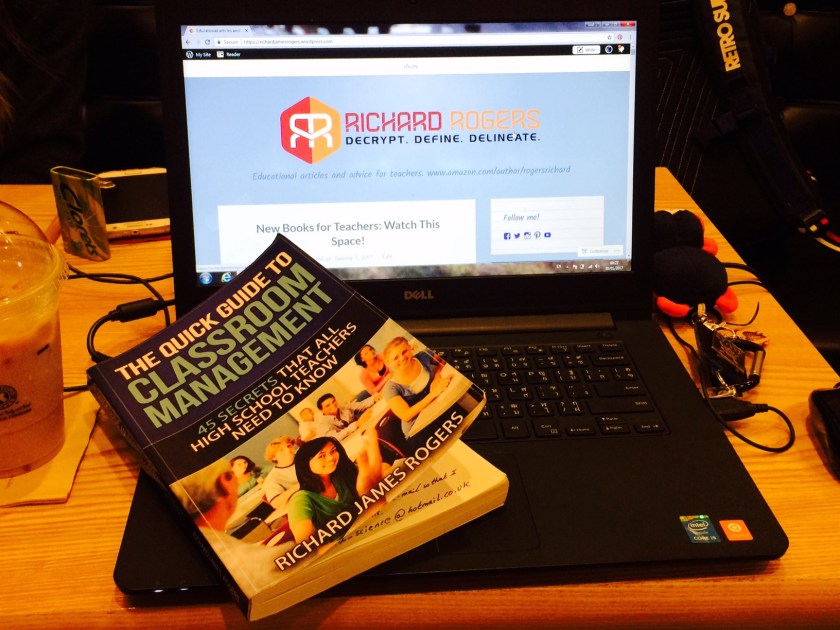
Did you enjoy this article? Why not check out Richard’s book?
We welcome you to join the Richard Rogers online community. Like ourFacebook page and follow us on Twitter for daily updates.