Secret Number One: Take a Genuine Interest in the Life of Your Students

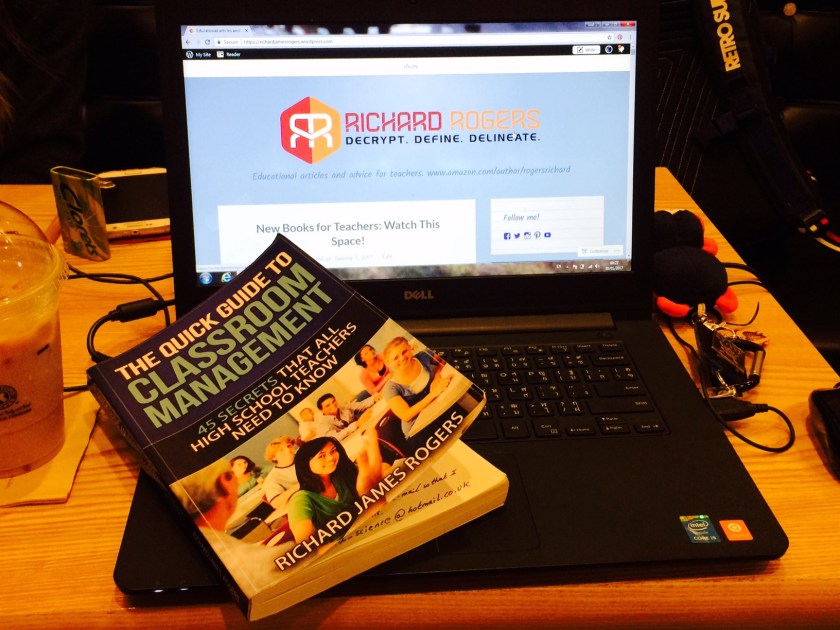
The follwing extract is taken from chapter 1 of my book: The Quick Guide to Classroom Management: 45 Secrets That All High School Teachers Need to Know (available at http://www.amazon.com/dp/B016ZG1IX0)

I wanted a front cover showing happy, stimulated students.

Secret number 1: Take a genuine interest in the life of your students

Youth is a time when so many things are happening: both positive and negative. Young  people at high school are involved in a range of human-relationship dynamics which involve family, school, friends and the people associated with their hobbies or interests. Humans are full of energy at this time, and the interconnections between the life of a student both inside and outside of the classroom create opportunities for us to channel this energy positively and:

  • Build trust
  • Use humour within lessons
  • Create a sense of importance and empowerment in our students
  • Offer guidance and support to students with difficulties
  • Create an environment of cooperation and compliance
  • Encourage our students to formulate their own learning goals
  • Personalise our lessons

Becky was an experienced and well-liked teacher of secondary science. She got on very well with her students, and parents would often mention that they appreciated her ‘special attention’ to their children. She was liked by her colleagues, and she enjoyed her work. One day, her physics student came to school with a broken arm in a plaster cast. Josh, a keen gymnast, mentioned that he had fallen very hard in a training session two days ago. Becky immediately knew that this was golden information for her lesson planning.

In Josh’s next physics lesson, Becky was teaching the class about forces and motion.  As Josh entered the class, she presented him with a starter activity revolving around the forces that act upon a gymnast when taking off and landing on a springboard. She also asked Josh how he was doing (and she was sincere in asking). He said he was healing well, and Ms Becky mentioned that “We can use your experience to help the class today, would that be okay?”. Josh said “sure”. After completing and peer assessing the starter worksheet, Ms Becky asked for Josh to tell the class what had happened to his arm. He gladly told his story, and Ms Becky asked for everyone to clap after he had finished. Using humour and good teaching practice, she said “So using Josh’s story to help you, what do you think one of today’s objectives could be”? One student mentioned a funny comment about how you should always land on your feet and not on your arm like Josh did, which Ms Becky responded to with a smile and a giggle. After this, and with some prompting from their teacher, some students spoke about the importance of gravity in determining the force upon impact, and the speed of free fall. At the end of a very interesting and varied lesson, Becky allowed her students the opportunity to sign Josh’s plaster cast, if they hadn’t done so already.

This example demonstrates the power that taking an interest in your students can have on the quality of a lesson. Let’s examine what Becky did that made this lesson (and her rapport, or relationship with her students, so special):

  • Becky used the hobby of her student to generate a lesson activity (the starter worksheet)
  • Becky shows a sincere care and concern for her student
  • Becky was genuinely interested in the life of her student outside of the classroom (as she was with all of her students)
  • Becky uses student experiences and ‘expertise’ to enhance the lesson content (she asks Josh to talk to the class about what had happened)
  • Becky is tasteful in her humour, and she makes sure that Josh is happy to share his story before she asks him to do so.
  • Becky rewarded the class for their good work by allowing them a few minutes at the end to sign Josh’s plaster cast. Not only did this subtly reveal her caring and ‘human’ nature, but it also bonded the class together as a whole.

#Edutechdebate: Tablets vs. Smart Phones in Education

Which is best? A smart phone or a tablet?
Which is best? A smart phone or a tablet? If you’re planning for a lesson and wondering whether or not to book your school’s iPad set, then this list might give you some food for thought.

Should you book your school’s iPad set for that excellent lesson you’ve planned, or should you just get the kids to use their smart phones? Some things to think about:

  • Tablets do provide a larger screen and greater accessibility to some programs and simulations, and this is a big advantage for students who like large text and who have issues with manual dexterity
  • Always test the software first: Unfortunately, many programs and simulations that work on a Windows™ PC do not function properly on tablets and smart phones that use other operating systems. It’s really embarrassing and frustrating to set a wonderful ICT-based learning task only to discover that it isn’t compatible with the kids’ devices.
  • If you’re planning on getting students to submit docs, PowerPoints or pdf files through Dropbox, or if you want students to download a file of this type, then tablets are typically better than smart phones. The larger screen means that more readable text can be displayed on the screen, and this also makes it much easier to edit files.
  • Cost is an important factor when considering ICT orders in schools. Tablets generally cost two to three times less than their smart phone counterparts, and often allow for greater functionality. The other advantage is that school tablets will have been set up consistently by an ICT administrator, and will often not have SIM cards that connect them to a cellular network. This means that kids are much less likely to be playing around on social media when using school tablets, since sites like Facebook™, Instagram™ and others are much more difficult to access without their corresponding apps. Schools can also put controls in place to prevent access to such platforms.
  • One downside of tablets is that they can be slow, especially if multiple students are using them to access the internet via the school’s Wi-Fi system all at the same time. Smartphones can offer a quicker alternative in these cases.
  • Students are much more likely to share school tablets with each other, rather than sharing their highly personalized smart phones with their peers. This has obvious ramifications for group work
  • One big advantage of tablets is that their battery life tends to be much longer than that of smart phones. Your school’s set should also be regularly charged by the ICT administrator.

Get the Students to Discover the Learning Outcomes

As a very keen and determined PGCE student at Bangor University’s outstanding School of Education, I was introduced very quickly to the importance of making my students fully aware of the learning outcomes (sometimes referred to as ‘aims’ or ‘objectives’), every single lesson. On a very fresh summer morning at the beautiful science labs at Bangor’s ‘Normal Site’, I and the rest of the science students were given a deck of playing cards. We were then asked to shuffle them and play poker, but keep any diamonds that were dealt to us, indefinitely. When this was finished, we repeated the game, but this time we kept any multiples of three. Once this was over, we were each given a set of coins and asked to toss each one in turn. If we got a head, we could keep the coin; whereas a tails meant that we had to dispose of that coin and place it into a big tub in the middle of the room. After about 30 minutes of doing this, we started to look at each other with rather puzzled and bemused faces. Some of my friends started to utter “What’s the point in this?” and “Why the hell are we doing this?” At this stage, our instructor stopped the activities and asked us all a very simple question: “How was that?”

A fun activity, but why were we doing it?

The replies came slowly at first, but as soon as a few people had mustered enough nerve to reply, more answers soon followed.”It was okay, but I wasn’t sure why we were playing those games”, “It was good at first, but I lost focus after a while” and “The whole lesson just seemed completely pointless”. After the exchange of a few giggles, we could all see that this was part of the instructor’s plan all along (he was always very shrewd in the way that he introduced us to key concepts). He then asked “What do you think the purpose of this lesson was?”. Again, the replies came in thick and fast “Something to do with data and numbers”, “Learning how to use games to entertain students” and, finally, one student hit the proverbial nail on the head – “To understand that if the students don’t know why they are doing something, then they’ll lose focus”. This final reply was correct, but incomplete. For this particular session, the instructor was trying to teach us two things. The first objective was to learn that it is easy to ‘cherry-pick’ data in scientific experiments (hence the collection of the ‘diamond cards’ and disposing of each coin that had yielded a tails). The second was the one that’s most important to me and you: that learning is only productive and effective if the students know what the mission/objective of each lesson is.

After learning this crucial lesson, I quickly put it into practice during my first year of teaching. I would always write the lesson objectives on the whiteboard (or project them on a screen), straight after I had given my starter activity. My lessons always started promptly, and my students always knew what my mission was. However, despite this, something was still missing. The problem was that almost every teacher in my school had been trained in a similar methodology, and were all doing the same thing. Each lesson to my students seemed like, in the words of one Year 9 boy, “different versions of a computer game with the same exact layout, just different colours and different bad guys to fight” (I thought that was quite a profound conclusion, actually. I gave that boy a house point for his linguistic creativity).

So what was missing? Why, despite following best practice, were some of my students still losing focus? Why was it that at the end of each lesson some students couldn’t even remember the objectives I’d shown them 45 minutes earlier? Well, the answer, as I discovered much later than I probably should have, was found in that unusual session back at Bangor University. The reason that I can remember that particular lesson so well is because it contained a sense of mystery, and because I and my peers had to figure out the lesson objectives for ourselves. But how did we figure out those objectives? Answer: The activities of the lesson aroused within us a sense of curiosity about its purpose.

We all remember things better if we’ve had to discover them by ourselves, as opposed to being ‘spoon-fed’ the information. More often than not, we are also more proud of those things that we’ve had to overcome, adapt to and solve by ourselves, than those things we’ve attained easily, and this principle feeds directly into this very effective methodology for beginning a lesson:

Begin each lesson by assigning work, analysing it and then getting the students to generate the learning outcomes for the lesson

By using this methodology you will not only capture your students attention as soon as the lesson starts, but you will also be encouraging them to use ‘higher order thinking skills’, especially if the students do the following:

  • Build models or construct some kind of concept illustration
  • Solve an open-ended problem (e.g. “You have five minutes to build a useful object out of the drinking straws on your desk”)
  • Include emotion in their work (e.g. “Imagine you are Neil Armstrong on the day he landed on the moon. Write a quick diary entry for him on that day. How did he feel?”)
  • Solve a logic problem (e.g. breaking a code, or answering a series of questions in sequence which lead the students to a final conclusion)
  • Use their physiology in an unusual way (e.g. “You have five minutes to build a tower out of the objects on your desks. One person in your group needs to balance the objects on their head. Who will create the tallest, most balanced tower?”)
  • Have a choice over whether to tackle the problem using a left or right-brain approach (e.g. “Sarah needs to buy food and drink for a birthday party. In front of you is a price list for every item at Partylicious candy store. Sarah only has 45 pounds to spend, so help her out! Maybe you could write some selected shopping lists for her, or draw a collection of items that she could buy.”)

Conclusion: Start your lessons promptly by assigning a good-quality starter activity, analyzing it thereafter and then asking the students to consider what the objectives of the lesson might be. I assure you, by starting your lesson in this way your students will benefit far more than if your lesson has an unfocussed start, directed solely by the teacher.

Behaviour Management: Speak Up and Look for Positive Deviants

Have you ever noticed that there are some teachers in your school who never seem to have behaviour management issues? They just seem to be able to teach their classes with no disruption whatsoever; or, at the very least, they deal with disruption or poor behaviour quickly, fairly and consistently. These people are positive deviants; they should have the same problems as you do, but they don’t. These are people you can learn from, and who you should consult with regularly.

Be open enough to admit when you have a problem, and seek help from your colleagues.

In many schools around the world teachers are made to feel inferior if they admit to having a problem. I have experienced this kind of culture first hand, and it can be very disempowering. You speak up and you say “I’m having problems with ‘student x’, he just never seems to listen”, and one of your colleagues pipes in with a “Really, well he’s fine for me”. The person who dishes out this quick and smarmy reply is either a positive deviant, who you can learn from, or they’re lying so that they can make themselves look good in public. If these kinds of conversation are commonplace in your school, then it can be difficult to have the courage to speak up when you have a problem. However, it is absolutely essential that you do speak up because you’ll probably find someone who can help you when the problem is in its infancy, allowing you to deal with it before it becomes really bad.

Key steps to take when seeking help from colleagues

  1. Speak up and admit when you have a problem: You can speak with a line manager or even another colleague you trust. If it’s a whole-class issue in which you’re having problems with disruption from multiple students, then try to find other teachers who teach that same class. Ask for their advice. The same rule applies if you’re having a problem with an individual student – find out who his or her other teachers are, and talk with them.
  2. Identify positive deviants: Find all of those teachers who have a positive relationship with the student, or group of students, you’re having problems with.
  3. Ask those positive deviants to observe your lessons: This can be hard to do, because most teachers absolutely hate lesson observations. However, you must see this as a massive opportunity to learn from the positive deviant who’s observing you. Besides, by just asking this person to observe your class you’ll be making them feel important, and they’ll probably like you all the more for it. Make sure you seek feedback from the observer, and be sure to record everything that he or she says about your lesson.
  4. Observe the positive deviants: Book a time when you can see the positive deviant ‘in action’. Try to observe them whilst they’re teaching the same students, and make lots of notes (or even ask for permission to video the lesson). Try to think of all of things that this person is doing to reinforce and promote positive behaviour, and then try to model this in your lessons. You may even ask the positive deviant to observe you again at this point, if you wish, just so that you can ‘fine tune’ the new techniques that you have learned.
  5. Be sure to sincerely thank the positive deviants when they have helped, and don’t forget to sing their praises to senior management and your colleagues too. For most people this seems silly – after all, why would you want to praise someone else’s teaching? I assure you: doing this will help you to build a strong professional relationship base that will really help if times get tough, or if you need help in the future. You’ll also be contributing to a whole-school ethos of mutual respect and openness, which can only serve to create a positive culture for everyone. You’ll also make a lot friends in the process!

This seems so obvious, doesn’t it? – Find your positive deviants and then model their behaviour. However; in most schools this never happens, and it’s mostly because our pride gets in the way. We don’t want to seem inferior to others by admitting we have a problem, and the rigour of school appraisal processes have turned lesson observations into an apprehensive, stressful part of a teacher’s life. This is incredibly regrettable and we must overcome this closed-mindedness and fear of being judged if we are to really learn from our colleagues and become the champion teachers we can be.

Lesson Observations: True Stress for a False Snapshot?

An article by Richard James Rogers (Author of The Quick Guide to Classroom Management)

Illustrated by Pop Sutthiya Lertyongphati 

It’s that time of the year again. Your line manager has asked you to choose a suitable class for her to observe, and a preferred time. You have about a week’s notice, in which you prepare every possible resource under the sun, ask for lesson suggestions from colleagues or online forums and basically get stressed like mad until it’s all over.

And the outcome of it all: In some cases, your observer evaluates you on the basis of an overly-prepared lesson in which you were probably very nervous and apprehensive. Those who do well under these conditions are praised as great teachers that we can all learn from, and those that don’t are asked to constructively reflect on ways in which they can improve.

There are pro’s and cons to this approach to ‘performance management’: much of which depend upon the school’s culture. On the pro’s side, if school managers are supportive, approachable and understanding, then teachers will readily accept the formal observation process as a necessary way to reflect upon their professionalism.

However, even under these circumstances, a teacher is only being evaluated on the basis of a snapshot of a lesson. Does this really help anyone? Doesn’t this seem like a lot of stress for a futile output?

As professionals working in a people-centred industry, shouldn’t we be approaching our personal growth in a much more adult and sophisticated way?

Surely a better approach would be as follows:

  1. At the start of the academic year, sit with your team and write down all of the things you’re good at as a teacher, and all of the things you think you could improve on
  2. Find out who in your team has a strength that you can capitalize on (e.g. Using tablets and mobile devices to support learning)
  3. Arrange peer observations with your team members, so that each person watches someone else who they feel they can learn from
  4. If you feel that you need help with a particular aspect of teaching (e.g. building rapport with students), then ask someone who has a particular strength in this area to come and observe one of your lessons, so that they can offer their advice for you to learn from
  5. Document all reflections, and use these as the basis for teacher appraisals

Isn’t this a more pleasant and, crucially, more productive way of using lesson observations as part of the performance management process?

One of my former colleagues once said “If you want to know who’s a good teacher, then ask the students”. I couldn’t agree more with this statement. Most people, when confronted with this, will say something like “Aha, well, kids are just gonna say that they love the teachers who don’t give them homework to do”. Hmmm, I don’t think so. My observations after twelve years of teaching in a wide variety of schools in both the UK and here in Thailand have told me that kids like the teachers who are rigorous and professional whilst also maintaining good classroom rapport.

With this in mind, consider doing some kind of student led self-appraisal every so often. Perhaps you can set up an anonymous Google form for your kids to fill in, which asks crucial questions about your performance as a teacher (e.g. How quickly you hand back homework).

When one works in a school where there is a collective culture of helping each other; where teachers help teachers, students help students and students and teachers help each other; then haven’t we achieved something special? Isn’t that the ideal environment for fostering good professional development and performance management?

I’ll end by providing some links, which will hopefully give some ‘food for thought’ on this topic for new and experienced teachers alike:

How to Ace Lesson Observations: 10 Tips for PGCE Students
Lesson Observations: We’re Coming to Get You!
Lesson Observations Can Ruin Teachers’ Careers


714symbol

richard-rogers-online

We welcome you to join the Richard Rogers online community. Like our Facebook page and follow us on Twitter for daily updates.

richardjamesrogers

ICT in the Classroom: Using Smart Phones and Tablets to Scan Codes

Don’t be camera shy!


Scanning QR codes can be a fun way for studevts to ‘discover’ new information
 

Smartphone cameras are absolutely amazing learning tools as they can often double up as scanners, analysers and editors when paired with the correct app or software programme. When used properly, they can get students out of the classroom and can act as conduits for engaging the whole brain.

That being said, one does have to be quite cautious when using smartphone cameras with students. There are many documented cases of pupils filming their friends or teachers covertly in school, and then instantly sharing the footage via social media or even video-sharing sites such as YouTube™. In schools and countries where there are heavy child-protection laws and policies, this can be quite serious and can land the supervising teacher in a lot of trouble. My approach to this problem has always been to lay down the ground rules with my students first (i.e. to only use their cameras for the task at hand), and then make sure I am vigilant in supervising the activity. If you do this, then smartphone camera activities will be an enjoyable part of your teaching, and will greatly enhance the students’ learning experiences.


Smartphone Savvy: Camera Based Learning Activities

Code scanning treasure hunts: This activity involves getting the students to scan codes (e.g. QR codes) using their smartphones and then following the clues to find information. It involves some planning and preparation by the teacher beforehand, but it is well worth it! The steps to follow are:

  • Step 1: Create a sequence of information sheets (e.g. 5 sheets of information about different aspects of cell division)
  • Step 2: Insert a QR code (or other) into each sheet. QR codes can be created for free at qrstuff.com. Your QR codes should encode a clue to tell the students where to go (e.g. ‘Go to the library’ or ‘This is where you eat fish and chips on a Friday’)
  • Step 3: Hide your clues in different places around the school (try to use rooms and places that will be unoccupied, if possible). Make sure your first information sheet (with embedded QR code clue) is in the classroom where you will start!
  • Step 4: Make sure that all of the students have the ‘QR Reader’ app (or similar) installed on their smartphones. This can be set as homework before the lesson starts, to save time.
  • Step 5: The students will scan the codes and follow the clues, picking up the information sheets as they race/walk around the school.
  • When the students have picked up all the information sheets (the last QR code ‘clue’ should be something like ‘Go back to class’), then the students will come back to their classroom and complete an activity with the sheets. You may wish for them to organize the information in some way (e.g. into a poster or flowchart, which can be used in a fun memory game like the ‘Poster Game’ – covered in chapter ). You could also get the students to communicate the information in an unusual way (e.g. by texting a friend or by posting to the school’s blog via their smartphone)

The image below goes through an actual example of a QR code treasure hunt that I used recently with my IBDP Year 13 Biology students.

Instructions for using QR codes treasure hunts in your teaching practice.