Behaviour Management Part 2: Model Your Colleagues

img_5938

If you are having problems dealing with whole-class disruption, or even engaging with some students on an individual basis, then one of the most sensible things you can do is seek help.

But what does ‘seek help’ actually mean? 

A casual chat with a colleague who works well with your problem students can be a great way to get some good tips. For example, when I was a young NQT, my colleague advised me to always focus on the work being done, not the negative behaviour patterns being expressed. I changed my reciprocations from “Steve, pay attention and stop talking”, to “Steve, how’s that work coming along? Nearly finished?”.

This worked wonders, and totally transformed my behaviour management skills.

However, sometimes a casual chat just isn’t enough, especially when you’re having problems with many students and many classes. 

I’ve developed a 5-step strategy that, if implemented in it’s entirety, is guaranteed to turn any situation of this type around for the better. 

The following extracts come from my debut book, The Quick Guide to Classroom Management’. I hope the advice is useful – I’ve seen this method work with hundreds of stressed out teachers over the years and I know it will work for you too!


new-doc-87_1

new-doc-87_2

new doc 87_3.jpg

By Richard James Rogers


Behaviour Management Part 1: Human Sense of Validation

Chapter 5 - drones and hacking 

An article by Richard James Rogers

Images by Pop Sutthiya Lertyongphati

The events in this article are based on actual occurrences. The names and, in some instances, the genders of individuals have been changed to protect the individuals’ privacy.

It happened a long time ago, but it seems like it was only last year. Time certainly deceives us: we think we’re stationary and planted firmly, but we whistle past the chimney tops as we rush along the railway line of our destiny.

In 2007 I had an experience that transformed me on a deep, emotional level. I’ll never forget what happened. 

His name was Jonathan: A student I had been gravely warned about. I’d just started a new Science Teacher job in the North of England, and the previous teacher had left some handover notes: “Avoid confrontation with this student at all costs. Do not set him off”.

Reading that as a shy 24 year-old was quite a shock, if I’m totally honest. My Head of Department even reinforced it verbally: “Richard, whatever happens, never argue with this student”.

new doc 32_3

Bear in mind I had yet to meet this kid yet!

Well, the dreaded time I had been warned about came: I was going to meet this young boy for the first time. 

Jonathan walked into the science lab slightly later than the rest of his peers, and I greeted him with a friendly “Welcome in young man, please take a seat”. This caused a giggle amongst the rest of the students, who were naturally expecting the same reaction that Jonathan’s other teachers would have given him – a good telling off! Jonathan sat down as instructed but, being a fiery young teen ready to push the boundaries and test what he could get away with, he pulled out a can of cola and started to drink it at his desk (something that is generally not allowed in a science lab).

new doc 20_2

I, knowing what I had been told about Jonathan, decided on a very positive and useful approach: I decided to ignore this misdemeanor at that moment and proceed on with the lesson.

As the lesson proceeded, I set a group work activity and walked around the classroom to see how the students were getting on. As I passed Jonathan, I noticed that he had a very neat and organized set of felt-tip colouring pens on his desk, arranged in a very nice standalone display case. I praised Jonathan  with a “You’re so organised, Jonathan. It’s good to see that you’re prepared for your lessons. I wish that every student was as prepared as you are.”

What do you think Jonathan’s reaction was? – He was absolutely stunned! This was a young kid who was accustomed to being reprimanded, put on detention and confronted on a daily basis. And here was a new teacher who could actually see his worth, aswell as what he could contribute. He lapped up the praise, and responded with an “Umm, err thanks. I always like to be ready for my lessons. I also love art”. This led to a short conversation about Jonathan’s love of drawing tattoo designs. I subtly drew his attention to the artistic graphics on the cola can, and reminded him he couldn’t drink it in the science lab. He smiled. Later that lesson, I assigned him the role of ‘Work Presentation Chief’ for the class. Each lesson, from then on in, I made sure that I praised Jonathan for his work, and allowed him to go around the class and assess the presentation skills of selected students. What was the effect on Jonathan? – He became my best student. He felt empowered, because, like all human beings, he craved a sense of importance and he craved appreciation.

IMG_6044

When Jonathan achieved his grade C in GCSE Science that year (a massive accomplishment considering his turbulent history) he said to me  “It was all because of you, sir”. Even at that moment, I wanted him to feel a sense of value and self-worth. I responded by saying “You did all the hard work, Jonathan”

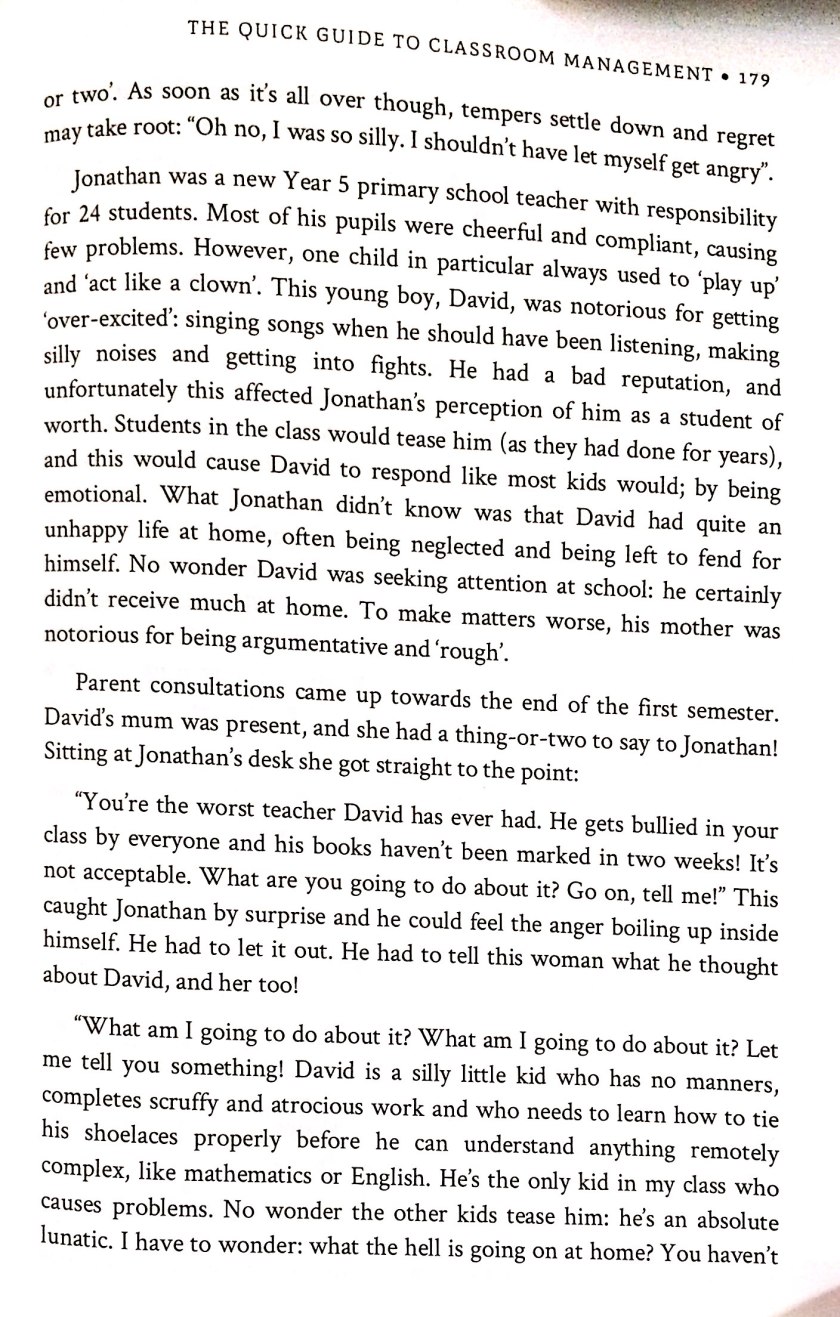
The following extracts come from my debut book: The Quick Guide to Classroom Management, and remind us that all kids seek validation from their actions, and that we, as teachers, can engineer the circumstances surrounding the child to generate positive sources of such validation. 


new doc 83_4.jpg

new doc 83_5.jpg

new doc 83_6.jpg


img_5938


Moandiering On! Moody Teachers List of Top Grumbles!

Chapter 7 - gossiping Chapter 7 - make too many friends at a time


An article by Richard James Rogers

Illustrations by Pop Sutthiya Lertyongohati

Are you a moody moaner? If you are, then join the club because schools all over the world; no matter what the ethos or demographic, all contain their fair-share of moaners.

But what do teachers moan about and is it justified? Let’s answer the first part of that question.


Top 3 grumbles of today’s teachers

In my book, 45 Secrets That All High School Teachers Need to Know, I outlined dynamic and practical  ways in which every educator can address problems associated with paperwork, parents, students and colleagues. In my research for that book, and my subsequent investigations since, I’ve determined the top 3 teacher grumbles to be:


  1. Paperwork: “There’s too much pen-pushing and not enough time to do real teaching”, “How the hell am I supposed to prepare my lessons properly when I have to do all of this ridiculous paperwork” and “All of this red-tape is just an exercise in jumping-through hoops” are expressions I’ve heard time and time again over the past 11 years of my career. It is true that the demands of school inspectors, parents, governing bodies and exam boards have placed an increased demand for accountability squarely on the shoulders of teachers over the past decade, and this accountability is usually expressed as more forms for both teachers and senior management to fill in, as well as more documentation to prepare. However, doesn’t this documentation revolve around things that help the students? Planning documents, for example, are great for letting you see the long-term goals of the course being taught, and keep you on track on a weekly basis. 

  2. Students: “He just doesn’t listen” or the infantile, pathetic “They just can’t…..” are phrases I have heard on an almost constant basis since I started teaching. The expectation to differentiate content to a variety of abilities, culture-backgrounds, motivations and maturities has also increased in the teaching profession over the past decade. This places more work in the hands of the teacher in the form of extra planning and preparation time needed to deliver effective content. This issue still, unfortunately, causes lots of resentment and frustration among educators. Let me tell you very bluntly – teacher’s who say “He/she/they can’t” are almost always wrong. I’ve had the fortunate experience of turning around kids who were simply ‘written off’ by other teachers, just by using the rapport-building strategies outlined in my book.

  3. Parents: I’ve heard them all in my time as a teacher. From the “She’s just mad” to “People like him shouldn’t be allowed to have kids”. Staffroom banter on this subject can be unnecessarily cruel and biased towards the teacher who has the issues with the parent, and many teachers often reciprocate in this fashion out of plain sympathy for their colleagues. This can lead to a dangerous climate of negativity around the issue, which is often disproportionate. In my book, I explain how you should see every parent as a valuable customer, who you can work with productively to make things work for your students. 


Why we should stop complaining – always and forever!


#1: Complaining about anything acts like a “crap magnet” in your life


I was recently very fortunate to receive a signed copy of T. Harv Eker’s Secrets of The Millionaire Mind (ISBN 978006133645-4). In that book, the author very eloquently and directly outlines the devastating effects that complaining has in our lives on daily basis. The following extract really woke me up, and I hope it will do the same for you! 


Complaining is the absolute worst possible thing you could do for your health or your wealth. The worst! Why?

I’m a big believer in the universal law that states “What you focus on expands.” When you are complaining, what are you focusing on, what’s right with your life or what’s wrong with it? You are obviously focusing on what’s wrong with it, and since what you focus on expands, you’ll keep getting more of what’s wrong.

Many teachers in the personal development field talk about the Law of Attraction. It states that “like attracts like,” meaning that when you are complaining, you are actually attracting “crap” into your life.

Wealth principle: When you are complaining, you become a living, breathing “crap magnet.”

Have you ever noticed that complainers usually have a tough life? It seems that everything that could go wrong does go wrong for them. They say “Of course I complain – look how crappy my life is.” And now you know better, you can explain to them, “No, it’s because you complain that your life is so crappy. Shut up…and don’t stand near me!”

Which brings us to another point. You have to make darn sure not to put yourself in the proximity of complainers. If you absolutely have to be nearby, make sure you bring a steel umbrella or the crap meant for them will get to you too!

#2 Complaining goes hand-in-hand with gossip. Gossip will kill your job and your career. 

Here are some extracts from my book which make it clear why gossip is destroying so many teacher’s careers, all over the world: 


slide1

slide2

slide3

Summary

Remove complaining and gossiping from your life, and watch the success and happiness flow in! 

img_5938


Teachers: Use Your Summer Vacation Wisely! 

new doc 27_2Chapter 7 - make too many friends at a timeChapter 7 - gossiping

An article by Richard James Rogers

Illustrations by Pop Sutthiya Lertyongphati

It’s finally here! You’ve waited all term, perhaps even counting down the days, and now it’s the summer vacation! If you’re teaching in a British or American school, or at an accredited International School overseas, then you’ve probably got a nice 6-8 week holiday to look forward to! Time to put your feet up!

Or is it?

Chapter 8 - going to bkk

Most teachers would agree that we need our vacations. We work so hard during term time and we only really realise the strain this has placed upon us mentally and physically when we do get the chance to have a holiday. It’s important to rest now, but; and many experienced teachers will hate me for this: it’s also time to start preparing for your next semester!

new doc 27_8

In my debut book: The Quick Guide to Classroom Management, I include numerous case studies of teachers who got their time-management all messed up, and paid for it massively! For my next book: Marking and Assessment Strategies, I invited twenty educators from all over the world to offer their advice on time-saving marking tips. One common theme that permeates their advice is the productive use of holidays and break-times, along with with great tips such as ‘live-marking’ and using peer-assessment strategies.

What do you plan do during your next school vacation?

vacation-149960_960_720.png

Take a look at this list. Could you find time for some (or all) of these? 

Top Tips for Time-Saving Teachers: Using your holidays

  1. If possible, find out which classes you will teach next semester. Even if you only know some of them, start planning ahead. Draw up a curriculum map of the topics you will teach and the order you will teach them in. This will save tremendous time at the start of the new semester. You’ll be ahead of the game when everyone else is rushing around trying to figure things out!
  2. Plan your marking! I talk about this extensively in my soon-to-be released book. Examine your syllabuses and long-term planning closely, and cross-reference it with your school’s academic calendar. Look for weeks when paperwork could get new doc 27_3heavy (e.g. around the time when reports need to be written, parent consultations take place and when exams and tests need to be taken). Think about the assignments and homework you will set, and plan ahead so that you spread out your marking evenly over the whole year. This will save you many a future headache!
  3. Read ahead! If you’ll be teaching unfamiliar topics then look them up, and make sure you can do the questions that you’ll set for kids. Subject knowledge acts as a great confidence base that improves and enhances your classroom performance. 
  4. Gather your resources together! The last thing you want to be doing is fumbling around finding PowerPoints, Prezi’s, worksheets, assignments and tasks whilst your on the job, teaching a full timetable! Get prepared now, and enjoy a happy work-life balance when you’re back in school!
  5. Go into school the week before you start an get your printing done! Now, I know that many readers might not like the idea of this. However, when you consider the mad rush for the photocopier that will ensue in your first week back, you can see new doc 27_6how it makes sense to get a head-start. 
  6. Get your life back on track! Have you been skipping your gym classes? Too tired to do your morning run? Get your routine back in order and set your body clock to rise early and retire at a reasonable time. Keep up your new routine, and plan ahead so that you can keep doing it when you’re back at school!


Can you add any more items to the list? Please fee free to comment in the box below. 

Have a happy (and productive) holiday!

IMG_5942

Check out Richard’s Pedagogical series of books here:

Marking_and_Assessment   IMG_4498


Active Engagement Part 3: Use your physiology in unusual ways! #pgce #teachstrong #ukedchat

new doc 32_3

An article by Richard James Rogers

Illustrations by Pop Sutthiya Lertyongphati

Hello and Happy Sunday! Wherever you are, and whatever you’re doing, we hope that today has been (or will be) happy and productive for you.

new doc 32_1new doc 32_2

In this final article in our three part Active Engagement series, we’ll be exploring:

  1. How outstanding teachers can often be rather eccentric by using action and movement to make their lessons fun, compelling and effective
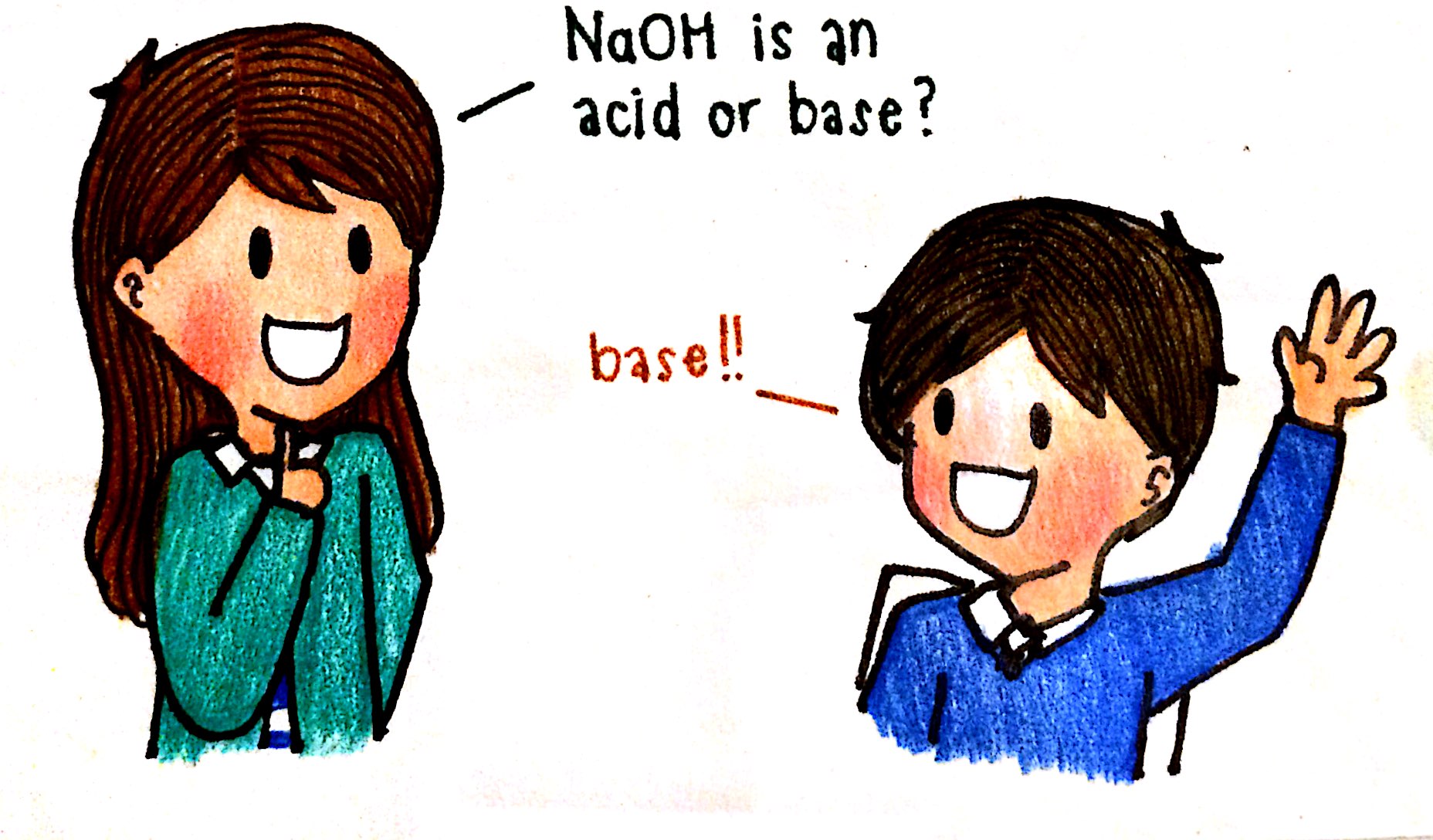
  2. Some simple actions you can take to turn mundane questions such as “Is sodium hydroxide an acid or a base?” into an opportunity for action, movement and full sense-perception

new doc 32_5This article is slightly shorter than the previous two and, as it is the final section for this series, you’ll find a very useful summary at the end. As always, please feel free to share this post with anyone you feel would benefit from it, and please do comment with your own ideas in the comments box at the bottom. 

The following extracts and pictures come from my debut book: The Quick Guide to Classroom Management. Enjoy!

new doc 32_4


Here we go!

new doc 31_1

new doc 31_2

Try these simple activities to bring movement and action into your lessons!

Human graph and true or false

Human numbers

Active Engagement Summary: Make sure you read Part 1 and 2 too!

new doc 31_3

new doc 31_4

Thank you! Please share, bookmark and come back soon!

IMG_5942


Active Engagement Part 2: Learning Outcomes and Games. #ukedchat #teachforamerica #ittchat #nqtchat #pgce

new doc 27_8new doc 27_6new doc 27_5

An article by Richard James Rogers

Illustrations by Pop Sutthiya Lertyongphati

In this second of our three-week, three-part series, we’ll be continuing our investigation into how outstanding teachers keep their students on-task, entertained and engaged every single lesson.

new doc 27_4

This week, we’ll be focussing on a further two key areas of Active Engagement:

  • How outstanding teachers consistently create an ‘air of mystery and anticipation’ by getting the students to figure out the learning outcomes by themselves
  • How an atmosphere of immense excitement, enjoyment, participation and learning can be created by using a few simple games and applying them to your subject area, on a frequent basis

new doc 27_3new doc 27_2

The following extracts and images come from the Active Engagement chapter of my debut book: The Quick Guide to Classroom Management. I hope the information is useful to you, and don’t forget: we welcome your comments with open-arms!  If you’d like to share your thoughts with us then please do comment using the comments box at the bottom of the page. 

This week’s blog post is quite a large one, but we urge you to please read until the end as the information contained here is incredibly practical and helpful. Please feel free to bookmark this page and visit it often!

new doc 20_5

Here we go!

new doc 28_1

new doc 28_2

new doc 28_3

new doc 28_4

new doc 28_5

new doc 28_6

new doc 28_7

new doc 28_8


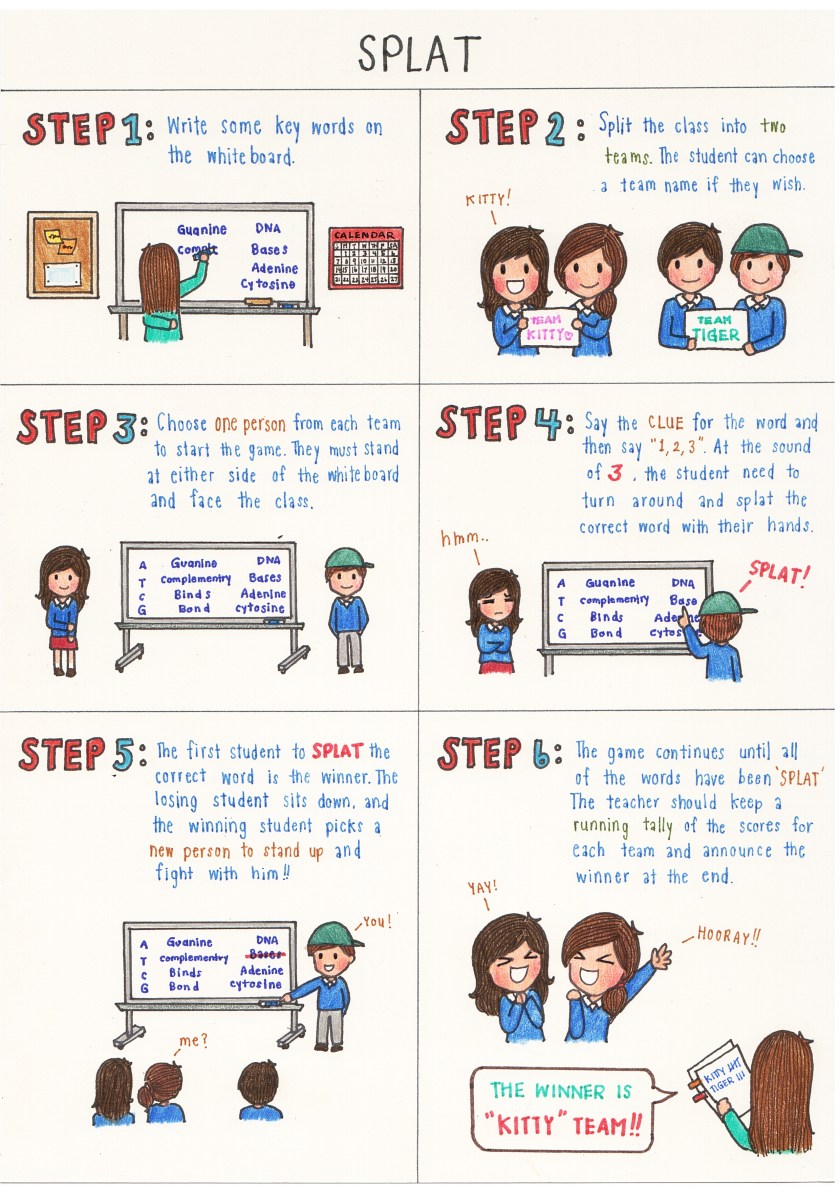
Here are some cool games you can use for any lesson!

Splat: Write a few key words on the whiteboard and you’re ready to go!

Splat

Mystery Picture: This one really gets the cognitive juices flowing and it’s a lot of fun!

Mystery pictures

Mystery Word: Simple and inexpensive. Another vocabulary-based game

Mystery word

Corners: I play this every Friday afternoon with my Year 9 Science class. It perks them up and is very competitive! Great for issuing out House Points, merit stickers or other rewards.

Corners

Bingo: Not just a numbers game! Read the game card below to see how it can be applied across different subject areas!

Bingo

Who am I? : Despite it’s childish nature, kids of all ages love this!

Who am I

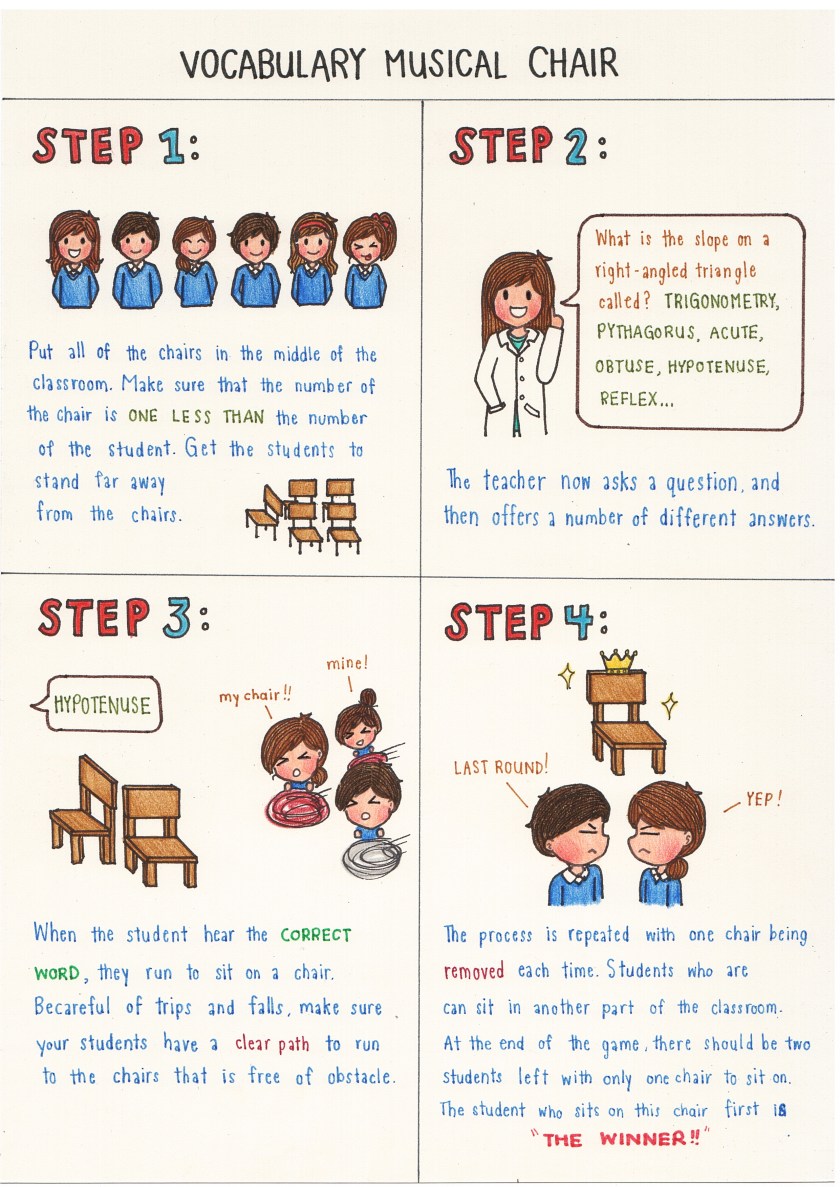
Vocabulary Musical Chairs: Get ready for an exciting class with this one! Make sure there are no obstacles in the way for kids to trip on.

Vocabulary musical chair

The Poster Game: One of my proudest pedagogical inventions. This game takes some time to set up, but once it’s ready it works like a treat! This game gives you the best of both worlds: fun and deep learning!

Poster game page 1

poster game page 2

Poster game page 3

Thank you for reading! Please share and please come back to visit us!

714symbol01

Active Engagement Part 1: Start Lessons Promptly. #pgce #teachforamerica #blendchat #teachstrong

new doc 20_6new doc 20_3 new doc 20_1

An article by Richard James Rogers

Illustrations by Pop Sutthiya Lertyongphati

In this first of a three-week, three-part series, we’ll be investigating how outstanding teachers keep their students on-task, entertained and engaged every single lesson.

new doc 20_4

This week, we’ll be focusing on two key areas of active engagement:

  • The personality traits and pedagogical attributes that are shared by all outstanding educators 
  • The importance that a prompt lesson start has on engaging your learners, along with the best ways to implement this, practically.

For many of us, the end of the academic year is approaching, and many students will be in ‘let’s slack off’ mode right now. As teachers, we need to be more vigilant than any other time in the year right now, particularly with regards to lesson planning and keeping our students on task.

new doc 20_2

The following extracts come from the Active Engagement chapter of my debut book: The Quick Guide to Classroom Management. I hope the information is useful to you, and don’t forget: we welcome your comments with open-arms!  If you’d like to share your thoughts with us then please do comment using the comments box at the bottom of the page. 

new doc 20_5

Are you keeping your students engaged all year-round?


Author note: You may wish to supplement your knowledge of starter activities by reading our beautifully illustrated (and most popular blog post ever!): 7 Starter Activities for PGCE Students and Newly Qualified Teachers.

new doc 22_2

new doc 21_2

new doc 22_1

new doc 21_4

new doc 21_5

new doc 21_6

new doc 21_7

IMG_5942


Teacher Problem: Dealing With ‘Difficult’ Parents. #pgce #nqt #ittchat #teacherproblems

Chapter 7 - gossiping Chapter 7 - make too many friends at a time Chapter 5 - drones and hacking

An article by Richard James Rogers

Illustrations by Pop Sutthiya Lertyongphati

It’s parent’s evening and you know that the mother of your ‘problem child’ will be showing up, and she’s not best pleased! Or maybe you’ve been receiving e-mails from a parent who just won’t quit at nitpicking over the ‘little things’. Maybe you’ve had some personal complaints sent to you from a father who’s a bit ‘aggressive’, or maybe ‘complaints’ have been coming in to the school office and you’re finding out about them from your line manager.

First things first: If any of the above scenarios describe your current situation (or a situation you fear you might find yourself in), then please do not fret: help is at hand.

Chapter 6 - maxwell and jones
Working with parents should be a productive and enjoyable part of your job.

Any experienced teacher will tell you that we all face ‘challenging’ parents (although that word: ‘challenging’, conveys the wrong attitude, as I’ll explain shortly). What fewer teachers will tell you, however, is that the key to fostering good relationships with parents is this golden rule:

Parents are your key customers. Without parents; all parents, you wouldn’t have a job. Make sure that you treat every parent like a valuable customer. Every parent deserves the very best level of service from their child’s teachers. This applies especially to parents who have complaints or who grumble on a regular basis.

Once you have this attitude firmly placed in mind, the rest of what I’m about to share will be easy to apply. I wonder how many teachers reading this will be resistant to adopt this mindset!

The following extracts come from my debut book, The Quick Guide to Classroom Management. In these pages, I write about the technique of ‘detached objectivity’, and how it’s a great problem-solver when dealing with parents who have complaints. I would welcome any comments you have from your own personal experiences (please write in the comments section below), and please feel free to share this blog post with anyone you feel would benefit from it. 

Disclaimer

Disclaimer

Here we go!

Quick Guide to Classroom Managment Rogers PE1

Quick Guide to Classroom Managment Rogers PE2

Quick Guide to Classroom Managment Rogers PE3

new doc 16_3

new doc 16_4

new doc 16_5

new doc 16_6


new doc 16_7

new doc 16_8

new doc 16_9

new doc 16_10new doc 16_11

new doc 16_12

IMG_5942


Your Chance to Appear in a Great Book

IMG_6045IMG_6044Chapter 7 - sending emails

Would you like the opportunity to appear in my next book?

After the unprecedented success of The Quick Guide to Classroom Management, I’m asking teachers all over the world to write a few paragraphs that would help out a total teaching newbie.

You’ll be helping new teachers, you’ll receive full acknowledgement in my book and I’ll even give away five free books to five lucky contributors!

This is something super cool that you would be able to show to your colleagues and future employers too!

I want to know what advice you would give to a new teacher who’s getting stressed out because they’re marking too much work. What advice would you give to help them reduce their workload, improve their marking efficiency and reduce stress when marking? Do you have a story from your own experience that you would like to share?

Final deadline for submissions is June 20th, thank you! Book will be published on June 30th.

Please e-mail your advice to richard_science@hotmail.co.uk, along with your name and any other info you’d like to share about yourself (especially the country you’re writing from). Alternatively, you can comment on this blog post too (please write at least two paragraphs).

I look forward to receiving your replies!

Click on the picture below to find out about this great new book

Marking_and_Assessment