The Perfect Teacher Morning

An article by Richard James Rogers, author of The Quick Guide to Classroom Management

Wakey, wakey! It’s a bright new morning! Are you feeling ready to seize the day? If you’re like most people (and like me in a former life), then the word ‘zombified’ is probably the best adjective to describe your condition.

Fear not! Help is here. Follow these tips to start your day refreshed and full of life!

#1 Wake up early

Okay. Thanks. Tell me something I don’t know, right? Well, give me few minutes to explain first.

It’s amazing how many people find it hard to get up at a sensible time each morning. One survey even found that more than a third of American adults hit the snooze button at least three times each morning, and more than 50% of people of ages 25 to 34 press the snooze button daily. Do we want to rush around like crazy and gulp down our breakfast in a manic frenzy before we dart to work? Of course not. We know that some extra time in the morning would really help us get things sorted at our pace. Try the following:

  • Take baby steps. Most people try to do too much at once, and fail. Take it easy. Aim to wake up five minutes earlier for one week. Then move to ten minutes the next week. Then try fifteen.
  • It’s useful to have a reward in place for waking up early. This will motivate you. Maybe you can have the coffee pot ready and hot, or get everything set up in the kitchen the night before so that making a cup of tea is quick and easy.

forest-54555_1920

#2 Do some form of simple exercise

You might be so tired first thing in the morning that the thought of doing some exercise seems worse than boot camp with the S.A.S.

Don’t fret.

If you really don’t feel like dong any exercise, then have a quick, warm rinse in the shower or splash some warm water on your face. You’ll be amazed at the wakening effect this has on you. After this, you can do some simple morning exercises (and you only need to do a few minutes if you’re a total beginner). Try easy things such a push ups, jogging, stretching, simple yoga or even martial arts routines (there are tons of videos that demo these for you – you don’t even need to be trained by a instructor).

abdominal-1203880_1280

But why? What are the benefits of some morning cardio? Check this out:

  • You’ll be more focussed when you reach school
  • Endorphins (pleasure inducing hormones) are released into the bloodstream in response to exercise. You’ll feel great!
  • If you can make this a regular thing, then you’ll be keeping your heart healthy, reducing stress and keeping your body strong and fit for daily life
  • Exercising in the morning makes sense from a time perspective – this is much better than hitting the gym at the end of a long day at work, when you’re weary and you’ve just tried to race through rush-hour traffic

#3 – Hydrate yourself as soon you wake up

water-747618_1920

You’ve been asleep all night, and your body has not had a drink. As soon as you wake up, drink a big glass of water (and squirt some lemon or lime juice in there too, if you can). The benefits of this practice are very well documented:

  • Your metabolism gets boosted. Drinking a large, cool glass of water after you wake up has been shown to fire up your metabolism by an amazing 24% for 90 minutes.
  • Your body gets rehydrated. You just slept for 7-8 hours (or, at least, you should have done) without drinking any water! Even if your body isn’t screaming at you that it’s thirsty, it probably is.
  • Water helps your body to detox. Getting fluids into your body as soon as you wake up will help your body flush out toxins that have accumulated overnight.
  • Your brain becomes activated. When you’re not properly hydrated you can feel drained or experience fatigue or mood variations. Dry brains don’t work well, period.

#4 – Read and reflect on your lesson plans for the day ahead

I learnt the importance of this much later than I should have. It goes without saying – all of your lessons should be planned before you start the teaching day.

student-849825_1920

Use your morning to either create or, even better, read over the lesson plans you’ve already created for that day. This will prime your mind for what you will expect that day, and you’ll be able to perform better in the classroom because of it. You may also think of some very useful last minute adjustments too!

#5 Develop a morning ritual

As soon as you’ve got the basics in place (waking up early, drinking a glass of water as soon as you get out of bed, doing some form of exercise and going through your planning), you’ll be ready to develop a more advanced morning ritual that meets a variety of your personal needs.

Many of the world’s most famous celebrities, sports people and business titans have developed morning rituals that empower them for the day ahead. You can find some examples of these here.

For tips on how to create your own morning ritual this website is amazing.

—————————————————————–

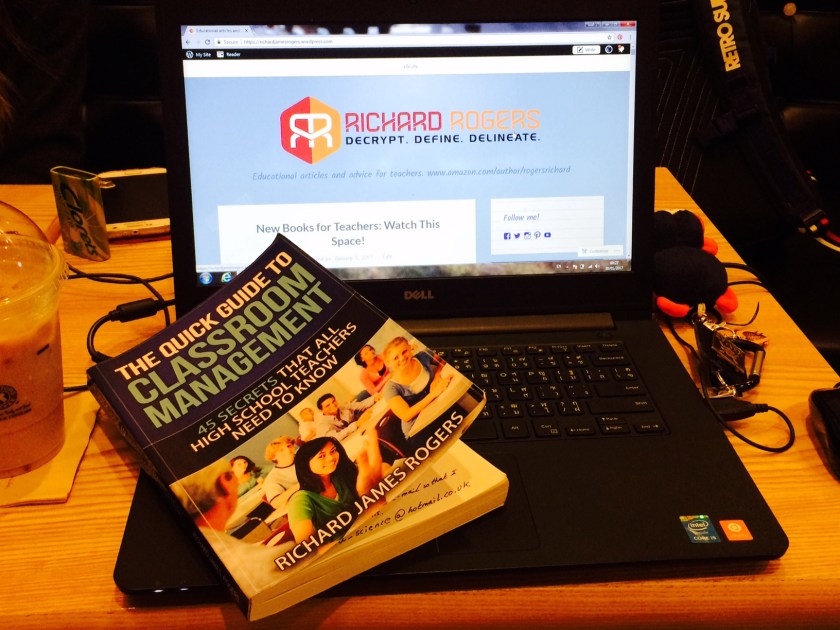
Did you enjoy this article? Why not check out Richard’s book? 

IMG_4498

img_5938

richard-rogers-online

We welcome you to join the Richard Rogers online community. Like our Facebook page and follow us on Twitter for daily updates.

Latest hybrid


#Edutechdebate: Tablets vs. Smart Phones in Education

Which is best? A smart phone or a tablet?
Which is best? A smart phone or a tablet? If you’re planning for a lesson and wondering whether or not to book your school’s iPad set, then this list might give you some food for thought.

Should you book your school’s iPad set for that excellent lesson you’ve planned, or should you just get the kids to use their smart phones? Some things to think about:

  • Tablets do provide a larger screen and greater accessibility to some programs and simulations, and this is a big advantage for students who like large text and who have issues with manual dexterity
  • Always test the software first: Unfortunately, many programs and simulations that work on a Windows™ PC do not function properly on tablets and smart phones that use other operating systems. It’s really embarrassing and frustrating to set a wonderful ICT-based learning task only to discover that it isn’t compatible with the kids’ devices.
  • If you’re planning on getting students to submit docs, PowerPoints or pdf files through Dropbox, or if you want students to download a file of this type, then tablets are typically better than smart phones. The larger screen means that more readable text can be displayed on the screen, and this also makes it much easier to edit files.
  • Cost is an important factor when considering ICT orders in schools. Tablets generally cost two to three times less than their smart phone counterparts, and often allow for greater functionality. The other advantage is that school tablets will have been set up consistently by an ICT administrator, and will often not have SIM cards that connect them to a cellular network. This means that kids are much less likely to be playing around on social media when using school tablets, since sites like Facebook™, Instagram™ and others are much more difficult to access without their corresponding apps. Schools can also put controls in place to prevent access to such platforms.
  • One downside of tablets is that they can be slow, especially if multiple students are using them to access the internet via the school’s Wi-Fi system all at the same time. Smartphones can offer a quicker alternative in these cases.
  • Students are much more likely to share school tablets with each other, rather than sharing their highly personalized smart phones with their peers. This has obvious ramifications for group work
  • One big advantage of tablets is that their battery life tends to be much longer than that of smart phones. Your school’s set should also be regularly charged by the ICT administrator.

Get the Students to Discover the Learning Outcomes

As a very keen and determined PGCE student at Bangor University’s outstanding School of Education, I was introduced very quickly to the importance of making my students fully aware of the learning outcomes (sometimes referred to as ‘aims’ or ‘objectives’), every single lesson. On a very fresh summer morning at the beautiful science labs at Bangor’s ‘Normal Site’, I and the rest of the science students were given a deck of playing cards. We were then asked to shuffle them and play poker, but keep any diamonds that were dealt to us, indefinitely. When this was finished, we repeated the game, but this time we kept any multiples of three. Once this was over, we were each given a set of coins and asked to toss each one in turn. If we got a head, we could keep the coin; whereas a tails meant that we had to dispose of that coin and place it into a big tub in the middle of the room. After about 30 minutes of doing this, we started to look at each other with rather puzzled and bemused faces. Some of my friends started to utter “What’s the point in this?” and “Why the hell are we doing this?” At this stage, our instructor stopped the activities and asked us all a very simple question: “How was that?”

A fun activity, but why were we doing it?

The replies came slowly at first, but as soon as a few people had mustered enough nerve to reply, more answers soon followed.”It was okay, but I wasn’t sure why we were playing those games”, “It was good at first, but I lost focus after a while” and “The whole lesson just seemed completely pointless”. After the exchange of a few giggles, we could all see that this was part of the instructor’s plan all along (he was always very shrewd in the way that he introduced us to key concepts). He then asked “What do you think the purpose of this lesson was?”. Again, the replies came in thick and fast “Something to do with data and numbers”, “Learning how to use games to entertain students” and, finally, one student hit the proverbial nail on the head – “To understand that if the students don’t know why they are doing something, then they’ll lose focus”. This final reply was correct, but incomplete. For this particular session, the instructor was trying to teach us two things. The first objective was to learn that it is easy to ‘cherry-pick’ data in scientific experiments (hence the collection of the ‘diamond cards’ and disposing of each coin that had yielded a tails). The second was the one that’s most important to me and you: that learning is only productive and effective if the students know what the mission/objective of each lesson is.

After learning this crucial lesson, I quickly put it into practice during my first year of teaching. I would always write the lesson objectives on the whiteboard (or project them on a screen), straight after I had given my starter activity. My lessons always started promptly, and my students always knew what my mission was. However, despite this, something was still missing. The problem was that almost every teacher in my school had been trained in a similar methodology, and were all doing the same thing. Each lesson to my students seemed like, in the words of one Year 9 boy, “different versions of a computer game with the same exact layout, just different colours and different bad guys to fight” (I thought that was quite a profound conclusion, actually. I gave that boy a house point for his linguistic creativity).

So what was missing? Why, despite following best practice, were some of my students still losing focus? Why was it that at the end of each lesson some students couldn’t even remember the objectives I’d shown them 45 minutes earlier? Well, the answer, as I discovered much later than I probably should have, was found in that unusual session back at Bangor University. The reason that I can remember that particular lesson so well is because it contained a sense of mystery, and because I and my peers had to figure out the lesson objectives for ourselves. But how did we figure out those objectives? Answer: The activities of the lesson aroused within us a sense of curiosity about its purpose.

We all remember things better if we’ve had to discover them by ourselves, as opposed to being ‘spoon-fed’ the information. More often than not, we are also more proud of those things that we’ve had to overcome, adapt to and solve by ourselves, than those things we’ve attained easily, and this principle feeds directly into this very effective methodology for beginning a lesson:

Begin each lesson by assigning work, analysing it and then getting the students to generate the learning outcomes for the lesson

By using this methodology you will not only capture your students attention as soon as the lesson starts, but you will also be encouraging them to use ‘higher order thinking skills’, especially if the students do the following:

  • Build models or construct some kind of concept illustration
  • Solve an open-ended problem (e.g. “You have five minutes to build a useful object out of the drinking straws on your desk”)
  • Include emotion in their work (e.g. “Imagine you are Neil Armstrong on the day he landed on the moon. Write a quick diary entry for him on that day. How did he feel?”)
  • Solve a logic problem (e.g. breaking a code, or answering a series of questions in sequence which lead the students to a final conclusion)
  • Use their physiology in an unusual way (e.g. “You have five minutes to build a tower out of the objects on your desks. One person in your group needs to balance the objects on their head. Who will create the tallest, most balanced tower?”)
  • Have a choice over whether to tackle the problem using a left or right-brain approach (e.g. “Sarah needs to buy food and drink for a birthday party. In front of you is a price list for every item at Partylicious candy store. Sarah only has 45 pounds to spend, so help her out! Maybe you could write some selected shopping lists for her, or draw a collection of items that she could buy.”)

Conclusion: Start your lessons promptly by assigning a good-quality starter activity, analyzing it thereafter and then asking the students to consider what the objectives of the lesson might be. I assure you, by starting your lesson in this way your students will benefit far more than if your lesson has an unfocussed start, directed solely by the teacher.

Think Before You Click ‘Send’: How E-mails are Secretly Destroying Teaching Careers

All character names contained in this article are fictional

Wayward e-mails are secretly destroying careers
Sending and receiving e-mails has now become an obligatory duty for teachers, especially in big institutions. A form tutor asks you for feedback about a particular student, so you e-mail your reply. The deputy head asks for any items for tomorrow’s meeting agenda, and those people that have issues they wish to raise type their responses and click ‘Send’. You have a problem opening a file on a school computer, so you send a quick message to the ICT technician. You e-mail parents. The list goes on and on.

As teachers, we are spending more time sat down in front of computers than ever before. E-mails allow us to communicate important items quickly and efficiently, and this ‘convenience’ is being improved upon year after year as smart phones and smart watches increasingly utilize novel systems to make dealing with e-mails an easy and fun task. All of this has made e-mailing become a ‘mechanical’ part of one’s working day, where little thought is needed to deliver a quick message.  What most people don’t consider, however, is that e-mails are secretly destroying the careers of teachers, along with everything else they’ve worked for.

Charlene was annoyed. She had been slaving away for the past two terms getting her ‘A’ – Level Chemistry students ready for their final exams. She had lead after school revision clubs, printed reams of past-exam papers and resources, spent hours after school planning and setting up practical activities and had spent many a late night updating her school’s VLE with a myriad of resources for these senior, pre-university students. She felt that she had gone above and beyond the call of duty, and when term three came along and her students were on study leave, she planned to use her gained time to prepare resources for the next academic year.

Knowing that Charlene now had a considerable amount of free time, her head of department, Francis, thought it would be a good idea for her to help the other science teachers alleviate some their workload. She asked Charlene to take on one of her colleague’s Key Stage 3 classes for that term, and she asked her to help assess some of the end-of-year tests for the students in classes that she didn’t teach.

Charlene was furious! She felt completely unappreciated and exploited. She had worked her socks off all year, doing things that her other science colleagues didn’t have to do, and now she was being asked to do more. She needed to get all of her frustration off her chest, so she decided to e-mail her good friend: Tracey; who happened to be her NQT tutor in her previous school. She laid it all out, saying how her boss was a complete idiot (using some rather colourful language) and how her efforts all year had gone completely unnoticed. She felt really ‘hard done to’, and typing it all out made her feel much better. However, she made one mistake that proved to be the Armageddon for her career in that school – she sent the e-mail to Francis by accident, and not to her NQT tutor.

smartphone-569076_1280
Using an e-mail system to complain behind someone’s back can be a fatal, career-killing mistake
This kind of situation happens all the time – teachers sending e-mails to the person they’re talking about, and not to the intended recipient. For Charlene it was coffin nails for her job at that school. Francis scheduled a meeting with Charlene, and her conclusions were made very clear. She felt that Charlene could have dealt with her frustration in a much more professional way; for example, by simply talking it over with her. If Francis had known Charlene’s plans to get some good resources in place for the next academic year, then she would have passed on less work for her to do in her ‘gained time’. Additionally, the tone of Charlene’s e-mail was so negative and ‘immature’, that her character as a professional was now being called into question. Could she be trusted as a sensible member of the staff body? What if she had sent an e-mail like that to a parent instead? After Charlene was passed up for promotion the following academic year (because of feedback from her head of department to the school principal), she left by her own accord. To add insult to injury, Charlene’s new school needed a reference letter from her current head of department. Thankfully, Francis felt kind enough to emphasise Charlene’s good points, as opposed to writing the king of all character assassinations that she could quite easily, and understandably, have produced.

This story teaches us that e-mails should be handled with care. Always take time to craft e-mails properly, and always assume that every person in your school will see it. Never assume e-mail privacy, and always choose your recipients carefully. With the ability to send e-mails through voice-command and touch-screens on smart phones, it is now even easier to make these fatal mistakes than it has ever been before. Be vigilant!

Using e-mail as a professional messaging tool

  • E-mails are not private: That’s right – you’re school principal could be looking through your inbox as you read this! E-mails provide managers with a unique window into an employee’s life that they would never normally have in their day-to-day interactions. It is such a good ‘teacher monitoring tool’ that most schools will now have professional e-mail systems set up for them which allow ‘snooping’ by senior management. This is perfectly legal, and you’ve probably signed your consent for it in your employee contract. Many schools are now making all new teachers sign an ‘Acceptable use of ICT’ agreement, where it will explicitly say that your e-mails should not treated as though they are private. However, despite this, many teachers still do not follow professional e-mail etiquette.
  • beautiful-15679_1280
    Smart phones and tablets have made it easier for us to make silly mistakes, such as sending an e-mail to the wrong recipient
    Never complain in an e-mail: There are lots of obvious reasons for this, and many centre around the ‘management snooping’ issue. Additionally, however, many employees fall into the trap of sending an e-mail to the person they’re complaining about, rather than the person it was intended for. This can have apocalyptic consequences for you, especially if the e-mail is sent to a manager. Avoid this by making all e-mails professional, imagining that they’ll be blown up to A1 size and posted on the headmaster’s wall (because as far as you’re concerned, they might as well be).
  • E-mails can be copied, forwarded and saved forever: Whenever you send an e-mail, you are creating a permanent piece of evidence which may be used against you (or to support you) in the future. E-mailing your best friend to tell them how much time you’ve wasted drinking coffee today, or how you can’t wait for the semester break
    beautiful-15742_1280
    An e-mail is a digital document that can be copied, forwarded and saved in a retrieval system indefinately
    to come around because you’ve ‘had enough’, are not good ways to fill your HR file. I feel it’s important to repeat that you should treat all e-mails as if they were posters in the principal’s office.
  • Extinguish all flames: A ‘flame’ is a hostile or insulting message that is sent from one internet user to another. They often contain profanities, expletives or complaints, and in the teaching profession they are most commonly sent and received through e-mail. If you receive a flame from anyone then you must do two things right away:
  1. Respond to the person who sent you the flame, making it clear to them that they should never send you a hostile message via e-mail again. Make it clear that e-mails are not a private messaging tool, and that you do not respond to expletives or profanities. You should also do this for any unprofessional or inappropriate e-mail, such as one from a colleague talking about how much he has slacked off that day.
  1. Delete the original flame e-mail. If your inbox is being monitored, and a member of senior management sees the flame, they may think that you are in agreement with the person who sent it.


Teachers are held in high regard by students, parents and the wider community as a whole. We can never be ‘off-duty’, and we must strive for perfection and professionalism in all of our undertakings.