World Book Day 2025: Every Teacher is an English Teacher

UPDATED: 1st March 2025

An article by Richard James Rogers (Award-Winning Author of The Quick Guide to Classroom Management and The Power of Praise: Empowering Students Through Positive Feedback). This blog post is illustrated by Pop Sutthiya Lertyongphati.

Related article –  Vocabulary Values: Helping Students to Learn Key Words

He waddled his way through the corridor like a happy duckling. Amid the giggles and cries of small children he looked liked a giant orange with tentacles as he waded through the masses on his way to the library. Mr Jones was dressed as ‘Mr Tickle’ from the ‘Mr Men’ series of books. 

The outfit must have taken an astronomical amount of time to create. With orange fur and controllable arms it was clear who was going to win the ‘Best Dressed Teacher’ competition. 

I, on the other hand, tend to be a little too lazy with my outfit on World Book Day. This year was no exception. Can you guess who I am?:

James Bond World Book Day

If you said ‘James Bond’ then well done: you’re right! It’s a quick (and a little too lazy) conversion for me: change my tie to a bow, add a dinner shirt and a white pocket square and I’m ready to serve on Her Majesty’s Secret Service!

“Who have you come as?” one of my friends says to me as I walk into the staff room on Friday (we held our World Book Day a day later because Thursday coincided with a religious holiday here in Thailand — something that happens most years) “I’m James Bond — a classic literary icon who’s been thrilling readers and moviegoers alike for over 70 years” I say (rather upset that I wasn’t instantly recognizable). “Is that even a book” he says. “It’s a whole series of books, written by Ian Fleming”

“Wow. I had no idea”

Costume Capers

World Book Day is great for getting people to ask good questions. Often, the characters we dress up as are in fact movie stars which we never knew existed in books. This can really get kids inspired to read more as they gradually realize that good books are often the basis for their favorite movies or TV shows. Good examples include:

  • Harry Potter – The all-time legendary series of fantasy books written by J.K. Rowling. These books have formed the basis for 8 beloved movies, with new adaptations and spin-offs continuing to keep the magic alive.
  • The Hunger Games – These action packed dystopian novels featuring stoic and passionate heroine: Katniss Everdeen, have been transformed into five excellent films. 
  • Twilight – Popular with teenagers and young adults: these fantasy/romance novels were brilliantly conceived and written by legendary author Stephenie Meyer

What message does all of this send to kids when they are fully aware of the facts? That’s simple: Books are cool! Books are inspirational. Books change lives. Read books!

It’s a shame that World Book Day is only once per year. In reality, every day should be a World Book Day as we should encourage our kids to read books and enjoy learning English on a daily basis. 

As a teacher at an International School in Bangkok, I have the unique privilege and pleasure of working with classes where, in many cases, more than 90% of the students are working with English as an additional/second language. One of my unique missions every day is to help my students to see why English is a beautiful language. To help them notice patterns and sounds. To ensure that they use the correct language in their answers to exam-style questions.

Examination language

Try putting up a ‘command-terms’ display in your classroom (like the one below):

Command Terms Blooms Display.JPG
A command terms hierarchy display that follows Bloom’s Taxonomy

I use this display on a daily basis to teach my students how to phrase their answers. I like to turn the command terms into kid-friendly language when going through exam-style and past-paper questions. For instance:

  • Describe: Tell me ‘what’
  • Explain: Tell me ‘why and how’
  • Deduce: Work out the answer and show every step in your work

Eventually, the students can build up a long list of command terms in their Learning Journals or notebooks, coupled with their ‘kid-friendly’ descriptions. The display also follows Bloom’s Taxonomy, with command terms demanding more sophistication in written responses as you go up the pyramid.

The result: Students learn good English vocabulary and score better on exams. What could be better than that! 

Command terms are so important, in fact, that many textbooks are now emphasizing them as students work through the chapters. Take this extract from a book my students were using in one of our Science tutoring sessions this week:

Command Terms Hw
Command terms emboldened in a Science textbook

As I was helping these students, I found that explaining the command term first, before tackling the question, really helped in getting a suitable answer. The two girls who I was tutoring would say “Ah, I get it now” when the command term was made clear.

Do you think that students will use these command terms in their daily and future lives? Absolutely! Command terms come up in a range of contexts when operating through the medium of English. For example: “How can we justify this business decision?”, “On the basis of the previous two-years sales, can you predict likely sales for the first quarter of this year?”, “How can we determine who is the best candidate for this role?”, and on we could go ad infinitum.

Isn’t this what language-learning is all about? Getting students to learn key words, then to enjoy using those words and then to apply them to a range of contexts?

sit n talk

In my honest opinion, command terms offer the ultimate key in cross-curricular learning and should be explored by curriculum leaders as a way to really ‘gel’ their subjects together. The result of this: deep learning and an added sense of importance attached to each subject as students see how they link together. 

Learning Journals

I have a system set up where students in Year 11, 12 and 13 (ages 15-18, or Grades 10-12 in American/International schools) bring me a journal filled with revision notes, key words, past-paper questions and answers every Monday. It’s such an effective way to boost confidence and performance, but it does require a bit of organisation and leadership from the teacher.

If you have identified students who could use such a journal to focus specifically on learning key words and command terms, then here are the steps to take:

Step 2: The students should divide the first page into three columns:

  • Key word
  • Meaning
  • Pronunciation

For example: Moment, The force applied to a lever multiplied by the distance from the pivot, mo-men-t

For an EAL student you can include a fourth column:

  • Translation

In this column, the student can write the word in his/her native language.

Step 3: The students should write down the key words they learn every week into this journal, along with all of the other information.

Step 4: CRUCIAL! The key words and information must be CHECKED every week. Check the words, the meaning and the pronunciation (you can even get the students to say the words to you – this reinforces their memory of the terminology). 

Explaining

Don’t forget to reward students for good work too: use your school’s points/merits system, write nice comments on their work and even think of special rewards: a ‘star of the week’ for example, where you display the student’s work on the class noticeboard. 

Use voice inflections

Science is great for teaching kids new words. When we, as teachers, genuinely love to pronounce and say key words then our kids will love doing that too.

I have quite a funny little system I use in class. When a key word comes up, I’ll give it a rank:

“Precipitate. Precipitate. Such a beau-ti-ful word. Say “Pre-ci-pi-tate”

Class: Precipitate

“Excellent! Precipitate is number 3 on my ‘Favorite Words in Science’ list”

Student: “What’s number one”

“That’s a secret! One day you’ll find out! A prize to first person to e-mail me my number one Science word when they hear it!”

Of course, my number one word will come at the end of the academic year when the suspense and excitement has been building up for two terms. 

Use vocabulary jokes

I’ve recently started experimenting with this and it’s working like a treat! It does take some planning and skill though, and is best described through some examples:

Vocabulary Joke 1: ‘Formal Charge’

I recently used this joke with my Year 13 students to reinforce the term ‘Formal Charge’ – a concept in Organic Chemistry. 

“I was walking to the coffee shop yesterday and Mr Davies asked me “Mr Rogers, what is your favorite F.C.? Is it Liverpool F.C.?’ And guess what?”

Class: “What?!!!”

“I said ‘No. My favorite F.C. is ‘Formal Charge'”

Class: (laughing)

I then laugh and say “This is the life of a Chemistry Teacher.  Hashtag #chemistrylife”

Class: (giggles and laughter)

This has long-term effects outside of the classroom too. Effects which fully embed the phrases. For example: when I was actually walking to the coffee shop one of my Year 13 students passed me and I said “What is your favorite F.C.?” and she said “Formal Charge”.

Chapter 5 - drones and hacking

Vocabulary Joke 2: ‘Alkali’

An alkali is the opposite of an acid, having a pH higher than 7 (think of soap, for example). I used this joke recently with my Year 10 students:

“A student of mine in Year 9 asked me: ‘Mr Rogers, do you like my homework?’, and guess what happened!'”

Class: “What?!!” (they know that a joke is coming!)

“I said I more than like your work, I ‘alkalike‘ your homework”

Class: (laughing)

I then laugh and say “This is the life of a Chemistry Teacher. Hashtag ChemistryLife — still trending strong in 2025!”

Class: (giggles and laughter)

Clean and fun jokes can like this can be very powerful. The kids will say them to their parents and friends, and if you refer to them outside of the classroom (e.g. John, do you like my new notebook? John: I ‘alkalike’ it), then you can really embed these key terms. The result: Kids will love English, will repeat the words you say and will eventually use these key terms frequently in their written responses. 

Other strategies

There are many more strategies you can use to get your learners to enjoy learning the English language. Check out my blog posts on Learning Journals and Vocabulary Values for more tips. 

Conclusion

Our aim must be to get our students to LOVE English – speaking it, reading it, listening to it and writing it. Encourage good language learning by:

  • Using and embedding command terms
  • Creating a Learning Journals system
  • Pronouncing key words in a funny way and getting students to repeat them out loud (elocution)
  • Making full use of powerful ‘Vocabulary Jokes’
  • Using other strategies, such as vocabulary games, which you can find on my blog posts here and here.
IMG_5938

richard-rogers-online

We welcome you to join the Richard Rogers online community. Like our Facebook page and follow us for daily updates.

Latest hybrid

Marking Week 2: What Should Teachers Actually Mark?


An article by Richard James Rogers (Author of The Quick Guide to Classroom Management)
Illustrated by Pop Sutthiya Lertyongphati

This article follows on from last week’s popularMarking: Why, What and How? blog post: A highly recommended read!

Week 2: What and How?

The long, dark journey of my PGCE was long over. Gone were the constant lesson observations, full-page lesson plans and intense work-scrutiny from my university tutors and in-school mentors. Now I had autonomy. Now I was trusted.

With the onset of my first year as a qualified teacher came the intense sense of duty that one acquires when realizing that this is your chance to ‘sink or swim’.

And swim I did: as hard as I could with the tools I had at the time. But it wasn’t enough.

At about this time of the year in 2006 I was entering my February half-term holiday with an absolute ton of marking to complete. I took inventory of my week’s stock of coffee-inducing baggage and found that it contained:

  • Classwork
  • Homework
  • Tests
  • Online work
  • Journals (which I’d just started after receiving the idea from a friend)
  • Classwork/homework in the form of loose bits of paper and worksheets
  • Coursework for GCSE Science
  • The data entry that would come with recording all of this stuff

with-ukedchatIt was quite a sight to see and I remember Friday drinks with my colleagues that week in which I brought a huge sports bag into the pub. “What’s in the bag, Richard” some said; to which I replied “Marking”. The place erupted with laughter as my friends saw the gritty and not-so-pleased look on my face!

I’m sure they sympathized with me deep-down inside as they were merrily propping-up the bar.

Get a Marking Timetable in Place!

Back then I didn’t have a marking schedule in place and that was a bad idea! Work would just come to me as and when I set the deadlines and I would let it accumulate until I had some semblance of free time in which I would mark, say; four notebooks!

It just wasn’t sustainable.

Nowadays, I follow a very strict marking timetable so that I spread out my marking evenly across a recurring two-week period. I’m happy because I’m getting things done, my students are happy because they are receiving acknowledgement and feedback and parents are happy because they can see measurable steps of improvement due to the way that I mark (more on that later).

walking around wt laptop

I know, for example, that on Tuesday Week 2 I am marking Year 10 IGCSE books. I see them that day so I can easily collect their books. I also know that I’m marking Year 13 IB Diploma books on Friday Week 1; so I’d best get those done on Friday otherwise I’ll have two loads to do the following Monday.

Get a marking timetable in place if you don’t already have one. It’s a self-discipline tool that will set you apart as an organized teacher who actually cares about the everyday work that your students do.

Prioritizing

Some types of marking must take priority over others. 

Take Year 11 GCSE coursework, for example. Now if you had a choice between marking that on-time or marking Year 7 notebooks, then you’re definitely going to go for the coursework. It’s a greater priority.

As teachers we are messing up our schedules and creating added stress because we do not ruthlessly prioritize enough. It’s absolutely essential.

All marking is important: every student must receive feedback and acknowledgement for their efforts. However, you may have to give your exam-preparation classes more detailed feedback than your younger classes at certain points in the year. You may also have to give it back in a more swift and timely manner too (e.g. when you’ve just finished the mock exams, or when you’ve had an end-of-unit test). 

High five

Learn to prioritize. I’ve known some teachers in their first year who were desperately trying to cover every single scrap of work with ‘two stars and wish’, ‘targets’ and literacy/numeracy feedback. This level of dedication is admirable, but it does not accurately reflect the differing needs of different classes. It may also cause long-term health problems for the teacher!

The Students Should be Doing More Work Than The Teachers!

Lazy teachers are the best teachers because they get the students to do all of the work

These words spoken to me in 2008 by a former colleague got me wondering about my workload as a teacher. Was I spoon-feeding my students too much? Was I giving them too much guidance without giving them the chance to think for themselves?

After a difficult self-appraisal, I took a rough-guess that I was somewhere in the middle.

It was at this point that I started to write questions on students’ work. “What is this part called” on a diagram, for example, or simply a “?” next to something that wasn’t clear. 

Mai's wprk
Have you spotted the question I wrote in this IBDP Biology homework? 

Make sure to check that students have actually improved their work! You can set ‘work-improvement’ as a short homework or classwork task. 

Use Marking as a Means of Encouragement and Motivation! 

We all love positive feedback: especially when it’s sincere.

Make your feedback useful and sincere by writing (or saying) “Well done for….” from time to time. It will help the student to store the concept in their long-term memory and will prop-up their confidence so that they enjoy your subject more and more in the future.

Be aware that this must be constantly reinforced. Once or twice won’t be enough – we should be praising the positive attributes of our students’ work on a regular basis for maximum effect. 

IMG_0574

 You should definitely use your school’s reward system for this. If your school doesn’t have one, then create one (stickers, class points, the chance to win chocolate at the end of the month, etc.)

img_1470

Showcasing

Placing students’ work on display is an excellent way to take the motivation and inspiration element a step-further.

In my current school we have a weekly ‘Science Stars’ noticeboard where every teacher pins up an excellent piece of work for that week. Students regularly stop by to see their friends’ work, and it offers a great sense of achievement for those students who have been selected to be ‘Stars’.

Showcasing provides a benchmark for other students to aspire too. It shows examples of work considered to be detailed, presentable and accurate, and should aim to teach about the importance of effort in achieving the desired outcome. 

Showcasing doesn’t have to be done on a weekly noticeboard. It can be done electronically on a VLE or school website or blog, and can even be as simple a task as standing in the middle of the class and showing the students an excellent notebook. 

Showcasing also adds an extra level of effectiveness that day-to-day marking doesn’t always reach – it shows that the teacher is noticing things! It makes it really clear what stands out and what does not, and raises the bar for all students to aspire too (when done regularly). 

Recurring Work (Very Powerful)

I use journals a lot in my teaching. It’s a shame they are not used more in the profession as a whole (I write about the amazing effectiveness of student journaling in an earlier blog post here)

Every Monday my Year 11, 12 and 13 Chemists bring me a journal filled with:

  • Revision notes
  • Answers to exam style questions and test corrections done in class
  • Mind maps and memory joggers, such as acronyms and mnemonics
  • A summary of what they’ve learnt that week

Journals used in this way are designed to instill self-discipline in students as they require one to regularly review work done in class. They are also a very excellent way for me to see and address weaknesses quickly, and I can provide feedback on a weekly basis, which helps a lot with focus and improvement.

The students bring their journals to class on Monday and sign their names on the big sheet on the wall. I then read through every book and write one sticky note of feedback in each (this keeps my feedback focused on the essentials, reduces my marking time and ensures that students get a rapid response).

Every Tuesday my students collect their journals from my room, read my feedback and hand them in again the following Monday. 

The kind of regular, recurring feedback is great for me and my students. Common misconceptions become clear very quickly (allowing me to address those issues) and my students feel that their teacher cares deeply about their learning (which he does). 

Conclusion

I’ve found that consistency is key; no matter what methods of marking I use. My students need to know that I care about the work they produce. Often, this sense of ‘someone actually gives two hoots about the work I do’ is the major factor in a student’s success at school.

I think John Hattie summarizes the importance of feedback as a tool for improving performance much better than I can: 

The aim is to get the students actively involved in seeking this evidence: their role is not simply to do tasks as decided by teachers, but to actively manage and understand their learning gains. This includes evaluating their own progress, being more responsible for their learning, and being involved with peers in learning together about gains in learning. If students are to become active evaluators of their own progress, teachers must provide the students with appropriate feedback so that they can engage in this task.

Recommended books for further reading (click on the book images to go to their Amazon pages):

Visible Learning for Teachers by John Hattie. Includes excellent strategies for using feedback to dramatically enhance learning.

hattie.jpg

Formative Assessment by Margaret Heritage. Great for new and experienced teachers alike as it really shows how assessment can be used inform teaching in a practical and easy-to-understand way. 

Heritage


NEXT WEEK: Peer-assessment vs. Self-assessment – The Best Methods to Use

cropped-facebook.png

Proud sponsor of

We welcome you to join the Richard James Rogers online community! Join us on Facebook and Twitter for regular updates, giveaways of Richard’s books, special offers, upcoming events and news. 

richard-rogers-online

Mock Exams: Preparing Your Students The Right Way

An article by Richard James Rogers (Author of The Quick Guide to Classroom Management)

Illustrated by Pop Sutthiya Lertyongphati 

For many of us the next few weeks will be very eventful. Christmas is just around the corner and we’re all looking forward to spending time with our families and enjoying the festivities.

For our final year students, however, the festive period will be very busy. They’ll be preparing for mock examinations in IGCSE’s, GCSE’s, ‘A’ – Levels, IBDP subjects and others. Many, unbeknownst to us, will also be topping up their revision time with private tuition and extra classes. 

The pressure is on: as it should be. 

My view point has always been that if students are going to give up a whole Christmas break revising and studying in this way, then they need to be doing it properly. 

As teachers, I feel we have a duty to train and monitor our students thoroughly as they get ready for the most difficult exams they’ve ever taken. 

In many schools, students are simply told that they have mock exams coming up in January and that they’d better revise or else! But is this really fair?

We sometimes assume that our students are old enough to take responsibility for their own learning. Sometimes we are content to take a back seat and let the students take ownership of their own revision.

snacking

I believe that standpoint neglects the true needs of our learners in terms of guidance and assurance. By adopting the idea that we can leave these kids to their own devices over the Christmas vacation, we are essentially being negligent in our duties. 

So how do we make sure that our students are really making the best use of their time? What can we do to truly help them achieve success in the mock exams?

#1: Provide Past-Papers

We must not assume that our students can, or will, find past-papers online.

We must not assume that our students can, or will, find mark schemes and model answers online.

a guy sitting

Consider doing the following:

  1. Print out booklets filled with past papers and mark schemes. Give these to your students just before they set off for the Christmas vacation. Perhaps set the papers as a homework? Between 10 and 15 past-papers usually suffices.
  2. If you’re conscious of the cost and/or environmental impact of printing so many past-paper booklets, then simply share the pdfs with your students. You can publish these online via your school’s VLE or even set up a padlet or bulk e-mail. 
  3. Encourage your students to complete the past-papers under timed conditions: this will train them to answer efficiently without leaving blank spaces.
  4. Provide the examiner’s reports for each exam paper: these offer rich information which the official mark schemes don’t offer. Show your students how to use these.
  5. Just prior to the mock exams (i.e. just after or just before the Christmas break), consider holding some past-paper ‘clinics’. These can be run after-school if class time is taken up with whole-school exams. Use these clinics to go through the mark schemes to specific papers. Whilst you’ll be sacrificing some of your time, the pay off is that you’ll be helping your students immeasurably and at exactly the right moment for maximum impact. 

#2: Teach your students how to revise

Just recently I held a very active Year 11 revision class. It was a summary session on polymers and plastics. 

Providing material for revision: such as websites and printed summaries, I gave the students a menu of options from which to complete their topic overviews:

  • Mind-mapping
  • Flash cards/revision cards
  • Writing bullet points
  • Recording notes on their phone (spoken verbally)
  • Creating a website summary
  • A Google slides presentation
  • Build a game or quiz
  • Past-paper question hunt
  • Anything else they could think of

Sessions like this encourage the students to find out what their preferred methods of revision are. They also show students new methods they may never have thought of before. 

studying with com

Try to increase the frequency of revision sessions like this as the terminal exams approach. Use tried-and-tested methods you already know about, and draw upon the ideas of your students for new creative inspiration. 

#3: Do your students know when to revise?

Have you done the research yourself? How many hours per night should students be revising? Are morning sessions better than afternoon sessions? How many breaks should they have? When should they have breaks? What should they eat? When should they eat? When should they sleep, and for how long? 

Surprisingly, the vast majority of educators do not know the answers to these questions. As a consequence, our students are often misguided and left to figure all this out by themselves. 

Whilst research in the area of effective revision and knowledge retention can be conflicting, there are many startling consistencies. I’ve summarised this research in my ‘Mock Exams Preparation!’ infographic below. Please feel free to share this with your students, colleagues and parents. They need to know this information!

mock-exams-richardjamesrogers

#4: Monitor their revision over the school vacation

Yes, I know that we’re on holiday too. 

Yes, I know that we deserve a break too.

What I’m suggesting is not massively time-consuming, but it will have a MASSIVE impact on the success of your students. 

Set up some kind of online journal, where the students can record a few sentences each day describing what they revised. Consider the following ideas:

  • Make the journal open for all students to see, maybe by creating a Google doc that every student has access to. This will provide other students with ideas as the vacation progresses and they see what their peers are revising. It also adds a thin layer of accountability, as it’s easy to see who hasn’t added to the class journal. Use your judgement of your students to see if this is appropriate. Maybe ask them for their opinion about it before you set it up. 
  • Make the journal closed, perhaps by setting up a Google doc for each student that you can check each day. Maybe an e-mail system works better for you: where students e-mail you a few sentences each day. 
  • Market the idea as a ‘help tool’: an online journal where students can record what revision techniques worked well for them that day, and ask any questions they have. The other students in the group can then answer those questions, comment on the suggestions and the teacher can even offer written guidance too. This ‘collaborative’ form of journaling can have an amazing motivational effect, and can even raise students’ enjoyment of your subject. 

There’s one experience in my sixth-form schooling that I’ll never forget as long as I live. It shows the impact that a dedicated teacher can have on his or her students.

on the bike

It was Christmas 2001. I was 17 and getting ready for my mock exams, but I was slacking off. One week into the holiday and I hadn’t done any ‘AS’ – Level Physics revision.

Then, the telephone rang. I picked it up and to my shock and embarrassment it was my Physics teacher.

“How’s the revision going, Richard?”

“Err, err, it’s going okay, sir” 

“Do you have any questions so far?”

“Err, no I think I’m good”

“Okay then. Don’t forget that the exam is only 10 days away”

“Okay. Thank you, sir, bye”

“Bye Richard”

If ever there was a wake-up call in my life, that was it. I was embarrassed to have to lie to my teacher. The revision wasn’t going well – I hadn’t done any.

That day I pulled up my socks and went at my studies like a steam train. It was the phone call that did it – a call from someone who cared. Someone I respected.

Sometimes a little bit of pain does a lot of good. Left to my own devices I would have crammed my Physics revision into the last few days of the holiday. 

Summary

  • Provide plenty of past-papers, mark schemes and examiner’s reports. Crucially: go through the papers when the students have completed them.
  • Teach your students the science of good revision. Feel free to share my infographic with them!
  • Monitor revision over the Christmas vacation (very powerful!). Set up some kind of online journaling system that suits your students. Ask for their input on it before you set it up. 

cropped-facebook.png

Don’t miss the Christmas Giveaway for 2017! From 25th – 29th December, Richard’s book will be free to download on the Amazon Kindle store globally. Merry Christmas and enjoy (and tell your friends)!

richard-rogers-online

Like our Facebook page and follow us on Twitter for daily updates.

Latest hybrid

Developing Independent Learning Skills: Teaching Our Students to Teach Themselves

An article by Richard James Rogers (Author of The Quick Guide to Classroom Management)

Illustrated by Pop Sutthiya Lertyongphati 

The ability to learn independently is a key aspirational skill of all of our students; or at least it should be.

Not only do our top students need to learn how to study independantly when they get to university, but all of our students need to be prepared for careers that may not yet exist.

Empower students through marking

When you first meet your advanced learners, or when they are starting out on their ‘independent learning training’, empower them with encouraging comments on their work.

Take this recent example of mine for instance:

img_1470

with-ukedchat
“Excellent advice!”

This work is from a final year IBDP student. She’s done a good job of finding and filtering relevant information by herself. I’ve praised the things she’s done well, and offered tips on how to extend her research.

Over time, the amount of written comments I give on this kind of project work/research will definitely decrease. This is only needed in the initial stages.

For her next piece of work, peer assessment and some verbal feedback from me may be all that she needs to be encouraged to keep on track and continue to improve.

Design project work with a creative outcome in mind

Here are some ideas for group and individual projects:

  • Create an infographic about a particular topic, to be displayed on the classroom wall
  • Create a class presentation, perhaps on Google slides, to be presented to the class at some future date
  • Create a website summary of a topic
  • Build a model or a demo to show the class
  • Create a dramatized play/news report about a topic
  • Create a song/rap
  • Create a stop-motion animation of a process
  • Create a spatial Learning activity (kids might need some training for this one: see my blog post here for help)
  • Create a leaflet or brochure, to be distributed to another class or Year group (cooperate with other teachers on this one – perhaps a leaflet exchange is a good idea)

Can you think of more to add to the list?

Use Imaginative Evaluation

When people think of an ‘evaluation’ they’re often drawn to their early memories of their Science lessons at school.

In those kinds of evaluations students have to decide what worked well, what didn’t work well and what changes could be made to methods and equipment to make the experiment better next time.

With Imaginative Evaluation, students use their ingenuity to think of what they could do better if there were no limitations in terms of equipment, time, resources and technology.

In an attempt to create the innovators of tomorrow, Imaginative Evaluation aims to get kids thinking about what technology, currently not available, that they would invent to solve the problem they’re facing.

This excerpt from my book shows a planning and evaluation form that can be used with any assignment, in any subject, to encourage Imaginative Evaluation:

Slide1
Slide2
Slide3

Build things

Get your students to build what they are learning in some way. You don’t need fancy equipment: straws, bottle caps, crumpled paper, cardboard, paints and even plastic bottles can all be mashed and mangled together by students to create amazing models.

I’ve used this technique across my teaching in Science to get students to create everything from atomic models (a recent example is given below) to makeshift ‘eco gardens’.

Can you think of times where you could use this technique in your curriculum area?

cropped-facebook.png
richard-rogers-online

We welcome you to join the Richard Rogers online community. Like our Facebook page and follow us on Twitter for daily updates.

Latest hybrid

Spatial Learning: A Powerful Teaching Tool

An article by Richard James Rogers (Author of The Quick Guide to Classroom Management)

Illustrated by Pop Sutthiya Lertyongphati 

It was a cold October morning in North Wales. I was a fresh, Newly Qualified Teacher at Denbigh High School. 

Young and inexperienced with rose-tinted goggles: I was mindful of my responsibilities as a new Science teacher. Expectations were high.

When the Deputy Head of the school suddenly asked to observe one of my Year 9 Physics lessons I knew I had to perform well. As a thriving school with a great reputation, Denbigh definitely set the bar high.

My Year 9 kids were typical 13 and 14-year-olds. Some days they were great and some days they’d just had enough. Keeping them on-task was a challenge for an unskilled teacher like me. 

Frantically thinking of ideas for this major lesson observation that was coming up, I thought about how to keep the kids interested whilst maintaining challenge at the same time. I was going to be teaching a lesson about series and parallel circuits, but I’d made the mistake of not ordering circuitry and equipment from my Science technician. A class practical was simply out of the question at such short notice, and the circuitry was booked by a number of other teachers that day anyway. I could only order enough equipment for a class demo.

What on Earth was I going to do?

with-ukedchat
“An AMAZING book! 5 stars!”

Simulations and online learning was out of the question – this was 2006 and kids didn’t have the right mobile devices and they didn’t carry laptops. Online resources were also limited.

I felt uneasy about taking the kids to the computer lab, even though it was available. My Deputy Head wanted to see me teach, not watch the kids work on computers for 40 minutes (or so I assumed).

In a moment of despair and perplexity I was suddenly given a flash of inspiration: what if I could turn the lab into a giant circuit? The kids could become ‘model electrons’ and could walk around the classroom holding up little signs, pretending to be flowing around a circuit. I could even hold up a sign saying ‘cell’, and a few kids could be model ‘switches’ and ‘bulbs’. Hell, it might just work!

The day comes

I frantically printed a class set of A4 signs – just simple sheets which said ‘electron’, ‘switch’ and ‘bulb’ in big letters. 

‘This crazy idea might save my day after all’, I thought!

The kids came in and sat down. Back then I hadn’t mastered the art of giving students something quick to do as soon as they enter the door (see my three A’s in my book). I got right into this activity as a starter (which turned into a semi-main body of the lesson). 

robot

I lined all the kids up and gave them each a sign. Most of them would pretend to be electrons and a few would be switches and bulbs (‘switch on’, ‘switch off’, ‘bulb on’ and ‘bulb off’ signs were given to these pupils). 

The desks were arranged in rows, so I started with a series circuit. I explained the route the kids had to take and they started walking, holding up their signs. They smiled and giggled along the way. When the ‘electrons’ passed the ‘bulb’ it ‘lit up’, and when the ‘switch off’ student held up his sign, the ‘electrons’ stopped moving and the ‘bulb off’ sign was held up, proudly.

To my astonishment, the kids absolutely loved it. More importantly: they understood the concepts of the lesson brilliantly. They completed a short worksheet after the ‘circuit walk’ (which they all could answer with ease) and then I gave my short circuit demo with actual wires and bulbs and switches. 

Feedback

My deputy head was very impressed. She praised my creativity and said that the ‘circuit walk’ was very effective.

Not bad for a freshy who prepared in rush!

That day I became a hardcore Spatial Learning fan. Fast forward to today and all of my students will tell you that I use spatial learning in almost every lesson I teach. It’s effectiveness speaks for itself.

But what is Spatial Learning?

There are many definitions and interpretations of spatial learning on the web and in various books. Some of this pedagogical mumbo-jumbo can be really confusing, but I believe I’ve nailed it down to one sentence:

Spatial Learning is when students use bodily movements to express themselves, solve problems and model situations. 

Spatial Learning has both general and specific applications. I’ll now go through some great examples that illustrate the power of this excellent teaching tool. 

Here’s a quick video I made about Spatial Learning:

A human graph and true or false?

Do you want to know the opinions of your students on a subject matter? Maybe you’re taking a survey (e.g. which day is the best for canteen food). Maybe you have a list of multiple choice questions and you want a fun way to get the kids through them.

A human graph might be the right tool for you!

What if you just want to quickly check your students’ conceptual understandings (e.g. as a plenary)? You could ask some true/false questions and get the kids to raise their hands, or you could use a way cooler (and more fun) method! 

Choose one wall to be the ‘True’ wall and one to be the ‘False’ wall.  Once you’ve asked the question, get the kids to walk to the correct wall. It’s that simple! Just make sure that the kids walk back to the middle of the classroom before each question. 

This great illustration from Pop shows you the steps to take for each of these activities:

Human graph and true or false

Body numbers

Do your kids need to express numerical answers sometimes? Maybe they need to work out a percentage or a fraction, or translate numbers from one language into another. Maybe they need to express something in Binary Code. Well it’s time to put pen and paper down and get your kids moving!

Turn your students into ‘human numbers’ by following Pop’s beautifully illustrated instructions:

Human numbers

For double and triple-digit numbers you can put students into groups for added fun!

Modelling

The vast majority of the Spatial Learning I do involves modelling a situation, concept or solution. Like the example I gave earlier about the electrons travelling around the circuit, the students actually become the things that you’re teaching about. 

I find that almost everything I teach can be modelled spatially in one form or another. 

I’ll provide some examples to show just how easy it is, with just a little creativity, to turn any monotonous textbook paragraph into a living, breathing, exciting and stimulating task. 

Modelling example one: Diffusion

Textbook definition: Diffusion is the passive movement of liquid or gas particles from a region of high particle concentration to a region of low particle concentration. The speed of diffusion of any given particle is dependent on its molecular mass. This means that a particle of ammonia, for example, will diffuse faster than a particle of hydrogen chloride as ammonia is the lighter of the two particles. 

Modelling activity: As you can see, the textbook definition is rather hard to swallow. So, to jazz things up a little, you can turn the students into ammonia and hydrogen chloride particles and tell them to diffuse! In this activity, the students simply walk across the classroom at different speeds, depending on which molecule they are. Quick, easy to do and a nice break from writing, reading and listening to a lecture. More importantly: it’s really useful as a tool to help kids understand this concept.

See this illustration I drew below (my art work is dire compared to Pop’s, so I hope it’s understandable!):

Spatial Learning Diffusion Richard James Rogers

Modelling example two: A Typical Home Network

In an attempt to show you just how pliable spatial learning is, I’ve designed a task for a subject area I don’t specialise in: ICT

Concept: A typical home network may be wired, wireless or a combination of both. Hardware components process and convey the data message from from part of the network to another.

Spatial learning task: For this task you need moving and stationary students. The stationary students stand at predetermined positions in the classroom (you can put signs on desks or on walls to help). These students represent the hardware. The rest of the students are the ‘data message’, and they move from one component to another. I hope the illustration below helps you to see just how easy this is to implement and how much fun it can be. Students should shout out the name of the hardware component they reach at each stage as they walk around the room. 

Spatial Learning ICT Richard James Rogers

Can you think think of ways to use modelling in your subject area?

Further reading

My debut book is filled with great spatial learning and active engagement tips. After the enormous success of that book I’ve decided to work on a new book that will be released mid-2018 which goes into even greater depth and breadth about the range of classroom management tactics available to teachers. Also, if you’re looking for a great book to build up spatial learning skills in small children, then I strongly recommend Julie Dillemuth’s Lucy in the City:

61rOmEopr7L._SX397_BO1,204,203,200_

Also, a great manual for designing great spatial-learning activities is Dr. Thomas Armstrong’s Multiple Intelligences in the Classroom (highly recommended):

51W5tQ-Y1ML._SX384_BO1,204,203,200_


IMG_5938

cropped-facebook.png

richard-rogers-online

We welcome you to join the Richard Rogers online community. Like our Facebook page and follow us on Twitter for daily updates.

Latest hybrid

Vocabulary Values: Helping Students Learn Key Words

An article by Richard James Rogers (Author of The Quick Guide to Classroom Management)

Illustrated by Pop Sutthiya Lertyongphati 

“Feedback functions formatively only if the information fed back to the learner is used by the learner in improving performance.” 
Dylan WiliamEmbedded Formative Assessment

A half-term has ended and so much has happened already! New students, new classes, new systems, new parents and maybe even a new school. 

walking around wt laptop

If you’re like me: following a British/American academic year, then you’ve probably given your older kids some mid-term exams. In my case, I’ve already had a parent’s consultation evening in which I could discuss the results.

This time of the academic year is a great opportunity to assess your students in some way. It allows you to identify problems early on, so that you can ‘nip them in the bud’, so to speak.

with-ukedchat
“An AMAZING book! 5 stars!”

One key problem area for many students is their use of subject-specific language in examinations. Mark Schemes for external exams, such as iGCSEs, GCSEs, ‘A’ – Levels, the IB Diploma and many others, are often very rigorous with no room for compromise when it comes to key words.

In short, if students don’t use the correct subject-specific terminology, then they perform poorly in examinations. This is a problem that native English speakers often face, as well as students with English as an Additional Language (EAL). 

What follows next are my top three strategies for helping students learn key words. I hope you find them useful, and if you have any strategies that you really like then please do comment using the form at the bottom of the page. 

#1: Vocabulary Journals

I already have a number of students who I’ve identified as needing one of these. It’s such an effective way to boost confidence and performance, but it does require a bit of organisation and leadership from the teacher. Here are the steps:

Step 1: Tell the students to get a special notebook. It doesn’t need to be fancy. Just a cheap spiral bound one will do just fine. 

Step 2: The students should divide the first page into three columns:

  • Key word
  • Meaning
  • Pronunciation

For example: Moment, The force applied to a lever multiplied by the distance from the pivot, mo-men-t

For an EAL student you can include a fourth column:

  • Translation

In this column, the student can write the word in his/her native language.

Step 3: The students should write down the key words they learn every week into this journal, along with all of the other information.

Step 4: CRUCIAL! The key words and information must be CHECKED every week. Check the words, the meaning and the pronunciation (you can even get the students to say the words to you – this reinforces their memory of the terminology). 

Woman reading

For native translations you may have to simply trust the students with that one. You could possibly spot check these every so often with an MfL teacher, but that’s not always possible (e.g. if the native language of the student is Japanese, but the school doesn’t have a Japanese teacher).

To save you time, you could get small groups of students to check each others’ journals. This would also work well with groups of EAL students who all speak the same native language. 

JOUNALING IS SUCH A POWERFUL TEACHING TOOL, BUT IT IS SELDOM USED BY TEACHERS! Make use of it!

#2: Play Vocabulary Games

I’m a HUGE advocate of these. They are so much fun, and can be used by students of almost any age! Here are may favorites:

Splat

This quick game is so easy: all you need is a whiteboard, whiteboard markers and class of kids. It’s a great game for consolidating key vocabulary, and is perfect for E.A.L. learners.

Splat

Here’s a short video showing a quick clip of me playing ‘Splat’ with my students (I will include some more lengthy clips soon, but this is a good start):

Mystery Word

Another easy game. This time, students randomly pick out written words from a hat (or cup, beaker, container, etc.), and then they have to explain their word to the class (without saying the word). The students who are listening have to guess what the word is.

Mystery word

Who am I?

A very simple game. All you need are post-it notes and a class full of energized students! Great fun. Perfect for reinforcing key vocabulary and concepts.

Who am I

There are some more games that you can play with too (no pun intended). Details can be found at my blog post here. Also, if you’re looking for a great book filled with practical and easy-to-implement vocabulary games, then check out this great book (one of my favourites): Vocabulary Games for the Classroom by Lindsay Carleton and Robert J. Marzano. 

vocab games for the classroom

#3: Highlight key words in your marking

Mai's wprkThere’s a number of ways that this can be done:

  • Refer to key words by writing questions on the piece of work (e.g. what’s the name of this part?)
  • You could highlight less technical terminology and get the students to make it more technical (e.g. ‘movement energy’ becomes ‘kinetic energy’)
  • You could circle key words that are spelt incorrectly and get the kids to look them up online or in a dictionary, and change the spelling
  • You could do some peer assessment and get all the kids to write down words spelt or written incorrectly on little bits of paper. These words can then be your ‘feeder vocabulary’ for the games given above.
  • Your school may have it’s own strategy for key words, so check that first!


image1 (8)

IMG_5938

cropped-facebook.png

richard-rogers-online

We welcome you to join the Richard Rogers online community. Like our Facebook page and follow us on Twitter for daily updates.

Latest hybrid

Falling Behind Your Teaching Schedule: Prevention and Cures

An article by Richard James Rogers (Author of The Quick Guide to Classroom Management)

Illustrated by Pop Sutthiya Lertyongphati (a former student of mine, and a key illustrator in my book). You can e-mail her at popslittlespace@gmail.com if you’d like her to do some beautiful illustration work for you!

The start of a new academic year at any school is usually very hectic, especially if you’re starting somewhere new. With fresh classes, new systems, new students, new workload demands and a new timetable, it’s easy to become overwhelmed.

out-of-control

Falling behind on your teaching schedule (i.e. the topics you’re supposed to cover and when), is easily done. Sometimes it’s unavoidable, like when the floods hit Bangkok in 2011 and schools were closed for two weeks, or when you have to go on a residential or field trip. Sometimes it’s a symptom of getting used to life at school, and adapting to new changes.

Don’t feel guilty

Falling behind schedule happens to every teacher at some, or multiple points, in our careers. Don’t beat yourself up – accept what’s happened and use the prevention and cure strategies in this article to solve the issue quickly and easily.

Fundamentals: The Curriculum Map

In order to know whether you’re behind schedule in the first place, you’ll need curriculum maps set up for each of your classes.

A curriculum map is basically a long-term plan for each class for the whole academic year. It doesn’t have to be fancy – even a table drawn on paper is enough. However, a good curriculum map should show the topics you intend to teach each month, or week, of the academic year. These topics should be linked to the textbook you are using in class or the syllabus you are following or both.


making plans
A curriculum map doesn’t need to be complicated


Once your curriculum maps are set up, and you know what you should be teaching and when, you can start using these prevention strategies which will enable you to keep on schedule for the rest of the year.

Prevention Strategies

These can be used at any point in the year, as you may be behind, or ahead of schedule (a topic for another blog post?), at multiple points during the academic year.

Set time aside each week to plan ahead

When I first qualified as a teacher I used to plan my lessons day-by-day. This was not a good strategy, as I found it hard to gain a long-term focus for my planning, which sometimes caused me to fall behind.

Now I set aside time every Sunday afternoon to plan all of my lessons for the week ahead. However, I don’t just simply scribble activities into each and every box in my planner. I ask myself these five questions for every class:

  1. Let’s take a look at the curriculum map. Am I on schedule?
  2. Where are the kids up to now?
  3. Where do they need to be by the end of the week?
  4. Has anyone missed any lessons (including me?). How can we catch up?
  5. Which new activities or games should I use this week, which I haven’t used for a while? (Great ideas for learning games and differentiation tips can be found here, here and here).

always learn

Going through these five steps allows me to not only plan lessons which are enjoyable, tailor-made and meaningful, but also allows me to keep up with the pace of the curriculum.

I addition to this, some extra strategies are sometimes needed to fully answer to above five questions. Let’s take a look at those strategies now.

Set up a marking timetable

I know this is probably not a popular way to phrase a sub-heading, but please stay with me and you’ll see the immense benefits that this strategy has.

For this current academic year, I am teaching 8 different classes. Obviously, I see those classes at different points during a typical week, so I spread out my marking as follows:

  • Year 11 on Monday
  • Year 9 and 10 class 1 and 2 on Tuesday
  • Year 13 on Wednesday
  • Year 7 and Year 10 class 3 on Thursday
  • Year 12 on Friday

Okay, so you get the idea of what a marking timetable looks like. How does this help you to keep your teaching on schedule?

discussing-homework

  1. You’re constantly checking the students’ books to see if they have covered exactly what you think they’ve covered. Sometimes it can be easy to lose track of where your kids are at, especially if you have multiple classes to teach. Sometimes planner or VLE (Virtual Learning Environment) records are not enough – you need to check if the kids have actually UNDERSTOOD what you taught them.
  2. It doesn’t take long to do if you do it each day and spread it out. A quick glance may be all you need to see where the kids are at.

My grandad was a very keen and competent gardener. He lived by the Little And Often Principle: “I do a little bit of gardening, every day, so that I don’t have a load of weeding and pruning to do every Sunday” is what he used to say.

I like that idea.

Make sure that your marking timetable fits in well with your school’s homework timetable (if they have one) and your free-time.

Other benefits of having a marking timetable are as follows:

  1. You’ll get to know the writing, presentation and artistic styles of your new students really quickly.
  2. Checking through the students’ books and homework yourself is one way to quickly memorise new names
  3. It allows opportunity to provide written and verbal praise, which helps you to build rapport

Set meaningful and robust cover work

Whether you’re out on a school trip, ill with the cold or attending PD overseas, your cover work should aim to minimise re-teaching when you come back.

instructional software

Some teachers fall into the common trap of setting work that keeps students occupied or entertained, rather than work that challenges the students or covers new material.

It is understandable why some teachers are reluctant to give new content as cover work – if you’re a subject specialist who’s away from school, then it’s likely that your class will be supervised by a non-specialist.

But does that mean you should make your cover work easy?

If you want to avoid being behind schedule, then set cover work that covers some of the syllabus that the kids would normally learn if you were at school. 

For example, I was just recently away for three days on an Outdoor Expedition trip. I asked my Year 12 class to complete the End of Chapter questions on Atomic Structure – a challenging task since they haven’t quite learnt everything about successive ionization energies yet. When I go back to school tomorrow, I’ll check their books to see how far they got and to see if they could do the successive ionization energies question.

bean bags

If they could all do it, then congrats – the kids have taught themselves some new knowledge whilst I was away. I can quickly go through that question and move on.

If some couldn’t do it, then I’ll take those individuals aside during a class activity and go through it with them.

If they all couldn’t do it, then I know that my cover work was too challenging (or the kids chose to slack off whilst I was there). However, now that I know the kids really well, I can gauge that my cover work wasn’t too challenging (a skill that takes experience to master). If all of the kids couldn’t do it, then I’ll have to spend time to teach that topic to them again. 

Bottom line – Cover work should aim to teach, not just to entertain. 

Keep spares

A basic one this, and more for individual kids who have missed classes.

If you’ve handed out worksheets or paper-based homework in class, then keep the same sheets in some kind of filing cabinet or folder. When the kid comes back, you can hand him or her the work that he or she needs to catch up on.

Even better – put everything on a VLE. Good systems include Google Classroom® (which is virtually free of charge), Firefly® and Moodle®. 

Stick to the syllabus

We all want to enrich our lessons with real-life examples, practical work, field-trips, case-studies and projects (which are all great and all have their place in teaching). However, it can be easy to get carried away a bit.

tablet activity

I made the mistake of doing this in my NQT (Newly Qualified Teacher) year – my first year of teaching. I was going through genetic diseases with a Year 11 Biology class, and I decided to teach them about Huntington’s Chorea when it wasn’t on the syllabus. 

with-ukedchat
An AMAZING Book!”

Whilst it was nice for these kids to have another example of a genetic disease in their toolkit, and they found it interesting too, they weren’t going to be examined on it. I basically wasted a lesson teaching them this. 

The odd lesson here or there of additional material isn’t usually a major problem, but large periods of time need to be considered more carefully. Do your kids really need one week to complete a recycling project, or will one lesson give them enough material for their test or exam?

Plan your enrichment material carefully. Make sure it fits into your curriculum map without disrupting the flow of the main syllabus content. Ideally, enrichment activities should embed and enhance the curriculum, not digress from it. 

Use focussed resources

Have you ever produced a worksheet or resource that was designed for a slightly different course, but you had little time so you set it anyway? I’ve done this in the past, especially when I was just starting out as a teacher, and it usually has one or more consequences:

  1. There will be a question or two that the kids can’t do, and you’ll need to spend extra time explaining the theory behind those questions
  2. The kids may spend too long on the worksheet or activity, eating into valuable teaching time
  3. The kids will get confused about what they actually need to know, and what they should revise for their test or exam

poll everywhere

There is a flip-side to this though – some resources designed for the same topic but other exam boards can be used as extension material – stretching you’re best learners to excel in the lesson. Just be sure to specify though – “Everyone should do questions 1-5 in 10 minutes. Questions 6 and 7 are bonus questions if you finish early”

Behind Schedule Cures

But what if you’re already behind schedule (whether or not it is your fault)? How do you get back on track?

Play accelerated learning games

There are some activities you can do in class which speeds up the amount of content learnt per lesson. My two favourites are marketplace activities, and the Poster Game (given below). 

Possibly the most fun and competitive game I’ve ever invented for teaching new content. You’ll need space for the kids to walk/run, and the game does take some prep. However, once you (and your students) become used to playing this game you’ll find that it’s a doddle to set up in no time at all.

Poster game page 1poster game page 2Poster game page 3

Set homework

Can some of the simpler stuff be given as homework? If you’re behind schedule with your teaching, then this could prove to be a useful tactic. Just be sure to check the work quickly to make sure that no-one is left behind.

Sharing a class? Speak to your partner!

If you share a class with another teacher, then be open and honest and tell them that you are behind schedule. Two heads are better than one, and together you may be able to find a creative solution to the problem (e.g. the other teacher might be able to cover the missed material, while you progress to the next topic).

Assign extra time

This might be your only option if you are far behind and exams are approaching. Sometimes this happens through no fault of our own, and sometimes we’ve just gone too slow (which could be the result of multiple causes, some of which may be beyond our control).

it integrated

You may need to find out when all of your kids are free, and give them some extra sessions. After school, lunchtimes, school holidays and weekends can often be used.

The last resort, but still an option.

Speak with your head of department

If you are really struggling to keep up and are finding that the pace of your lessons is not adequate to meet the demands of the curriculum map (despite trying the tactics I’ve mentioned), then speak with your line manager as soon as possible. 

You’ll be seen as more mature, focussed and trustworthy by owning up to the problem than trying to sweep it under the carpet. What’s worse – a discussion with your HoD at the beginning, or multiple problems towards the end the academic year?

Your HoD should sympathize with you and offer a suite of solutions, some of which you may never have thought about. You may be going too slow because behavior management is taking up too much time, or maybe your kids just find learning a challenge in general.

Speak up and don’t be afraid. You’ll be respected for doing so. 

Facebook

richard-rogers-online

We welcome you to join the Richard Rogers online community. Like our Facebook page and follow us on Twitter for daily updates.

Latest hybrid


Your First Few Weeks Back at School: Are You Doing These Six Things?

An article by Richard James Rogers

Illustrated by Pop Sutthiya Lertyongphati (a former student of mine, and a key illustrator in my book). You can e-mail her at popslittlespace@gmail.com if you’d like her to do some beautiful illustration work for you!

So you’ve been at school for a short while. You’ve settled in, got to know some (maybe all?) of your new students and are using the school’s new systems. You’re hopefully getting settled in and used to the new routine.

That’s great!

This article is designed to be a self-check for you – to see if you’re on track and doing the very best things you can do to be effective as you start the academic year. 

#1 Professional Intelligence Gathering

A large part of your time has probably already been spent trying to get to know your new students. I’ve personally just started at a brand new school, so all of my new students really are, well, new. 

A good way to quickly get to know your kids is to do some professional intelligence gathering. I wrote about this last week, so hopefully, you’ve already got your notebook set up! ;-D

Marking work

To cut the explanation short, you should get a notebook and keep all non-confidential information about each student you teach in there. Write down their dreams, aspirations, hobbies, ECAs, talents and significant events that have occurred, or that are coming up in their lives.

alphabetic mat

This information can then be used to generate good professional rapport – the key cornerstone of all great teaching. Kids will learn most effectively when they like and respect their teachers. There’s only one way to get your kids to like and respect you – build up a rapport with them.

Use your professional intelligence to:

  • Strike up conversations with your new students during lessons when activities are happening or even at impromptu times such as when you’re on duty or walking around school. This will show that you’re interested in their wellbeing and that you remember what they’ve said. Kids and young adults love being listened to and, deep-down, they all want to recognised and admired for their skills and abilities. 
  • Inform your lesson planning by dividing the class into skills groups for activities, or even link the hobbies and interests of your kids to the content. 
  • Speak with students when they slip up or fall behind. I remember once having a one-to-one conversation with a 17 yr old boy who wanted to be a restaurant manager one day. His attitude and focus had been slipping in class, so I had a one-to-one chat with him. I reminded him of the dream and goal he once told me – that he wanted to be a restaurant manager. The effect was profound and deep, and he quickly put himself back on track. 

#2 – Settling-In Assessments

with-ukedchat
“The book that transformed my teaching!”

If you’ve got new kids doing new courses, then you’ll need to know their strengths and weaknesses.

I recently gave my IB Year 12 Chemistry students a full IGCSE exam to act as a baseline test for the course. It allowed me to quickly identify students who needed help so that I could start tutoring and support measures to get these kids up to the right standard. It also helped me to see who the high flyers are so that I can prepare suitable extension work to push these high-achievers. 

Get some kind of assessment done at the start of the year. It will provide valuable intelligence which you can use to inform your lesson planning and feedback. 

#3 – Extra Curricular Activities

Getting involved in your schools ECA programme is a great way for you to get to know your kids, some of which you may not teach in your mainstream curriculum. It also sets you aside as a contributor to the school community, which reinforces the level of trust that your students will have in you (and you’ll need to build trust quickly if you’re at a new school, or teaching new kids). 

robot

Think of things that the kids will enjoy and benefit from:

  • Sports 
  • Languages
  • Special certification courses (e.g. CREST Award, Duke of Edinburgh’s Award, St. John’s Ambulance First Aid, etc.)
  • Crafts
  • Music 
  • ICT clubs (e.g. coding, animation, game design, app building)

#4 – Marking 

Not everyone’s favourite but, nevertheless, a staple for the new teacher at a new school. Last week I wrote about how your first few weeks should involve slightly more teacher-led marking than peer, automated or self-assessment because:

  1. You’ll quickly get to find out about your kid’s strengths and weaknesses (e.g. classwork presentation, homework completion, creativity, numeracy, language proficiency) which can all go into your professional intelligence notebook?
  2. You’ll learn new names more quickly
  3. It’ll give the parents a good impression of you when they see your comments on their kids’ work
  4. It can be used as a POWERFUL opportunity to provide sincere and meaningful praise, which will empower your students right from day one

Read my blog post here about marking and assessment strategies if you’d like some advice or ideas for ways to implement this key strategy. 

#5 – Have Energy

Are you pumped up for every lesson? Do your kids see you as enthusiastic and upbeat, or just an old bore?

be enthusiastic

Sorry for the direct statement, but it is important to make the point that ENERGETIC TEACHERS MAKE THE BEST TEACHERS.

Of course, you’ll be adjusting your activities and intensity to suit each year group (post-16 kids need more content delivered per unit time than younger kids, for example), but your energy should be high every single lesson.

Here are some tips for you to create high-energy lessons, every time:

Play Games

I mentioned some learning games last week that will help you to get to know your students (‘Mystery Word’, ‘Splat’ and ‘Who Am I’), but there are so many that you can play on a regular basis.

Here is a high-energy clip of me playing some learning games with my kids in China:

I’m currently in Week 6 at my school and my kids are already trained up and loving a variety of games that I play with them. They’re all easy to do, are inexpensive, provide deep learning and keep the students interested and focused. 

As well as the games I mentioned last week, try the following high-energy lesson transformers!:

The Poster Game

Possibly the most fun and competitive game I’ve ever invented for teaching new content. You’ll need space for the kids to walk/run, and the game does take some prep. However, once you (and your students) become used to playing this game you’ll find that it’s a doddle to set up in no time at all.

Poster game page 1poster game page 2Poster game page 3

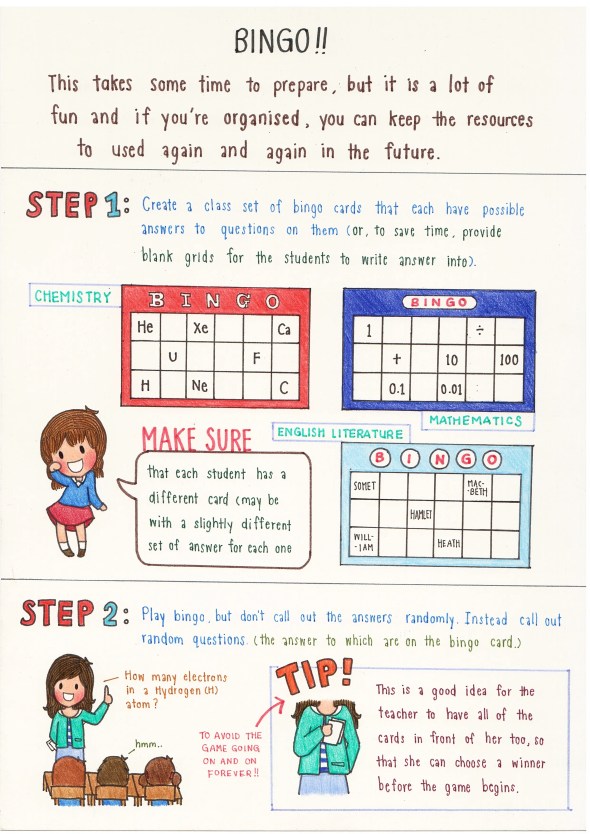
Bingo

Got some equation symbols or mathematical problems to teach your kids? Perhaps the symbols of the periodic table is more your thing? Whatever it is, this simple game can be adapted to suit any subject.

Bingo

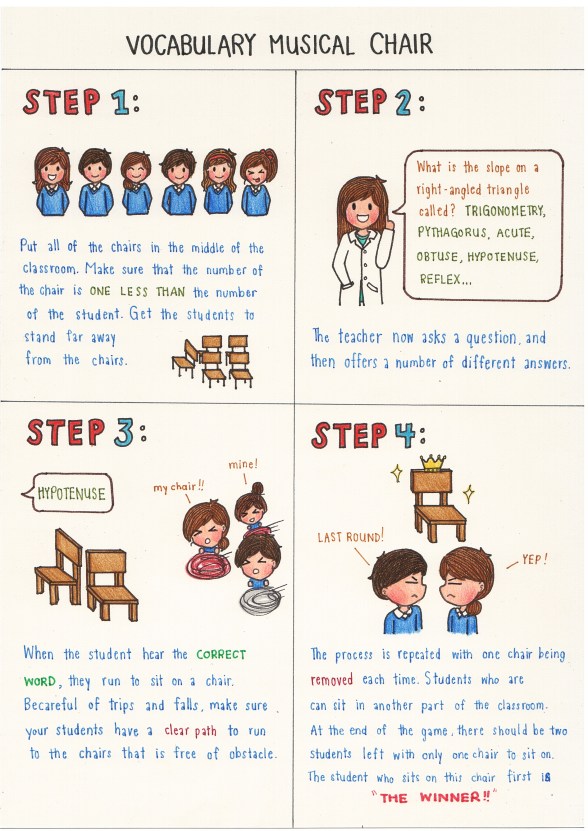
Vocabulary Musical Chairs

You’ll need a good rapport with your kids to use this one, as it needs to be controlled really well by the teacher (e.g. to avoid kids bumping into each other). However, it is simple, fun and worth the effort!

Vocabulary musical chair

Mystery Picture

This one takes some imagination on the part of the teacher and some training of the kids beforehand. However, it’s really, really good for encouraging higher order thinking skills.

Mystery pictures

Be Eccentric

You’ll come across as boring and monotonous if you aren’t, well, yourself. 

You don’t need to put on a fake persona. Be wacky and quirky and be yourself (just don’t break any school rules – obviously).

One thing I love to do is sing and rap to my kids. They love it! I also use voice inflexions and funny noises to make the content a bit light-hearted and funny. It loosens up the mood in the room and gets the kids giggling a bit.

One thing that I’m a big fan of is modelling. No, not the cosmopolitan cat-walk modelling, I mean getting your students to BECOME THE CONCEPT YOU’RE TEACHING.

Just last week I had my kids stood in circles and spinning, pretending to be electrons orbiting a nucleus. The week before they were spreading around the room randomly pretending to diffuse like gas or liquid particles would.

The possibilities for modelling are endless. Here are some ideas that can be applied to any subject:

Human numbers.jpg

Human graph and true or false.jpg

Memory Mind bender.jpg

img_5938

richard-rogers-online

We welcome you to join the Richard Rogers online community. Like our Facebook page and follow us on Twitter for daily updates.

Latest hybrid

Getting to Know Your New Students: Tips That Actually Work!

An article by Richard James Rogers (Award-Winning Author of The Quick Guide to Classroom Management and The Power of Praise: Empowering Students Through Positive Feedback).

Illustrated by Pop Sutthiya Lertyongphati (a former student of mine, and a key illustrator in my book). You can e-mail her at popslittlespace@gmail.com if you’d like her to do some beautiful illustration work for you!

Updated August 2022

Accompanying podcast episode:

The first few weeks of a new academic year can be really challenging, not least because you’ll have a lot of new names to remember!

Whether you’re a new teacher working in a completely new school, or whether you’re simply rolling into a new academic year with new classes to teach, this article will help you.

Strategy 1: Gather Intelligence

Knowing your students on a deep level is a fundamental principle of rapport building. You need to know ALL of your students’ dreams and aspirations, strengths and weaknesses and other relevant information (such as issues at home or Special Educational Needs).

This kind of knowledge or ‘intelligence’ can even be used to inform your lesson planning. See the examples I included in my book and at Angela Watson’s great Cornerstone for Teachers site here.

image1 (7).JPG

Unfortunately, however, few teachers truly utilize the power of professional intelligence gathering.

The best way I’ve found to gather such knowledge is by getting a fresh notebook and setting a page aside for each student you teach. On each page write down important (but not confidential) information about each student – e.g. the ECA’s they do, their career goals, subject-area strengths, competitions they’re entering or have won, etc.

Woman reading

The information you gather can be used to:

  • Inform lesson planning so that content is made more relevant to individual students, and the group, than it normally would be
  • Trigger conversations in leisurely school settings such as at the lunch queue, when you’re on duty or when you’re supporting students in a mentoring or pastoral role
  • Provide fuel for you to reinforce the credibility and brilliance of the students’ personal goals, so that a ‘hypnotic rhythm’ of focus empowers each student tofulfill their goal

Strategy 2: Marking

In your first few weeks it might be a good idea to get a lot of marking done, especially for your new students.  

Whilst you might normally do peer-assessment, self-assessment and automated assessment tasks throughout the main body of the academic year, it is worth spending a bit of extra time at the beginning of the year to do traditional, teacher-led ‘red-pen on paper’ marking.

IMG_0574.JPG

Benefits of this strategy include:

  1. You’ll get to know the writing, presentation and artistic styles of your new students really quickly.
  2. Checking through the students’ books and homework yourself is one way to quickly memorise new names
  3. It allows opportunity to provide written and verbal praise, which helps you to build rapport
Teacher-led assessment

My Head of Science recently started a ‘Science Stars’ notice-board at school. Every few weeks the Science teachers pin up some examples of beautiful work. What a great way to celebrate the success of your new students whilst getting to know them and build rapport with them at the same time! 

Strategy 3: Contact Parents

If you’re a form tutor/homeroom teacher, this one is really important, but it can be used by any subject teacher too.

In the first few weeks of school it can be a good idea to contact parents to let them know how their child is getting on. 

Contacting Parents Richard Rogers.jpg

I’ve found that telephone calls work best, as well as face-to-face conversations, as both of these methods involve a relaxed sense of dialogue that’s not normally available through methods such as e-mail.

Benefits of this strategy include:

  • Extra intelligence, such as the student’s approach to homework in their real home environment, can be gathered
  • It puts the parents’ at ease and reassures them
  • It can be used as a motivational tool for your new students – if you’ve passed on praise to their parents then they will feel happy and will know that mum or dad is only a phone call away. 
  • It can pre-empt a settling-in parent’s evening, providing common ground and information before a face-toface meeting

Strategy 4: Play Games 

People who have been following me for some time will know that I am a big advocate for the use of learning games in teaching. They break up lessons into chunks, appeal to the multi-sensory needs of your learners and stop your kids getting bored.

card games

What could be better than that?

But which games should you use to get to know your students?

There are a number of learning games you can play at this very useful blog post of mine here. All of those games can be adapted to a ‘getting-to-know-you’ lesson, but my favourites for this specific context are given below:

#1: Splat

This quick game is so easy: all you need is a whiteboard, whiteboard markers and a class of kids. It’s a great game for consolidating key vocabulary and is perfect for E.A.L. learners. You could potentially replace key words with students’ names in a ‘getting-to-know-you’ lesson. 

Splat.jpg

Here’s a short video showing a quick clip of me playing ‘Splat’ with my students (I will include some more lengthy clips soon, but this is a good start):

#2 Mystery Word

Another easy game. This time, students randomly pick out written words from a hat (or cup, beaker, container, etc.), and then they have to explain their word to the class (without saying the word). The students who are listening have to guess what the word is. Again, you could potentially replace the words with students’ names in a ‘getting-to-know-you’ lesson. 

Mystery word.jpg

#3 Who am I?

A very simple game. All you need are post-it notes and a class full of energized students! Great fun. Perfect for reinforcing key vocabulary and concepts. In a ‘getting-to-know-you’ lesson, you might want to use the hobbies and interests of different students as the key words. 

Who am I.jpg

Personally, I feel that it’s a shame that more teachers don’t make use of simple learning games such as these. They aren’t costly, they’re simple to do and they provide so much fun and great, deep learning for your students (when applied properly). 

img_5938
richard-rogers-online

We welcome you to join the Richard Rogers online community. Like our Facebook page and follow us on Twitter for daily updates.

Latest hybrid

New Teacher Starting at a New School? Here Are Some Tips You Cannot Miss!

An article by Richard James Rogers

Illustrations by Pop Sutthiya Lertyongphati

The events in this article are based on actual occurrences. The names, locations and, in some instances, the genders of individuals have been changed to protect the individuals’ privacy. 

It can be daunting when you start at a new school, especially if you’re a fresh graduate. Friendship and social groups will already be in place, and you may be nervous about trying to fit in, especially since you’ll be working with your new colleagues so closely.

walking around wt laptop

Your first few weeks and months on the job will be a time when your new colleagues will be getting to know you for the first time too. They may also be a little nervous about approaching you for a conversation. 

Here is a video summary of this blog post:

The trick here is to try and make one friend at a time. You’re in no rush! Relax, be respectful and polite, and slowly people will warm to you and trust will be built. 

Don’t alienate people

People respond to new social environments in a variety of different ways. Some people are shy and reserved, whilst others are confident and chatty. 

In the teaching profession, I’ve noticed that a conservative ‘middle path’ – that of being slightly reserved whilst being happy to chat with new colleagues, is the best way to go.

In my book, I describe a real situation that a former colleague of mine found himself in. He was much too cocky and intense with his humour and talk in the first few weeks of his new school year, and he annoyed a lot of people. Here is his story. 

Greg was a new psychology teacher at a rapidly growing international school in Brunei. He had come from a school where staff members enjoyed a very close and communal atmosphere: where the men played on football and basketball teams together and the women often played netball, badminton and did aerobics classes. The school was managed well, and staff were encouraged to socialise and be friends with one another. Greg was sorry to leave, but the prospect of more money and a substantially better benefits package tempted him to move on.

Greg’s new school was very different to his previous one, but it took him a long time to figure that out. As soon as he started at the school, everyone knew who he was. He would greet everyone loudly and proudly, making jokes and aiming to get everyone laughing in the staff room. He had a lot of opinions about things, from religion to politics and even which teachers in his new school spoke the clearest English, even though he had only been working there for a few weeks. At staff gatherings, including casual chats in the staffroom, he was loud and boisterous and would irritate people with anecdotes and questions, even when they wanted to be left alone. He had an opinion about everything, and he thought that his new colleagues would love him for revealing all of his infallible wisdom and sharing his sense of humour with them. How wrong he was!


Chapter 7 - make too many friends at a time
Greg thought he was so cool!

Greg made the inconspicuous mistake of alienating his coworkers, to the point where they didn’t even want to be around him anymore. He tried to be friends with everyone all at once, and all he ended up doing was irritating people. One member of staff even went so far as to tell him, in front of everyone in the staffroom, “Greg, sometimes I don’t know if you’re joking or if you’re just a complete retard!” This was the statement that woke him up.

Greg eventually toned things down, but it took a while for other staff members to warm to him again. Greg tried to run before he could walk, aiming to make everyone his friend all at once. What he should have done instead is focussed on making one friend at a time by taking a sincere interest in his coworkers, and gradually getting to know them.

Avoid gossip

Gossip, in all of its forms, generates distrust and is highly destructive. It is also dangerously contagious, so you really must guard against contributing to it. This is with-ukedchatan important rule to follow at all times in your career, but especially when you’re a brand new teacher.

Building trust with your colleagues takes considerable time. One of the quickest ways that you can destroy trust before you’ve even built it is by gossiping. 

Again, I make reference to this in my book as I feel it’s such an important point to make. Unfortunately, however, too many teachers fall into the habit of gossiping at all levels of the profession. I include some advice about this in Chapter 7 – ‘Working With Colleagues’, which I’ve included below:

You and I could walk into any school staff room at morning break time and, after about five minutes, we could easily distinguish between the ‘Chatty Cathys’ and the ‘Reserved Richards’. Gossips love to espouse whatever is on their mind, even if nobody else wants to hear it. They’ll tell you one funny anecdote after another, ranging from which salon they went to last week to how difficult they find the new pupil assessment software the school’s made them use. There’s also one other thing that gossips are really good at, and that’s dishing out the dirt on anyone who happens to be the topic of the current conversation.


Chapter 7 - gossiping
Avoid gossip at all costs!


Gossips, without fail, are people to completely avoid at all costs (where possible). One of the reasons why gossips are famously passed over for promotion is because they can’t be trusted with the sensitive information they’d be exposed to in a managerial role. They generate distrust, and you should be very cautious with what you say when around anyone who is a famous gossip; you don’t want to give them fuel for a fire that they can burn behind your back! Additionally, if you happen to be sat with a gossip who starts to speak negatively about a colleague or the school in general, then don’t be afraid to get up and walk away. What’s more important: having a laugh or having a job? Besides, do you really want to be sat there when everyone’s complaining about the principal and that awkward moment happens when the Deputy Head walks in the staff room?

If you’re sat with gossips, or if you’re seen to be hanging around with them and chatting with them frequently, then you’ll be associated with them in the minds of senior management. If you plan on having a long and fruitful career in teaching, then remember this golden rule: don’t gossip, and don’t associate with gossips.

You never know who might be in earshot of your gossiping. You could be walking past an open window when a colleague hears you, or even standing on duty in the lunch queue when a number of students hear you too. Gossip is just simply too dangerous to get involved in. Avoid it, period!

Be careful at staff parties

Many schools around the world enjoy a congenial and lively atmosphere in which staff feel happy and trusted. Schools like this often have social gatherings, and in your first week you may be invited along to some kind of staff party or get-together.

Be careful about how you come across at staff parties. It can be easy to let loose too much, especially after a few drinks. If you feel yourself getting a bit tipsy, then don’t be afraid of calling it a night and going home. 

I’ve attended my fair share of staff get-togethers over the years and sometimes drunkenness can cause issues. New teachers seem to be particularly prone to this. 

Remember this: Staff parties are not for partying! Do that with your social group outside of school (and far away from school) if you must. 

Know your courses and plan properly

Lesson planning can be a particularly daunting task for new teachers, especially if this is your first year on the job. 

In my book, I write about the real story of a teacher who started a job in a new school with a new set of courses to teach. She found herself overwhelmed and making silly assumptions, which landed her a spot of trouble. Let’s find out what happened. 

Bethan, a young teacher with high aspirations, had just started her new job at an IB World School. It was a prestigious position, and expectations were high. She had taught ‘A’ – Level Geography in her previous school, but had not taught the IB Diploma before. When she started teaching her new Year 12 class, she already had a high workload and issues to deal with at home due to relocating to her new school. To save time, she taught subject content on the ‘A’ – level syllabus, assuming that it equated to what was in the IB Course Guide. Since she already had the necessary resources from her previous school, she could prepare lesson materials quickly and easily.

Was this a good move on her part? By using the resources from her old school was she really preparing her students for their IB exams? The answer to both of these questions, unfortunately, is no. She was teaching content that possessed some overlap with the IB course, but it was patchy. In parts, her material was either not specified in the IB Course Guide, or was too complex. After several lessons of finding the subject too difficult, a student decided to find the IB Course Guide online. When he couldn’t find the material he had been taught by Bethan in there, he informed his parents, and shortly afterwards they sent an e-mail to the Head of School: Mr Brian.

making plans
How well do you know the courses you will teach?

Mr Brian, being a principal with some experience of dealing with this sort of issue before, wanted to verify the facts. He arranged a meeting with Bethan and asked her to go through her semester plan for that class. When she couldn’t produce one, and when she couldn’t answer the questions pertaining to the IB curriculum she was supposed to be teaching, Mr Brian was not the least bit happy. As a result of this, Bethan was made to produce detailed long-term plans for all of her classes; she was asked to e-mail the concerned parent with an explanation and she was placed under a lesson observation schedule so that her line manager could monitor her teaching. Additionally, this had the knock-on effect of reducing the students’ confidence in her as their teacher. Sounds excessive? The principal didn’t think so, especially when one considers that the parents at this school were all fee-paying, and rightly expected a good quality of teaching. All of this pressure, extra-workload, and embarrassment could have been avoided had Bethan had simply read through the syllabus for her course and planned accordingly.

You would be surprised at how different some syllabuses can be, even when they pertain to the same examination. An Edexcel IGCSE Mathematics syllabus, for example, is significantly different to the CIE IGCSE Mathematics syllabus. Make sure that you know which syllabus you are teaching, and don’t assume that it is the same as what you’ve taught before. Also, watch out for syllabus updates – new syllabuses can be very different to their predecessors.

Summary: Tips for new teachers starting at new schools

  1. Focus on making one friend at a time. Don’t worry yourself with ‘fitting in’ or ‘being a part of the club’. Be polite, offer your opinions only when asked and be friendly. You’ll soon find that your new colleagues will warm up to you and will be happy to be friends with you.
  2. Don’t come over too intense or loud. Building professional relationships takes time.
  3. Avoid gossip at all costs. Avoid it as you would cobras, rattlesnakes and poisonous spiders. 
  4. Staff parties are a chance for you to socialize in a relaxed setting. Don’t forget that you’re in the company of your new colleagues and your bosses. 
  5. Plan properly and thoroughly. Don’t assume that different courses in the same subject follow the same content. 

714symbol01

richard-rogers-online

We welcome you to join the Richard Rogers online community. Like our Facebook page and follow us on Twitter for daily updates.

Latest hybrid