Using ICT in the Classroom Part Two: A Guide for Teachers

An article by Richard James Rogers

Illustrated by Sutthiya Lertyongphati

ICT offers a whole new world of discovery and adventure to the learning process, but how many of us actually use it strategically?

Tragically, many teachers are still ‘ticking the boxes’ with ICT, using it as a means to impress an observer or inspector, or to fill in an obscure rubric.

This is concerning.

Last week, we looked at ways in which ICT can be used to support instruction and support learning, and we emphasized the fact that the full use of computer systems can even save you massive amounts of time and energy in lesson planning and assessment. 

teaching with laptop.jpg
Are you working too hard? Computers can even do most of the teaching for you now, leaving you to embrace the roles of mentor and facilitator

This week, we will focus on exploratory and collaborative ICT systems, and how they can revolutionize learning and improve student grades. 

Exploratory and Collaborative ICT

I’ve grouped these methodologies into one category as groups of students often use ICT to explore and create content at the same time. Let’s take a look at some of the best ways to implement this into your teaching.

Allow opportunities for research

If you are trying to teach a large topic (e.g. cell division, transformations of functions,

vr
Capitalise on the creative abilities of your students when using ICT to enhance learning

the Battle of the Somme, etc.), then you’ll naturally have lots of content to get through. Why not try the time-tested method of the market place activity, whilst using ICT at the same time?  Follow these steps:

  1. Split the class into groups, each with a specific task and roles to play (this is crucial). For example: Team 1: Rosie (Information researcher using iPad), Charles (Prezi creator using laptop, receives info from Rosie via e-mail), David (voice narrator using the AudioMemo app on the Smartphone), Thomas (Final editor and team leader, ensures good communication flow between members). Teams 2-4 would be constructed in the same way.
  2. After a suitable length of time, get the team leader to quickly go to another team and find out what they’ve been studying and researching. After about five minutes, the team leader can come back and report his or her findings to the group, so that they can put it into their presentation.
  3. At the end of this lesson (or the next lesson, if time is limited), allow students time to present their work. Perhaps each group could peer assess each other?

    with-ukedchat
    “This is a great book for people who are trying to get to grips with their busy teaching schedule” –

Think of novel ways to create content

Part of a new wave of educational culture focusses on achieving success criteria. This is language that you’ll have to teach to the kids, but once it’s in place it can work wonders in your classroom.

For example: Let’s say you are leading a Year 8 art class on city-scape images. The objective is to create an image of a metropolis from the perspective of an alien visitor. But what are the success criteria? How will the students know that they have achieved this objective, and what methods will they use to achieve it? If you plan in advance and you’re smart, you’ll let your students decide how to tackle the problem by themselves, using whatever technology is available. 

Now a traditional artist would quickly get to work with brushes, paint, pens, pencils and the like. But why be limited to this? Try providing the students with a wide-range of materials to use, including technology (e.g. Tablets, smartphones, camera’s, digital sketch pads, 3D printing, etc). Perhaps you can group the students, and allow them some planning time first, before they embark on their project.

schematic
Try providing your students with as many technological options as possible when embarking on a project. Allow them time to plan. This builds up collaboration and problem-solving skills, and it’s enjoyable! Perfect!

Does this sound scary to you? Some educators and schools would frown on this, saying that students should never direct the methodology of the lesson and the teacher should always lead from the front. This ‘sage on a stage’ approach, however, doesn’t adequately provide students with the key skills that employers and universities are really looking for these days. Take this quote, from targetjobs.co.uk, for example:

Teamwork is one of the fundamental skills employers look for and it’s on the graduate recruiters’ high priority list. The best way to show off any skill is to explain how you used it to get results. However, with teamwork you will have to show how you achieved a group result.

So try killing two birds with one stone: Get your students working together and using ICT at the same time. They’ll be engaged, they’ll be learning and they’ll be building up their key skills.

Use, create and edit videos

You’ll notice that I’ve created my first ever instructional video this week! (Well, I would be a bit of a hypocrite if I didn’t!).

Nowadays, it’s easier than ever to do this. Videos can be used in all sorts of ways. See this extract from my book:

Blog 26th March 1

When it comes to editing movies, iMovie (Apple) and FilmoraGo (Android) are great apps you can use. Why not ask your school’s ICT department to download these onto your school’s iPads or tablets? In addition, get your students to share their videos on the school’s VLE or official Facebook, Vimeo or YouTube site. This is great PR for the school and gives the students a wider sense of purpose to their work as they can inform a wide audience and showcase their project to their parents.

Try stop-motion animations

I’ve sued these many times in my career and they are great. Some of the earliest forms of film-making involve taking still images of a scene and then sunning them together to make a ‘moving picture’. Students can do this with model building to illustrate any process or strategy. Take a look at this video, for example, of a stop-motion animation illustrating DNA replication:

You Tube

Collate data in unique ways

These extracts from my book show how smartphones and tablets can be used to collate and present data:

Slide2.JPG

Slide3.JPG
Just look at these beautiful charts that can be easily made on tablets and smartphones

Try using social media

It’s unstoppable: Social media platforms continue to grow in both influence and functionality. The following infographic outlines some cool ways in which you can use social media in education. Can you think of more ideas?

Using social media in education-page-0

Summary

I really hope that both this week’s and last week’s blog posts have given you some tips that you can use in a practical way in the classroom. Please feel free to comment below with any extra ideas you have, and please feel free to contact me through any of the social media buttons on the top right of the page if you have any questions or comments. 

The following summary extracts are taken from my very popular debut book. I hope they’re useful.

Slide5

Slide6

Slide7.JPG

img_5938

richard-rogers-online

We welcome you to join the Richard Rogers online community. Like our Facebook page and follow us on Twitter for daily updates.

Latest hybrid

Using ICT in the Classroom Part One: A Guide for Teachers

Updated July 2022

An article by Richard James Rogers (Award-Winning Author of The Quick Guide to Classroom Management and The Power of Praise: Empowering Students Through Positive Feedback)

Illustrated by Sutthiya Lertyongphati

We all know that we should be using different forms of information technology to enhance our students learning experiences. In my 11 years of teaching experience, I’ve had the great fortune of being able to experiment with different methods and I’d like to share my findings with you.

One thing is certain: ICT definitely enhances learning, when it is used and planned properly!

Chapter 5 - drones and hacking
The possibilities are endless when ICT is used to enhance learning

I’m going to split the methodologies into four streams for the sake of clarity: Instructional ICT, Supportive ICT, Exploratory ICT and Collaborative ICT. If all four of these streams are used in unison with each other, then teachers will find that their workload reduces dramatically, their students progress rapidly and parents are kept happy and informed. Now what could be better than that?

Safety First

Make sure your students are safe online. Educate them about the SMART acronym. See this extract from my book below:

SMART

Instructional ICT

Interactive Presentations

MS PowerPoint has been around for more than two decades. My lecturers were using it in university, and I even created PowerPoints as a student when I was in high school. Now I’m 33 years old, and some schools are still content with the notion that using a PowerPoint can count as ‘using ICT to enhance learning’.

I’m sorry, but that just doesn’t cut the mustard these days.

Try using presentations that get the students actively engaged. Do your students come up to the whiteboard to move objects around, match words to descriptions or interact with simulations? Do you use your PPT or other presentation as a prompt for getting students out of their seats, such as by making them stand on either sides of the room for True/False answers, or asking them to form a human graph?

projector interactive
Are you just lecturing at your students lesson after lesson? Try making your presentations interactive, and get students up out of their seats.

Tablets, Smartphones and Laptops

with-ukedchat
“This is a great book for people who are struggling to cope with their busy teaching schedule”UKEdChat Book Review

Portable technology has revolutionized every area of teaching. When embraced and utilised properly, mobile devices can assist in the the delivery, assessment, record keeping and discovery of content, as well as building up key skills such as communication and collaboration.

I wrote about this exhaustively in my book, which I would recommend for any teacher who wants to brush up their classroom management skills through the use of ICT. For the sake of conciseness, I shall summarise the main themes here.

Don’t be camera shy

Chapter 5 - seeking for clues

Camera’s on smartphones, tablets and laptops can be used for variety of purposes. Try the following:

  • Taking photos and videos of experiments, projects and fieldwork to put in reports
  • Setting up a QR code treasure hunt where the students have to hunt for ‘clues’ and information around the school campus (great fun).  Students can even compete in teams for this task, and collate the information together in a unique way, such as a flow chart, at the end of the lesson. See below:
QR hunt summary jpeg
Instructions for using QR codes treasure hunts in your teaching practice.
  • You can also use smartphone, tablet, laptop and standalone cameras with students to create videos (which can be shared online), podcasts, radio shows, stop-motion animations and even instructional lectures, such as a model-building demo. I’ll write about this in more detail in next week’s blog post, in which we’ll focus on Exploratory and Collaborative ICT. 

Use instructional software

I’ll never forget when I first started using MyiMaths, an online maths tutoring and assessment system, to teach mathematics. It was back in 2013, and it totally transformed my work life. 

Why? That’s simple. Students would go into the ICT lab, or use their laptops or tablets in class, and literally be taught mathematics by the computer! The program would even assess the work immediately, and differentiation wasn’t a problem because students could work through the tasks at their own individual pace. The benefits were enormous:

  1. All of the students were focussed and engaged
  2. All of the students were challenged
  3. The teacher had more time to spend with individuals working on specific problems
  4. The content was relevant and stimulating
  5. No behavior management issues as the students were all quietly working
  6. No time was needed by the teacher for marking and assessment. The program did all that for you. All you had to do was collate the data.
tablet activity
Try using instructional software with your students. The benefits for everyone are enormous, and the cost is usually cheap.

Supportive ICT

Allow for research opportunities

Gone are the days when ‘chalk and talk’ and ‘sage on a stage’ methodologies permeated every school. ‘Collaboration’ and ‘exploration’ are the buzzwords of education now, and we are able to do this better than ever before.

walking-around-wt-laptop

Don’t be shy about allowing students to use their smartphones in class (but be sensitive to what they’re actually accessing, and also be aware that some students might not own smartphones. Have a stack of iPads or tablets ready, to give students the ‘choice’ of using them). 

Students can use the web to find out facts about their subjects, as well as for revision. Great websites to use include these classics:

http://www.bbc.co.uk/education

http://www.s-cool.co.uk/

Also, check out this earlier blog post of mine where I provide great websites split into subject areas. 

Making graphs and charts and editing images

Any form of data set can be graphed in various ways by tablets and smart phones. This could happen in a history lesson in which you’re studying the number of new cases of the bubonic plaque over a set period of time; a mathematics lesson where the students have conducted a simple survey; a science lesson where the kids are measuring the light absorbance of different solutions or even an English lesson where you’re studying the frequency of particular adjectives in different texts. Good graphing apps include ‘Numbers’, ‘Viz’, ‘3D Charts’ and ‘Chart Maker’ (Apple™) and ‘Simple Graph Maker’, ‘My Graph (Chart)’, ‘ChartGo’ and ‘Juice Labs’ (Android™).

Portable homework diary

Are you sick of your students forgetting their homework? Does your school still use those old-fashioned homework diaries where everything needs to be written down? If your school isn’t using a homework database or a VLE to set assignments, then one way to solve this is to get the students to take a photograph of the homework task after you’ve written it on the whiteboard or projected it. This is also a very good option for students with additional learning needs and those who are operating with English as their second language. Additionally, if the homework is complex and involves multiple steps (e.g. navigating through a particular VLE portal), then students should be encouraged to take photographs of each step in the process.

Chapter 7 - sending emails
Messaging systems and Virtual Learning Environments have revolutionized the way that students keep track of their homework and grades

Create!

There are a myriad of programs offered within the Apple™ and Windows™ suites can assist students in the creation of their assignments. You can be very open minded, and give your students the task of ‘using ICT to produce this homework’, or you can even train students in the use of a particular platform first, and then set them the task of creating something with it. Furthermore, online interfaces such as Weebly and WordPress allow students the opportunity to create websites quickly and easily. Websites that students create can be used for:

  • Blogging
  • Recording topic summaries each month or on a regular basis
  • Keeping track of coursework (the website itself can be a coursework log)
  • Homework assignments
  • Revision
  • Collaboration – working with teams at school or between schools
PC activity with mouse pen
Allow your students the freedom to be creative in their use of ICT

What if the kids don’t have any ideas?

The following form was included in my book and is great for getting students to think creatively about using ICT, with special reference to future systems that haven’t been created yet:

Slide1
Slide2
Slide3
Slide4
img_5938
richard-rogers-online

We welcome you to join the Richard Rogers online community. Like our Facebook page and follow us on Twitter for daily updates.

Latest hybrid

Careers Advice: Your First Year at University

An article by Richard James Rogers (Author of The Quick Guide to Classroom Management)

Illustrated by Sutthiya Lertyongphati

Students all around the world are approaching the final sprint to their terminal examinations right now. Whether its ‘AS’ or ‘A’ – Levels, IB Diploma exams, SATs or IGCSE’s, students and teachers all over the world are feeling the pressure. 

However, one thing that can be overlooked at this time is good-quality careers advice for students who will soon (6 months in some cases) be at university starting their first of a degree programme. 

And yet, this careers advice is probably the most important facet of this approach to the exam apocalypse. Students need to feel excited by going to university now. They need to know why they’re working so hard for their final exams in the first place (the purpose). They need to have a dream; a goal, to work for.

with-ukedchat
“This is a great book for teachers who are struggling to get to grips with their busy teaching schedule”UKEdChat Book Review

Have you sat down with each of your final year students to find out what their dreams are? I promise you – you’ll be very surprised at what comes from this.

And then, what do you do? You reinforce the importance of each dream, as often as you can. “Debbie, I know you’re going to be a great drummer one day. The best. We will work together to get you to Birmingham City to start your music degree”. “John, I’m so pleased with this vectors homework you did. You put so much effort into this. You will use this material when you’re studying engineering at Loughborough. I know you’ll make it. Keep working hard. Keep up the excellent work”.

Do you know what effect comments like these can have on your students? They can be life-changing!

For my next book, I have compiled advice from 100 young graduates who have studied at universities all over the world. Many of these graduates are my former students.

a-girl-holding-folders
Going to university is a massive learning curve for many students

Take a look at these extracts below:

Name: Orachitr Bijaisoradat

Latest accomplishment: Ph.D in Polymer Science. The petroleum and petrochemical college, Chulalongkorn University, Bangkok, Thailand

Advice to freshmen

1. Make lots of friends and be sociable. Some students may struggle at the first term of uni but you will feel much better if you work as a team and help each other by sharing your knowledge. And knowing lots of people will help with connections for your future career. Sometimes connections are more important than grades.
2. Plan ahead. It is okay if you don’t know what you want to be when you graduate but it is best to plan so that you can have everything prepared for your next step. For example, if you plan to continue a master’s degree, what are the requirements that you need to prepare. If you want to apply for the top 10 famous universities but your GPA is lower than the requirement, then you won’t be able to apply.

discussing-homework
Students are required to take ownership of their learning at university

Name: Mintra Rungruengsorakarn

Accomplishments:
Bachelor’s Degree in Music from University of Rochester, Eastman School of Music, Class of 2015
Master’s Degree in Music from Mannes School of Music, The New School, New
York, Class of 2017

Advice for freshmen: 
There were many things that happened during my studies in the United
States in the past five years and a half. Those memories and experiences were all valuable regardless of any rises and falls. As a second year Master’s student, I am here to share with you my advice from a perspective of someone who has graduated with a Bachelor’s Degree and is on her way to finishing her Master’s.

Here is some advice I would like to give:

‘Time’ is precious, and it is the only treasure that everyone has equally. Use your time wisely, the better you manage your time the better advantage you have over others. Four years in a university is so short that you will be out of school before you know it. Secondly, be sure to know your responsibilities and realize how fortunate you are to be in school. School prepares you for the real world, as you are being exposed to new surroundings learn to adjust as soon as you can and stay strong, be positive and optimistic.

Do not start your new life with a goal to just graduate and leave. You need to strive and look for opportunities which are plenty out there, embrace the experiences which make you grow and never forget to consistently work hard. Appreciate the gift of ‘today’ and do your best so that you will not regret when you look back. For whichever route you are taking, there will always be certain things you would wish to have done better. However, that will always be alright.

Take risks and be spontaneous. Live life to the fullest while being generous and kind. Be happy and enjoy life. Be fearless and have faith, believe in yourself that you are capable and that nothing is ever impossible.

walking-around-wt-laptop
Collaboration is key. Do your high school students collaborate enough?

What advice would you give to a final year high school student who wants to go to uni?

Check out my next book, to be published on March 31st:

img_7476

 714new1

richard-rogers-online

We welcome you to join the Richard Rogers online community. Like our Facebook page and follow us on Twitter for daily updates.

Latest hybrid

Working With Parents: A Teacher’s Guide

An article by Richard James Rogers (Author of The Quick Guide to Classroom Management). 

Illustrated by Sutthiya Lertyongphati

Customer satisfaction is a key driving force of success in any business. Customers who are happy come back for more, and usually tell other people about the great service or product they’ve just bought.

In the teaching profession, your number one job is to do a good job. However, we often lose sight of the fact that our students are not actually the main people we’re aiming to serve. By providing the best quality of service to our students, we’re actually satisfying the needs of the parents by proxy. 

shake-hands
All of your parents deserve respect and the highest level of service

In many service – based industries, the key goal is to make the customers happy. This poses a unique question for teachers, as it is sometimes unclear who our customers are.

If our customers are our students, then should we aim make them happy all the time? Not necessarily. Our aim is do what’s best for the students, whether they like it or not. A student may be happy if they do not receive any homework or if they’re allowed to sleep in class, but this would never help them in the long-term.

So that leads us to parents. Are they our customers? Yes. Absolutely yes. 

Most parents want the best for their children, and it’s always very important to know their expectations. Some parents are happy enough if their child is simply in class, being supervised and on-task. Others may have very high expectations, such as achieving a level 7 in IB Biology and then going on to study at an Ivy League or Russel Group university.

Our key priority, above all else, must be to exceed each parents’ expectations. We can only do that if we know what those expectations are in the first place.

with-ukedchat
“This is a great book for people who are struggling to get to grips with their busy teaching schedule”UKEdChat Book Review

Parent’s can help teachers in key ways, if we get to know them:

  1. Parent’s can offer a lot of insight into their child’s study habits, hobbies, interests and family situation. All of this information can be used to inform lesson planning, facilitate mentoring and provide a wider perspective into the life of the student.
  2. Parent’s can help you to keep track of work being done at home, and can help with reinforcing schedules. The advent of e-mail and chat apps has made teacher-parent communication easier than ever before.
  3. Keeping in touch with parents is a great way to keep your students motivated. A quick e-mail or phone call to praise a child for a great piece of work done, or showing a good attitude in class, can work wonders (especially with students who are consistently disruptive). 

discussion-mother-and-daughter
Parents should be treated as very important customers 

In my debut book, I wrote a whole chapter about working with parents. Getting this key-relationship right can help you in so many ways, even with the regular management of your students in class.
Chapter 6 - maxwell and jonesAsk yourself these questions to see how well you know your parents:

Do you know the first names of your parents? This is vital, as all humans respond in a more alert and friendly manner to people who address them by name. Make the effort to contact your parents at the start of the semester (or as soon as possible) and introduce yourself. You’ll be amazed at the positive impression this will give of you and your school.

Do you know what your parents do for a living? This is often overlooked, but it is such vital information. Knowing that John’s dad is an engineer, for example, allows you to reinforce the importance of a good education in your students, and build up their respect and pride of their parents. “Well, John, I know that your dad is good at mathematics because he uses it every day in his job as an engineer. You should be really proud of him”.  In addition to this, whenever you need guest speakers or specialist knowledge for your lessons, you could bring a fresh perspective to your teaching by contacting parents for help.

discussion-father-and-son

Do you know your parents’ expectations? This is essential if you want to get parents on your side. Find out exactly what they want from you, and make sure they know that you know what they want. Keep them informed along the way, and always report on progress, or lack thereof. 

It’s quite time-consuming, but important, to know the desires of each parent you work with. If you don’t have this information yet, then a good starting point is the Seven Key Desires of Parents that I outlined in my book:

parents-key-desires

In my opinion, parents are the most under-used resource in the education profession, and yet they can offer such rich benefits. I write about this at length in my book, and I’ve included the summary of the chapter below:

slide1

slide2

img_5938

richard-rogers-online

We welcome you to join the Richard Rogers online community. Like our Facebook page and follow us on Twitter for daily updates.


Latest hybrid


Teaching in the UK: Some Thoughts

whiteboard new doc 20_5

An article by Richard James Rogers, award-winning author of The Quick Guide to Classroom Management: 45 Secrets That All High School Teachers Need to Know and The Power of Praise: Empowering Students Through Positive Feedback

Illustrated by Sutthiya Lertyongphati

I still remember the day I walked into Rhyl High School as a PGCE student. The hustle and bustle of excited students, the long corridors of a traditional school and staffroom banter. My first experience of professional teaching was really challenging for me, not least because I was inexperienced and I found it hard to deal with many excited students asking questions all at once. Rhyl was a brilliant school and was my baptism, and I’ve loved teaching ever since.

I stayed in the UK until the end of the 2008 academic year before moving to Thailand to teach at an international school. I was initially reluctant to go, as I was unsure of what to expect in the Land of Smiles (and I didn’t even know it was called that until I landed and saw a big sign at the airport).

I loved teaching in the UK, but Thailand was so much better from day one. Why? That was simple: Students who were all willing to learn (no behaviour management problems at all) and much less paperwork and ‘red tape’ to contend with. One has to remember though – I was teaching in fee-paying, international schools in Bangkok. In the UK I was working in maintained state schools, where the abilities and agendas of the student populace can vary enormously.

out-of-control
Some would say that this kind of classroom scene is more common in the UK than in schools overseas. Would you agree? I’ve never experienced large-scale student disruption or distraction in Thailand. Have you taught overseas? How does your experience relate to this?

That may sound condescending to educators currently in the UK, but my experience is not unique.

Take, for example, this quote from a damning article by the Guardian newspaper last year:

The chief inspector of schools, Sir Michael Wilshaw, has claimed that the UK faces a “teacher brain drain” as newly qualified educators move abroad to find work. But actually it’s not just the warmer climate of places such as the Middle East that’s so appealing to the UK’s best teachers all of a sudden – it’s the warmer professional climate that the international schools offer that’s really alluring.

There was certainly a warm, professional climate in all of the schools I worked at in Thailand, but I also found that in the UK too. In fact, because a number of teachers were working together to deal with issues ranging from individual student behavior management to improving coursework collection and completion, I found the professional climate to be a little warmer (at times),  but a little colder when you were asked to justify things, such as putting students on detention to catch up with missed work.

Then there’s this alarming fact, which I also made reference to in my book:

pgce-left-uk

A mass exodus of teachers from the UK. Something must be luring them away.  

In fact, the UK has been facing teacher shortages for well over a decade. But what are the reasons behind this? The Huffington Post ran an article last year that listed five causes of teacher shortages in the UK:

1) Numbers of pupils are increasing

Whilst the British government makes the claim that more and more teachers are entering the profession each year, the Huffington post article makes it clear that this is not enough to compensate for the increasing number of pupils that are going through the system. In fact, the British government itself has made projections for the current decade up to 2020 predicting that school numbers could rise by 800,000 – 900,000 pupils nationally. If class sizes are to remain capped at 30, then this increase is unsustainable and the classroom management expectations of teachers are only going to increase.

img_6446

2) Graduates are finding jobs elsewhere

I can tell you from my experience that UK graduates are among the most valued globally in the teaching profession. Our world-class universities, along with our country’s reputation as a beacon of etiquette and good morality make us very marketable to parents of international students. The implications are that UK graduates, and especially those with some UK teaching experience, can find a job overseas relatively easily (although, of course, there is still competition for places). This, coupled with the fact that international schools tend to offer very attractive salaries and benefits packages, with some even offering free accommodation, makes the UK seem like a bit of silly choice for any talented, aspiring teacher. 

The-Quick-Guide-to-Classroom-Management-amazon-and-ku-1

Also, by ‘elsewhere’, I don’t just mean outside of the UK. Many graduates are now choosing alternative careers to teaching as a starting profession, especially since NQT pay has not kept up with the increases seen in the past five years in other job sectors. Graduates are simply choosing other careers paths that pay more, and require less training. 

3) Routes into teaching have fundamentally changed

I graduated back in 2005 thinking that taking a  PGCE was the only way to become a secondary school teacher. I was wrong, of course, and now there are even more options than ever before. During his time as Education Secretary, Michael Gove made some of the most radical reforms to teacher training ever seen in the history of the profession. Traditional routes into teaching could be bypassed by the new School Direct approach, which basically placed pressure on schools, rather than universities, to fully train new teachers. 

Chapter 6 - maxwell and jones

One might think that this would help increase teacher numbers, but the opposite seems to have happened. Estelle Morris, the British Labour Party MP, famously criticised the School Direct approach in 2013 by making the following points:

  • Since the TDA’s removal by the government coalition, schools have not been obligated to recruit enough teachers to fill the places they’ve been allocated. Training new teachers is burdensome and time-consuming, and there are no penalties for schools that under-recruit. For many schools, it’s easier to allocate more classes to their experienced teachers rather than hire and fully train new staff.
  • School Direct places are not evenly allocated around the country, and some schools don’t even have access to this recruitment channel!
  • The approach has destabilized University-based teacher training provision, with some universities, such as Bath, proposing to scrap their PGCE courses.

4) The burden on teachers is greater than ever before

work-overload
Teachers in the UK tend to find themselves ‘bogged down’ with lots of paperwork. And it’s not just marking the many assignments from large classes that contributes to this, it’s lots of other things too. Should teachers really be taking on the role of ‘office clerk’ at the same time as being an educator?

Teachers are more accountable now than they have ever been. Couple this with the fact that technology has increased along with paperwork, and it’s easy to understand why teachers are finding themselves overworked, particulary in the UK. Many recent surveys have shown that British teachers are working longer and longer hours. Just think of all of these things a modern British teacher is expected to do:

  • Mark and assess a variety of student work thoroughly and record grades and scores accurately, often on shared mark books where other teachers can see your students’ marks
  • Adapt to almost constant changes in curricula, syllabi and the National Curriculum
  • Find novel ways of assessment in which the criteria are often blurry, including assessment without levels
  • Constantly learn and develop new ways of using technology and ICT in the classroom
  • Prepare detailed termly plans, weekly plans and Schemes of Work
  • Deal with parents and their concerns, particularly if you have a pastoral role (such as being a form tutor)
  • Be ready for a snap Ofsted inspection at any time
  • Deal with a variety of targets, particularly if you’re working in an academy school (and, over the past 5 years, 1100 UK schools have converted to academies)
  • Photocopying and preparation of resources, which can be particularly time-consuming if you are trying to differentiate to a variety of learning-styles or special educational needs.
  • Mentoring of trainees (especially if your school is involved in School Direct)
  • Can you think of more to add to this list?

being-told-off
Have you ever had a telling-off from your line-manager? From lack of ‘effective’ planning to not performing well in snap Ofsted inspection, there are more reasons than ever before for school managers to reprimand their staff.

5) Education budgets are seeing real-terms cuts for the first time in decades

The Comprehensive Spending Review published last November announced a £600 million cut in schools’ Education Services Grant and a six per cent real-terms cut. The impact of this on the recruitment crisis is huge. Schools are facing the risk of bankruptcy, and are having to make wide-ranging savings. This means fewer support assistants, tighter budgets for essential resources and considerably less for ICT, and less money to spend on furniture at a time when research demonstrates its impact on attainment.

But it’s not all rosy overseas either

In my book, I listed some major reasons why teaching overseas can have its drawbacks too:

book-extract-disadvantages

Conclusion

Every school is different. It is wrong to say that teaching overseas is better or worse than teaching in the UK. Every school has their own individual merits and downfalls, and it is important to research carefully before applying for, or accepting, a teaching position at any school in the world.

Make sure you consider the country profile of a particular location before moving there, and you may even be able to read reviews of your chosen schools before making a final decision. 

richard-rogers-online

We welcome you to join the Richard Rogers online community. Like our Facebook page and follow us on Twitter for daily updates.

Follow me on Instagram

cropped-img_0002.png

Fresher Freshman: Your First Year at Uni

Are you a final year high school student? Do you know someone who’s thinking about going to university? If so, then read on!

Taking those first crucial steps into higher education can be daunting! Everything is new: teachers, friends, courses and the city or country you’ll be studying in!

This ground-breaking new book is filled with great advice from 100 graduates from all over the world! Students who’ve been there an done that in America, the UK, Europe and Asia. This is the must-read book for anyone who wants to make their first year successful, enjoyable and hassle-free.

Beautifully illustrated by Sutthiya Lertyongphati, and compiled by Richard James Rogers (High School Teacher and Author), this book will be released globally on Amazon on Feb 20th.

Watch this space for updates!

Behaviour Management Part 3: Outcomes and Affinity

An article by Richard James Rogers

Illustrated by Pop Sutthiya Lertyongphati

Behaviour management is a fine art: It takes years to master, but the basic principles are always there. At its foundation lies good lesson preparation (so that students are fully engaged) and a good student-teacher rapport. However, even with the best of intentions, the most through plans and even time spent getting to know your students well, there can still be occasions when students feel the need to be challenging. The root causes of poor student behaviour are numerous, but good teacher behaviours are always the cure (even if the problem needs to be referred on to someone else, as sometimes it does).  

new doc 20_2 IMG_6045new doc 27_2

So far we have seen the tremendous effect that the following teacher behaviours have on student engagement:

  1. Taking a genuine interest in your students, using praise and taking time to discover special skills and talents (e.g. artistic abilities). This not only provides students with a sense of validation, but also provides information that you can capitalise  on lessons.

  2. Modelling the behaviour of your colleagues, without fear of ridicule or embarrassment. This requires a school ethos of non-judgmental collaboration to work properly. Try observing teachers who teach the same classes as you. Find ‘positive deviants’ and ask them to observe you. Maybe these people can ‘diagnose’ what’s going wrong. 

new doc 32_1new doc 27_4

In this next article we will focus on the impact imparted by two key primers:

  1. Focussing on the work output, not the poor behaviour
  2. Learning to actually like your students (especially the challenging ones)

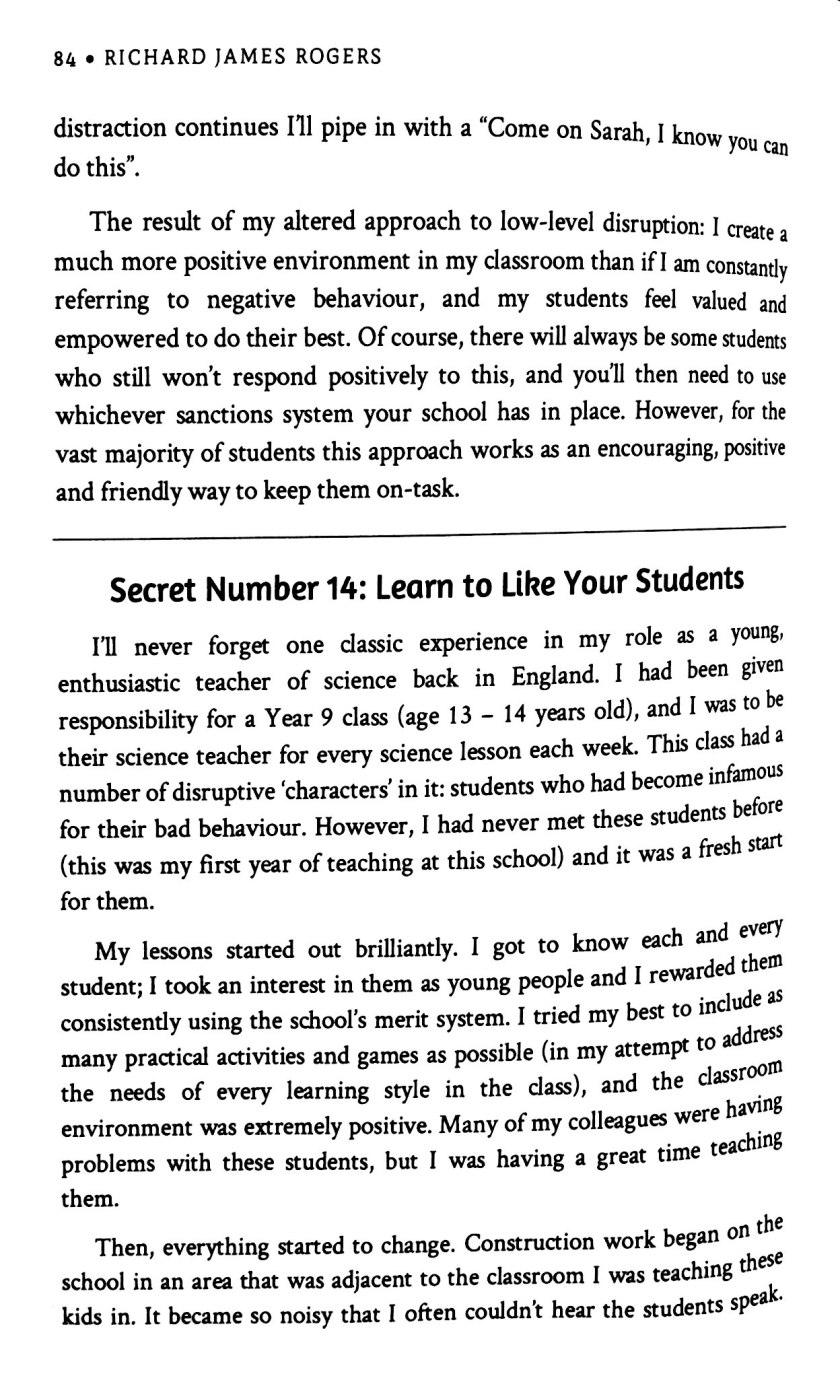
The following extracts come from my book, The Quick Guide to Classroom Management. I offer a short summary at the end.

secret-13-quick-guide-to-classroom-managmentnew doc 27_8new doc 32_6new doc 32_2

secret-13-and-14-quick-guide-to-classroom-managment

new doc 32_5

secret-14-quick-guide-to-classroom-managment

new-doc-20_4new-doc-20_1whiteboard

So, to summarise:

  1. Keep students focused on their work by drawing their attention to it. Encourage them with praise, commenting on how well they have done so far and what they need to do to finish.
  2. Learn to like your students. Find out about about their hobbies and interests and try to make reference to them in lessons if possible. Be approachable and trustworthy – this always works better than being scary and authoritative. 

richard-rogers-online

We welcome you to join the Richard Rogers online community. Like our Facebook page and follow us on Twitter for daily updates.

714new1


Behaviour Management Part 2: Model Your Colleagues

img_5938

If you are having problems dealing with whole-class disruption, or even engaging with some students on an individual basis, then one of the most sensible things you can do is seek help.

But what does ‘seek help’ actually mean? 

A casual chat with a colleague who works well with your problem students can be a great way to get some good tips. For example, when I was a young NQT, my colleague advised me to always focus on the work being done, not the negative behaviour patterns being expressed. I changed my reciprocations from “Steve, pay attention and stop talking”, to “Steve, how’s that work coming along? Nearly finished?”.

This worked wonders, and totally transformed my behaviour management skills.

However, sometimes a casual chat just isn’t enough, especially when you’re having problems with many students and many classes. 

I’ve developed a 5-step strategy that, if implemented in it’s entirety, is guaranteed to turn any situation of this type around for the better. 

The following extracts come from my debut book, The Quick Guide to Classroom Management’. I hope the advice is useful – I’ve seen this method work with hundreds of stressed out teachers over the years and I know it will work for you too!


new-doc-87_1

new-doc-87_2

new doc 87_3.jpg

By Richard James Rogers


Behaviour Management Part 1: Human Sense of Validation

Chapter 5 - drones and hacking 

An article by Richard James Rogers

Images by Pop Sutthiya Lertyongphati

The events in this article are based on actual occurrences. The names and, in some instances, the genders of individuals have been changed to protect the individuals’ privacy.

It happened a long time ago, but it seems like it was only last year. Time certainly deceives us: we think we’re stationary and planted firmly, but we whistle past the chimney tops as we rush along the railway line of our destiny.

In 2007 I had an experience that transformed me on a deep, emotional level. I’ll never forget what happened. 

His name was Jonathan: A student I had been gravely warned about. I’d just started a new Science Teacher job in the North of England, and the previous teacher had left some handover notes: “Avoid confrontation with this student at all costs. Do not set him off”.

Reading that as a shy 24 year-old was quite a shock, if I’m totally honest. My Head of Department even reinforced it verbally: “Richard, whatever happens, never argue with this student”.

new doc 32_3

Bear in mind I had yet to meet this kid yet!

Well, the dreaded time I had been warned about came: I was going to meet this young boy for the first time. 

Jonathan walked into the science lab slightly later than the rest of his peers, and I greeted him with a friendly “Welcome in young man, please take a seat”. This caused a giggle amongst the rest of the students, who were naturally expecting the same reaction that Jonathan’s other teachers would have given him – a good telling off! Jonathan sat down as instructed but, being a fiery young teen ready to push the boundaries and test what he could get away with, he pulled out a can of cola and started to drink it at his desk (something that is generally not allowed in a science lab).

new doc 20_2

I, knowing what I had been told about Jonathan, decided on a very positive and useful approach: I decided to ignore this misdemeanor at that moment and proceed on with the lesson.

As the lesson proceeded, I set a group work activity and walked around the classroom to see how the students were getting on. As I passed Jonathan, I noticed that he had a very neat and organized set of felt-tip colouring pens on his desk, arranged in a very nice standalone display case. I praised Jonathan  with a “You’re so organised, Jonathan. It’s good to see that you’re prepared for your lessons. I wish that every student was as prepared as you are.”

What do you think Jonathan’s reaction was? – He was absolutely stunned! This was a young kid who was accustomed to being reprimanded, put on detention and confronted on a daily basis. And here was a new teacher who could actually see his worth, aswell as what he could contribute. He lapped up the praise, and responded with an “Umm, err thanks. I always like to be ready for my lessons. I also love art”. This led to a short conversation about Jonathan’s love of drawing tattoo designs. I subtly drew his attention to the artistic graphics on the cola can, and reminded him he couldn’t drink it in the science lab. He smiled. Later that lesson, I assigned him the role of ‘Work Presentation Chief’ for the class. Each lesson, from then on in, I made sure that I praised Jonathan for his work, and allowed him to go around the class and assess the presentation skills of selected students. What was the effect on Jonathan? – He became my best student. He felt empowered, because, like all human beings, he craved a sense of importance and he craved appreciation.

IMG_6044

When Jonathan achieved his grade C in GCSE Science that year (a massive accomplishment considering his turbulent history) he said to me  “It was all because of you, sir”. Even at that moment, I wanted him to feel a sense of value and self-worth. I responded by saying “You did all the hard work, Jonathan”

The following extracts come from my debut book: The Quick Guide to Classroom Management, and remind us that all kids seek validation from their actions, and that we, as teachers, can engineer the circumstances surrounding the child to generate positive sources of such validation. 


new doc 83_4.jpg

new doc 83_5.jpg

new doc 83_6.jpg


img_5938


Moandiering On! Moody Teachers List of Top Grumbles!

Chapter 7 - gossiping Chapter 7 - make too many friends at a time


An article by Richard James Rogers

Illustrations by Pop Sutthiya Lertyongohati

Are you a moody moaner? If you are, then join the club because schools all over the world; no matter what the ethos or demographic, all contain their fair-share of moaners.

But what do teachers moan about and is it justified? Let’s answer the first part of that question.


Top 3 grumbles of today’s teachers

In my book, 45 Secrets That All High School Teachers Need to Know, I outlined dynamic and practical  ways in which every educator can address problems associated with paperwork, parents, students and colleagues. In my research for that book, and my subsequent investigations since, I’ve determined the top 3 teacher grumbles to be:


  1. Paperwork: “There’s too much pen-pushing and not enough time to do real teaching”, “How the hell am I supposed to prepare my lessons properly when I have to do all of this ridiculous paperwork” and “All of this red-tape is just an exercise in jumping-through hoops” are expressions I’ve heard time and time again over the past 11 years of my career. It is true that the demands of school inspectors, parents, governing bodies and exam boards have placed an increased demand for accountability squarely on the shoulders of teachers over the past decade, and this accountability is usually expressed as more forms for both teachers and senior management to fill in, as well as more documentation to prepare. However, doesn’t this documentation revolve around things that help the students? Planning documents, for example, are great for letting you see the long-term goals of the course being taught, and keep you on track on a weekly basis. 

  2. Students: “He just doesn’t listen” or the infantile, pathetic “They just can’t…..” are phrases I have heard on an almost constant basis since I started teaching. The expectation to differentiate content to a variety of abilities, culture-backgrounds, motivations and maturities has also increased in the teaching profession over the past decade. This places more work in the hands of the teacher in the form of extra planning and preparation time needed to deliver effective content. This issue still, unfortunately, causes lots of resentment and frustration among educators. Let me tell you very bluntly – teacher’s who say “He/she/they can’t” are almost always wrong. I’ve had the fortunate experience of turning around kids who were simply ‘written off’ by other teachers, just by using the rapport-building strategies outlined in my book.

  3. Parents: I’ve heard them all in my time as a teacher. From the “She’s just mad” to “People like him shouldn’t be allowed to have kids”. Staffroom banter on this subject can be unnecessarily cruel and biased towards the teacher who has the issues with the parent, and many teachers often reciprocate in this fashion out of plain sympathy for their colleagues. This can lead to a dangerous climate of negativity around the issue, which is often disproportionate. In my book, I explain how you should see every parent as a valuable customer, who you can work with productively to make things work for your students. 


Why we should stop complaining – always and forever!


#1: Complaining about anything acts like a “crap magnet” in your life


I was recently very fortunate to receive a signed copy of T. Harv Eker’s Secrets of The Millionaire Mind (ISBN 978006133645-4). In that book, the author very eloquently and directly outlines the devastating effects that complaining has in our lives on daily basis. The following extract really woke me up, and I hope it will do the same for you! 


Complaining is the absolute worst possible thing you could do for your health or your wealth. The worst! Why?

I’m a big believer in the universal law that states “What you focus on expands.” When you are complaining, what are you focusing on, what’s right with your life or what’s wrong with it? You are obviously focusing on what’s wrong with it, and since what you focus on expands, you’ll keep getting more of what’s wrong.

Many teachers in the personal development field talk about the Law of Attraction. It states that “like attracts like,” meaning that when you are complaining, you are actually attracting “crap” into your life.

Wealth principle: When you are complaining, you become a living, breathing “crap magnet.”

Have you ever noticed that complainers usually have a tough life? It seems that everything that could go wrong does go wrong for them. They say “Of course I complain – look how crappy my life is.” And now you know better, you can explain to them, “No, it’s because you complain that your life is so crappy. Shut up…and don’t stand near me!”

Which brings us to another point. You have to make darn sure not to put yourself in the proximity of complainers. If you absolutely have to be nearby, make sure you bring a steel umbrella or the crap meant for them will get to you too!

#2 Complaining goes hand-in-hand with gossip. Gossip will kill your job and your career. 

Here are some extracts from my book which make it clear why gossip is destroying so many teacher’s careers, all over the world: 


slide1

slide2

slide3

Summary

Remove complaining and gossiping from your life, and watch the success and happiness flow in! 

img_5938