It’s finally here! You’ve waited all term, perhaps even counting down the days, and now it’s the summer vacation! If you’re teaching in a British or American school, or at an accredited International School overseas, then you’ve probably got a nice 6-8 week holiday to look forward to! Time to put your feet up!
Or is it?
Most teachers would agree that we need our vacations. We work so hard during term time and we only really realise the strain this has placed upon us mentally and physically when we do get the chance to have a holiday. It’s important to rest now, but; and many experienced teachers will hate me for this: it’s also time to start preparing for your next semester!
In my debut book: The Quick Guide to Classroom Management, I include numerous case studies of teachers who got their time-management all messed up, and paid for it massively! For my next book: Marking and Assessment Strategies, I invited twenty educators from all over the world to offer their advice on time-saving marking tips. One common theme that permeates their advice is the productive use of holidays and break-times, along with with great tips such as ‘live-marking’ and using peer-assessment strategies.
What do you plan do during your next school vacation?
Take a look at this list. Could you find time for some (or all) of these?
Top Tips for Time-Saving Teachers: Using your holidays
If possible, find out which classes you will teach next semester. Even if you only know some of them, start planning ahead. Draw up a curriculum map of the topics you will teach and the order you will teach them in. This will save tremendous time at the start of the new semester. You’ll be ahead of the game when everyone else is rushing around trying to figure things out!
Plan your marking! I talk about this extensively in my soon-to-be released book. Examine your syllabuses and long-term planning closely, and cross-reference it with your school’s academic calendar. Look for weeks when paperwork could get heavy (e.g. around the time when reports need to be written, parent consultations take place and when exams and tests need to be taken). Think about the assignments and homework you will set, and plan ahead so that you spread out your marking evenly over the whole year. This will save you many a future headache!
Read ahead! If you’ll be teaching unfamiliar topics then look them up, and make sure you can do the questions that you’ll set for kids. Subject knowledge acts as a great confidence base that improves and enhances your classroom performance.
Gather your resources together! The last thing you want to be doing is fumbling around finding PowerPoints, Prezi’s, worksheets, assignments and tasks whilst your on the job, teaching a full timetable! Get prepared now, and enjoy a happy work-life balance when you’re back in school!
Go into school the week before you start an get your printing done! Now, I know that many readers might not like the idea of this. However, when you consider the mad rush for the photocopier that will ensue in your first week back, you can see how it makes sense to get a head-start.
Get your life back on track! Have you been skipping your gym classes? Too tired to do your morning run? Get your routine back in order and set your body clock to rise early and retire at a reasonable time. Keep up your new routine, and plan ahead so that you can keep doing it when you’re back at school!
Can you add any more items to the list? Please fee free to comment in the box below.
Have a happy (and productive) holiday!
Check out Richard’s Pedagogical series of books here:
Hello and Happy Sunday! Wherever you are, and whatever you’re doing, we hope that today has been (or will be) happy and productive for you.
In this final article in our three part Active Engagement series, we’ll be exploring:
How outstanding teachers can often be rather eccentric by using action and movement to make their lessons fun, compelling and effective
Some simple actions you can take to turn mundane questions such as “Is sodium hydroxide an acid or a base?” into an opportunity for action, movement and full sense-perception
This article is slightly shorter than the previous two and, as it is the final section for this series, you’ll find a very useful summary at the end. As always, please feel free to share this post with anyone you feel would benefit from it, and please do comment with your own ideas in the comments box at the bottom.
In this second of our three-week, three-part series, we’ll be continuing our investigation into how outstanding teachers keep their students on-task, entertained and engaged every single lesson.
This week, we’ll be focussing on a further two key areas of Active Engagement:
How outstanding teachers consistently create an ‘air of mystery and anticipation’ by getting the students to figure out the learning outcomes by themselves
How an atmosphere of immense excitement, enjoyment, participation and learning can be created by using a few simple games and applying them to your subject area, on a frequent basis
The following extracts and images come from the Active Engagement chapter of my debut book: The Quick Guide to Classroom Management. I hope the information is useful to you, and don’t forget: we welcome your comments with open-arms! If you’d like to share your thoughts with us then please do comment using the comments box at the bottom of the page.
This week’s blog post is quite a large one, but we urge you to please read until the end as the information contained here is incredibly practical and helpful. Please feel free to bookmark this page and visit it often!
Here we go!
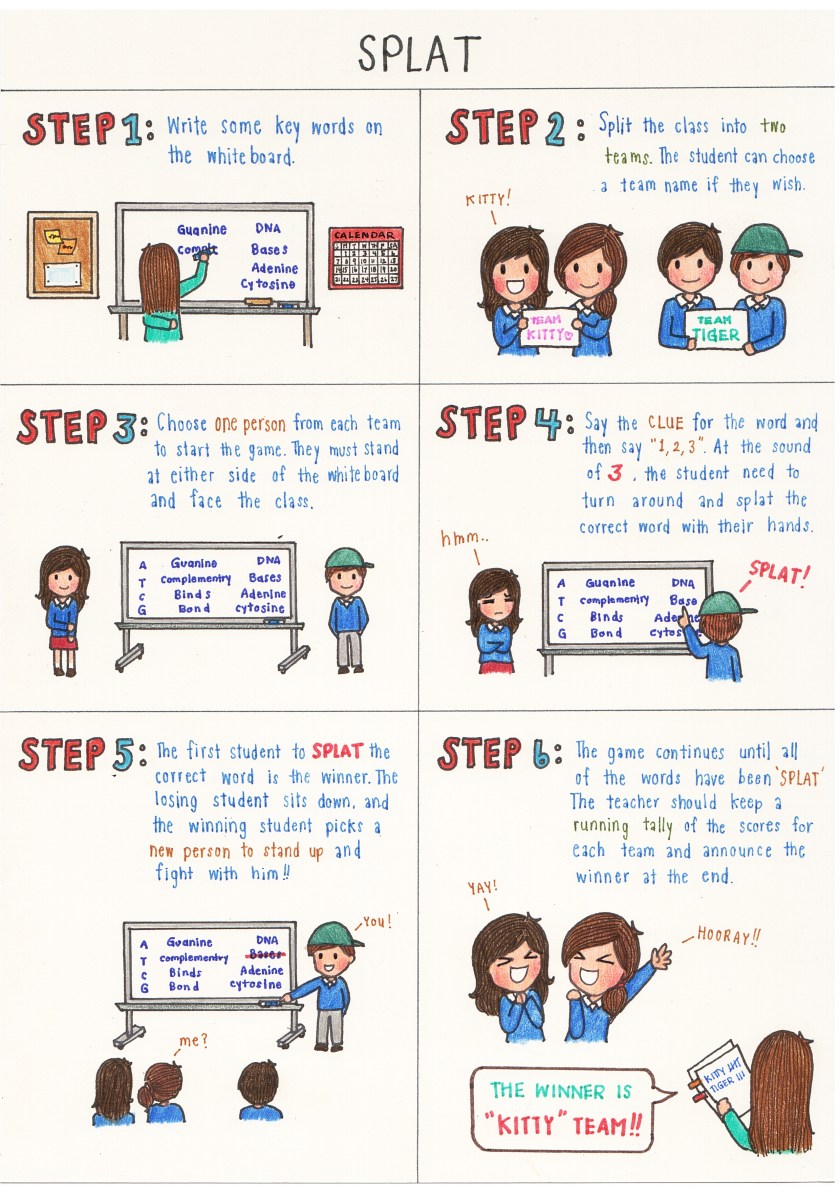
Here are some cool games you can use for any lesson!
Splat: Write a few key words on the whiteboard and you’re ready to go!
Mystery Picture:This one really gets the cognitive juices flowing and it’s a lot of fun!
Mystery Word: Simple and inexpensive. Another vocabulary-based game
Corners:I play this every Friday afternoon with my Year 9 Science class. It perks them up and is very competitive! Great for issuing out House Points, merit stickers or other rewards.
Bingo:Not just a numbers game! Read the game card below to see how it can be applied across different subject areas!
Who am I? :Despite it’s childish nature, kids of all ages love this!
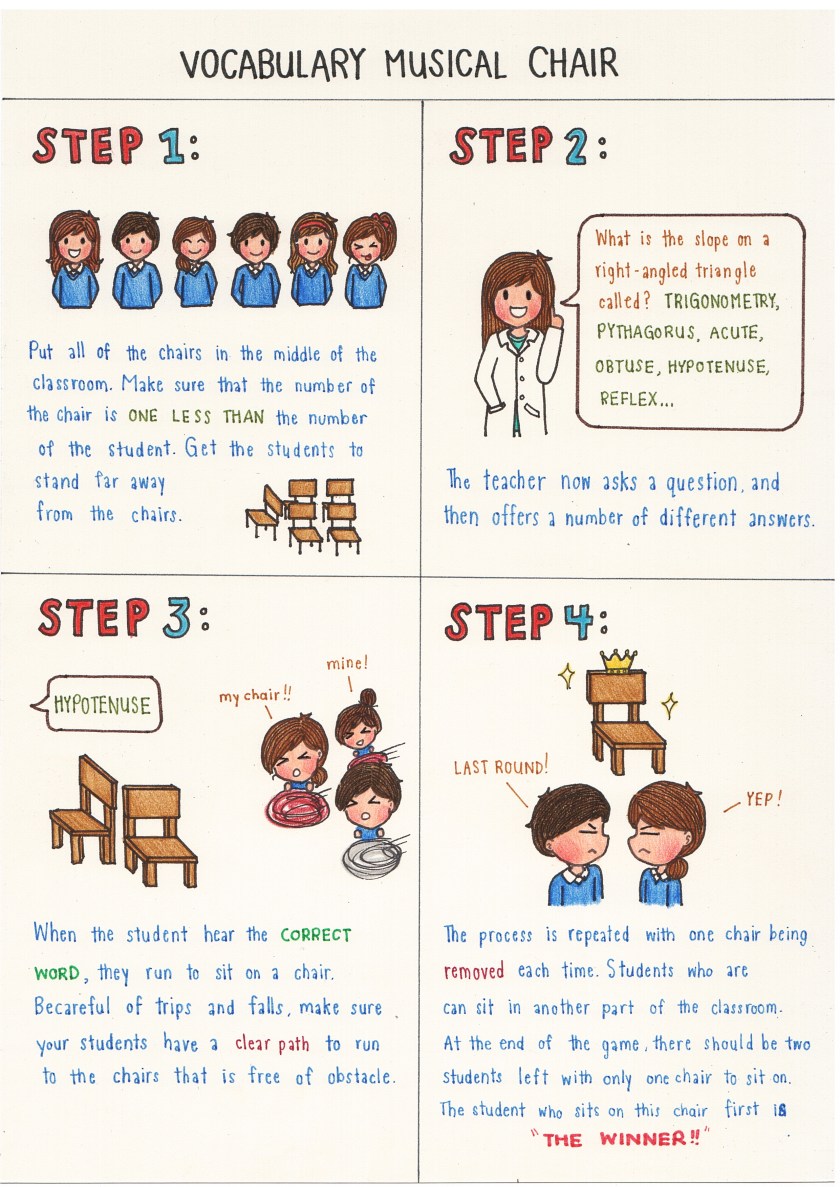
Vocabulary Musical Chairs: Get ready for an exciting class with this one! Make sure there are no obstacles in the way for kids to trip on.
The Poster Game: One of my proudest pedagogical inventions. This game takes some time to set up, but once it’s ready it works like a treat! This game gives you the best of both worlds: fun and deep learning!
Thank you for reading! Please share and please come back to visit us!
In this first of a three-week, three-part series, we’ll be investigating how outstanding teachers keep their students on-task, entertained and engaged every single lesson.
This week, we’ll be focusing on two key areas of active engagement:
The personality traits and pedagogical attributes that are shared by all outstanding educators
The importance that a prompt lesson start has on engaging your learners, along with the best ways to implement this, practically.
For many of us, the end of the academic year is approaching, and many students will be in ‘let’s slack off’ mode right now. As teachers, we need to be more vigilant than any other time in the year right now, particularly with regards to lesson planning and keeping our students on task.
The following extracts come from the Active Engagement chapter of my debut book: The Quick Guide to Classroom Management. I hope the information is useful to you, and don’t forget: we welcome your comments with open-arms! If you’d like to share your thoughts with us then please do comment using the comments box at the bottom of the page.
Are you keeping your students engaged all year-round?
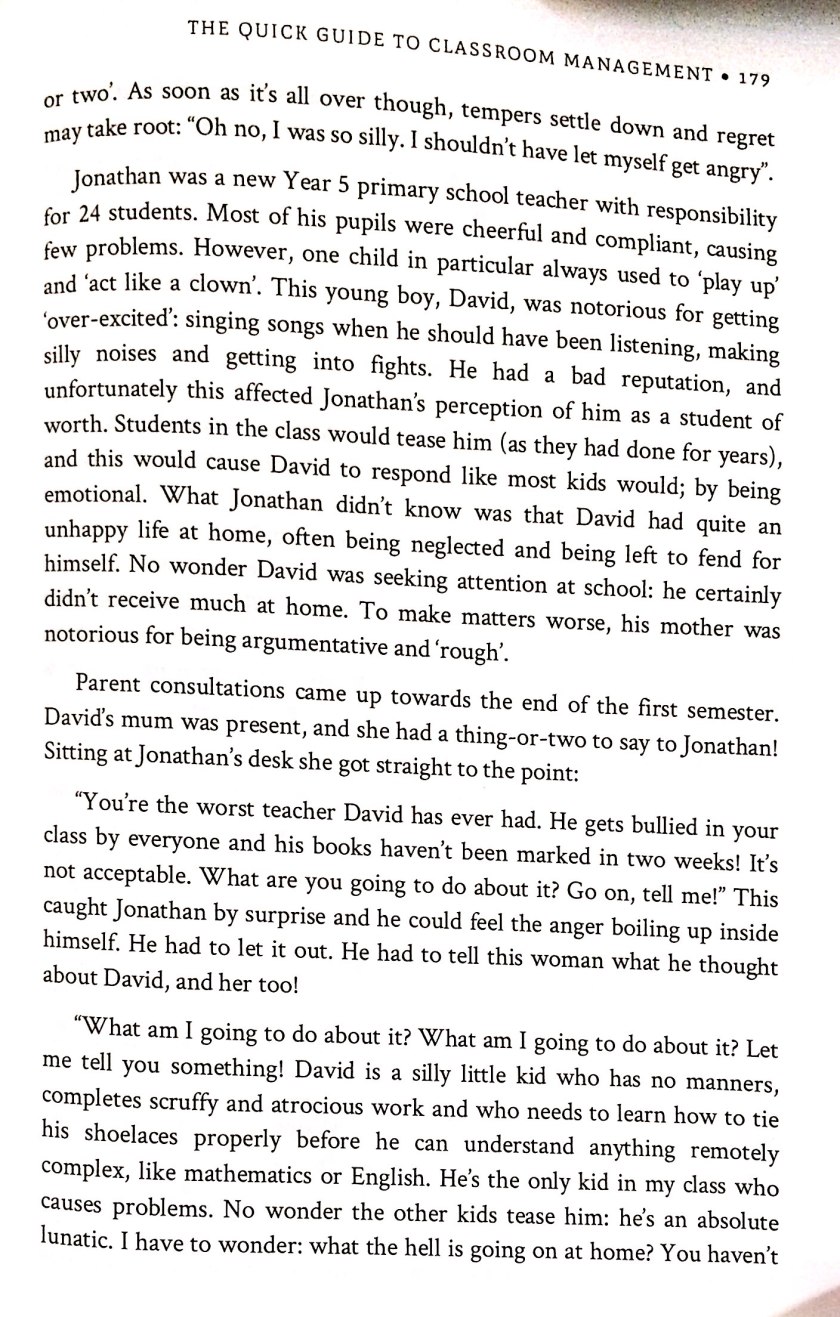
It’s parent’s evening and you know that the mother of your ‘problem child’ will be showing up, and she’s not best pleased! Or maybe you’ve been receiving e-mails from a parent who just won’t quit at nitpicking over the ‘little things’. Maybe you’ve had some personal complaints sent to you from a father who’s a bit ‘aggressive’, or maybe ‘complaints’ have been coming in to the school office and you’re finding out about them from your line manager.
First things first: If any of the above scenarios describe your current situation (or a situation you fear you might find yourself in), then please do not fret: help is at hand.
Working with parents should be a productive and enjoyable part of your job.
Any experienced teacher will tell you that we all face ‘challenging’ parents (although that word: ‘challenging’, conveys the wrong attitude, as I’ll explain shortly). What fewer teachers will tell you, however, is that the key to fostering good relationships with parents is this golden rule:
Parents are yourkey customers.Without parents; all parents, you wouldn’t have a job.Make sure that youtreat every parent like a valuable customer. Every parent deserves the very best level of service from their child’s teachers. This applies especially to parents who have complaints or who grumble on a regular basis.
Once you have this attitude firmly placed in mind, the rest of what I’m about to share will be easy to apply. I wonder how many teachers reading this will be resistant to adopt this mindset!
The following extracts come from my debut book,The Quick Guide to Classroom Management. In these pages, I write about the technique of ‘detached objectivity’, and how it’s a great problem-solver when dealing with parents who have complaints. I would welcome any comments you have from your own personal experiences (please write in the comments section below), and please feel free to share this blog post with anyone you feel would benefit from it.
Would you like the opportunity to appear in my next book?
After the unprecedented success of The Quick Guide to Classroom Management, I’m asking teachers all over the world to write a few paragraphs that would help out a total teaching newbie.
You’ll be helping new teachers, you’ll receive full acknowledgement in my book and I’ll even give away five free books to five lucky contributors!
This is something super cool that you would be able to show to your colleagues and future employers too!
I want to know what advice you would give to a new teacher who’s getting stressed out because they’re marking too much work. What advice would you give to help them reduce their workload, improve their marking efficiency and reduce stress when marking? Do you have a story from your own experience that you would like to share?
Please e-mail your advice to richard_science@hotmail.co.uk, along with your name and any other info you’d like to share about yourself (especially the country you’re writing from). Alternatively, you can comment on this blog post too (please write at least two paragraphs).
I look forward to receiving your replies!
Click on the picture below to find out about this great new book
Every good lesson should end with some form of plenary. A plenary offers the chance to review the concepts, information and skills covered in your lesson, as well as providing a fun way for students to end a session of learning.
Let’s take a look at some of the best plenaries out there – all of which have been tried and tested and have been found to work with any lesson and any subject area. I’ve tried to include those activities that draw out the most cognitive output from the students, and therefore have the greatest benefits. However, if you’re looking for hundreds of quick ideas, then both the University of Southampton and the University of Essex have published documents outlining, briefly, some great plenaries that you can try.
#1 ‘Splat’
This is such a simple game and it’s tons of fun! Any lesson you teach, no matter if it’s playing football in P.E. or writing sonnets in English, will involve the use of specialist vocabulary. Why not review this vocabulary with a fun game at the end of your lesson? It’ll provide your students with a short break and will help them to link concepts together.
#2: Use graphic organizers
Do you know what graphic organizers are? They are becoming increasingly popular in schools and offer a great way for students to link ideas, concepts, information, skills and background thinking in a visual way. Take a look at these examples below, kindly shared by Doug and Melissa over at Write Design. How could you use these (or others – please check the website!) to provide meaningful conclusions to your lessons?
Examples of Graphic Organisers
#3: Play ‘corners’
This is so much fun that you often have to calm the students down half-way through! It’s a very competitive game, and lends itself well to both closed and open questioning. When you couple it with your schools rewards system (e.g. merits or house points) it can really get your kids motivated and thinking. Perfect for a Friday afternoon (trust me – I know).
#4: Cartoon strip
Students create a cartoon strip that goes through what they learnt that lesson. You can even print out a three or six-box grid for the kids if you like. Really gets the creative juices flowing! Students can do this by hand, or can even create comic strips online. The one below was created at http://www.makebeliefscomix.com/ and it only took five minutes!
#5: Bingo
Can be used with words or numbers. Takes some setting up, but is great fun and really helps the students to learn a lot!
#6: Mystery Word
Another simple game. Fun and takes minutes to set up. Kids love it!
#7: Who am I?
A fun and childish game. Kids of all ages love this (even at 18 years old!). Again, simple, easy, fun and productive.
#8: Musical chairs
Can be used with maths problems, vocabulary, concepts or actions. Be careful that students don’t trip up or fall! They need lots of room to run!
#9: Mystery Picture
This is probably the most cognitively challenging plenary that I’ll mention today. It really encourages deep learning, but requires the teacher to have a good control over the class. Worth the effort! Give it a go!
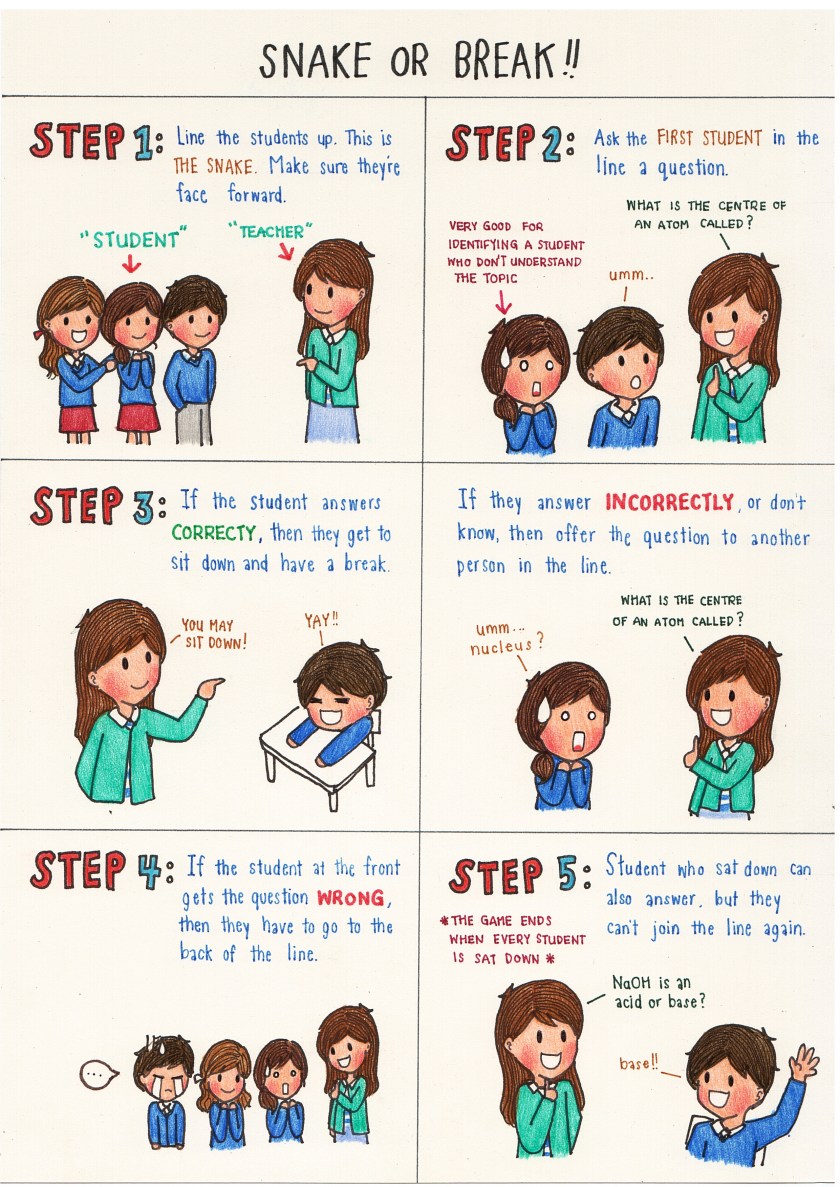
#10: Snake or Break
You’ll need space for this, but it’s simple and fun. Again, can be adapted to suit vocabulary, maths problems, concept questions, etc.
Did you enjoy this article? Why not check out Richard’s book? Now at a discounted price until July 14th!
To celebrate the birthday and life of Arnold Lobel(Born 22nd May 1933), The Quick Guide to Classroom Managementwill be offered at a 40% discounted price for 54 days (representing the 54 years of Arnold’s Life).
Arnold Lobelwas a famous writer who contributed greatly to the education of so many children through delightful books and stories such as Frog and Toad are Friends and Prince Bertram the Bad (which appeared on the famous Jackanory TV series).
He sadly passed away on December 4th 1987, aged 54 years.
Click on the image below to enjoy Richard’s book at this special, limited time price.
N.B.: Thank you so much for coming to my website! You’re amazing! Please comment on this post with your experiences and the methods you’ve used when everything seemed to just ‘go wrong’. I really want this page to be a sanctuary where newbie teachers can come and get some great tips about how to overcome their struggles (and to know that they are not alone!)
All teachers can make innocent, but devastating mistakes at work. As a new teacher, you’re bound to mess up a lot in your first year. So what do you do when everything goes South?
Illustrations byPop Sutthiya Lertyongphati. You can contact her atpopslittlespace@gmail.comif you would like her to do some beautiful illustration work for you too.
Being told off by your line manager when you’re just crossing the threshold of your new career can be an upsetting and stressful experience. You’re bound to make mistakes as a Newly Qualified Teacher, and you’re bound to be told off for them too. It happens to even the very best educators, and if it hasn’t happened to you yet, then don’t be complacent, because everyone can mess up at some point.
What follows next are some tips to get you through those tough times in a way that actually makes you look mature and professional at the same time.
#1: Admit when you’re wrong
Always apologise quickly and sincerely when you slip up. This could be for something relatively minor like forgetting to mark a student’s book, or something more silly like forgetting to turn up for a lesson.
Don’t be afraid of apologizing to students too. If you’re sincere, and you rectify things quickly, you’ll actually come across as being a genuine, human and approachable person. An example might be “Ah yes, Mark, you are right. I did agree to bring that textbook in for you today. It completely slipped my mind. I’ll make sure I pack it tonight for you and I’ll bring it in tomorrow.”
If you are genuinely to blame for what went wrong, then covering up your mistake can be the worst decision you make. When the real truth is uncovered later on down the road you’ll be seen as untrustworthy, deceitful and immature – the exact opposite of how you want to come across.
#2 Sleep on it
I know many teachers who have received aggressively toned, accusatory e-mails from bosses and line managers whilst in their early years of teaching, and later on too. It’s happened to me as well, and it can cause a wave of emotions to flood your thoughts and perceptions. Anger, fear, hatred, panic, worry and, of course, the desire to justify yourself.
When this happens, the best thing you can do is take a deep breath and relax. If possible, wait until the next day to send your response or to speak to the person in question. You’ll be in a better frame of mind, and your brain will have had the chance to process the information and think about solutions, subconsciously and unconsciously, whilst you were asleep (and make sure you do sleep: Tomorrow will deal with itself. Don’t toss and turn in a fit of worry the night before. Life is too short.).
This approach can be phrased as being ‘proactive, not reactive‘.
The worst thing you can do when you receive a flame (the technical name for an angry or aggressive e-mail) is to react instinctively by sending an equally aggressive reply. You’ll be acting on the basis of emotion, probably with a high desire to prove yourself right, and you could end up really annoying your boss in the process.
#3 Focus on solutions, not on justifying yourself
I once worked with a colleague who was in a right fit of worry. He was a trembling wreck, and was convinced he was going to lose his job.
The previous week, he had been leading a really fun activity with his class which involved singing, dancing and making wall art. The class loved it, but one student decided to covertly record part of that lesson on his mobile phone. The video later appeared on YouTube, and was brought to the attention of my friend’s line manager.
“What the hell am I going to do Richard? This is it, I know it. I’m finished. My career is in the toilet now”
I calmed him down and told him that nothing was ever that final in life. I told him that the very first thing he should say to his boss was not “I’m sorry, it’ll never happen again”, or “I asked all the kids for their mobile phones and he hid his” or any other justification. The damage had been done. The first thing he should say to his boss is “How can we solve this?”.
He took my advice and later reported that the conversation with his boss went a lot better than he thought it would. As soon as he shifted his focus towards solutions, his boss agreed to ask that student to delete the video off YouTube and to ask him (the student) to apologise to his teacher, which he later did. The whole situation was forgotten about that same day, and life went on as normal.
My colleague was wise that day. He realised that justifying yourself when being accused of something by your boss, especially when you’re in the wrong, only leads to conflict and argumentation. By making the focus of the conversation squarely on solutions, my colleague came across as being mature, in control of his emotions and committed to the greater good of the school.
#4 Speak with your line manager
There will be times when things happen, and you just won’t know what to do to solve the situation. Whether this is because you’ve made a mistake or not, you should always speak with your line manager, or someone with more experience than you.
A classic example of this scenario happened to me in my first year of teaching practice. I was walking along the corridor on a free period when I saw a student, who was supposed to be in class, just walking about aimlessly.
I stopped him, and asked him if he was okay and if he needed some help, when suddenly his teacher popped her head out of the classroom door and looked at me as if I was the most evil man in the world. She ushered the boy into her room (she’d sent him out of class, but I didn’t know that).
After class that teacher saw me in the science prep room and gave me a right telling off. “Richard, don’t you ever talk to my students again. I am well-capable of dealing with behavior issues. I don’t need your help”. Woah!! Now where did that come from?
I was fuming. I was doing my job and being told off for it. Ridiculous, I thought. What an arrogant, silly old bat she is. I was really mad. I asked to speak with my head of department, because I’d rather he heard my side of the story before he received a complaint next week.
We sat down together and I told him the story I just told you. He calmed me down and said “Don’t worry Richard”. He explained how that teacher had a very disruptive and challenging class that Friday afternoon, and she’s probably a bit stressed out. He advised me to just let it go and have a good weekend.
I took his advice and I’m glad I did. The situation was never brought up again. It was totally forgotten about by everyone.
Oftentimes, as teachers, we worry too much about silly things. If you ever find yourself worrying about a situation, then you have nothing to lose by talking it over with a more experienced colleague. I’ve used this principle many times in my career with great affect.
#5 Listen first, then explain
If you genuinely haven’t done anything wrong, or if you’ve been misunderstood, then you’ll need to explain your side of the story. Failure to do this may cost you your job.
Your line manager or principal might be angry with you about something. Let them vent first. Don’t get tense. Relax, and listen. Don’t react to the bubbling up of your negative emotions.
When the chance arises, calmly and politely explain your case. You’ll be surprised in the change of mood this will generate in your once angry boss. You’ll come across as mature and level-headed.
#6 Keep people updated
I was once accused of allowing my tutor group to graffiti on the tables in the Science lab. Of course, it wasn’t my kids. I knew this because we only had ten minutes together each morning and my eyes were on them throughout this. But how could I be proactive in ensuring that my name was cleared?
I set up a ‘graffiti log book’, and every morning at registration I would get my students to tell me if they saw any new graffiti on the desks. I also diligently went around the class and checked the desks myself, to really make sure that it wasn’t my kids that were making the mess.
After two weeks I presented my log book to the line manager that had accused me originally. I politely suggested that the graffiti was probably happening in the main lessons of the day, when students have up to an hour per session to scribble something on a desk.
My line manager appreciated my diligence, and we set up a monitoring system to ensure that kids who graffiti’d were identified quickly and made to clean up their mess. We even had special ‘graffiti cleaning kits’ set up in the prep room.
#7 Seek Advice
There will be times when you don’t know what to do. Instead of stewing around and worrying about things, or even plodding along and just ‘getting by’, use your inexperience as a chance to grow and develop.
A story from my own life journey comes to mind here. I was an NQT (Newly Qualified Teacher) at a school in northern England and I was having problems with Behaviour in one of my Year 9 classes. I tried sanctions, tellings off, rewards for good effort and even bringing in chocolate to give to the students if they worked hard. Each strategy worked to some degree, but collectively things were still not perfect .
I spoke with a senior colleague of mine in the Science department and he gave me one tip that had an almost instantaneous transformative effect on my classroom management. He advised me to focus my attention on the work being done and not on the student who was being disruptive. “Instead of saying something like ‘John, why aren’t you working?, or ‘John, you’re not concentrating’, try ‘John, how’s that work coming along? Are you finished yet?” Wow. Such a simple piece of advice but it helped me a lot. I would later write a whole chapter about behaviour management in my debut book, in which this technique played a significant part.
Speaking with your colleagues about your problems presents another benefit too. The people from whom you seek counsel will feel flattered that you consider them in such high esteem and will, consequently, be happy to help you out. By seeking help you also show that you are mature enough to realize that you don’t know everything, and when you share your problems you’ll often find that other people are going through similar problems in their lives too.
Did you find this post useful? Why not check out Richard’s books? Rated 5 stars on Amazon, and enjoyed by thousands of teachers globally, Richard’s work has earned a place in the global pedagogical hall of fame.
Book trailer: The Quick Guide to Classroom Management


 heavy (e.g. around the time when reports need to be written, parent consultations take place and when exams and tests need to be taken). Think about the assignments and homework you will set, and plan ahead so that you spread out your marking evenly over the whole year. This will save you many a future headache!
 how it makes sense to get a head-start.