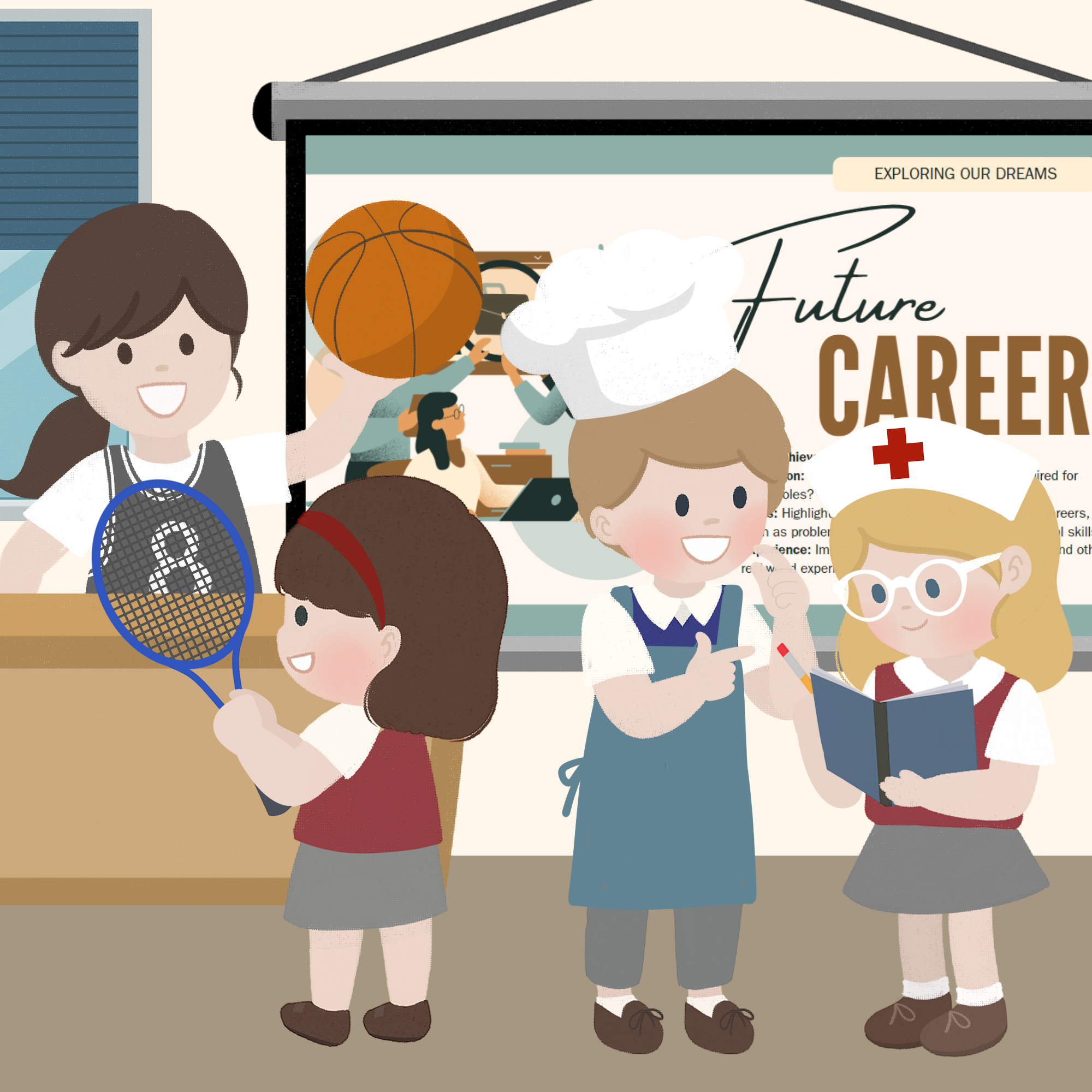
An article by Richard James Rogers (Award-Winning Author of The Quick Guide to Classroom Management and The Power of Praise: Empowering Students Through Positive Feedback). This blog post has been beautifully illustrated by Pop Sutthiya Lertyongphati.

Sometimes it is necessary for teachers to reflect on the overall purpose of education. After all, knowing the why will often give us new perspectives on the how.
Many thought-leaders have articulated their ideas on what the purpose of education should be. Some notable quotes are given below:
“The purpose of education is to give to the body and to the soul all the beauty and all the perfection of which they are capable.”
– Plato
“The goal of education is the advancement of knowledge and the dissemination of truth.”
– John F. Kennedy
The object of education is to prepare the young to educate themselves throughout their lives.”
– Robert Maynard Hutchins
In my 2019 blog post entitled 5 Things Schools Should be Teaching Kids (But Most Aren’t) I came straight to the point with my thoughts on what the purpose of education is (albeit much less elegantly that the esteemed individuals quoted above):
School must prepare students for life
– Richard James Rogers
My statement is probably most aligned with that of Robert Maynard Hutchins (the legendary American educational philosopher and former Chancellor of the University of Chicago and, to my shame, a person I had only heard about during my research for this blog post). It brings me great satisfaction to know that I and such an esteemed and well-respected educator are pretty much in agreement: even if our opinions are more than a few decades apart! (Hutchins was born in 1899).

Schools must prepare students for life, but what does that actually look like in 2025 (and beyond)? Today, I’ll deliver a condensed version of my research into the top 5 skills employers are looking for, and what schools (and, by inference, teachers) should do about it.
#1 In-Demand Skill for 2025: AI Literacy and Human/AI Collaboration
Unless you’ve been meditating in a remote forest somewhere for the past three years, you’ll know that AI, and particularly GenAI, has skyrocketed in capability, use-applications and accessibility. Everybody who’s anybody in the corporate training or online education sector is offering courses in AI integration and for a good reason: there’s a lot of money to be made! Additionally, the World Economic Forum’s Future of Jobs Report 2025 lists “AI and big data” as the top technological skills that are projected to “grow in importance more rapidly than any other skills in the next five years”.
I will admit openly that I have also jumped on this bandwagon: I have personally completed four very detailed online courses covering AI integration this year (see my LinkedIn profile for details) and I now offer AI integration as one of my corporate training workshops (and it’s proving to be one of my most popular).
Bottom line for teachers:
- Learn AI skills and get certified (there’s lots of free and inexpensive courses available online).
- Once you have some foundational knowledge (or have access to someone who does) build a spiral AI curriculum (including ethics, prompting, verification, model limits), and embed AI use across subjects in schemes of work (e.g., AI-assisted drafting in English; model evaluation in Science, and so on).
- Keep up to date with the latest use cases of AI in education (this topic stream by Edutopia is well-worth bookmarking!)

#2: In-Demand Skill for 2025: Data Literacy and Analytical Thinking
In July 2025, Elon Musk weighed in on the debate about what children should study in the age of AI. Responding to a call for students to prioritise mathematics, he argued that the true focus should be “Physics (with math)”, highlighting his belief that a deep grasp of fundamental principles, supported by mathematics, is more valuable than coding alone in an AI-driven world. Additionally, The World Economic Forum’s Future of Jobs Report 2025 makes clear that analytical thinking is still one of the top core skills employers expect to be in high demand by 2030.
Bottom line for teachers:
- Encourage deep learning (as opposed to ‘surface learning’) in all subjects through guided activities (see my blog post here as a starting point).
- Require students to source and clean datasets from time-to-time and include activities where students choose appropriate displays, quantify uncertainty, and write claims with evidence. My blog post entitled Putting Numbers Into Everything offers a good launchpad of ideas from which you can start this process in your lessons.

#3: In-Demand Skill for 2025: Cybersecurity and Digital Trust
According to the 2024 ISC2 Cybersecurity Workforce Study (which is the latest available study, at the time of writing), the world is short of nearly 4.8 million cybersecurity professionals, and almost nine out of ten teams say they lack key cybersecurity skills. With AI bringing both powerful new tools and serious new risks, the call is growing for people who can think critically about digital safety and design systems that are secure from the start. For schools, this is a clear signal: cyber-awareness and responsible use of AI should be part of every student’s education, not just for future specialists but for all young people who will live and work in a digital world.
Bottom line for teachers:
- Build cyber-awareness into everyday lessons. Connect topics like passwords, phishing, and data privacy to students’ daily digital use, not just to IT classes.
- Treat AI as both a tool and a topic. Encourage students to explore how AI can help (e.g. with research and problem-solving) while also discussing its risks (such as bias and security breaches). This great blog by LittleLit gives five AI tools that can be tailored for use by children, and I would recommend all teachers reading this to look at ways to bring a few of these into your lessons.
- Practise ‘secure-by-design’ thinking: When students create projects, apps, or even presentations, have them consider safety, privacy, and ethical use as part of the design process. See my blog post about design thinking to get started.

#4: In-Demand Skill for 2025: Sustainability Literacy
Employers are warning about a major shift from 2025 onwards: environmental stewardship is expected to be one of the fastest-growing skill demands globally. Recruitment needs for so-called “green skills” is already rising more quickly than the supply of qualified workers. LinkedIn’s Global Green Skills Report 2024/25 shows that this growth will continue worldwide, with the gap between demand and supply projected to widen steadily through 2030 to 2050.
Bottom line for teachers:
- Use real data in lessons: In maths or ICT, have students analyse datasets on carbon emissions or renewable energy growth. This builds both numeracy and awareness of global sustainability trends. National Geographic Kids is a great resource for acquiring some useful data for projects.
- Run project-based learning on green innovation: In science or design technology, set tasks like designing a low-waste product, creating a model of a solar-powered device, or calculating the energy savings from switching to LED lighting. Initiatives that encourage students to reduce single-use plastic, or to reduce printing costs, can also raise awareness in powerful ways.
#5: In-Demand Skill for 2025: Communication
According to Lightcast, a leading labour-market analytics firm, 76% of job postings request at least one durable (human) skill, with communication consistently ranking among the most in demand. The World Economic Forum highlights related skills such as creative thinking, resilience, and leadership/social influence as essential for the workforce of 2025 and beyond.

Bottom line for teachers
- Do more in-class group/individual presentations. Students can use Google Slides, Canva or other technology to present their ideas. See my blog post on tips for slide presentations (aimed at teachers, but applicable to students) for top tips on getting the delivery right.
- Design lessons that force students to work through ambiguity, such as group work, debates, and peer review, so they build resilience, leadership, and creative thinking, which are rising fast as employer priorities.
Conclusion
So what does all of this mean for us in the classroom? The future world of work is crying out for five big things: AI know-how, data smarts, cyber-savvy thinking, green awareness, and those all-important human skills like communication and resilience. The good news is that we don’t need to bolt these on as extra lessons. Instead, we can weave them into what we already do: use AI tools for research, crunch real-world data in maths or science, chat about online safety whenever tech comes up, link projects to sustainability, and give students plenty of chances to work together and present their ideas.
Bibliography and references
- Aristotle. (1992). Politics (trans. B. Jowett). Chicago: Encyclopaedia Britannica.
- Kennedy, J.F. (1963). Public Papers of the Presidents of the United States: John F. Kennedy, 1963. Washington, DC: U.S. Government Printing Office.
- Mann, H. (1846). Twelfth Annual Report to the Massachusetts Board of Education. Boston: Massachusetts Board of Education.
- Rogers, R.J. (2019) 5 things schools should be teaching kids (but most aren’t). Richard James Rogers [Blog]. 21 April. Available at: https://richardjamesrogers.com/2019/04/21/5-things-schools-should-be-teaching-kids-but-most-arent/ (Accessed: 14 September 2025).
- Leopold, T. (2025) ‘Future of Jobs Report 2025: The jobs of the future – and the skills you need to get them’, World Economic Forum. 8 January. Available at: https://www.weforum.org/stories/2025/01/future-of-jobs-report-2025-jobs-of-the-future-and-the-skills-you-need-to-get-them/ (Accessed: 14 September 2025).
- Times of India (2025) ‘Math or Physics? Telegram’s Pavel Durov tells students to pick math; Elon Musk says pair it with physics’, Times of India, 16 July. Available at: https://timesofindia.indiatimes.com/education/news/math-or-physics-telegrams-durov-tells-students-to-pick-math-musk-says-pair-it-with-physics/articleshow/122565037.cms (Accessed: 14 September 2025).
- Rogers, R.J. (2018) Putting numbers into everything. Richard James Rogers [Blog]. 26 August. Available at: https://richardjamesrogers.com/2018/08/26/putting-numbers-into-everything/ (Accessed: 14 September 2025).
- Rogers, R.J. (2022) Deep learning vs surface learning. Richard James Rogers [Blog]. 24 May. Available at: https://richardjamesrogers.com/2022/05/24/deep-learning-vs-surface-learning/ (Accessed: 14 September 2025).
- ISC2 (2024) 2024 ISC2 Cybersecurity Workforce Study: Global Cybersecurity Workforce Prepares for an AI-Driven World. Available at: https://www.isc2.org/Insights/2024/10/ISC2-2024-Cybersecurity-Workforce-Study (Accessed: 14 September 2025).
- LittleLit AI (2025) ‘Forget ChatGPT! These AI tools for kids will blow your mind’, LittleLit AI Blog. 25 January. Available at: https://www.littlelit.ai/post/forget-chatgpt-these-ai-tools-for-kids-will-blow-your-mind (Accessed: 14 September 2025).
- LinkedIn Economic Graph (2024) Global Green Skills Report 2024. Available at: https://economicgraph.linkedin.com/content/dam/me/economicgraph/en-us/PDF/Global-Green-Skills-Report-2024.pdf (Accessed: 14 September 2025).
- National Geographic Kids (no date) Environment – Teacher Resources. Available at: https://www.natgeokids.com/uk/teacher-category/environment/ (Accessed: 14 September 2025).
- Rogers, R.J. (2022) How students can help reduce single-use plastic. Richard James Rogers [Blog]. 19 January. Available at: https://richardjamesrogers.com/2022/01/19/how-students-can-help-reduce-single-use-plastic/ (Accessed: 14 September 2025).
- Rogers, R.J. (2021) 3 ways to reduce your printing costs at school. Richard James Rogers [Blog]. 22 December. Available at: https://richardjamesrogers.com/2021/12/22/3-ways-to-reduce-your-printing-costs-at-school/ (Accessed: 14 September 2025).
- Lightcast (2025) ‘New research tracks the growing demand for durable skills’, Lightcast Blog. 6 August. Available at: https://lightcast.io/resources/blog/growing-demand-for-durable-skills (Accessed: 14 September 2025).
- Rogers, R.J. (2023) 5 mistakes teachers are making when delivering slide presentations. Richard James Rogers [Blog]. 5 November. Available at: https://richardjamesrogers.com/2023/11/05/5-mistakes-teachers-are-making-when-delivering-slide-presentations/ (Accessed: 14 September 2025).


Check out my award-winning book on Amazon (click on the image below):