As teachers, we often form strong connections with our students as we guide them on their learning journeys. This can be incredibly rewarding for us – we gain much joy from helping our students to improve. However, it’s essential to maintain a professional distance to ensure that our relationships with students remain appropriate and conducive to learning. The following ten guidelines, adapted from research by Willing and Haney (1994), provide a framework for maintaining this balance. Please note that William and Haney’s research was aimed at ABE (Adult Basic Education) teachers, so I have attempted to back-extrapolate the guidance to cover high-school teaching.
Before we begin
An important note on context before we start – the guidelines described in today’s blog post are exactly that – general principles to consider. ALWAYS follow your school’s official guidance regarding professional distance – and if you’re not sure about what the expectations are for a particular scenario, then seek advice from a member of your school’s senior leadership team.
Rule #1: Know Your Own Vulnerabilities
Understanding your own personal “shadows”; unmet needs, motivations, and expectations; is crucial. As teachers, we often enjoy the appreciation we receive from students, but it’s important to avoid crossing the line into a co-dependent relationship. Recognizing this helps ensure that your role remains that of an educator, not a confidant. Whilst our students may wish to divulge sensitive information to us, it’s important that this information is passed on to the appointed safeguarding individuals in your organization in a professional manner (more on this later).
Rule #2: Understand the Temporary Nature of the Relationship
Teaching is a temporary relationship. While it’s easy to feel close to students, allowing them to perceive you as a friend can imply a level of commitment that neither party is prepared to uphold. This understanding helps in setting clear boundaries from the outset.In addition to this, the teaching role requires there to be a level of authority present within the classroom – and that authority belongs in the hands of the teacher. It is difficult to exercise a level of authority when students perceive you as a ‘friend’. We are not our students’ friends – we are their educators, and that means our focus must be on maximizing our students’ attainment and progress, and not on anything else.
Rule #3: Know Professional Standards for Behaviour
Familiarize yourself with your institution’s guidelines for out-of-class interactions with students. These rules are in place to protect both you and your students, ensuring that all interactions remain professional.
If you are someone who is designing a child safeguarding policy for your school, or if you’re seeking extra guidance, then you should definitely familiarize yourself with national and international guidelines. Some useful documents are linked below:
Please note that these resources may be updated at any time, so make sure you are accessing the latest versions of the guidance.
Rule #4: Be Mindful of Your Communication
The way we communicate, through touch, language, or self-disclosure, sends messages to students. What might seem like a harmless gesture, or a casual conversation, can be misinterpreted, potentially blurring professional boundaries.
In the context of a high school teaching scenario, self-disclosure on the part of the teacher can be damaging – not least because it leads to excessive familiarity, which we should aim to avoid. Some forms of disclosure, such as describing the study habits and techniques we successfully implemented when we were students, may potentially be helpful to our learners – so, of course, there are levels to this! Revealing a personal story of pain and tragedy, however, may be not an appropriate activity for a lesson.
Seek official school guidance on the matter. In addition, when describing useful scenarios that involve a level of storytelling to students, you may wish to precede the description with….
Some people experience/find that…………………………..
In my experience, students who perform well do these things……………………..
I once knew someone who…………………………
Keeping stories in a kind of ‘third person’ context can help to maintain professional distance.
In terms of touch, it is essential that you adhere to your school’s Code of Conduct and guidance. In the majority of high-school scenarios, touch should NEVER be initiated by the teacher unless:
There is an educational purpose to the physical contact, such as adjusting body posture in a physical activity (e.g. adjusting a student’s stance in a martial arts lesson), music lesson (e.g. holding a violin bow correctly), art activity (e.g. holding a paintbrush correctly) or other scenarios. ALWAYS ask the students’ permission before initiating the physical contact and double-check with your school’s senior leadership team before beginning the course.
There’s an essential Health and Safety purpose, such as rescuing a child from drowning, administering first aid, preventing an accident (e.g. in science class) or other scenarios.
Rule #5: Express Clear Expectations
Clearly outline the time boundaries, the learning process, and what is expected from both you and your students. This helps in establishing a professional relationship where everyone knows their roles and responsibilities.
You may to consider giving your students some time to create a class list of expectations that everyone will agree to follow. In my experience, students will often approach this with maturity and will come up with sensible suggestions, such as….
We will raise our hands if we have questions, and we will not shout out.
We will not play on our phones in class, and we will ask for permission to use our phones if we need to.
We will complete our homework on time.
We will be punctual to class.
It may be useful to bring out this list from time to time during the academic year to remind the students of the rules and expectations they have come up with.
Rule #6: Consider Students’ Perceptions of Interaction
Recognize that students may interpret personal information sharing or familiar language as signs of a personal relationship. Understanding this helps you maintain a professional distance.
Rule #7: Be Aware of Cultural Differences
Cultural expectations regarding interactions between teachers and students can vary widely. What may seem normal in one culture could be inappropriate in another. Being culturally sensitive helps in maintaining professional relationships.
Rule #8: Use Names Appropriately
The use of first names or nicknames can unintentionally create a sense of intimacy, especially when it comes to how students are expected to address their teachers. Be mindful of how you address students too, as this can affect the professional nature of your relationship.Only use the students’ official names as recorded in the school register and double-check with a senior teacher if a student requests to be addressed by a different name. Check your school’s guidance on how students should address teachers, too.
Rule #9: Dress Professionally
Your attire sends messages about how seriously you take your role. Dressing too casually can give the impression that the educational process is not important, while overly provocative clothing can cause discomfort in diverse cultural settings.
Unfortunately, whilst the issue of teacher dress codes was pretty much cut-and-dry in the twentieth century and earlier, it has become quite a controversial topic to discuss in recent years. I think it is useful to remind ourselves that, as teachers, we are representing the process of education (not just our own personal fashion preferences) through the way that we choose to dress.
Case in Point: An Anchorage District teacher was put on administrative leave after posting a clip of herself in the classroom, on X. The clip was shared by the hugely popular Libs of Tik Tok account, and the teacher in question received much criticism online due to the way she was dressed at school. You can read the full story, here.You may also wish to read my blog post which contains guidance on how teachers should behave on social media, here.
Rule #10: Know Referral Resources
Familiarize yourself with resources available for student referral and how to guide students to them. This helps in addressing students’ issues without becoming personally involved in their problems.For example, you may be lucky enough to have a school counselor employed on-site that you can refer students to. If not, then look into official partnerships the school has with local agencies and professionals.
Conclusion
By following these guidelines, we can maintain a healthy balance between being approachable and upholding the professional standards necessary for effective teaching. It’s about fostering a positive learning environment while protecting both yourself and your students from unwanted issues.
Bibliography
Willing, D.C., & Haney, H. (1994). Maintaining “Professional Distance”: A Dilemma for the ABE Teacher. Developments, 10(4), 6-7. Available at: https://files.eric.ed.gov/fulltext/ED372265.pdf(Accessed: 18 August 2024).
One of the biggest factors that will determine your effectiveness in the classroom as a teacher will be your confidence in front of your students. Your students can only have faith in you if you have faith in yourself.
In today’s blog post, I will go through the top three actions you can take to immediately boost your classroom confidence as a teacher. These tips will prove to be equally useful for both trainee teachers and more experienced educators. Let’s get started!
#1: Know the topic you are teaching REALLY well
By far the best way to boost your confidence in the classroom, or even in any public presentation you will give (e.g. at a talk, seminar or assembly) is to have excellent subject knowledge.
This does NOT mean that you must have a master’s degree or a PhD to be an excellent teacher (on the contrary, some research even indicates that gaining an advanced degree has no effect on a teacher’s overall effectiveness). What it does mean, however, is you must read ahead, you must understand all of the content you are delivering to your students, and you must thoroughly understand how you will use the resources you have selected. Consider enacting the following action steps:
Read over the lesson material before you deliver the lesson. Do NOT assume that, just because you have a degree in this subject area or because you have taught the lesson a few times previously, that you will automatically understand all of the content. It can often be quite surprising just howmuch you may have forgotten when you read over the lesson materials again.
Never provide resources that involve questioning (e.g. worksheets and live quizzes), if the model answers are not available. Also, make sure you have read over the model answers to such questions and that you understand those answers really well.
Check out my award-winning book on Amazon today!
Subject knowledge is the ultimate confidence booster because it allows you to walk into a lesson knowing the ins and outs of what you will teach. Knowing the topic really well also prepares you for any questions the students may have on the content, and also provides you with the skills you need to provide your students with exam-style practice (never neglect that, too).
#2: Plan EVERY lesson thoroughly
Even if you have been teaching full time for twenty years (as I have), you must still go through the process of planning each and every lesson. This does not mean that you need to write a full A4 lesson plan for every class, like you did when you were a trainee. What it does mean, however, is that you should know the ‘running order’ of activities for every lesson you deliver. A good lesson should include the following:
A quick starter activity (see this link for ideas)
Between 1 and 3 activities that make up the body of the lesson
A quick plenary that summarizes what was covered (see this link for ideas)
I recommend using EdTech where possible for any part of your lesson. Live quiz apps are really good, as are shared collaborative whiteboards like Miro and G Suite tools.
Research tells us that lessons that are planned are almost always more effective than those that are not. For me personally, I simply use a teacher’s planner (see this link for the planner I created that you can purchase) and I include a few bullet points of notes for each lesson. I also do a weekly review, so that I know where I am at and where I need to go next. You can read about my top lesson planning tips at this very popular blog post.
#3: Utilize Professional Intelligence
What is ‘Professional Intelligence’ you might ask? Well, put simply, it is professional knowledge that you have gathered about your students. The kind of information you should acquire includes, at a minimum:
Student names – these can take a while to remember, even for the most seasoned educators among us. Consider utilizing live quiz apps in your first few lessons – these will help you to quickly identify the students’ preferred names.
Which students work well together and which students should be kept apart – this information can be gathered by simply talking with colleagues and line managers about the students before you meet them, or you can gather this information firsthand by trying out a few group games and activities.
Any students with Additional Learning Needs/Special Educational Needs in the class – make sure you have read their Individual Education Plans (if available), spoken with the Special Educational Needs Coordinator (or the equivalent person in your school) and check out this blog post for tips on helping such students.
You may also want to gather non-confidential information about your students, such as hobbies and interests, as this may help you to create lessons that are tailored to student preferences. Also, don’t forget to check on the running order of school events – some students may need to leave class early, for example, to attend some kind of school event (e.g., orchestra practice) – have you planned for that?
Conclusion
Every teacher must exhibit confidence in the classroom in order to deliver an effective lesson. Much of this will come from experience, but even the most seasoned educators must enact three main action items before any lesson begins:
Read ahead and understand the topic you will be teaching
Plan every lesson, even if that just involves writing a few bullet points that go through the running order of activities
Gathered (and thought about how to utilize) professional intelligence
As teachers, we are mindful of the omnipresent and aspirational societal expectations that we are constantly subject to. Whilst these expectations vary slightly from country to country and territory to territory, we are generally expected to be better behaved, more mature and more conservative than those who work in the majority of other professions, fields, trades and industries.
There are good reasons for this, of course. Children are guided by us and look up to us, so we have to be exceptional role models for them. In some countries, like the UK for example, we are even given the glistening designation of ‘Person of Good Standing’ and are even entrusted to sign people’s photographs to aid in their application for new passports.
Since we are expected to be so much, for so many people, this can leave many of us wondering how to seek out a new relationship partner. Are we allowed to have a dating profile, for example? What would happen if a member of the public recognised me on a dating app? Would they have grounds to complain to my school? Which dating apps are acceptable for teachers to use? Should we use more conservative dating apps, like Bumble, or can we go for apps that (unfortunately) have been tarnished with the reputation of being more ‘hookup’ focussed, like Tinder?
In this blog post I aim to answer these questions as best as I can.
What’s the official guidance on teacher conduct as it applies to dating app usage?
Whilst teaching regulatory bodies from various countries and jurisdictions have issued extensive guidance regarding teachers’ use of social media and electronic communication, there appears to be no specific government-issued guidance exclusively for teachers regarding dating apps at the time of writing. However, there are some general guidelines that have been issued by various educational and safety organisations that I will delineate below:
Schools generally have codes of conduct that include guidelines on social media use, which can (sometimes) extend to dating apps. Teachers should maintain strict privacy settings on their social media accounts and avoid mentioning their school or adding students and parents as ‘friends’ online. The guidelines outlined in a typical school’s Code of Conduct/Staff Handbook are intended to protect teachers’ professional reputations and prevent any potential conflicts or inappropriate interactions (Schools Week).
The UK Safer Internet Centre reiterates and emphasises the importance of online safety for educators. Teachers are advised to be cautious about the personal information they share online and to separate their professional and personal lives as much as possible. This extends to our behaviour on dating apps to ensure we do not compromise our professional integrity. They recommend not using location-based dating apps at work to avoid unintentional interactions with students or colleagues (UK Safer Internet Centre).
Although specifically for doctors and dentists, Health Education England has issued guidance that can be relevant to teachers as well. This guidance advises against using dating apps at work and highlights the risks of geolocation features on these apps, which can inadvertently expose users to colleagues or students. It also stresses the importance of maintaining professional standards online and avoiding any actions that could lead to reputational damage or legal issues (Health Education England North East).
My personal advice on this issue
The good news for all of us is that, in the absence of official government guidance specifically for teachers and their dating app usage, it would be challenging for any school to enact disciplinary procedures on the grounds that a teacher simply has a dating profile to begin with. However, the rules and expectations become blurry when considering how we should behave on such apps, as this does fall under the umbrella category of ‘acceptable social media usage’ and ‘acceptable electronic communication’. Here are my guidelines to keep teachers as safe as possible when using dating apps:
In the first instance, check your school’s Code of Conduct and Staff Handbook, to see if any mention is made of dating app usage. Also, check the employment contract you signed – that may also contain references to dating apps, and your contract may also legally bind you to the terms outlined in the Code of Conduct/Staff Handbook.
Most teachers won’t feel confident enough to ask their headteacher or a member of the Senior Leadership Team about guidance regarding dating app usage. After all, it’s a very personal topic and not something we want to raise at work, especially with our bosses! However, it may be a wise move to seek such advice (and get the guidelines in writing – as an email, for example) as at least then you’ll be clear about the school’s expectations. This written confirmation from your Headteacher or other senior leader will also serve as protection should a parent/student see your dating profile and complain in future. In the unlikely case of litigation being filed, that email you asked for could be a key piece of evidence for your defense lawyer to use in a court case.
Once you’ve been given the green light to actually have a dating profile to begin with (either through your inspection of school documents, such as your contract, or via a discussion with your Headteacher/Senior Leader), you then need to be mindful of your dating profile. Keep it clean, make sure your photos are clean and do not mention your school in the profile – you almost always need permission to mention any organization in a social media post. If you mention your school on your dating profile, then they could use that as a key piece of evidence in any disciplinary proceedings that they may wish to enact, should they discover your profile.
Whilst the guidance from the UK Safer Internet Centre and HEENE cited earlier advises teachers not use to location-based dating apps/to turn geolocation off, this is incredibly challenging as most dating apps these days require location services to be switched on. Where possible, however, use apps that do not require geolocationor, as a minimum safety protocol, do not use location-based dating apps whilst at work (we shouldn’t be accessing any dating app whilst at school, actually).
Watch out for the age-range of potential matches that you specify on the app. If you select, say, ‘Women aged 18 – 29′, then you may find that some high school students in your area may have made a profile specifying their age as ’18’ (even when they might be younger than that). Again, specifying an age range that begins at 18 could be problematic from a legal standpoint too, as it could be implied that you were knowingly searching for school-age children. Be sensible – set your matches for a respectable, non-debatable minimum adult age, say at 23 years or older. Watch out for default age-ranges for matches set by some dating apps too, as they often start at age 18.
Apps that rely on ‘swiping’, as opposed to openly accessible websites (where every profile is visible) are probably the safest for teachers. You’ll be exposed to fewer people who can see your information and such apps usually have a paywall in-place to ensure that only subscribed users can swipe on an unlimited number of profiles.
Utilise apps that rely heavily on payment for access, especially if payment is needed for messaging. If only paid members can message you, then that will exclude the overwhelming majority of unauthorised users who can see your information.
Do not put personal information on your dating app profile, such as social media links or phone numbers. Some apps will allow non-paying users to see this information, which can be problematic as students, parents and colleagues could potentially see your profile and message you on one of your chosen messaging apps (such as WhatsApp).
If you suspect that a student, parent or colleague has messaged you, then handle that professionally. Seek your school’s official guidance on the matter. In the case of a student/parent, it is probably best to take screenshots of the chat log and block the user, and then inform your school’s Designated Safeguarding Lead. In the case of a colleague, it may depend on the nature of the messages. Again, screenshot (for evidence), block and report if you feel that’s necessary.
Consider using dating apps that are specifically made for teachers (yes, they do exist!). Apps such as Edudate (which has even been featured on the Times Educational Supplement and BBC Radio 5 Live) and Just Teacher’s Dating are designed to help forge romantic connections between educators. If that sounds like your thing, then why not try it out?
Overall Conclusion
According to 2023 statistics from the Pew Research Center, around 53% of single individuals in the United States under 50 actively seeking relationships had an online dating service at that time or had used one within the past year. Dating apps are already a big part of our lives as adults seeking romantic connections, and their popularity seems set to continue to grow as the years go by.
As teachers, we need to be mindful of our special role in society and act in such a way as to protect ourselves when using dating apps. Seek your school’s guidance, keep your profile clean, do not share personal information on your profile, turn off geolocation (if you can) and keep everything behind paywalls if possible. Be mindful, also, of the age range of potential matches as set on your profile.
Students who are quiet in class are often the ones who are most overlooked by educators. They tend to be compliant; they rarely (if ever) ask questions; they turn in their homework on time and generally just get on with things.
One could be forgiven for thinking of such learners as the ‘perfect’ students.
This is, however, quite a narrowly focused viewpoint and stance to take. Such students may be well behaved, but how can we be sure that they have understood the content we have delivered in a lesson (aside from formally assessing them)? Additionally, how are we, as educators, helping our quiet and withdrawn students to develop their self-confidence and key skills, such as public speaking, teamwork and problem-solving?
It is my conviction that such students can be reached, as I have successfully engaged hundreds of such learners over the past 17 years in my role as a secondary school mathematics and science teacher. The process requires patience and long-term planning, but the results one can achieve are well worth this investment in time and energy.
So, let’s explore some practical strategies to engage these quiet and withdrawn students.
Strategy #1:Use more spatial response tasks in class
The concept here is quite simple: a ‘spatial response’ task allows students to answer questions without verbalizing anything.
“How is that possible?” you might ask.
Well, instead of the traditional ‘hands up’ for answering a question, students use movement and their physical bodies to signal their responses. This is a good first step in any long-term ‘engagement development’ plan you may have for a shy student, as they can interact with the lesson content without having to say anything. That. at least, is better than no engagement at all.
Two of my favourite such spatial response tasks are….
A ‘Human Graph’ and ‘True or False’ Walls
Do you want to know the opinions of your students on a subject matter? Maybe you’re taking a survey (e.g. Which day is the best for canteen food?). Maybe you have a list of multiple-choice questions and you want a fun way to get the kids through them.
A human graph might be the right tool for you!
What if you just want to quickly check your students’ conceptual understandings (e.g. as a plenary)? You could ask some true/false questions and get the kids to raise their hands, or you could use a way cooler (and more fun) method!
Choose one wall to be the ‘True’ wall and one to be the ‘False’ wall. Once you’ve asked the question, get the kids to walk to the correct wall. It’s that simple! Just make sure that the kids walk back to the middle of the classroom before each question.
This great illustration from Pop shows you the steps to take for each of these activities:
I’ve written a separate blog post that covers spatial learning activities in more detail, here. Please do check it out – all of the activities I write about have been field tested by me in the classroom, and they work!
Strategy #2: Do more ‘live marking’
Live marking means that you have more one-to-one conversations with students about their work, in real time. Here’s another great thing about it too: Live marking is not only a highly efficient formative assessment tool, but it also provides a comfortable space in which most of your shy and quiet students will be willing to open up and talk. There are two main methods to implement live marking: ‘diffusively’ and ‘absorptively’. Let’s explore these in more detail.
Diffusive Live-Marking
This is really simple:
Set a task for your students to complete (it could be a Google Slides presentation, a worksheet to complete, some questions from their textbook to do, etc.).
When a few minutes have passed, ‘diffuse’ through the classroom by walking around with a marking pen in hand (I use a red pen).
Mark student work in real time, as they are doing it. Of course – reinforce your written comments with verbal feedback (and you can even write ‘verbal feedback give’ or ‘VF’ on the work).
Hey presto – you just saved yourself an hour or so of after-school marking time, and you’ve engaged some quiet students in some short conversations.
Check out my award-winning book for high-school teachers on Amazon.
Absorptive Live-Marking
In this scenario, one can imagine the teacher being like a ‘sponge’ that ‘absorbs’ the students: instead of walking around the classroom to mark work in ‘real-time’, you sit at your desk (or at a designated ‘consultation point’ in the room) and call the students to your desk one-at-a-time.
Which is better – absorptive or diffusive live-marking?
In my personal opinion, both forms of marking can have a role to play in engaging our shy learners.
I tend to use absorptive live-marking more than diffusive as I am lucky enough to work in a school where the overwhelming majority of the students are very well-behaved. This means that I can call them to my desk one-at-a-time and the class will still stay on-task. A big advantage of the absorptive method is that I can give more detailed and personal feedback to each student and I have my whole desk-space to neatly mark the work on.
Strategy 3: Utilise Live-Quiz Apps
These have been around for quite a while now. Most educators have heard about Kahoot!, but did you know that are a wide-range of live quiz apps, similar in style to Kahoot!, that utilise multiple-choice questioning?
When it comes to engaging shy, withdrawn and quiet students, Quizlet Live and Blooket are my two most favourite apps as they encourage peer-to-peer communication. Let’s find out a little more about them.
Blooket
Blooket distinguishes itself from other quiz-based apps in that there are actually multiple types of games that you can play with the students, all based on the much-loved multiple-choice quiz format. My personal favorites are:
Crypto Hack: With a dark theme and Bitcoin-centric atmosphere, Crypto Hack is one of the students’ favorites. After answering a series of questions correctly the students are then able to guess fellow students’ passwords (passwords are chosen from a pre-determined list that the game provides). A correct guess allows the player to hack the other player and steal imaginary crypto currency from them.
Fishing Frenzy: This one’s a bit crazy – hilariously so! Students, again, answer multiple choice questions but this time they cast a virtual fishing line into the water after answering correctly. What they pull out are usually different types of fish, but they can pull out junk and other crazy objects too. Players are ranked by the weight of fish they pull out of the water. Players can also ‘plunder’ other players’ fish and steal their poundage. It gets very competitive and you can expect to hear a lot of laughter in the classroom as this gets going!
Tower Defense:According to Blooket themselves, this is their most popular game. In this mode, the students answer multiple choice questions and are then presented with a map. On this map, the students must place towers in strategic positions to shoot enemies that appear on-screen. In this sense, Tower Defense is more similar to the kind of computer games that children are playing in their free time than all of the other game modes provided.
Quizlet Live
Hidden within Quizlet‘s excellent flash card system is a little-known activity called Quizlet Live. When the teacher selects this, the students in your classroom join the game (by entering a code on their devices) and are then placed into random teams. Once the game begins, all of the players in each team are given different questions to answer, so they MUST help each other if they want to win. The first team to pass twelve rounds of questions is the winner, and the teacher’s screen shows the real-time position of each team (1st place, 2nd place, 3rd place and so on).
Quizlet Live has two features which I believe make it a very unique learning tool:
Students can read through the flash cards for the game as they’re waiting for other students to join. This, I believe, gives Quizlet Live a big advantage over many other quiz-based systems as students are not sitting around doing nothing as they’re waiting.
Quizlet Live provides each team member with a different question, making the game more thorough/rigorous than some other quiz-based systems. Every member of the team has to answer their question correctly before the team can move to the next round.
Quizlet has an immense database of flash cards created by other educators from all over the world, so it’s highly likely that you’ll find a question set that is suitable for your topic. If not, then you can make a set yourself.
Strategy 4: Try ‘Flipped Learning’
Flipped Learning allows students the opportunity to research a topic before it is explored in class. This may provide your quieter students with more confidence to speak up as they will have had a chance to acquire some knowledge before the lesson begins.
The following extract comes from a great guest blog post on Flipped Learning that Kiara Miller from The Speakingnerd wrote for me back in March 2023:
“A flipped classroom is a form of blended learning model where students learn about new concepts at home. They then discuss their findings with their teachers and the rest of the students in a classroom. With this teaching approach, students interact with the course material beforehand and while inside the classroom, they engage in interactive group learning activities.
Students aren’t bombarded with new material, but rather, they come with their own understanding of the concepts. That is through online videos and any other supporting content that can be text-based. It can also be provided by a teacher or students can do their own research.“
Strategy 5: Seek professional help for the student if no improvement is observed
All students who exhibit shy and withdrawn behaviors have underlying reasons for their lack of confidence, or lack of engagement. In some cases, it’s worth referring such students to trusted professionals, such as school counselors, who will be able to work with them on a one-to-one basis.
We welcome you to join the Richard Rogers online community. Like our Facebook page and follow us on Twitter for daily updates.
The safety of students MUST be the number one priority for every school, regardless of location. If schools are not safe places for children, then anything and everything we do in terms of teaching and learning, practical pedagogy and all other strategies aimed at educating our learners will be negatively affected.
It is, therefore, most unfortunate that a simple Google search yields so many devastating news stories on the subject matter of bullying incidents in schools. Today, for example, these were the top three results that came up for me after typing in ‘high school bullying incident’ and performing a Google ‘News’ search:
Jakarta: ‘Education watchdogs condemn viral bullying at international high school’. The first paragraph of the news report reads as follows: “Education observers have condemned a bullying incident against a student of BINUS International School in South Tangerang, Banten, that went viral on social media following reports from netizens on Monday.” – Asia News Network. Available at https://asianews.network/education-watchdogs-condemn-viral-bullying-at-international-high-school/ [Accessed on 24th March 2024]
Minneapolis: ‘Another disturbing bullying incident sees at least two boys beat up smaller student in corridor of Minneapolis school’. The first paragraph of the news report reads as follows: “Disturbing video of a group of boys shoving a smaller student against lockers before beating him up at a Minneapolis school has surfaced online.” – Daily Mail. Available at https://www.dailymail.co.uk/news/article-13205263/middle-school-boys-beat-smaller-student-fight-eagle-ridge.html [Accessed on 24th March 2024]
Los Angeles: ‘Bullying, on-campus fight at South LA high school led to teen girl’s death, mother says’. The first paragraph of the news report reads as follows: “A Southern California mother claims her 16-year-old daughter died due to injuries she suffered during a school fight, but law enforcement says the teen died after falling down stairs. Now, the mother is demanding accountability.” – ABC 7. Available at https://abc7.com/shaylee-mejia-death-16-year-old-girl-who-was-allegedly-bullied-at-school-died-after-fight-on-campus-mother-says/14555873/ [Accessed on 24th March 2024]
The accompanying podcast episode, which is linked at the top of this blog post, was recorded about a week before writing this blog post. I performed the same Google News search on that day, and a different list of equally disturbing articles were retrieved by the search engine.
I believe that all of these bullying incidents could have been prevented if some simple, yet high-impact strategies were put in-place by the schools affected. This conviction I hold is reinforced by some of the best quality research available, too. A 2017 study by the British Psychological Society, for example, found that…..
Results show a substantial school- and classroom-level effect on prevalence of bullying. Effective school policies were found to be related to levels of bullying.
Muijs, D. (2017). Can schools reduce bullying? The relationship between school characteristics and the prevalence of bullying behaviours. British Journal of Educational Psychology. Retrieved from https://pubmed.ncbi.nlm.nih.gov/28220471/
It is my aim today to bring such “effective school policies” and strategies to the proverbial ‘table’ for school leaders and teachers to consider. I’ve garnered such strategies from my personal experiences over the past seventeen years as a high school teacher of Science and Mathematics, as well as from the official guidance of agencies, governmental panels and research findings. Let’s get started!
#1: Teachers need to be ‘on duty’ and visible around campus at key times
I must admit, after reading the last story in the above list (the alleged bullying-related death of the 16-year-old girl in Los Angeles) I felt incredibly sad, and also somewhat angry, despite not knowing the family or the child who died. Fights on school campuses simply should NOT BE HAPPENING and should be ENDED QUICKLY if they do happen. Where were the supervising teachers or staff members who should have been on duty, monitoring the communal areas?
To my American readers I must apologise up-front: I don’t know what you call this concept. As a British teacher I can tell you that we call staff who supervise areas of the school campus at break times, lunch times, before school and after school (and, ideally, between lessons) as being ‘on duty’.
It’s a simple concept – station your trusted adults in communal areas around the school campus at key times – particularly during lesson changeovers (which, I have to say, is a time period that is often overlooked by many schools). With more ‘eyes’ on the students at these times, and by teachers being visible around the school site, fights and other bullying incidents are much less likely to happen in the first place.
British schools have been doing this for decades, and it’s pretty simple to set up. Typically, teachers are placed ‘on duty’ on their lightest teaching days, in order to make the workload as proportionate and manageable as possible.
Problem areas of the campus to consider include:
Toilet areas: Station teachers directly outside toilet areas at key times. Ideally, doors to communal toileting areas should be kept open (if possible). In terms of allowing teachers to go into student toilet areas to check on what’s happening, this can be problematic and can put teachers at undue risk, unless very clear guidelines are in-place. This is an issue that you and your colleagues at school should carefully consider – especially in terms of legal compliance.
Empty rooms: Are they locked when not in use? They should be.
‘Out of sight’ areas: These vary from school to school but can include spaces behind buildings and walls, foliage (e.g., bushes, trees and woodland), storage rooms and other locations.
Entry and exit points: Who can access the school site, and how? What security protocols are in-place to ensure that only authorized personnel are allowed on-campus?
Consider doing an audit of all such ‘hard to see’ places in your school, perhaps with a small team of teachers who are particularly passionate about tackling bullying and who are willing to dedicate time to such discussions.
But……..is increasing supervision enough?
According to several researchers, the simple answer that question is no. An excellent qualitative study by Horton et al (2020) summarizes this conundrum perfectly:
While improved playground supervision is perceived to be an effective component of anti-bullying programmes, it is not sufficient on its own (Flygare et al., 2011). A number of researchers have highlighted the importance of not only improving supervision of school spaces but also of addressing the ways in which school spaces are designed (e.g. Carney & Merrell, 2001; Fram & Dickmann, 2012; Gordon & Lahelma, 1996; Lambert, 1999; Malone & Tranter, 2003; Mulryan-Kyne, 2014)
Horton, P., Forsberg, C., & Thornberg, R. (2020). “It’s hard to be everywhere”: Teachers’ perspectives on spatiality, school design and school bullying. International Journal of Emotional Education, Volume 12, Number 2, pp 41 – 55. Retrieved from https://www.um.edu.mt/library/oar/bitstream/123456789/65096/3/v12i2tm3.pdf
This brings me on to my next strategy to consider…..
2: Remodel current spaces if possible. If you’re building a new school, or new parts of a school, then design the campus with anti-bullying architecture in mind.
An excellent study by Dickmann and Fram (2012) analyzed different aspects of school architecture to determine their effect on encouraging, or inhibiting, bullying incidents. One key part of the study that really stood out to me is quoted below:
The hallways, as closed spaces, were repeatedly mentioned in the surveys when answering questions about commonly used spaces regarding safety and surveillance. All of the themes from the data appeared as interrelated problems feeding off each other in hallway spaces. Comments about isolation (e.g., “the weird design of the building isolates rooms”) how the hallway spaces isolated the classrooms, discipline (“running in the hallways”), movement (“passing in the hallways”), security (lack of supervision in the hallways), and the lack of lighting highlighted the dimensions of the hallway spaces that potentially intensified bullying tendencies.
The study goes into great detail to describe problematic areas of school campuses from a bullying standpoint and offers great insights into where supervising teachers should be focusing their attention.
I suggest school leaders to invite their staff to join a ‘Building Design’ working group, or similar, and allow them input into the design of new spaces that your school wishes to build, as well as re-design of current areas of the campus. Consider space, visibility and ease of access. Are there ways in which current building spaces can be improved? Perhaps consider how students move through the school (e.g. going up and down staircases – do students keep to one side, or are there no rules in place?), lighting and any obstructions that may be hindering visibility or student movement.
#3: Consider installing CCTV systems
Good CCTV systems can provide the deterrent needed to prevent a bullying incident from happening in the first place. They should, however, NEVER be used as a replacement for staff being on duty as they only record data and cannot intervene (obviously). Camera footage can also provide suitable evidence that can be passed on to school administrators and law enforcement later on, if the need arises.
Some research into the effectiveness of CCTV systems on tackling bullying in schools has been completed in the past decade, with some promising conclusions being made. A study by Timothy Gitonga at the University of Nairobi, for example, found that…
CCTV surveillance cameras were perceived positively by a large number of students and the cameras were linked with keeping the school safe.
Gitonga, T. (2020). Effect Of Closed Circuit Television (Cctv) Surveillance Technology On School Safety In Public Boarding Secondary Schools In Igembe South Sub-County, Meru County, Kenya. University of Nairobi. Retrieved from http://erepository.uonbi.ac.ke/handle/11295/153086
Of course, there are challenges with installing and maintaining CCTV systems, which include:
Cost
Management of data and legal compliance
Quality of footage and sound
Despite these disadvantages, however, CCTV systems are worth installing – not least because of the positive psychological impact and feeling of safety that they imbue.
#4: Law enforcement need to set the right example, and schools need to defer to law enforcement at all appropriate times
The message needs to be clear – if you are violent towards another person, you will be punished to the fullest extent of the law, even if you are a high school student. This, surely, is the ultimate deterrent?
In addition to this, schools need to be unafraid of contacting law enforcement when a violent incident or other potential crime has happened. Keeping everything in-house does not send the right message to the school community. Again, the message must be clear – if you are violent towards another student then law enforcement will be contacted, and they will be cooperated with fully.
#5: Reinforce a collaborative school ethos through assemblies, PSHE, events and tutor time/homeroom periods
When schools have clear Visions, Missions and Core Values, and when these are fully embedded, a collaborative community is created. This isn’t an idealistic view of the world that I have naively taken – it’s backed-up by legitimate research. Take this conclusion from a massive study that compared teacher-rated school ethos and reported incidents in bullying at Stockholm schools, for example:
Five teacher-rated sub-dimensions of school ethos (staff stability, teacher morale, structure-order, student focus, and academic atmosphere) were examined in relation to student-reported perpetration of and exposure to traditional school bullying and cyberbullying. The data material combines student and teacher information from two separate data collections performed in 2016, comprising teachers and students in 58 upper secondary schools in Stockholm. Analyses showed that bullying was associated with all but one of the five sub-dimensions of school ethos, namely structure and order for dealing with bullying behaviors at the school. Results are discussed in light of this counter-intuitive finding. Our findings nevertheless lend support to the idea that the social organization of schools, as reflected in their teacher-rated ethos, can affect individual students’ attitudes in a way that prevents the emergence of bullying behavior among students.
Modin, B., Låftman, S. B., & Östberg, V. (2017). Teacher Rated School Ethos and Student Reported Bullying—A Multilevel Study of Upper Secondary Schools in Stockholm, Sweden. International Journal of Environmental Research and Public Health, 14(12), 1565. Retrieved from https://doi.org/10.3390/ijerph14121565
There are a number of ways in which a positive school ethos (which emphasizes collaboration and a zero-tolerance approach to bullying) can be created and reinforced:
Student Conduct Agreements – This is great idea that my current school implements. At the start of every academic year, students and parents sign a conduct agreement that outlines the expectations of the learner. These expectations include a statement along the lines of “I will not bully other people.” The signed agreement is kept on file at school and can be retrieved if needed for the purpose of discussions later on, should an incident happen.
Reinforce school expectations through the homeroom teachers/tutor time: Regular sessions that focus on school expectations, and why they are in-place, can form the basis of PSHE lessons and tutor time. Children, like adults, need to be reminded of key messageson a regular basis, and that includes whole-school practices, policies, goals and ethos.
Celebrate achievement as a whole school community: A phrase I coined years ago has garnered much attention in educational circles, which is an encouraging sign. That phrase is “Praise must be collective in order to be effective”. Encourage other teachers to praise your students when they do good work and celebrate achievement through assemblies and events. When schools become positive spaces where achievements are celebrated, bullying has difficulty taking root.
Tied in with all of the above ideas are rapport-building strategies – a aspect of classroom management that’s so important, that I dedicated an entire chapter of my first book, The Quick Guide to Classroom Management: 45 Secrets That All High School Teachers Need to Know, to it. I highly recommend this book to any trainee teacher who is struggling with behaviour management and/or classroom management.
Other strategies to consider
Employ a school counselor
School counselors can work with victims and bullies to resolve conflict and work through personal issues they may have. They may, in some cases, also have extensive knowledge of evidence-based anti-bullying strategies, yet some research shows that they are rarely consulted when school policies are created regarding bullying prevention:
A sample of 560 school psychologists and school counselors completed a Web-based survey regarding bullying in their schools, related training, and interventions used. Few school-based mental health professionals used evidence-based bullying interventions or were involved in the selection of interventions for their school, and administrators were often cited being in charge of selecting the antibullying program(s) to be used by a school or district.
Lund, E. M., Blake, J. J., Ewing, H. K., & Banks, C. S. (2012). School Counselors’ and School Psychologists’ Bullying Prevention and Intervention Strategies: A Look Into Real-World Practices. School Psychology Review, 41(2), 246-265. Retrieved from https://doi.org/10.1080/15388220.2012.682005
In light of such research I would advise school administrators to employ school counselors who are trained in, and have experience of, anti-bullying strategies. Invite school counselors to discussions on whole school policies and encourage them to help formulate the school’s anti-bullying system/strategy.
Consult trusted sources for specific advice
I’m not going to pretend that this one blog post contains the solutions to all of your school’s bullying issues. I do hope, however, that it has been a good starting point and a useful prompt for further discussions to take place at your institution. You’ll notice, for example, that I’ve not touched upon cyberbullying, race-related discrimination or other specific issues that often require specific solutions. I have, however, included some useful PDF open-source guides on a range of issues below that you are welcome to download:
Bullying in schools continues to be a global issue. A 2018 study by UNESCO, for example, showed that one in three children globally are bullied at school. Strategies to tackle bullying must be proactive and collaborative, and could include (but are not limited to):
Assigning duties to teachers and school staff so that they are present and visible at key communal areas of the school, particularly during break times and lesson changeover periods
Remodeling and designing school architecture so that ‘problem areas’ of campuses are reduced in frequency. This involves ensuring that lighting, visibility and accessibility are carefully considered. Empty rooms should be locked and staff should be made aware of where potential problems could flare up on-site.
Installing high-quality CCTV systems that are legally compliant, highly visible and supported by good software and technical personnel. Such systems should be strategically placed around campus to focus on communal areas that have been identified as ‘problem locations’ in the first instance.
Defer to local enforcement for every instance that a suspected crime, such as an assault, has taken place. It’s important that high school children realise that there are consequences for their actions.
Develop a collaborative and communal school ethos through clear school values, tutor period time, assemblies, events and tools like Conduct Agreements. Celebrate achievements openly and remember that “Praise must be collective in order to be effective”.
Bibliography and references (in order of appearance)
Muijs, D. (2017). Can schools reduce bullying? The relationship between school characteristics and the prevalence of bullying behaviours. British Journal of Educational Psychology. Retrieved from https://pubmed.ncbi.nlm.nih.gov/28220471/
Horton, P., Forsberg, C., & Thornberg, R. (2020). “It’s hard to be everywhere”: Teachers’ perspectives on spatiality, school design and school bullying. International Journal of Emotional Education, Volume 12, Number 2, pp 41 – 55. Retrieved from https://www.um.edu.mt/library/oar/bitstream/123456789/65096/3/v12i2tm3.pdf
Gitonga, T. (2020). Effect Of Closed Circuit Television (Cctv) Surveillance Technology On School Safety In Public Boarding Secondary Schools In Igembe South Sub-County, Meru County, Kenya. University of Nairobi. Retrieved from http://erepository.uonbi.ac.ke/handle/11295/153086
Modin, B., Låftman, S. B., & Östberg, V. (2017). Teacher Rated School Ethos and Student Reported Bullying—A Multilevel Study of Upper Secondary Schools in Stockholm, Sweden. International Journal of Environmental Research and Public Health, 14(12), 1565. Retrieved from https://doi.org/10.3390/ijerph14121565
We welcome you to join the Richard James Rogers online community. Check out our official Facebook Page, Instagram and Podcast for regular updates.
As a recently designated Certified ScrumMaster®, I thought it would be appropriate for me to share my newly acquired knowledge with my readers – with a particular emphasis on how Scrum can be utilised in the high school classroom, and when managing teams of high school teachers. Scrum is a hugely popular Agile Project Management technique that is most commonly associated with boardrooms, not classrooms! Today I aim to explain why Scrum is an excellent framework for use with any school project, and how the logistics of the system work.
The Student Experience
For students, adopting Scrum is like discovering a secret potion that turbocharges their project work. Here’s how it unfolds:
Project proposal: Picture a brainstorming session where students pitch their project ideas – from building a mini-robot to organizing a charity event. With Scrum, they can form self-organized teams around these ideas, each team with its unique blend of skills and passions.
There are three ‘roles’ that students can choose to play in Scrum:
Product Owner: Decides which tasks need to be completed as part of the project and clarifies requirements. The Product Owner manages the Product Backlog – prioritizing tasks that require the most attention and keeping track of team progress.
Scrum Master: Understands Scrum philosophy and facilitates and coordinates the entire process of Scrum.
Developer: These are the team members who carry out the daily work of creating the parts of the project that the Product Owner decides are the highest priority. Developers are the only team members who MUST attend the Daily Scrum, but the Product Owner and Scrum Master can join too.
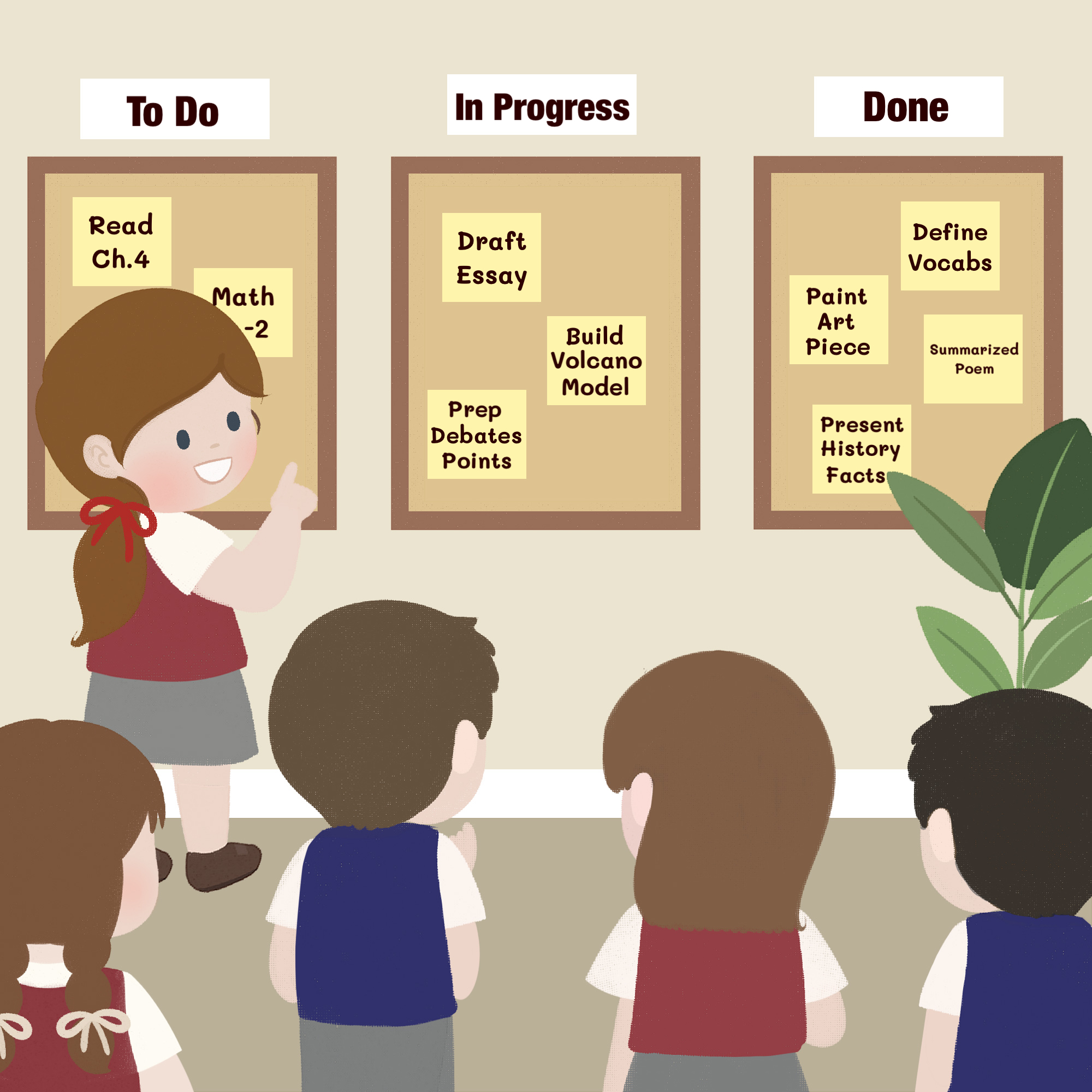
Sprints and ‘Increments’: In Scrum, projects are broken down into manageable chunks called sprints – think of them as short, focused bursts of activity. For our high school heroes, this means setting clear goals for each sprint – whether it’s designing a prototype or conducting research – and diving headfirst into action. A sprint should last between 7 – 10 days, ideally (although, officially, a Sprint can last up to four weeks but I don’t recommend this). The objective of the sprint is to produce a useable part of the project, called an ‘increment’. This increment could be a data analysis on Google Sheets, a working model of particular concept, a series of slides, a short video with text, a summary of research conducted, etc.
Daily Scrum (or ‘Standup’): Every day, students gather for quick (no longer than 15 minute) meetings, sharing progress updates, discussing roadblocks (or ‘impediments’), and tweaking their plans accordingly. It’s like having a daily pow-wow to keep everyone on the same page and ensure that nobody gets lost in the shuffle. Of course, you may not teach the students every single day, which is why Scrum teaches them how to collaborate and agree upon a daily meeting place (e.g. the school library).
Feedback and Adaptation: Scrum thrives on feedback loops, and our students are no exception. Whether it’s peer reviews, teacher feedback, or reflections on their own progress, students constantly iterate and refine their work, learning the invaluable art of adaptation along the way. The review part of the Scrum cycle is called the ‘Sprint Review’ and should be conducted at the end of every Sprint. It is a process designed for the team’s benefit, so it may not need to be run as a whole class presentation but rather a group meeting of around 30 minutes.
Showcase and Celebrate: As each sprint concludes, students showcase their achievements – whether it’s a working prototype, a compelling presentation, or a tangible outcome (once again, the outcome is called an ‘increment’). It’s a moment of pride and celebration, reminding them of how far they’ve come and fueling their drive for the next sprint.
Utilising Scrum with teams of teachers
Now, let’s shift gears and zoom in on the teachers – the unsung heroes behind the scenes. The very same Scrum cycle that we use with students can be used with teachers too – the framework doesn’t change. Here’s how Scrum empowers them to lead by example:
Facilitation: As senior teachers lead their teams of educators, they wear the hat of facilitators rather than dictators. They create a safe space for collaboration, encourage open dialogue, and empower their peers to take ownership of their professional development.
Coaching and Support: Just like coaches on the sidelines, senior teachers provide guidance, mentorship, and support to their fellow educators. They help them navigate challenges, sharpen their skills, and unleash their full potential – all while fostering a culture of continuous improvement.
Alignment and Coordination: With multiple projects and initiatives in play, senior teachers use Scrum to align their team’s efforts, coordinate schedules, and maximize productivity. It’s like conducting a symphony orchestra, where every teacher plays their part in perfect harmony.
Adaptability and Innovation: In today’s fast-paced educational landscape, adaptability is key, and Scrum equips senior teachers with the tools to embrace change and drive innovation. They experiment with new teaching methods, incorporate feedback loops, and stay ahead of the curve – all while inspiring their colleagues to do the same.
Celebrating Success: Last but not least, senior teachers celebrate the wins – big and small. Whether it’s a breakthrough in teaching pedagogy or a collaborative project that captivates students, they shine a spotlight on achievements and foster a culture of appreciation and camaraderie.
So there you have it – a glimpse into the magical world where Scrum meets high school, where students become agile innovators and teachers become champions of collaboration. As we continue to explore new frontiers in education, let’s remember that with Scrum, the possibilities are endless – so let’s roll up our sleeves, rally our teams, and embark on this exhilarating adventure together!
Teaching is one of the most stressful professions on Earth. From behaviour management issues, to meeting deadlines and working on projects in small teams: teaching, as a job, requires very high levels of competency, lots of patience and bucket loads of resilience. Take these recent, shocking revelations, for example:
The Headspace 2023 Workforce Attitudes Toward Mental Health report found that British people overwhelmingly deem education to be the most stressful career path available, with an alarming 93% of those in the profession feeling stressed at least once a week!
In such a complex and dynamic environment as a school, in which in our ‘product’ is the gradual and positive development of children (i.e. the most complex beings in existence), it is only natural that we will make mistakes along the way and be involved in a wide variety of professional ‘incidents’ that may cause us some frustration.
It is at these times that we MUST remember the ‘Four S’s’:
Stop
Smile
Sleep
Send
Here’s a handy graphic to remember the process (feel free to share this with colleagues):
Let’s go through these steps one-by-one:
#1: Stop
I once witnessed a former colleague shout at a fellow language teacher in the staff room, calling him ‘unprofessional’ and saying that his actions were ‘unacceptable’. Of course, the issue causing the altercation was a trivial matter, but by her getting emotional and berating him in front of everyone she achieved nothing, and actually did a lot of harm to her reputation. Everyone was talking about that exchange afterwards, and guess who came out as the ‘good guy’ in people’s minds? – The polite language teacher who just stood there and listened and didn’t respond or get emotional, of course.
It’s so tempting to respond by reflex-action in a moment of frustration, venting our anger in an email, a verbal exchange or other action. It’s so crucial to be mindful of our emotions when we feel frustration bubbling up inside of us and remember to STOP!
#2: Smile
Numerous studies have shown that a simple smile can immediately improve our mood. Take a moment to reflect upon what you are grateful for in life. If nothing comes up, then ask yourself “What COULD I be grateful for right now?”. This act of ‘reframing’ the moment will act to alleviate any feelings of dread, anxiety or frustration – even if it’s only by a small amount.
#3: ‘Sleep on it’
If you find yourself becoming angry, anxious, enraged or frustrated by any situation at school, then pause for a while and calm down before you respond. If possible, respond to the issue the next day after a good night’s sleep – you’ll be in a better mood and will be more emotionally balanced to handle the issue rationally.
In my experience, almost every incident that causes a teacher frustration can be dealt with the next day, when we are in a better mood. If this is not the case for whatever you happen to be dealing with right now, then at least Stop and Smile, and wait a while before responding.
#4: Send
Have you been guilty of sending a quick response email out of frustration? I know I have. For one former coworker of mine, this had catastrophic consequences.
The head of our secondary school had emailed a colleague of mine in a former school I worked at to discuss some behaviour management issues that some children in his classes were having. This colleague then replied out of anger and frustration, justifying himself in every which way possible, but he inadvertently cc’d the entire secondary school in his response!
He didn’t last long at that school. His reputation in the eyes of his colleagues had soured, and his position became somewhat untenable. He was let go at the end of that academic year.
Please – be the person who responds when your emotions are stable. We ALL get frustrated at times. We ALL get angry a times. We ALL panic at times. Please – Stop, Smile. Sleep THEN Send/Respond.
Extra advice for dealing with frustration at school
Speak to someone
Speak up about any issues you are having, in a positive and non-complaining way. The trick to executing this is to be ‘solution focussed’. When talking with your line manager about the issue, or whomever the other parties are, adopt the mindset of ‘This is the problem, so how can we work together to find the solution?’.
Only click ‘send’ when you are in an emotionally positive state
E-mails last forever, and once they are sent, they can be fully utilised in any litigation that may follow. Silence is always the best option at first, if possible, then only send a written response/summary of the issue after very careful consideration. In some extreme situations you may wish to speak with a lawyer before responding.
Learn new skills
If behavior management is causing frustration, then seek to learn new strategies or ask colleagues for help. Resources like this blog can be very useful for acquiring new tips, as can professional development courses. If your issue is skills-related, then you may find that a professional development course, such as my Powerful Public Speaker Certificate Course, may be of use to you.
Find a good lawyer, and build a good relationship with them, regardless of your situation
It has been my experience via the many hundreds of online coaching calls I have done with teachers over the years that extremely few educators understand their legal rights. Employers can sometimes pray on this naivety – few teachers will approach a lawyer when their employment is terminated, or when contractual changes arise, or when they are asked to sign a sudden ‘official school document’, for example. Get used to consulting with lawyers. Yes, they’re expensive, but the investment is worth it in the long run. If you are lucky enough to teach in a country where teacher unions exist, then make sure you are an active member – they will be able to offer legal advice when the need arises, too.
We welcome you to join the Richard James Rogers online community. Check out our official Facebook Page, Instagram and Podcast for regular updates.
Whether it’s high-stakes assessments, end-of-unit tests, coursework, homework or classwork, it’s inevitable that every teacher will have to mark some assignments the old-fashioned way from time-to-time – i.e. by hand.
This can be a daunting task for many of us who, in today’s EdTech age, are so used to marking things digitally (or allowing software to do the work for us!). I’ve written at length, for example, about how automated systems like MyMaths and Educake, and live-quiz apps that have ‘assignment’ options, can mark classwork, homework and other assignments within seconds and provide detailed analytics within summary reports.
Thankfully, I’ve been in the position where there’s no other option but to mark assignments by hand more than a few times in my 17 years as a high school teacher, and I’ve made every blunder possible – wasting countless hours of my life in the process!
At least I now have enough experience of doing marking the wrong way to pass on my knowledge to my readers – I guess every cloud does have a silver lining, after all!
So, get your red pen ready (or whichever color you wish to use) and let’s learn how to efficiently mark assignments by hand!
#1: Mark every script one question at a time, or one page at a time
What this means is that if you have, say, thirty exam papers to mark, then ONLY mark question 1 for each paper (or page 1). Then, when you’ve finished marking question 1 (or page 1) for each paper, ONLY mark question 2 for each paper (or page 2), and so on.
The reason this works so well to improve your marking efficiency is that:
You will get quicker at marking the same question the more times you do it in succession.
It becomes easier to compare one student’s answer to another, which is great for choosing model answers to showcase and to ensure fairness.
Marking our papers this way is MUCH quicker than marking, say, one whole exam paper/assignment, followed by another, then another.
#2: ALWAYS have a mark scheme available for the assignmentyou are marking
Never set an exam paper or assignment if it doesn’t come with a mark scheme. If you don’t have one, then create one. This ensures fairness and efficiency during the marking process.
During my early years of teaching, I would find myself quickly creating exam papers and assignments due to my poor time-management skills. I would often forget to source the mark schemes for those documents.
Have you ever tried to mark a stack of exam papers without having the model answers to hand? It’s a nightmare scenario! You’ll find yourself spending tons of time attempting to apply marking consistency across multiple answer types. This is almost impossible to do without a mark scheme.
Another behavior to avoid is quickly sourcing worksheets or assignments from the internet, without making sure there’s model answers that go along with them. This is a particularly toxic action for the busy/stressed teacher, as time is limited. It seems like a great short-term fix to quickly source those questions from a particular web link you’ve found. However, in the long term, you’ll pay for it with frustration and more wasted time since it will become very difficult to mark that work in the absence of proper marking schemes.
#3: Keep your papers organized
Don’t lose them – and that’s easier said than done! I find that it’s often best to keep all of my papers at school and do all of my marking at school, because:
Papers don’t get lost in transit (e.g. if I were to take papers home to mark).
It’s good for my work-life balance – schoolwork stays at school.
Consider creating a special area of your room to keep the work that you are marking by hand. Perhaps a special drawer in your teacher’s desk is appropriate, or a shelf on your classroom wall.
My award-winning book for high school teachers.
#4 Utilize live marking where possible
One-to-one conversations with students offer the best possible feedback out there – because those conversations are personal and should involve some metacognition. Students will have to process information and think about their responses deeply during the live-marking process, which should always involve some type of conversation (even if it’s a short one).
If possible, walk around the class and mark work in real-time as the students are doing it, or call them to your desk one at a time for a conversation and to add some hand-written comments to their work.
#5 Do NOT give the work back to the students until the data has been inputted into your school’s tracking system
This is sounds so obvious, yet, to my embarrassment, this is a mistake I have made in the past.
This really is the epitome of stupidity because once the graded work has been given back to the students, you’re going to have quite a job on your hands to get it all back again so that you can input the assessment data.
Mark it, input the data, then give it back to the students. If that means that the students have to wait a little longer to get their work back, then so be it. Due diligence is more important than quick turnaround.
Summary
I really hope this blog post was helpful. Life is precious, and short, and too valuable to be marking work inefficiently in my opinion.
Speed up your marking time by….
Marking one question at a time, or one page at a time
Sourcing mark schemes for EVERY piece of work that is to be marked by hand
Demonstrating good housekeeping by organizing your papers – don’t lose any!
Marking work in real-time, if possible
Input the assessment data into your school’s system before giving the work back to the students
In addition to the above points, I would also advise teachers to seek help from colleagues when you are unsure about how many marks to award for a student’s answer. You may find that a fresh perspective will confirm, or refute, your initial thinking on the matter. Also, get efficient with free periods/non-contact time, too. If you plan what you will mark in those ‘frees’ carefully, you’ll find that minimal weekend and evening time is taken up with marking (which is what the status quo should be).
We welcome you to join the Richard James Rogers online community. Check out our official Facebook Page, Instagram and Podcast for regular updates.
Unless you’ve been hiding in acave for the past five years, it’s highly likely that you have heard the phrase ‘retrieval practice’ being bandied about multiple times at educational seminars, Professional Development workshops and even in the departmental meetings you’ve attended at school. It’s one of those areas of pedagogy that has gotten educators excited due it’s evidence-based effectiveness, as well it’s inclusion, affirmation and promotion of metacognitive strategies (another hot topic in education).
It is my observation, however, that the majority of teachers are not 100% clear about what retrieval practice actually is – in part because some of the professional literature on the issue is conflicting, and also because as a concept it complexifies something rather simple (something that teachers have being doing for decades):getting students to reflect upon and use what they know.
In today’s blog post, I aim to provide my readers with the following:
A simple, understandable description of what retrieval practice is
A handy acronym (P.O.W.E.R.) that we can all use to remember the stages we need to follow as teachers when carrying out retrieval practice with our students
Some ideas on techniques and activities we can use in the classroom to facilitate good retrieval practice
Think ‘expression’ as opposed to ‘ingestion‘
I was most impressed with this great video by Unleash Learning which described retrieval practice as focusing on getting information out of students’ heads, rather than into students’ heads. This implies that retrieval practice only works if information has been put into the students’ heads in the first place – and this is true – retrieval practice is used as a follow-up when students have already been taught the information they need to know.
Retrieval practice is used as a follow-up at some point after a topic/unit has been taught.
Students should be encouraged to articulate what they have learned in some way, and then use what they have learned in some way (e.g., to answer an exam-style question). Retrieval practice places heavy emphasis on learning rather than assessing, although low-stakes assessments can be used as part of the retrieval process (see this blog post of mine on assessment ‘for’, ‘of’ and ‘as’ learning for more info on that!).
Give your students the P.O.W.E.R. they need to succeed!
So, let’s look at an easy-to-remember step-by-step process for facilitating retrieval practice in the classroom – the P.O.W.E.R. technique.
Prime (P): Prime the Mind
Start by priming the mind. Review essential concepts, key points, or summaries to prepare your students for the learning experience ahead.A great activity for this is Mind Map Mayhem: Encourage students to create colourful mind maps summarizing key concepts from the previous lesson. They can use doodles, arrows, and even emojis to make it visually appealing. This primes their minds for what’s to come!
At this stage, summaries do not need to be organized – they can be scattered and random, and do not necessarily need to be handwritten – a group discussion, quick verbal presentation to the class or even a bulleted list will suffice.
Organize (O): Organize Thoughts Actively
Encourage active organization of thoughts. Have your students organize information in their own words, creating meaningful connections and enhancing comprehension through an engaged approach. There are many tools that can be used for this, but my favorites are:
Mnemonics
Acronyms
Infographics
Graphic organizers
Google Slides, Docs, Sheets and Sites
Flow charts
Audio notes
It’s quite important at this stage that information follows the required pattern in which it needs to be retrieved in the final exams – e.g. the stages of cell division (in order), a timeline of King Henry VIII’s reign (in order), the points to raise in a written response to a language question (in order), etc.
Wrestle (W): Wrestle with Challenges
Yes! – we finally have a teaching acronym with ‘Wrestle’ in it (cue the giggles in teacher workshops all across the world from this point onwards). If nothing else, this wise choice of a word will help us all to remember that in this stage the students should tackle thought-provoking questions that demand active recall.
This step engages the mind in a mental wrestling match, strengthening memory and reinforcing the learning process.
The questions do not necessarily need to be provided in a mini-test or handout format (although you can go with that too), live quiz apps, verbal questioning, exam-style questions, past-papers, flash cards, quick writing exercises, worksheets and learning journals can all be used as tools to facilitate this process. At this stage, the questions should be low stakes, so that making mistakes is encouraged.
Evaluate (E): Evaluate Understanding
Promote self-evaluation to gauge understanding. Guide your students to reflect on their comprehension, identifying areas of strength and pinpointing topics that may require additional attention.
Check out my award-winning book for high-school teachers on Amazon. Purchases support the creation of my blog posts and podcast episodes.
A great technique that teachers have been using for decades for this is Traffic Lights. Provide students with red, yellow, and green cards. Ask them to hold up the corresponding card to indicate their understanding. Red for unclear, yellow for partial, and green for solid comprehension. It’s a quick and visual way to evaluate understanding.
Again, live quiz apps can be used for student self-evaluation, as well as self-reflection rubrics. Metacognitive tools, such as self-regulation checklists, are also great for this.
In my current practice, I like creating Google Sheets in which students can type in their reflections as they do them – essentially creating a long-term digital journal/record of their progress. The sheets are very simple – usually asking which questions the students got wrong, why they got them wrong, and what they should do next to improve further. When created on a Google Classroom assignment, one sheet is enough, as a copy will be made for each student if you select the correct option from the drop-down menu.
Reinforce (R): Reinforce Through Practice
Transition to reinforcement through practice. Engage your students in hands-on activities, be it additional past-paper questions, problem-solving scenarios, experiments, or real-world applications. This step solidifies knowledge and encourages practical application.
Practice makes perfect!
One activity you might want to try (if you’re looking for something unusual) is Escape Room Extravaganza. Create a virtual or physical escape room with challenges related to the lesson. Students work in teams to solve problems, unlock clues, and apply their knowledge. A QR-code treasure hunt may work well for this, for example. It’s a fantastic way to reinforce learning through collaboration and critical thinking.
Conclusion
Retrieval practice is essentially a way to build long-term memory of concepts, skills, ideas, key vocabulary, techniques and knowledge. At some point after a topic or unit has been taught to your class, use the P.O.W.E.R. strategy to get your students retrieving that prior knowledge – you’ll soon find that concepts will be generally better understood, performance in future assessments will increase and students will feel more confident articulating, processing and recalling the material they have covered.
Recommended further reading
Head over to retrievalpractice.org where you will find lots of free, downloadable pdfs containing tons of advice on how to implement retrieval practice in your lessons.
We welcome you to join the Richard James Rogers online community. Check out our official Facebook Page, Instagram and Podcast for regular updates.
In the rapidly evolving landscape of education, traditional teaching methods are being reshaped by innovative approaches that prioritize creativity, problem-solving, and collaboration. One such methodology gaining traction is Design Thinking. Originally conceived in the realm of product design, Design Thinking has found its way into education, offering a dynamic framework for educators to foster critical thinking and innovation among students. In this blog post, we will explore what Design Thinking is and how it can be effectively applied in classroom teaching.
What is Design Thinking?
Design Thinking is a human-centered problem-solving approach that places empathy for the end-user at the core of the creative process. Coined by David Kelley and Tim Brown of IDEO, this methodology has since transcended its origins in design and has been embraced across various fields, including education. The key stages of Design Thinking typically involve empathizing, defining the problem, ideating, prototyping, and testing.
How can Design Thinking be used in classroom teaching?
Here’s a handy acronym to help remember the stages of Design Thinking:
E.D.I.P.T.
Empathize
Define
Ideate
Prototype
Test
Let’s go through each stage one-by-one:
Empathize
Design Thinking encourages educators to understand their students on a deeper level by empathizing with their needs, challenges, and perspectives. By gaining insights into students’ lives, educators can tailor their teaching methods to address individual learning styles and needs.
Define
The second stage of Design Thinking involves clearly defining the problem at hand. In a classroom setting, this translates to identifying the learning objectives and challenges faced by students. This step sets the foundation for targeted and effective teaching strategies.
Ideate
Design Thinking encourages a culture of brainstorming and creative thinking. In the classroom, this means fostering an environment where students feel free to express their ideas without fear of judgment. Educators can facilitate brainstorming sessions to generate diverse solutions to educational challenges.
Prototype
Just as designers create prototypes to test their ideas, students can develop prototypes of their learning solutions. This might involve creating projects, presentations, or interactive activities that demonstrate their understanding of a concept. Prototyping allows for hands-on learning and experimentation.
Testing
Design Thinking emphasizes an iterative process. In education, this means encouraging students to gracefully receive feedback on their work, reflect on their learning experiences, and make improvements. The iterative cycle fosters a growth mindset and resilience in the face of challenges.
A real classroom example of E.D.I.P.T.
Let’s see how E.D.I.PT. can be used in the planning and execution of a real high-school lesson.
Subject: High School Biology
Lesson Title: “Adapting to a Changing Environment: A Design Thinking Exploration”
Objective: Students will use the Design Thinking process (E.D.I.P.T.) to propose and prototype innovative solutions for an organism’s adaptation to a changing environment.
1. Empathize (E):
Activity: Begin the lesson with a short video or reading about a species facing environmental challenges (e.g., climate change, habitat loss). Engage students in a discussion about the impact on the species, their ecosystem, and the challenges they might face.
Outcome: Students develop empathy for the organisms and understand the need for adaptations in response to environmental changes.
2. Define (D):
Activity: Guide students in identifying specific challenges faced by the chosen species due to the changing environment. Encourage them to narrow down their focus to one key problem that they want to address.
Outcome: Students articulate a clear definition of the problem, such as the impact of temperature changes on the species’ reproduction or food sources.
3. Ideate (I):
Activity: Conduct a brainstorming session where students generate various ideas for how the species could adapt to the identified challenge. Encourage creative thinking and diverse solutions.
Outcome: Students compile a list of potential adaptations, considering biological, behavioral, or physiological changes the species might undergo.
4. Prototype (P):
Activity: In small groups, students choose one of the adaptation ideas and create a prototype or model showcasing how the species might implement this adaptation. This could include drawings, diagrams, or even physical representations.
Outcome: Each group produces a prototype that visually represents their chosen adaptation solution.
5. Test (T):
Activity: Groups present their prototypes to the class, explaining the rationale behind their chosen adaptations. Facilitate a class discussion where students provide constructive feedback and ask questions.
Outcome: Students refine their prototypes based on feedback, considering the practicality and effectiveness of their proposed adaptations.
Can you think of a suitable topic that would lend itself well to an E.D.I.P.T. lesson in your subject area?
Conclusion
Design Thinking in classroom teaching is a powerful tool for cultivating a generation of creative, adaptable, and empathetic individuals. By integrating this methodology, we can transform traditional classrooms into dynamic spaces where students are not just recipients of knowledge but active participants in their own learning journey. Embracing Design Thinking in education is not just about preparing students for the future; it’s about empowering them to shape it!
Recommended further reading
Lee, D. (2018). Design thinking in the classroom: easy-to-use teaching tools to foster creativity, encourage innovation and unleash potential in every student. Berkeley, California: Ulysses Press.
Jakes, D. (2022). The Design Thinking Classroom.
D.M. Arvind Mallik (2019). Design Thinking for Educators. Notion Press.
We welcome you to join the Richard James Rogers online community. Check out our official Facebook Page, Instagram and Podcast for regular updates.