Release date: Wednesday 8th April 2020 on Amazon Globally [ISBN 979-8629490937]
Great news!: My GAME-CHANGING book, 100 Awesome Online Learning Apps, is now LIVE on Amazon. Copies can be ordered here:https://www.amazon.com/dp/B086PSMYRN/
The book covers:
1. Not-so-obvious things to be aware of when doing online learning 2. A big list of 100 Awesome Apps with suggestions for their use inonline learning
Book description
2020 marked a definitive year in the world of teaching. For the first time in history, teachers and schools all around the world were forced to quickly apply their skills to online learning as a result of widespread school closures in the wake of the novel coronavirus pandemic. This book is timely and long-awaited, and meets the needs of educators who are required to deliver high-quality teaching via online apps and platforms. This book takes the reader through 100 tried-and-tested online learning platforms, with suggestions as to how each one could be used to enhance teaching or assessment. As a high-school science teacher and a Google Certified Educator himself, Mr Richard James Rogers has first-hand experience of using each platform and speaks from a wealth of involvement rather than from a lofty and disconnected position in elite academia. This is a practical book for those who want to make a difference in their students’ lives, no matter how volatile local circumstances may be.
We welcome you to join the Richard James Rogers online community! Join us on Facebook and Twitter for regular updates, giveaways of Richard’s books, special offers, upcoming events and news.
My PGCE course was a long, dark road of pain. Not only was I new to teaching, and finding it difficult to teach in a way that was engaging and rightly-paced, but the paperwork was tremendous.
Back then, I was required to write out each lesson plan on an A4 piece of paper and have it checked by the main class teacher. I also had to submit the work to my PGCE mentor.
The process was laborious but it did get me thinking about:
How to start my lessons quickly and appropriately.
Where students should sit at each point in the lesson and what equipment they would need.
How to work through the syllabus at an acceptable pace.
How to end each lesson with a stimulating summary.
Nowadays, however, my lesson planning is done in a one-week-per-two-pages diary [this is the planner I use], and supported by departmental curriculum maps (which outline the topics to be covered for the whole year) and Schemes of Work.
It’s less work, and more ‘long-term’ in focus.
Planning is a skill that outstanding teachers have mastered. In this article, I want to share my advice on how to best plan our:
Lessons
Marking
Homework schedule
Events
Free time
Outstanding teaching is supported by outstanding planning – and this goes beyond the simple planning of one’s lessons.
“Simply Brilliant!” – Readers’ Favorite
Let’s now go through each item in the above list together.
Lesson planning
Experience has taught me that time spent planning lessons always reaps rewards. It requires one to spend a good hour or two of non-contact time doing the following:
Looking over the week ahead and scheduling the topics that will be covered on each day
Thinking about when homework will be set, when it will be collected in and when it will be marked
Accounting for meetings, events and any planned (or possible) disruption to one’s timetable
Planning our resource-preparation time
Here’s a video I made about efficient lesson-planning, and in that you will see thelesson plannerthat I use:
For me, I use part of my Sunday morning each week to plan the week ahead. It always pays dividends in terms of:
Reduced stress during the week
Better lessons
Marking
Do we really need to assign so much homework?: If we’re not taking the time to sit with our students to provide high quality feedback, then is that homework assignment we’ve set really that useful?
We need to think carefully about the quantity of marking we are creating for ourselves, and whether or not this is an effective way to enhance the learning of our students.
I believe strongly in the power of planning our marking. Every week I need to know:
When I will set homework, tests and assignments
When I’ll collect in homework, tests and assignments
When I’ll mark it all
How I’ll mark it (in-class strategies, such as a peer and self-assessment, can save us a ton of time)
This is another Sunday morning task of mine – I plan my week’s worth of marking.
Events and free time
As well as planning my work, I also know how important it is to plan my free time.
Knowing that I have a badminton session on a Sunday afternoon, for instance, gives me the motivation to get my work done promptly. Scheduling a Friday night of relaxation gives me a reward for my hard-work during the week.
Conclusion
I believe that productivity has to permeate and infuse into every cell of our bodies. Productivity must be a way of life – not simply a good habit to deploy at work.
By planning everything, we are more likely to implement the things that move us forwards.
In the early part of my career my poor time-management and planning skills left me wasting my weekend time, wasting my mornings and creating undue stress for myself.
Never again. I deserve better. My students deserve better.
We welcome you to join the Richard Rogers online community. Like ourFacebook page and follow us on Twitter for daily updates.
It was a typical morning tea break in the school staff room. Typical morning grumbles. Typical morning camaraderie.
“It’s like talking to a brick wall with John”, piped in one colleague.
“Yeah he’s pretty distant isn’t he?”, said another.
“He just doesn’t try. I doubt he’ll even get a grade D in GCSE Maths”, says the colleague who started this conversation.
Then I make the biggest cardinal sin a teacher can make in such moaning contests. It was the ultimate point of flippancy for a 23-year-old like me: “He’s great in my lessons”, I arrogantly say.
“An AMAZING book!”
The conversation went quiet.
Back then I wasn’t as polished in my speech as I am now. For some reason my colleagues still put-up with me, and I think they liked me. Perhaps I was given the benefit of the doubt because I was, essentially, a kid myself.
The truth, however, is that John was, actually, great in my lessons. The question is this: Why?
Coursework Conundrum
Then there was that time when something I said went down like a lead balloon at a departmental meeting.
A challenging Year 10 class, who were completing Science coursework, were given to me to cover for a lesson. Their teacher was absent that day.
I write about this story in my first book as a classic example of how teacher organisation and rapport-building can generate dramatically different results to the status quo when applied consistently. Basically, I booked the ICT lab and simply walked around the class and helped the students with their work. I also took all of the loose bits of paper that were loosely organised in a blue tray (their ‘coursework’ tray), and put them in plastic wallets with each students’ name on.
A simple tactic, but it worked really well. It meant that the students didn’t have to fish through papers at the start of each lesson and complain that bits were missing – adding to disruption.
I mentioned this story at that meeting, and whilst my Head of Deportment was impressed with me (he was, secretly, the person I was trying to impress anyway), the teachers of that class were not so happy with my ruthless expose’.
“If I was kid in that class and I had to root through a pile of mixed-up papers to find my coursework, then I’d be disruptive too” I said with a judgmental, 23-year-old voice.
I probably would use more tact and subtlety were I to raise the same issue today. Our colleagues are our allies, not our enemies.
So, what’s the point you’re trying to make?
Simply this:
A teacher’s behavior can have a profound, long-lasting effect on student behavior.
Robert Greene, in his bestselling bookThe 48 Laws of Powerdescribes something called the ‘Mirror Effect’. Basically, it’s a way of showing someone their faults and failures by mirroring their actions.
For teachers, the Mirror Effect works best by modelling the passion and determination we want to see in our students:
When we are passionate, our students become passionate
When we are relaxed, our students are relaxed [be careful how far you take relaxation, however. Relaxed demeanor: yes. Relaxed attitude to your professional role: no.]
When we strive for excellence ourselves, our students also strive for excellence
When we praise and encourage, with passion and real emotion, we inspire our students to work harder, and perform better
One of my proudest moments as a teacher was when I was given a very shy young girl from Iceland to teach. Starting in Year 11 and studying IGCSE Chemistry with me, she had two main challenges to overcome:
She had never learnt any chemistry before, and was due to take an IGCSE exam in Chemistry in 6 months time (that’s hard, by the way)
English was not her first language, and I was teaching her through the medium of English
After my first lesson with her had finished she told me straight: “Mr Rogers, I didn’t understand anything you taught me this lesson.”
That’s when I knew that this was serious, because I’d taught a lesson covering the basic fundamentals.
Her first test came back in two weeks – she got a grade U. She was devastated.
“I’m just going to fail Chemistry, aren’t I?” – she said
“No way. We won’t let that happen. Your target for your next test is an E, and come and see me on Monday lunchtimes so I can teach you the fundamentals. I believe in you.”
It saddens me to say this, but I received a massive public backlash about a year and a half ago when I suggested that one way that we can help exam-level classes is by giving up a few minutes at lunchtimes to tutor weak students on the run-up to the finals. One person went so far as to write damning review of my book (which, I assume, he hadn’t even read):
Another happy customer!
I’m not suggesting for one minute that top-up sessions are the only way to help students who are falling behind, but in the case of this student (who had zero prior knowledge of chemistry) it was an essential intervention move.
That student, incidentally, went on to achieve a grade A* in IGCSE Chemistry six months later – beating almost everyone else in Year 11.
This happened because:
The student worked really hard (this is the main reason)
The student wanted to work hard because I kept on pushing her, telling her that I believed in her (and I meant it), and because I gave believable and achievabletargets for each test (she scored a U, E, E, D, B, A and then an A* in the final).
This is a living testament of the efficacy of my core philosophy, which is this:
I believe that ANY student’s success can be engineered by a great teacher
You’ll find that statement in my bio onTwitter– it’s the personal philosophy that has guided me for more than 15 years. It works, because I’ve seen it work.
But how do we implement this philosophy?
Use the four-step T.I.P.S. method:
Step 1: Track progress. Look for patterns in grades. Keep a spreadsheet of scores.
Step 2: Intervene when grades slip. Have a short conversation with the student in which you use……..
Step 3: Professional Intelligence: Gather and use knowledge about the students’ past achievements, achievements in other subject areas and skills used outside of school to praise the student and remind him/her of the ability that he/she naturally possesses. Talk with other teachers to gather this intelligence if needs be. Couple this with…..
Step 4: Subtle Reinforcement: Be on-the-ball and remind your student regularly what his/her target is. Introduce new resources and offer your time to help. Remind him/her about a test that’s coming up and how you believe in their ability to get a good score. Praise small steps of progress along the way, or any positive work in your subject area.
We welcome you to join the Richard James Rogers online community! Join us on Facebook and Twitter for regular updates, giveaways of Richard’s books, special offers, upcoming events and news.
One of the massive perks about being a schoolteacher is that we get loads and loads of holidays. In fact, in my particular case, I’m only actually in school for around 180 days per year. That’s a lot of free time to deal with.
So, with this in mind, I find myself asking a rather controversial question: Are we using this free time productively?
I’ve been lambasted quite viciously in the past for expressing my views on this particular issue. My views haven’t changed, however, so if you’re one of those snowflakes who gets easily triggered, easily offended or who has a nervous breakdown when someone has a different opinion than you, then you might want to stop reading now.
The laziness of it all?
With all of this free time in-hand, I often wonder why more teachers aren’t starting their own businesses, writing books, setting up podcasts, starting up blogs, doing online marketing or anything to better themselves or improve their quality of life.
What would Elon Musk, one of the world’s most successful businessmen, do with 185 free days each year? Perhaps this quote from an interview he did (video embedded below) will shed some light on things:
Interviewer:
Did you ever consider retiring?
Elon:
No, not really. I did take a bit of time off. I did reasonably well from Paypal. I was the largest shareholder in the company and we were acquired for about a billion and a half in stock and then the stock doubled. So yeah, I did reasonably well, but the idea of lying on a beach as my main thing, just sounds like the worst – it sounds horrible to me. I would go bonkers. I would have to be on serious drugs. I’d be super-duper bored. I like high intensity – I mean, I like going to the beach for a short period of time, but not much longer than a few daysor something like that.
So what can we conclude that this formidable titan? Some would say that he is an example of what we should all aspire to become, and that he would use 185 days productively. He’d take some short-bursts of time-off, but mostly he’d be working on new projects and new ideas, or furthering current ones.
An ancient Chinese proverb that keeps me striving and moving ‘forward’ when I have free time is this:
An inch of time is an inch of gold, but an inch of time cannot be purchased for an inch of gold.
Mediocrity breeds more mediocrity?
One core philosophy that I think all teachers agree with is that with enough hard work and effort, our students can become anything they want to become (notwithstanding significant physical and psychological hindrances).
Surely then, as teachers, we also need to be at the top our game if we are to truly live that message: that a human really can become anything with enough effort.
Why then do so many teachers fall short of this principle? So many of us are one-timers: we got a university degree, trained to be a teacher and that was it. Zero significant achievements since then.
And yet, we expect our students to be excellent. We expect them to make excellent progress. We expect them to use their free time productively. We expect them to aspire, push themselves, have goals and achieve big.
Maybe it’s about time that we modeled that process. Only then can we really know what excellence is.
As for me, I’m not perfect but I’m no hypocrite either. This Christmas vacation, for which I get three weeks off school, will be divided between a number of tasks. I’ll take a short holiday for a few days, but the rest will be spent becoming a Google Certified Educator, completing a Certificate in Data Science from Berkeley and a number of additional tasks linked to this blog, my books, a new business and things to get me ready for my classes in January (including a rigorous gym schedule).
If we’re not advancing personally, then how can we encourage our students to advance?
I’ll post an update at the end of my Christmas vacation, to let you know how I’ve managed. After all, if I’m going to preach the ‘be useful and be productive’ mantra to you, my readers, then I absolutely need to lead by example and practice what I preach.
Update: August2022
This update has come a lot later than promised (sorry), but here it is anyway:
A LOT happened since this blog post was published (i.e. the pandemic). However, I was able to make some progress towards my goals.
I became a Google Certified Educator (Level 1), and I’m now working towards my level 2 certificate. I wrote a blog post all about becoming a Google Certified Educator here.
I stopped pursuing the Professional Certificate in Data Science with Berkeley, and opted instead for the Professional Certificate in FinTech with the University of Hong Kong. I completed this in December 2021. You can view my credential here.
Overall, I would say that I was only partly successful in achieving the goals I had set for myself. The lessons I have learned from this process are as follows:
Set realistic goals – sometimes we can have very high aspirations, which is good, but our personal deadlines are unrealistic
It takes a lot of self-discipline to achieve challenging goals. That’s why there are only a very small number of titans and tycoons in the world – these people relentlessly go after what they want, and set up systems and routines to make that happen.
We welcome you to join the Richard James Rogers online community! Join us on Facebook and Twitter for regular updates, giveaways of Richard’s books, special offers, upcoming events and news.
Mock exams offer an excellent opportunity for teachers and students to assess current knowledge and discover common misconceptions. They (should) provide a rigorous and thorough ‘trial run’ of the finals and may even act as a sharp and frightening wake-up call to some learners.
Considering the immense importance placed on mock exams (not least for providing a good basis for making final grade predictions), one would assume that the preparation of students for them should be organised like a well-planned military operation.
That’s certainly what should happen, and the aim of this article is to cover the ‘battleground’ that your students will need to fight through in order to be well-trained for those all-important practice exams.
Roger that! Let’s get right into it then!
Go through past-exam papers
These are by far the best revision materials for exam-level students. Rigorous past-paper practice, under timed conditions, offers a number of benefits:
Students become used to the ‘style’ of questions that will be asked in the real thing.
Frequent exposure to the ‘command terms’ that will be used in the real exam (words like ‘Deduce’, ‘Explain’, ‘Sketch’ etc.).
The level of challenge presented by past-paper questions will be at the level expected by students of that age-group.
When taken under timed conditions, students can develop their time-management techniques too (ensuring that they don’t run out of time in the real mock exam – a common problem!).
Some examination boards share their past papers for free (e.g.Edexcel),whilst others sell them them for a small fee. If you have the money (or if your school has the budget), then they are always worth the spend. Some ideas for saving money when purchasing exam papers include:
Keep any spare examination papers that you get sent each year by the exam board, and scan them to pdfs. Within a few years you’ll have a comprehensive bank of exam papers ready to share with your students.
Purchase a user account to an exam-board’s question bank and share the account with colleagues.
Make sure your students go through the model answers (mark schemes) when they’re done, and make sure they know how to actually use the mark schemes (Do they know that OWTTE means ‘Or Words to That Extent’, for example? Do they know what M1, M2, etc mean?).
Should your students be strict or lenient when marking past-paper questions?
Always be strict, because the examiner will strict and the final exams will probably contain questions that the students will never have seen before. If the answer does not match the mark scheme, then mark it wrong.
What about handwriting?
If the examiner cannot read the answers given, then your students will be penalized. Make this point really clear, as it is an issue that does affect many students (especially when rushing under exam conditions – another reason to train students by exposing them to past-papers under timed conditions).
Go through exam-style questions
These are a little different to past-paper questions and tend to be found within textbooks, on great websites (likeBBC Bitesize) and inside revision guides and workbooks (like those made by CGP, for example).
These provide much of the same benefits as a past-exam paper questions and are often organised by topic, allowing students to reinforce their subject knowledge in stages and target areas of weakness with relative ease.
Make sure that model answers are provided and that students mark their work strictly (just like with past-papers).
Provide a topic revision list
An obvious one I know, but worth mentioning. If students don’t know the topics that are going to come up on their mock exams, then how can they possibly prepare?
Share the official syllabus, perhaps through your school’s VLE, MOOC or even by e-mail if you have to. Make sure the students know which topics from the syllabus are going to come up in the mocks.
Provide topic summaries
Summaries of key topic areas can really help students to grab the essentials in a short space of time. Share these as Mind Maps, bulleted lists, end-of-chapter summaries in textbooks and even, again, revision websites that you recommend.
Share textbooks
A lot of schools cannot afford physical textbooks for every student. However, we should at least be recommending textbooks that the students can buy themselves if they want to.
One way to solve the problem of textbook costs is for schools to build their own (e.g. from slide presentations that teachers create), get students to create textbooks for themselves by setting up alearning journalssystem and even paying for an online subscription through the publisher’s website (which is often cheaper than purchasing physical books).
Recommend revision websites
There are many great websites that offer excellent, free resources for revision. My personal favorites are:
We welcome you to join the Richard James Rogers online community! Join us on Facebook and Twitter for regular updates, giveaways of Richard’s books, special offers, upcoming events and news.
This is one of my favorite pedagogical quotes and I’ve found it to be 100% accurate over the years.
As an International Baccalaureate Diploma chemistry teacher at an international school, I often have to teach topics to my students that are really, really difficult. Furthermore, the students will be examined on these topics at some point in the future, and those grades really mean something: the students will be using them to apply to study at universities all around the world.
“An AMAZING Book!”
A key question I often ask myself is how can I get my students to think deeply about the topics they are learning, so that they remember enough details to get excellent grades on their exams?
I’ve tried lots of different methods over the years, but I think I’ve finally nailed-down a system that works with every difficult topic I teach:
Explore
Question
Teach
Test
Hopefully you’ll see that this is a system that can be applied to your subject area/teaching context too.
Step 1: Explore (Thinking Intensity 2)
Provide the stuff you want the students to learn in multiple formats. Some that you may wish to use could be:
Online videos
Websites
Simulations
Textbooks
Podcasts
Magazine entries
Revision guides
Get the students to work in groups or pairs to produce some kind of creative, collaborative output. Examples include:
Create a Google Slides presentation about…..
Create a stop-motion animation about……
Create a large infographic about…….
Create a digital animation about…..
At the end of this exploration step, the students should present their work to the class in some form. This simple act of articulating what they have learned will cause deep-thinking (and therefore, memory) to take place.
Step 2: Question (Thinking Intensity 3)
Give the students a series of exam-style, challenging questions on the topic to complete under timed conditions. The students can work together on this if you wish, and may use the resources they have for help.
When the time-limit is over, provide the model answers (and make sure you actually have model answers available). Students can go through these answers via peer-assessment, self-assessment or even automated assessment (in the case of online teaching systems, like MyMaths and Educake).
As a teacher, I also like to go through any particularly difficult questions with the students so as to clear up any misconceptions. This is especially true if, for example, nobody in the class can do question 2.
Step 3: Teach (Thinking Intensity 1)
This acts as an incredibly useful review for students after what has been an intense exploration and self-assessment of stuff that was, essentially, self-taught (with a bit of help from the teacher).
Go through the key points of the topic traditionally, perhaps using a slide-based presentation, video, animation or even notes written and explained on the whiteboard.
Make use of a few learning games to spice things up a bit, especially if key vocabulary needs to be learned. Spend time going through common misconceptions: those things that students get wrong year-after-year.
Step 4: Test (Thinking Intensity 4)
Test the content covered using the most difficult questions you can find. Don’t go beyond the syllabus or above what’s been taught (obviously), but use past-paper questions that really do get the students to apply what they’ve learned to unusual contexts.
Prior to the test, you might want to provide questions of similar difficulty (with model answers provided) for the students to go through at home.
Make sure you go through the test afterwards too. Provide the mark scheme and make it really clear where, and how, marks have been lost.
Fluctuations
By fluctuating the intensity of thinking in this way (2,3,1,4) we’re exercising the brain in a similar way to how we exercise the body – gradual increases in intensity, followed by rest, followed by higher intensity.
I’ve found that this model works really well for getting students to understand really difficult topics.
We welcome you to join the Richard Rogers online community. Like ourFacebook page and follow us on Twitter for daily updates.
The Fundamentals of Classroom Management: An online course designed by Richard James Rogers in Partnership with UKEd Academy
I’m very excited to announce that I’ve been busy building an online course that covers all of the fundamental concepts in my widely acclaimed debut book: The Quick Guide to Classroom Management, in partnership with my good friends at UKEd Academy. Details are given below:
Price:£30.00(which includes a copy of my book) or£20.00if you’ve already got a copy of my book (you’ll have to enter a discount code found within the book)
Launch date:October 21st 2019(but you can start the course at anytime)
End of course certificate? – Yes, endorsed by UKEd Academy and Richard James Rogers
Course structure:Videos, quizzes, study notes, reflections and activities
Course schedule:Flexible(work at your own pace)
After successful completion of this course you’ll earn a certificate that will look very impressive on your C.V. and you will gain lots of knowledge, new techniques, tools and skills.
I look forward to mentoring and guiding you through the key concepts that make an excellent teacher, well, excellent!
If you have any questions at all about this exciting course, then please e-mail me atinfo@richardjamesrogers.com
We welcome you to join the Richard Rogers online community. Like ourFacebook page and follow us on Twitter for daily updates.
A dangerous culture has quietly found its way into a large number of American and British schools in the past decade. Like a wolf in sheep’s clothing that seems pretty on the surface but harbors malice within; over-rewarding continues to take hold like a malignancy to this day.
Betty Berdan was an American high-school junior at the time of writing thisexcellent opinion piecein the New York Times. She eloquently summarizes her thoughts on over-rewarding as follows:
Like many other kids my age, I grew up receiving trophy after trophy, medal after medal, ribbon after ribbon for every sports season, science fair and spelling bee I participated in. Today the dozens of trophies, ribbons and medals sit in a corner of my room, collecting dust. They do not mean much to me because I know that identical awards sit in other children’s rooms all over town and probably in millions of other homes across the country.
Rewarding kids with trophies, medals and certificates for absolutely everything they do, including participation in a sports event, seems harmless at first glance: what’s wrong with encouraging kids to take part, right?
My thoughts on this are simple:the real-world doesn’t reward mediocrity, and if school’s are designed to prepare kids for the real world, then they shouldn’t be rewarding mediocrity either.
Your boss doesn’t give you a pay-raise or certificate for turning up to a meeting: it’s a basic expectation. You don’t get instant recognition and brand awareness for starting an online business: you have to slog your guts out and make it happen.
The world is cruel, but it’s especially cruel to high-school graduates who’ve been babied right the way through their schooling and come out the other side believing that they’re entitled to everything: that they’ll receive recognition for doing the bare-minimum.
Some teachers may feel that rewarding everyone, but keeping ‘special rewards for winners’ is a good way to go. But what benefits can be extrapolated from removing first, second and third place prizes at a sporting event, or even removing winner’s trophies completely?
According toAlfie Kohn,author of Punished by Rewards:
A key takeaway here is that awards aren’t bad just because the losers are disappointed; everyone (including the winners) ultimately lose when schooling is turned into a scramble to defeat one’s peers
Really, Alfie? So awards are bad because losers and winners feel bitter? I think school culture has got a lot do with that. In school’s where students are encouraged to celebrate each other’s achievements, and aspire to do their best, overall achievement and attainment increases. A massive study by the University of East Tennessee, for example, found that classroom celebrations of achievement enhanced:
Group solidarity
Sense of belonging
Teacher’s ability to find joy and meaning in teaching
I don’t see much about bitterness there, Alfie.
Here’s another one I pulled-up: Ameta-analysis of 96 different studiesconducted by researchers at the University of Alberta found that (look at the last sentence especially):
…….reward does not decrease intrinsic motivation. When interaction effects are examined, findings show that verbal praise produces an increase in intrinsic motivation. The only negative effect appears when expected tangible rewards are given to individuals simply for doing a task.
This confirms what teachers have known for years (at least those with brains in their heads): that awards have no value when they are given to everyone, but have lots of value when they have to be earned. This coincides with the Four Rules of Praise that I wrote about in 2018 (supporting video below).
Conclusion
Teaching profession, some words of wisdom: Awards and rewards only work to improve motivation, attainment and achievement when the students have had to earn them. Foster a school culture of collective celebration when students achieve success (such as using awards assemblies), and articulate the skills and qualities needed to achieve success to those students who sit and watch the winners, hopefully with smiles on their face and pride in knowing that one of their own made it happen, and they can too.
We welcome you to join the Richard Rogers online community. Like ourFacebook page and follow us on Twitter for daily updates.
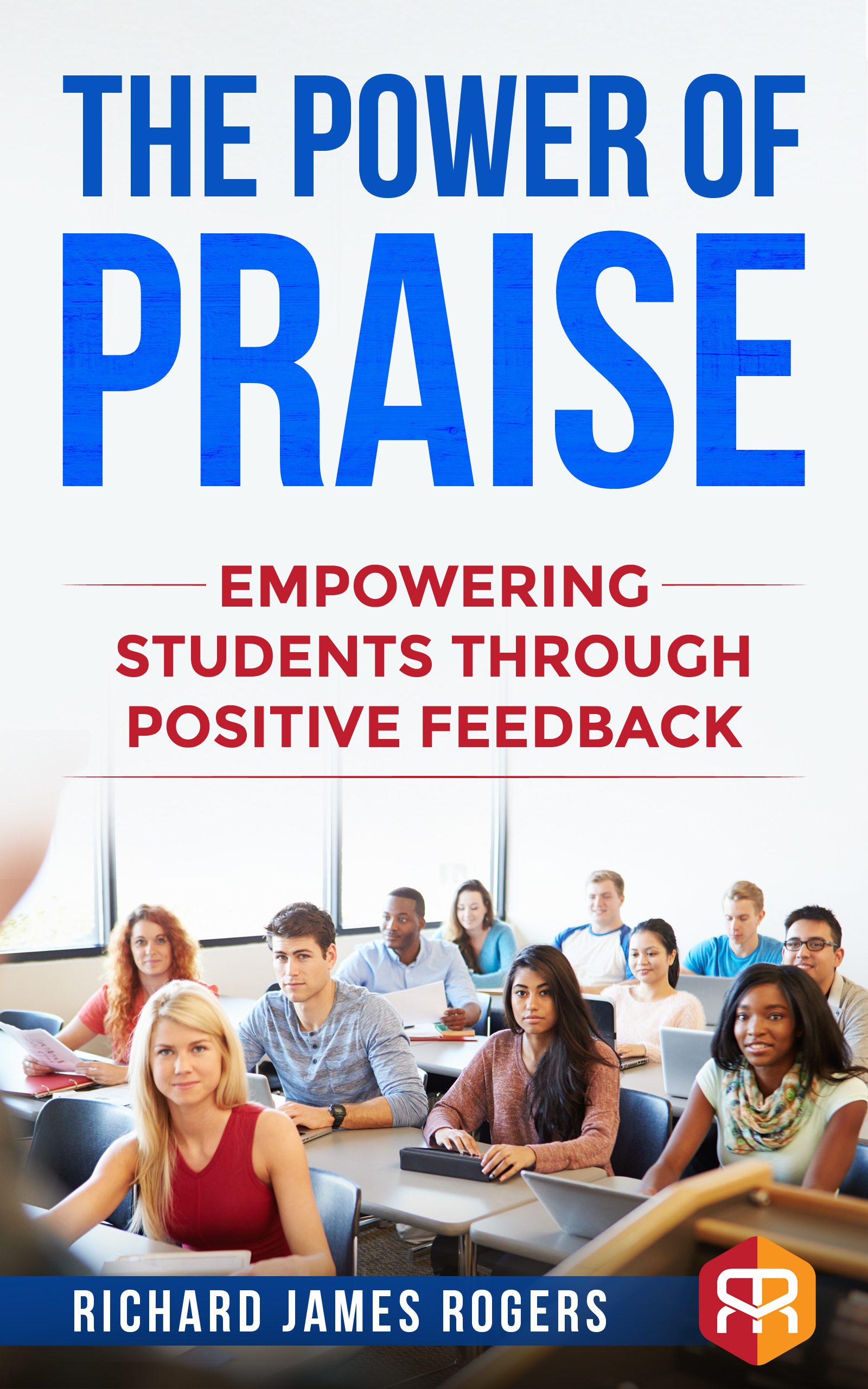
I’m very happy to announce that my second-book, which has (to my shame) been in the pipeline for many years, has finally been published on the Amazon Kindle store. The paperback will be released in mid-September. If you click on the image below, it’ll take you directly to the Amazon sales page.
My new book is split into three sections:
The philosophy of praise (why praise is important and what its effects can be)
The mechanics of praise (how to actually implement the various tactics available)
Ways to accentuate the efficiency of praise (how to ensure that praise and feedback only takes up the time and effort that it needs to)
From the outset I make the point that praise in the form of marking provides acknowledgement for work completed. This is essential, as every student needs to know that their time and effort has been noticed, is being monitored and has been recognized.
The implication of this statement is that quick turn-around of work is necessary so that students understand the reasons behind their feedback, gain empowerment maximally and receive positive reinforcement of the skills, knowledge and concepts that they are currently learning in class.
Teachers (me included) can find it a challenge to provide high-quality feedback in a timely manner, however. This is where praise mechanics and efficiency come into play.
There are a number of techniques that teachers can employ to save time whilst providing excellent feedback. In this new book, you’ll find sections on:
Peer-assessment
Self-assessment
The effective deployment of verbal feedback
Automated assessment – the use of software to test our students
Live marking
Many others
You can purchase my book here if you’d like a good, deep exploration of of a variety of praise-based techniques. As a little teaser for you, however, I’d like to share a particularly powerful technique with you.
‘Diffusive’ and ‘Absorptive’ live – marking
Diffusive live-marking is when the teacher walks around the classroom when the kids are working on a a task, pen-in-hand, and marks student work in real-time (i.e. ‘diffusing’ through the students).
Absorptive live-marking is when the teacher sits at a designated point in the classroom and calls the students to his or her desk. one-at-a-time, and marks work in real-time (i.e. figuratively ‘absorbing’ the students).
Coupled with verbal feedback, both techniques can be incredibly powerful. If you train the students to write “Mr Rogers said that………….(insert feedback here)” in a different color on their work, then you allow the students to process your feedback on a very deep-level, and this builds long-term memory. Obviously, use your name instead of mine!
Eventually, students will remember key mistakes that are repeating in their work and they will act to rectify those (they won’t like writing the same things over and over again).
We welcome you to join the Richard Rogers online community. Like ourFacebook page and follow us on Twitter for daily updates.
Preparing resources for students can be a really massive job: especially when you have the responsibility of getting kids ready for external exams.
They’ll need:
Presentations (usually a series of PowerPoints)
Worksheets
Homework
Exam-style questions
Practical activities (for Science, D.T. and other practical subjects)
Learning activities along the way to make things ‘fun’ and ‘engaging’.
In the olden days I used to source a ton of stuff from the web and make some stuff from scratch. The problems this caused were as follows:
An inconsistent teaching method/approach for each topic
Inconsistent format and detail of resources (some PPTs were excellent. others only skimmed the surface of the topic)
Inconsistent direction and focus of the class (i.e. the ‘road ahead’)
Kids need to be very clear about what they need to learn for their exams, and in what order/topic sequence. So please sit back and relax as I share my consistency-generating tips for exam-level students.
Richard’s new Kindle book. Only $3.99
Share the syllabus with the students on day one
This will really help to make the ‘road ahead’ clear. Some teachers like to make a ‘kid friendly’ version of the syllabus – using language that is more easily understandable. In my experience, however, I find that this isn’t generally necessary – syllabuses tend to be clear enough.
In addition to sharing the syllabus, map out the sequence of topics you will teach for the year ahead and share this with your students too. Some more able and hard-working kids will definitely read ahead, and it’ll help prepare your students for end-of-unit tests too.
Check them out if you want to really understand the importance of this aspect of Curriculum Clarity – her PPTs follow the same format and layout for each topic and are all detailed enough so that a complete course is created.
IB Chemistry is split into distinct topics that follow the Course Guide – there’s a PPT at Mindy Sautel’s site for topics 2.1, 2.2, 3.1, 3.2, etc. Everything is sequenced and clear.
Keep homework and questions consistent and linked to the syllabus
Maybe your syllabus is split into topics A,B,C and D with subtopics for each section. Do you have exam-style questions for topics A1, A2, A3, etc?
Organizing your questions by topic in this way will really build-up the subject knowledge that your students need to pass the final exam.
We welcome you to join the Richard Rogers online community. Like ourFacebook page and follow us on Twitter for daily updates.