
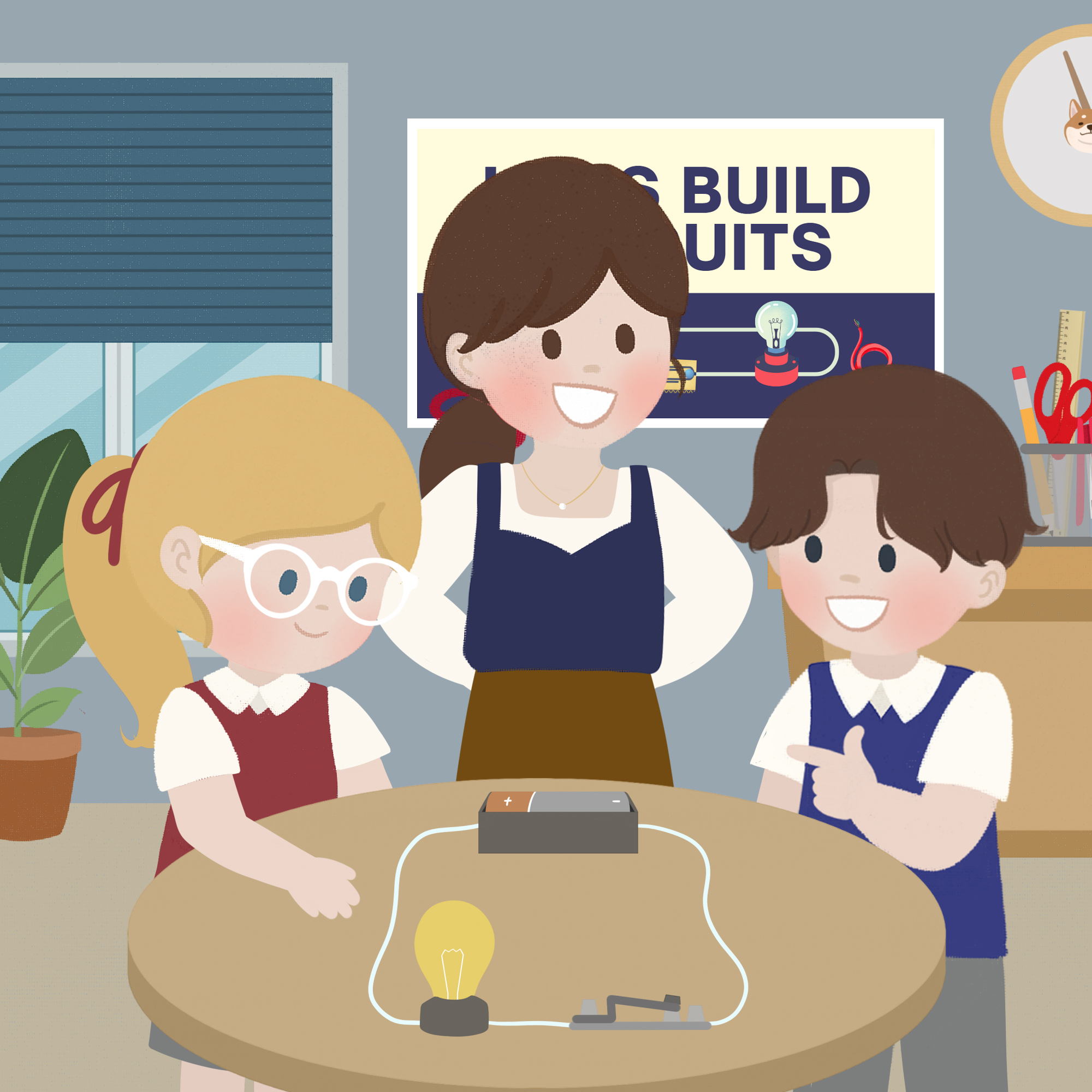
An article by Richard James Rogers (Award-Winning Author of The Quick Guide to Classroom Management and The Power of Praise: Empowering Students Through Positive Feedback). This blog post has been beautifully illustrated by Pop Sutthiya Lertyongphati.

After more than twenty years in education, I have seen classrooms in every imaginable state: from the sterile and rigid to the warm, colourful and alive with creativity. What has always fascinated me is how the design of a learning space quietly shapes the way students feel, think, and behave. Even thinking back to when I was a child at school: the classroom environment mattered to me, a lot!
In my early teaching years, I was utterly convinced that great learning came purely from great teaching. Over time, however, I have come to realise that the classroom environment (both physical and non-physical) matters just as much.

A thoughtfully designed classroom nurtures curiosity, collaboration, and happiness. A poorly designed one, even with the best teacher, can stifle all of those things.
Whether I am working with learners in a secondary science classroom or training corporate teams through my business, Richard James Rogers Corporate Training, one principle remains constant: the environment is acts as a vital teaching assistant.
What follows next are some tips to make your classroom the inviting, comfortable and engaging space that it should be: even if you’re starting from scratch.
Tip #1: Think ‘collaboration’, not ‘control’
Traditional classrooms were built for order, with rows of desks facing a single direction and the teacher as the focal point. That structure mirrors an industrial-age mindset that prioritises efficiency over engagement.
I remember one classroom early in my career where the layout made every lesson feel like a lecture, and students seemed to settle into listening rather than interacting. I was teaching in a science lab that had been built in the 1930s! The teachers desk was even on a stage (I’m not joking), and was elevated above the desks of the students.

I attempted to change the layout as best as I could mid-year, moving chairs into clusters, adding a corner for peer discussion, and letting students pick their seats. The impact was immediate: more voices in class, more movement, and more peer-to-peer help.
Research supports this shift. Classrooms that allow students to reconfigure their learning spaces, work in groups, and move freely can improve academic progress by as much as 16 per cent (Barrett et al., 2015).
When students have ownership of their environment, they feel a greater sense of belonging and motivation.
Key Takeaway: Create ‘zones’ for presentation, discussion, and quiet reflection. Give students the freedom to choose where they learn best.
Tip #2: Light, colour and air matter more than you might think
In my corporate workshops, I often talk about the power of small details such as lighting, colour, and even scent in influencing focus and creativity. The same applies to classrooms.
I recall a science lab with harsh fluorescent lighting and grey furniture, where even the brightest experiments seemed flat. It was dark, it smelt bad (it had just been built and stank of various solvents) and even the plumbing hadn’t been sorted properly. Later that year, when we replaced some lighting with daylight-mimicking LEDs, introduced a plant, and painted one wall a soft green, students began commenting that the room ‘felt calmer’ and ‘easier to think in’.
Environmental psychology shows that lighting, colour, and air quality directly affect concentration and emotional well-being (Cheryan et al., 2014; Tanner, 2008). Natural light sharpens alertness, calming colours reduce anxiety, and clean air supports cognitive function.

Key Takeaway: Bring natural elements into the classroom. Plants, daylight, and natural materials boost mood and reduce stress hormones (Li & Sullivan, 2016).
Tip #3: Furniture must fit the learner
Comfort is not an indulgence in teaching. It is a gateway to productivity. Whether in a classroom or a corporate training room, poorly designed furniture can send the wrong message: that the students don’t come first.
Ergonomic, adjustable furniture reduces strain and supports sustained engagement (Parcells, Stommel & Hubbard, 1999). Flexible arrangements make it easy to shift from discussion to collaboration to independent study (Rands & Gansemer-Topf, 2017).

Think of your favourite coffee shop. Is the furniture comfortable or uncomfortable? Successful restaurants and coffee houses understand the power of cosy furniture and surroundings in driving success, and it’s high time that schools realised it too.
Key Takeaway: Choose furniture that adapts to learning needs, if you can. Movable desks, adjustable chairs, cushions, etc. Flexibility signals trust and respect.
Tip #4: Design for neurodiversity
In inclusive classrooms, I have seen how noise, glare, or visual clutter can quietly exclude certain learners. One student I taught was bright in science but withdrew when the lab group became loud and the lighting flickered. Creating a quiet corner with soft lighting and clear visual boundaries gave that student a place to recalibrate, and from then on they participated more freely.

Neurodiverse students in particular may find typical classroom environments overwhelming (Botha & Frost, 2020). Simple design changes such as soft lighting, quiet corners, and visual order can dramatically improve comfort and focus (Ashburner et al., 2008).
Key Takeaway: Ask students what makes them feel calm and focused. Their insights often reveal inexpensive but transformative changes.
Tip #5: Consider the social architecture of learning
Classrooms are not just physical spaces: they are emotional ecosystems. The way we arrange furniture, display student work, and design shared areas communicates value and belonging.
In one school, I turned a corridor wall into a ‘student voice’ gallery: photos of projects, quotes, and creative pieces. Suddenly, students would pause by that wall; they felt seen. That sense of recognition carried into the classroom.
When student work is showcased proudly, engagement increases. When collaborative zones are designed intentionally, relationships flourish (Korpershoek et al., 2019).
Key Takeaway: Display work that tells a story of growth. Create informal zones for conversation, peer feedback, and mentoring.
Tip #6: Think of well-being as a design principle
In my training sessions with Richard James Rogers Corporate Training, I emphasise that well-being is not a programme: it is a design philosophy. The same applies in education more generally, too.
A well-designed classroom says ‘you are safe, seen, and capable’ before a word is spoken. The OECD (2021) places well-being at the heart of education in its Learning Compass 2030 framework, and it’s important tat we, as educators, recognise the profound impact that classroom design principles can have on our students sense of well-being.

I remember an IBDP class of 18-year olds where one student sat in the back corner, visibly withdrawn. I moved their seat into a small group circle near the window, offered a more comfortable chair that didn’t wobble, and asked for their opinion on how the classroom could feel better. By the end of the term, that student had become a peer mentor for others.
Sometimes the changes we make can be as simple as shifting a seat and making space for voices to be heard.
Key Takeaway: When you design a learning space, ask: does it encourage movement, curiosity, and connection? If so, then you are already designing for well-being.
Overall conclusion
Learning spaces should do more than contain lessons. They should inspire them. When we design with well-being in mind, we elevate not only academic outcomes but also joy, confidence, and belonging.
As educators and leaders, we design not just classrooms. We design cultures of care and creativity. The walls, the light, the layout, all tell a story. Let it be one that says:
‘You belong here. You can grow here.’
Bibliography and references
- Ashburner, J., Ziviani, J. and Rodger, S., 2008. Sensory processing and classroom emotional, behavioural, and educational outcomes in children with autism spectrum disorder. American Journal of Occupational Therapy, 62(5), pp.564–573.
- Barrett, P., Zhang, Y., Moffat, J. and Kobbacy, K., 2015. A holistic, multi-level analysis identifying the impact of classroom design on pupils’ learning. Building and Environment, 89, pp.118–133.
- Botha, M. and Frost, D., 2020. Extending the neurodiversity paradigm: Autism, identity and learning space inclusion. Disability & Society, 35(8), pp.1364–1386.
- Cheryan, S., Ziegler, S.A., Plaut, V.C. and Meltzoff, A.N., 2014. Designing classrooms to maximise student achievement. Policy Insights from the Behavioural and Brain Sciences, 1(1), pp.4–12.
- Fisher, K., 2016. The New Learning Environments Research Group: Linking pedagogy and space. The University of Melbourne.
- Heschong, L., 2003. Daylighting and human performance. ASHRAE Journal, 45(6), pp.65–67.
- Korpershoek, H., Canrinus, E.T., Fokkens-Bruinsma, M. and de Boer, H., 2019. The relationships between school belonging and students’ motivational, social-emotional, behavioural, and academic outcomes: A meta-analytic review. Educational Research Review, 27, pp.100–118.
- Li, D. and Sullivan, W.C., 2016. Impact of views to school landscapes on recovery from stress and mental fatigue. Landscape and Urban Planning, 148, pp.149–158.
- Oblinger, D.G., 2006. Learning Spaces. EDUCAUSE, Washington, DC.
- OECD, 2021. The Future of Education and Skills 2030: OECD Learning Compass Framework. Paris: OECD Publishing.
- Parcells, C., Stommel, M. and Hubbard, R.P., 1999. Mismatch of classroom furniture and student body dimensions: Empirical findings and health implications. Journal of Adolescent Health, 24(4), pp.265–273.
- Rands, M.L. and Gansemer-Topf, A.M., 2017. The room itself is active: How classroom design impacts student engagement. Journal of Learning Spaces, 6(1), pp.26–33.
- Tanner, C.K., 2008. Explaining relationships among student outcomes and the school’s physical environment. Journal of Advanced Academics, 19(3), pp.444–471.


