Preparing resources for students can be a really massive job: especially when you have the responsibility of getting kids ready for external exams.
They’ll need:
Presentations (usually a series of PowerPoints)
Worksheets
Homework
Exam-style questions
Practical activities (for Science, D.T. and other practical subjects)
Learning activities along the way to make things ‘fun’ and ‘engaging’.
In the olden days I used to source a ton of stuff from the web and make some stuff from scratch. The problems this caused were as follows:
An inconsistent teaching method/approach for each topic
Inconsistent format and detail of resources (some PPTs were excellent. others only skimmed the surface of the topic)
Inconsistent direction and focus of the class (i.e. the ‘road ahead’)
Kids need to be very clear about what they need to learn for their exams, and in what order/topic sequence. So please sit back and relax as I share my consistency-generating tips for exam-level students.
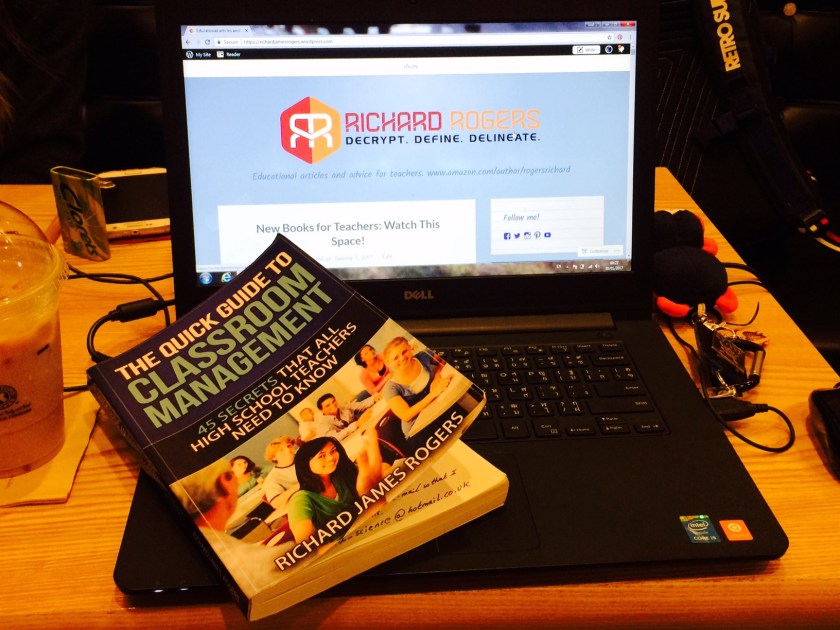
Richard’s new Kindle book. Only $3.99
Share the syllabus with the students on day one
This will really help to make the ‘road ahead’ clear. Some teachers like to make a ‘kid friendly’ version of the syllabus – using language that is more easily understandable. In my experience, however, I find that this isn’t generally necessary – syllabuses tend to be clear enough.
In addition to sharing the syllabus, map out the sequence of topics you will teach for the year ahead and share this with your students too. Some more able and hard-working kids will definitely read ahead, and it’ll help prepare your students for end-of-unit tests too.
Check them out if you want to really understand the importance of this aspect of Curriculum Clarity – her PPTs follow the same format and layout for each topic and are all detailed enough so that a complete course is created.
IB Chemistry is split into distinct topics that follow the Course Guide – there’s a PPT at Mindy Sautel’s site for topics 2.1, 2.2, 3.1, 3.2, etc. Everything is sequenced and clear.
Keep homework and questions consistent and linked to the syllabus
Maybe your syllabus is split into topics A,B,C and D with subtopics for each section. Do you have exam-style questions for topics A1, A2, A3, etc?
Organizing your questions by topic in this way will really build-up the subject knowledge that your students need to pass the final exam.
We welcome you to join the Richard Rogers online community. Like ourFacebook page and follow us on Twitter for daily updates.
Accompanying podcast episode (audio version of this blog post, read by Richard):
Accompanying video:
Being a Newly Qualified Teacher was difficult. Getting to know my new students was a challenge, as was the daily grind of behavior management and classroom management. Building up the skills I needed to be effective in these areas took considerable time, and one of the reasons I wrote my book back in 2015 was so that I could have a record of all of the ‘nuggets’ of experience I had picked up over the years.
I wanted something I could read over on a regular basis to remind myself of the lessons that had been hard-earned. I certainly wasn’t expecting the book to become a bestseller, as it did on three subsequent occasions.
I think my ‘raw’ style really resonated with teachers: teachers who were fed up with the confusing (and often contradictory) ramblings of researchers and consultants in the field. They wanted real advice. They wanted techniques that worked.
One thing I touched upon, but didn’t go into detail about in my book was the plethora of marking and assessment strategies I have learned over the years.
So, strap on your seat-belt because I’m about to go through the highest-impact, most effective strategies for marking and assessing work in ways that will save you time and energy.
Strategy 1: Diffusive Live-Marking
This is really simple:
Set a task for your students to complete (it could be a Google Slides presentation, a worksheet to complete, some questions from their textbook to do, etc.).
When a few minutes have passed, ‘diffuse’ through the classroom by walking around with a marking pen in hand (I use a red pen).
Mark student work in real time, as they are doing it. Of course – reinforce your written comments with verbal feedback (and you can even write ‘verbal feedback give’ or ‘VF’ on the work).
Hey presto – you just saved yourself an hour or so of after-school marking time!
Strategy 2: Absorptive Live-Marking
In this scenario, one can imagine the teacher being like a ‘sponge’ that ‘absorbs’ the students: instead of walking around the classroom to mark work in ‘real-time’, you sit at your desk (or at a designated ‘consultation point’ in the room) and call the students to your desk one-at-a-time.
Same result – you just saved yourself a ton of after-school marking time.
Which is better – absorptive or diffusive live-marking?
In my personal opinion, both forms of marking have their place.
Diffusive live-marking can actually double-up as an excellent behavior management technique – when you walk around the classroom and check work in real-time, pockets of low-level disruption tend to fade away because of the teacher’s proximity. The disadvantage of diffusive live-marking is that it can be difficult to stand behind, or to the side, of a student and mark work on a crowded desk.
I tend to use absorptive live-marking more than diffusive as I am lucky enough to work in a school where the overwhelming majority of the students are very well-behaved. This means that I can call them to my desk one-at-a-time and the class will still stay on-task. A big advantage of the absorptive method is that I can give more detailed and personal feedback to each student and I have my whole desk-space to neatly mark the work on.
Here’s a video I made about live-marking:
Here’s a podcast I made about live-marking:
Strategy 3: Peer-Assessment
I first learnt the power of peer assessment back in 2008, when I had just moved to Thailand.
As a keen young teacher with two years of UK teaching experience, I found myself teaching students who were ALL very keen to do their best (in stark contrast to what I was used to back home). Homework assignments and classwork seem to come my way on a real-time, live-stream basis, and I soon found myself inundated with work to mark.
At first, I tried the traditional methods of using a green or red pen to write lengthy comments on each piece of work. I had learned from my training in Assessment for Learning in the UK that written comments that help the student to improve were much better than a letter grade or a score followed by a ‘Well Done’. I’d learnt about the ‘two stars and wish rule’ – where I’d write two positive things about the work and then one item or target for improvement.
These ideas were great in theory, but I found that my weekends became shorter and shorter as I tried to write effective comments on every piece of work that came in. I was spending less and less time doing the hobbies I enjoyed, and I became quite the old grouch.
I finally expressed my concerns in the staff room one day and a colleague of mine said “You should do more peer assessment”.
She was right.
I instantly started getting my students to mark their own work, and reflect upon it, and the results were astounding: my weekends became ‘me time’ again, and students seemed to learn better than they would from receiving my comments.
As I continued to develop my skills in assigning proper peer-assessment, I discovered that I was sometimes making some catastrophic errors. I refined my strategy over the years, and came up with this six-step system:
Step 1:Make sure that the work you set has an official mark scheme or set of model answers associated with it. There’s nothing worse than trying to ‘guess’ the best answers along the way as you’re trying to get the kids to assess the work. Make your own mark scheme if necessary, but make sure the answers are clear.
Step 2: When it comes time for the kids to assess the work, ask them to swap their work with someone else in the class. Alternatively, if this doesn’t work for your particular class, then collect the work in and redistribute it.
Peer-assessment saves you time and energy, and is effective
Step 3: Ask each student to get a colored pen ready to mark with. Red and green are good. You may wish to have a set of special ‘marking pens’ somewhere in class that the kids can use whenever they mark each others’ work.
Step 4:Have the official mark scheme ready and give a copy to each student. This has the advantage of providing a permanent copy for each student to keep, and allows you time to help students as they mark. Projecting the answers onto a screen can also work, but you may find that students cannot see the answers clearly and that you may have to scroll through at a pace that’s not suitable for every student. Printing a copy, or sharing it on the schools VLE so that students can access it via a tablet or laptop, is best.
Step 5: Make it very clear that students should tick the answer if it’s correct, and make full corrections if it is wrong. The mere act of writing out the model answer onto the work being marked will reinforce the concepts into the subconscious minds of the students.
Step 6:Let the students give the work back. Collect it in at the end of the lesson so that you can glance through and check that everyone has peer-assessed properly. If anyone hasn’t, then make them do it again.
Once work has been peer-assessed, you can sit down with individual students and have ‘progress conversations’ designed to pin point areas of weakness and highlight areas of strength.
You have to be quite organised with this method (e.g. making sure you print or upload the mark schemes on time). However, this will save you loads of time in the long-run and will definitely help the kids to learn properly.
Strategy 4: Self-Assessment
Not surprisingly, self-assessment has similar perks to that of peer-assessment. This greatoverviewby the University of Sydney advocates for the wide-use of self-assessment with students for the following key reasons:
It encourages student involvement and participation, so it’s great for students who normally find group activities or active class tasks a little uncomfortable.
When used in conjunction with group work it can be a great way to assess one’s personal role and contribution in the group experience and learning process.
Academic appraisals aside, I’ve found from my personal experience that both self and peer-assessment are absolutely invaluable to the modern practitioner. They save you oodles of time as a teacher and students learn so much from each process.
There are a number of different ways that self and peer-assessment can be used in the classroom. My experience has taught me (the hard way!) that the following tasks work really well:
Making corrections to tests and assessments: When any important test or assessment comes up, I don’t think it is appropriate to have students marking these themselves. They’ll get things wrong, even with a mark scheme to use, and will be overly generous on themselves and their peers (unless they’ve been trained for a period of time – more on that next). However, a great activity is to mark the tests yourself, then give the tests back to the students along with a printed or online mark scheme. The students could then use a coloured pen to make full and detailed corrections to their test papers. You could turn this into an AfL exercise, with students writing down the question numbers they got wrong on the whiteboard, or on an anonymous piece of paper. You could then go through these questions afterwards to clear up common misconceptions. If you run a regular Learning Journals system (as I currently do), then students could write down the questions and the model answers in their Learning Journals. This causes very deep-learning to take place and is great for building long-term memory!
Assessing homework, classwork and regular assignments: A great time-saver for teachers. Just make sure the kids have access to the model answers. Don’t forget to collect the work in too – you need to know that the kids actually did the work you asked them to do.
Past-papers:Exam-level students really need to become familiar with the official mark schemes provided by exam boards. They need to become comfortable with key vocabulary, language and command terms. Provide exam-level students with regular past-papers to do as homework. Provide mark schemes too, so that they can self and peer-assess their work in class later. For older students (e.g. ‘AS’ – Level, SAT and IBDP learners) I’ll sometimes give them past papers and mark schemes to take home. Their task is to complete the past-papers under timed conditions and mark them using the mark schemes. The student then hands me the papers completed and marked (this is essential – I need to know that they have completed the assignment). I then check the papers for common misconceptions and target those in class.
Technological means:There a number of ways in which technology can assist in the peer and self-assessment process. Google formsare great; as are online quizzes provided by trusted third parties (e.g. BBC BitesizeandMyiMaths) and online quizzes that teachers can build by themselves (e.g.Quizlets). Make use of these and others (e.g.Kahoot– great for getting kids to use their mobile devices), as they are really interactive and can offer a nice break from traditional methods.
Strategy 5: Automated Assessment
I wrote ablog postabout the effective use of ICT in lessons some time ago and in that article I mentioned the first time I came across MyiMaths.
That was back in 2013, and it totally transformed my work-life balance.
Why? – That’s simple: students would go into the ICT lab, or use their laptops or tablets in class, and literally be taught mathematics by the computer! The program would even assess the work immediately, and differentiation wasn’t a problem because students could work through the tasks at their own individual pace. The benefits were enormous:
All of the students were focused and engaged.
All of the students were challenged.
The teacher had more time to spend with individuals working on specific problems.
The content was relevant and stimulating.
No behavior management issues as the students were all quietly working.
No time was needed by the teacher for marking and assessment. The program did all that for you. All you had to do was collate the data.
Instructional software can provide quick and comprehensive feedback to students, with little involvement from the teacher
There are numerous instructional software programs on the market today that save the teacher lots of marking time, and provide the students with engaging material to learn from. Whilst I wouldn’t advocate using instructional software every lesson, it certainly can become a significant and effective part of your teaching arsenal.
Some good programs to explore are:
Kahoot!– Did you know that you can set Kahoot! quizzes as homework challenges? The software even generates student performance reports for you.
Subject-specific software such asMyiMaths(for maths), Educake (for Science) andLexia(for English).
Class Dojo– totally free and a great way to award points to students and set homework tasks (which they can submit online).
We welcome you to join the Richard Rogers online community. Like our Facebook page and follow us on Twitter for daily updates.
The events in this article are based on actual occurrences. The names and, in some instances, the genders of individuals have been changed to protect the individuals’ privacy.
He walked into my room not really knowing what to expect. It was half-way through lunchtime and I had asked him to meet with me to discuss his grades in Chemistry.
David was an infamous Year 10 (15-year-old) student at our school. He had somewhat of an undisputed reputation for being ‘lazy’: not really caring about his studies, being untidy in his classwork and generally under-performing in tests and assessments.
I wanted to talk with David because I’d noticed a decrease in his grades on two end-of-unit assessments. He’d taken a cognitive test at the beginning of the academic year to determine his predicted grade: a C. However, on his first assessment he achieved a grade D, and on his second he dropped down to a grade E.
“An AMAZING Book!”
At this stage most teachers would have simply recorded the grades, reported to parents (e.g. in the school’s scheduled reporting cycle or at a parent-consultation afternoon), and just left it at that. After all, David was under-performing across the board; so there wasn’t really any pressure for me to ‘fix’ things, right? Almost all of his other teachers were reporting the same kinds of problems. If they were having trouble with him, then it was normal for me to experience those same problems.
I had an issue with seeing the situation this way, however. It bugged me that my default mindset was to ‘give up’ on David because this was ‘who he is’. I just didn’t like it. I tried to fix things.
“Hi David. Thank you for coming. This is just going to be a quick chat because I don’t want to take up too much of your time. Tell me: why do you think I’ve asked to see you today?”
“Err, because I’m doing badly in Chemistry.”
“I wouldn’t quite put it that way, but I do want to talk with you about your grades, yes.”
“Okay”
“Do you remember what grade you got on your first test this year?”
“Yeah, a grade D I think.”
“That’s right, and a grade E on your latest test. Now, tell me: do you think these grades really reflect the best you can can get?”
“No, sir”
“That’s correct, David. The answer is ‘no’. I know that you can do much, much better than this. I have seen your strengths in Chemistry, especially during that titration experiment we did. Do you remember that?”
“Yes”
“You got some great results in that didn’t you?”
“Yes, sir”
“So. I’ve seen how good you can be. I also know about your cool project in D.T. – Mr Reynolds told me about it.”
“Oh, really?”
“Yes, and I went to see it too. It’s a fine piece of work, David.”
“Thank you”
“So, how can we solve this, David. What do we need to do to get you a better grade in Chemistry?”
“I need to study harder.”
“Yes, David. Study more frequently for these tests. What resources can you use to help you?”
“My book, the notes on Google Classroom. my textbook.”
“Yes, David, and you know that you can always come and see me for help, don’t you?”
“Yes, sir”
“Good man. You must get a grade C on your next test in 4 weeks time. That’s your target, okay?”
“Okay”
“I believe in you, David. I know you can do this!”
I shake David’s hand as though we’d concluded a business negotiation. Wheels have been set in motion.
This conversation empowers David in a number of ways:
I draw upon his genuine success in D.T. and his good work in the Chemistry experiment. This kind of knowledge is called ‘Professional Intelligence‘ and is crucial for engaging our students on a deep, emotional level (which is where the real change needs to take place).
I give David a specific target to achieve. This focuses his mind on where to go next. I’ll have to reinforce this target over the next four weeks, as his next test approaches.
I tell David that I believe in him and, because I do actually believe in him, my tone of voice conveys that I’m telling the truth and not just making it up.
David is prompted to state the resources he can use to help his revision. This makes our conversation more memorable for him, and I assure him that he can always come and see me for help – this final part portrays me as an approachable, helpful person who’s not angry with David – just concerned about him.
Of course, this conversation is not where my influence ends. We have a whole four weeks until David’s next test, so it’s important for me to reinforce my message and my belief in him as the four weeks proceed:
Almost every time we have a Chemistry class together, I walk over to David’s desk and utter a few quiet words to him: “How’s the revision for the next test going?”, “Don’t forget to come and see me if you need help with your revision”, “I’ve uploaded some great resources onto Google Classroom that you can use for your revision”, etc.
When I see him around school (e.g. if I’m on duty or walking around the corridors, or at the canteen), I take the time to have quick chats with him. I ask him how he’s doing. I pass on any good news I’ve heard from other teachers (one of theFour Rules of Praise).
I constantly remind David that he’s going to get a good score in this next test. I remind him of his grade C target. I remind him that I believe in him.
I look especially hard for positives to praise in our lessons. The smallest piece of progress in homework or classwork; anything that’s good. I want him to feel empowered.
This process: of paying close attention to a student and reinforcing our belief in them and their targets for the future, is aptly named ‘Subtle Reinforcement‘: we subtly reinforce the student’s sense of self-worth and purpose.
The test day comes and David scores 68% – a grade C (and two marks away from a B).
This is not a fairly-tale. It’s a real story, and I’ve had many experiences like this during my teaching career. These experiences have led me to come to a significant conclusion: thatteachers can effectively engineer the progress they want to see in their students.
This means that we actually have tremendous power over how our students fare at school. It’s a shame that few realise this power.
T.I.P.S. : A four-step method to engineer progress
Step 1:Track progress. Look for patterns in grades. Keep a spreadsheet of scores.
Step 2: Intervene when grades slip. Have a short conversation with the student in which you use……..
Step 3:Professional Intelligence: Gather and use knowledge about the students’ past achievements, achievements in other subject areas and skills used outside of school to praise the student and remind him/her of the ability that he/she naturally possesses. Talk with other teachers to gather this intelligence if needs be. Couple this with…..
Step 4: Subtle Reinforcement: Be on-the-ball and remind your student regularly what his/her target is. Introduce new resources and offer your time to help. Remind him/her about a test that’s coming up and how you believe in their ability to get a good score. Praise small steps of progress along the way, or any positive work in your subject area.
I was walking down the corridor on a Friday afternoon, around 11 years ago. I guess I must have had a ‘free period’ (i.e. I wasn’t teaching that hour).
In of front me I saw a student walking aimlessly around the corridor. He should have been in class.
I approached him. “Aren’t you supposed to be in class….”
I was interrupted mid-sentence by a colleague who opened her classroom door and looked at me with a face of thunder. I felt like Criminal Number One.
She told the kid to come back into class. I didn’t realize she’d sent him out.
Well, I thought that was the end of it. I was wrong.
Later that afternoon I entered the Science prep room, which was effectively a hangout area for the science teachers. She was there, my colleague, and I remember clearly what she said: “Richard, I am well-capable of handling discipline and classroom management and I don’t need your help!”.
“He was walking around the corridor” I said, in my rather shocked and timid 23-year-old voice.
“He was walking around the corridor because I sent him out!”, she snapped.
She walked out of the prep room. I couldn’t believe it.
Later on, I decided to have a chat with my head of department, who was always a beacon of support and good advice. As I was about to talk with him my colleague walked in and saw me chatting with him. I asked her to stay, but she just walked right out in a most unsatisfied manner. She didn’t say anything,
“I think we need to move because this could get confrontational” my HoD said.
We moved to another classroom and I told my HoD what had happened.
“I wouldn’t worry about it, Richard. She has a really difficult class on a Friday afternoon and she was probably just stressed by it all. Let’s let her have the weekend to calm down. I’m sure it’ll all be forgotten about on Monday.”
That was very reassuring, and he was right. In fact, later that year she became a good friend of mine.
Always speak up
It’s really important that we speak up immediately when problems that we can’t solve arise. I recently had to ask for permission to extend some deadlines for my students, for example. I had to go through official channels. Had I have worried about the problem, and unofficially extended the deadline, then I may have had some awkward questions to answer later down the road. I would have lost trust.
Another thing worth mentioning is the issue of inter-gender dynamics in the workplace and at school. In the age of #MeToo and mildly masculine behaviour being deemed as ‘misogynist’ or a ‘micro-aggression’, it is important that men and women who meet or speak together at school do so in the most professional manner possible. It’s too easy for messages to be misconstrued and misunderstood in today’s climate. Even a simple compliment to a colleague about his/her appearance can be misunderstood.
Keep everything professional and academic, and document anything that makes you feel uncomfortable or uneasy. Speak up and tell a manager too – you’ll be in a much stronger position if you speak up early, than if you leave it too late. Send summaries of one-to-one discussions via e-mail and cc’ your line manager.
In the case of my story with my female colleague who was in a mood at me for speaking with her student – I absolutely had to speak up immediately and talk with my HoD. Had I have left it until later the following week she may have come to him with a totally inaccurate story and I would have been in a weaker position trying to defend myself. It’s also good to get reassurance from those more experienced than you, especially if you’re a compulsive worrier (like me).
We welcome you to join the Richard Rogers online community. Like ourFacebookpage and follow us onTwitterfor daily updates.
Here’s a quick video I made to supplement today’s blog post:
Every high school student you will encounter; no matter what their domestic situation is or how much peer pressure they are under, craves a sense of personal importance just like you and I do. It’s the reason why we wear posh designer labels; why we brag about our new car or house on social media and why we beautify images of ourselves using various apps on our smart phones. It’s also the reason why a lot of young people turn to drugs, join gangs and get involved in thug culture.
The trick with students is to make sure that they are receiving their validation (i.e. their sense of importance) from positive sources.
My experience has taught me that the best way that we can make our students feel empowered and important positively is by enacting the following steps:
1. Find out what the strengths, hobbies and interests of each of your students are: This can be daunting, as you’ve probably got a whole gaggle of students that you teach and it’s hard to remember everything about everyone. If you have to, then buy a special notebook and write down snippets of information that you pick up. Is Thomas exhibiting his artwork at a local gallery this weekend? Write it down. Does Cassandra love fashion design and magazines like Cosmopolitan? Write it down. Did Jason score a goal at lunchtime football? Write it down.
“An AMAZING Book!”
2. Act on the information you have gathered: Use the information to engage your students in their lessons. If the output of a task or project is open to negotiation, then suggest a way for a particular student to produce that output in a way that is personal to them. Does Damon like boxing? Get him to create an animation or movie of a boxing match in which each boxer represents one side of the debate. They can say counter-phrases whilst they box, and the winner will represent the argument that Damon agrees with the most. When doing group work, assign roles to each student based on their strengths, and make it clear why you have chosen each student for each role.
I once had a student who was famous for being confrontational, and he was the figment of every teacher’s worst nightmare at that school. However, I noticed quickly that he was very good at art, so I made him the class ‘Art Director’, where his job was to check each student’s presentation. He loved the positive attention, and he became my most compliant and hard-working student. I also took a special interest in him by going along to the art room to look at his work, and I viewed his pieces in a local art gallery. This extra effort on my part really paid off, and other subject teachers were amazed at the change they saw in him.
3. Always turn a negative into a positive: Have you just taught a student who ‘played up’ or had a ‘tantrum’? Has one of your students just had a ‘bad day’? Make a special note of this, sit down with the student and offer your help and guidance. Focus on the positives of this situation, and what the student did well. Perhaps this time the student didn’t swear – now that’s a positive and a step in the right direction. Maybe your student was frustrated because they couldn’t quite make their work ‘perfect’ – brilliant, this shows a desire to do well and to try their best. Tell the student how pleased you are that they care about their work so much and offer more time to get it done if needs be. Maybe another student annoyed the kid who played up; offer a number of solutions to the student such as a seating plan and the chance to have a ‘time out’. Get your ‘problem students’ to reflect on solutions, and praise them for being reflective and proactive in wanting to move forwards, and not backwards.
4. Focus on the long-term goals of the student: Some students are completely unsure of what they want to do in life even when they reach 18 years of age: when they’re about to start out at university or find employment. Others take time to develop their goals as they mature through high school and still others are very sure what they want from life since their first day in Year 7/Grade 6. Whatever the situation may be, you must remind your students that there’s a bright and happy light at the end of the tunnel (and it’s not an oncoming train!). Talk regularly with your students about their goals, ambitions and strengths, and constantly make them feel like they can achieve those goals by being supportive and enthusiastic for them. When students can see that there is a real purpose to school life; that all of these ‘pointless lessons’ can actually make their dreams come true, they tend to work harder. However, you, as a teacher, need to constantly reinforce this and it can take some time and effort before positive progression is seen.
Stay strong, have faith and I guarantee that your efforts will pay massive dividends!
5. Use rewards more than sanctions, and make them sincere: When a student accomplishes something, and is then rewarded for this accomplishment, this reinforces the positive behaviour/process that lead to the outcome. However, the extent to which this reinforcement is maximized depends upon the depth, relevance and sincerity of the feedback given to the student. We’re all very busy, and it can be really tempting to just sign that house point box in the student’s planner, or hand out that merit sticker, with little conversation afterwards. However, if we’re going to be effective behaviour managers, then we need to spend more time giving sincere and relevant feedback to our students that focuses on the effort/process that went into the work that was produced. Always sit down with your students, especially those who have a reputation for being disruptive, and talk with them about their accomplishments. Tell the student how happy you are, and give a good reason (e.g. “I was so pleased that you took the time to draw large, labeled diagrams in this work. You also asked lots of questions, and you tried your best to avoid distractions”).
This is actually quite simple when we think about it: all we’re trying to do is reinforce the behaviour that we want to see repeated again in the future.
Conclusion
Making your students feel important, or valued, is probably the most important factor in ensuring that you have a positive relationship with them (and, hence, lessons in which behaviour is good). One of the most memorable examples of this takes me back to my first teaching post in Thailand, when I was teaching Personal, Social and Health Education (PSHE) to a group of Year 8 students. At that time, I was taking the students through the Expect Respect™ programme, and we were covering themes that centred around domestic abuse and neglect. At the end of my first lesson with this group, a very shy and withdrawn young girl spoke with me privately and said that she enjoyed the lesson because it made her reflect on what was happening in her home environment. She then revealed to me something which almost shocked me to a frail state of nervousness as a young teacher – she told me she was self-harming, and she showed me the scars on her arms.
The first thing I did at that moment was talk about the positives of this situation, and I praised her for having the courage to speak to someone. I asked her what she thought of the lesson, and she said that she could empathise with the people involved in the scenarios we had discussed. I said that this was a brilliant quality to have, and that she could use this in her career when she leaves school. She left with a very bright smile on her face, and I could tell that she felt empowered. I saw her domestic situation as a positive, because it gave her the experience she needed to help other people in similar situations.
After our conversation, I referred her to our school counselor who worked with her twice a week to talk about what she was going through and how to move forward. She told her counselor how she felt so refreshed by her conversation with me, and how she felt that she could be a counselor too!
As time went by, I constantly reinforced my belief and professional interest in this student. When we covered career clusters in later PSHE lessons, she was keen to talk about how she wanted to be a person who cared for, and helped, others. She talked boldly about her plans to make people happy, and she would allude to her life experiences as being valuable in making her a strong person. Prior to this transformation, this young lady was famous for crying in class, and would often not take part in group activities. My belief in her, along with the help provided by other staff members, transformed her into a self-confident, determined person.
I am not ashamed to say that I was rather tearful when she got accepted into university to study occupational therapy five years later. She is now a professional, mature and empowered young woman who has a dream and a mission to help the people she comes across in her day-to-day life. I must admit, I can’t take all, or even most, of the credit for this, as many individuals in the school worked with her to empower her to be bold enough to face life’s setbacks and move forward. However, I like to think that that first conversation she had with me all of those years ago was the spark that set the forest fire of ambition raging through the wilderness of her life.
We welcome you to join the Richard Rogers online community. Like ourFacebook page and follow us on Twitter for daily updates.
The high school science teacher turns his students into ‘electrons’ and gets them to walk along a prescribed route in the classroom, reinforcing concepts associated with circuit diagrams and electricity. The primary school mathematics teacher gets her students to make funny shapes with their bodies that represent the numbers 0 – 9, creating a fun way to tackle mental arithmetic problems. The ICT teacher creates a variety of ‘human graphs’, getting students to line up in columns based on their chosen answers to assigned questions.
“An AMAZING Book!”
What do all of these examples have in common?: The students are using movement to solve problems and, in doing so, are engaging multiple regions of the brain.
Every single day, our experience of the world around us is created by five main sensations or senses, namely:\
Touch: Experiencing the texture of different objects
Taste: Stimulation of various taste receptors on the tongue
Smell: Linked strongly with taste and involves stimulation of olfactory receptors in the nasal passage
Sight: Our perception of light energy through stimulation of cells in the retina
Hearing: The way in which we receive and process longitudinal vibrational energy
The above five senses allow us to perceive the world around us so that we can make decisions effectively. However, what a lot of people forget is that all of the above five senses become obsolete, and can be switched off, if one vital organ is missing: the brain.
A point I often make with my biology students is that we see, hear, taste, smell and touch with our brains! We don’t see with our eyes, we don’t hear with our ears and we certainly don’t feel touch because of our skin alone. All of these sense receptors just mentioned are tasked with one job only: to send information to the brain to be processed. Once the brain processes the necessary information, we then feel the intended sensation.
Evolution has ensured that our brains are hard-wired to remember information generated by all five senses. It is essential that we can do this, otherwise we would not be able to survive.
Immanuel Kant, author of Critique of Pure Reason, puts this very eloquently:
All our knowledge begins with the senses, proceeds then to the understanding, and ends with reason. There is nothing higher than reason
When students have a good rapport with their teachers and are genuinely interested in the subject being taught, they acquire the self-confidence and motivation to pursue their learning with hard-work and enthusiasm. ‘Interest’ is a funny human condition because we often make the mistake of thinking that it’s just something that each person has an affinity for, based upon their life experiences or even the way they were born. However, the real truth is that the effective teacher behaviours outlined in this blog and my book can literally change students’ lives as they go from ‘liking’ a subject, to wanting to be the best student in the class!
But what is Spatial Learning?
There are many definitions and interpretations of spatial learning on the web and in various books. Some of this pedagogical mumbo-jumbo can be really confusing, but I believe I’ve nailed it down to one sentence:
Spatial Learning is when students use bodily movements to express themselves, solve problems and model situations.
Spatial Learning has both general and specific applications. I’ll now go through some great examples that illustrate the power of this excellent teaching tool.
Here’s a quick video I made about Spatial Learning:
A human graph and true or false?
Do you want to know the opinions of your students on a subject matter? Maybe you’re taking a survey (e.g. which day is the best for canteen food). Maybe you have a list of multiple choice questions and you want a fun way to get the kids through them.
A human graph might be the right tool for you!
What if you just want to quickly check your students’ conceptual understandings (e.g. as a plenary)? You could ask some true/false questions and get the kids to raise their hands, or you could use a way cooler (and more fun) method!
Choose one wall to be the ‘True’ wall and one to be the ‘False’ wall. Once you’ve asked the question, get the kids to walk to the correct wall. It’s that simple! Just make sure that the kids walk back to the middle of the classroom before each question.
This great illustration from Pop shows you the steps to take for each of these activities:
Body numbers
Do your kids need to express numerical answers sometimes? Maybe they need to work out a percentage or a fraction, or translate numbers from one language into another. Maybe they need to express something in Binary Code. Well it’s time to put pen and paper down and get your kids moving!
Turn your students into ‘human numbers’ by following Pop’s beautifully illustrated instructions:
For double and triple-digit numbers you can put students into groups for added fun!
Modelling
The vast majority of the Spatial Learning I do involves modelling a situation, concept or solution. Like the example I gave earlier about the electrons travelling around the circuit, the students actually become the things that you’re teaching about.
Ifind that almost everything I teach can be modelled spatially in one form or another.
I’ll provide some examples to show just how easy it is, with just a little creativity, to turn any monotonous textbook paragraph into a living, breathing, exciting and stimulating task.
Modelling example one: Diffusion
Textbook definition:Diffusion is the passive movement of liquid or gas particles from a region of high particle concentration to a region of low particle concentration. The speed of diffusion of any given particle is dependent on its molecular mass. This means that a particle of ammonia, for example, will diffuse faster than a particle of hydrogen chloride as ammonia is the lighter of the two particles.
Modelling activity:As you can see, the textbook definition is rather hard to swallow.So, to jazz things up a little, you can turn the students into ammonia and hydrogen chloride particles and tell them to diffuse! In this activity, the students simply walk across the classroom at different speeds, depending on which molecule they are. Quick, easy to do and a nice break from writing, reading and listening to a lecture. More importantly: it’s really useful as a tool to help kids understand this concept.
See this illustration I drew below (my art work is dire compared to Pop’s, so I hope it’s understandable!):
Modelling example two: A Typical Home Network
In an attempt to show you just how pliable spatial learning is, I’ve designed a task for a subject area I don’t specialise in: ICT
Concept:A typical home network may be wired, wireless or a combination of both. Hardware components process and convey the data message from from part of the network to another.
Spatial learning task:For this task you need moving and stationary students. The stationary students stand at predetermined positions in the classroom (you can put signs on desks or on walls to help). These students represent the hardware. The rest of the students are the ‘data message’, and they move from one component to another. I hope the illustration below helps you to see just how easy this is to implement and how much fun it can be. Students should shout out the name of the hardware component they reach at each stage as they walk around the room.
Can you think think of ways to use modelling in your subject area?
Further reading
Mydebut bookis filled with great spatial learning and active engagement tips. After the enormous success of that book I’ve decided to work on a new book that will be released mid-2018 which goes into even greater depth and breadth about the range of classroom management tactics available to teachers. Also, if you’re looking for a great book to build up spatial learning skills in small children, then I strongly recommend Julie Dillemuth’sLucy in the City:
John’s Year 10 English class consisted of a cooperative and friendly group of students. One problem persisted though; a problem found in scores of classrooms the world over: low-level disruption.
This class was notorious for doing as they were told but having a lack-luster approach to tasks: often chatting when more ‘work’ should have been done. John, a man from a traditional British family, saw himself as a ‘staunch disciplinarian’, and he would often respond to student chatter and distraction by shouting at the students who he thought were responsible for it. He would hand out scores of detentions, all of which ate into his lunchtimes and his free time after school.
Had this have solved things, John might have been be forgiven for feeling proud of his vigilant approach. However, the problem didn’t go away, and students started to resent going to John’s lessons and they began to dislike him personally. John had effectively created a very negative environment in the classroom and this was not conducive to effective learning or positive behaviour.
“An AMAZING book!”
As behavior got worse and worse, and students felt that they were being treated ‘unfairly’, John realized that he needed a radically different approach to his teaching methodology. He decided to attend a professional development course in accelerated learning, and after a day of various workshops his eyes were opened dramatically.
“I had been making fatal mistakes since I started working with this class” said John.
“I hadn’t shown them my human side, and I was too quick to criticize. I didn’t use my personality to generate humor and I created an environment of negativity”.
What do you think John did the next time he heard students chatting in his class? He used humor and his personality to ‘lighten the mood’ whilst, at the same time, getting the students back on–task.
“My student, Billy, was chatting to a girl called Sarah when he should have been listening to another student read a Shakespearean sonnet to the class. Normally, I would have responded to this by reading him the Riot Act and exploding, or putting both students on detention. Knowing that this could cause a backlash, or at least create an unhelpful atmosphere in the class, I decided on a different tactic. I said ‘Billy, please stop flirting with Sarah. You can do that at break time’ and I smiled. The response I got was a giggle from the class and a bit of teenage awkwardness from Sarah as she said ‘Ugh! I don’t think so’. After this, everyone listened attentively to the sonnet, and we proceeded on to our group activity”.
John’s story demonstrates the power that humor can have in making a lesson more palatable for students, and how humor can be used to keep students on-task. Again, it makes our human nature become visible to our students and, if used tactfully, it can even make lesson content more memorable and can help with behavior management. You have to be careful though, as some forms of humor will work with some students but not others. You need to have a good knowledge of your class before you employ the tactic that Josh used in the example above.
You really need to know your students well, as not every student you have will respond in the same way to the humor that you use.
I recall teaching a Biology lesson some years back in which we were studying inherited and environmental traits. One girl in the class asked to be excused to use the facilities and upon leaving she said something to her friend and was replied to with the word “retard!”.
Now I know that some people are going to tally disagree with I did in response to his, but in this particular situation it was definitely the right thing to do. I tackled this spontaneous outburst in a non-confrontational way by jokingly asking “Is that an environmental or inherited trait” and she said “both!”.
The whole class giggled, the situation was forgotten about and the students were back on task in a matter of seconds.
Had I have responded with some form of severe sanction, for what was essentially a typical exchange between two teenagers, then that would have created confrontation and a negative atmosphere in the classroom. This wouldn’t have helped anyone.
Word games: An idea worth exploring
Turn your key vocabulary into silly (bad?) jokes when talking to your students. Here’s an example: “I was sitting the staff room yesterday and Mrs Jones said ‘I like you, Mr Rogers, you’re funny’. I replied with ‘I alkalike you, Mrs. Jones: you are funny too’. This is the life of a Chemistry teacher, hashtag chemistrylife” (For those who don’t get it, I turned the word ‘alkali’ – a chemistry key word – into ‘alkalike’).
As bad as jokes like these are, I’ve found that students really like them, and they help the students to remember the key words they need for their tests and exams.
Suggestions: Ways to use humor in lessons
Tackle disruption with light-hearted comments that make the students aware that they need to be on-task, without being antagonistic. Use knowledge about student interests if possible (e.g. “David, I know you must be talking about the next ramp you’re going to fly off on your skateboard, but if you could please listen to me at this moment then I would be most grateful”, or “Simone, I’m sure that Diane already knows what a great dancer you are, so if you could please focus on the task in hand, then that would be great”). Remember, students may respond to this so be ready to be light-hearted and direct the conversation back to the task in-hand.
During group activities or short tasks, you can play some silly music (not too loud) to lighten the mood. You can start by saying something like “I’m going to play everyone’s favourite music”, and then proceed to play something funny and upbeat.
You can sing to your students. That’s right, I did just say that! You can make up silly songs about whatever the lesson content is and sing or rap them to the class. You can also get the students to do this too.
Use your whole physiology to generate laughter. A laugh eases tension and nurtures creativity. Use changes in your voice, funny personal stories, exaggerated facial expressions, dance moves and anything you can think of to raise a smile and a giggle.
Use learning games to make the atmosphere more happy and relaxed. If you’re a languages teacher, you may want to make your students formulate silly phrases, or use the vocabulary games mentioned in Chapter 2.
Make up rhymes, acronyms and funny mnemonics. For example, MR FAB is an acronym for Mammals, Reptiles, Fish, Amphibians and Birds (vertebrate animals) and “Never Eat Shredded Wheat” is a mnemonic for “North, East, South, West”. Even better: get the kids to make up their own.
Conclusion
In summary, humour increases happiness in the classroom, removes inhibitions, makes the teacher appear more human and can even be used as a behaviour-management tool. To add to this, decades of methodical research have shown that humour can even help students remember key concepts for long periods of time, if it is used to illustrate a concept that has just been taught (Banas et al, 2011).
We welcome you to join the Richard Rogers online community. Like ourFacebookpage and follow us onTwitterfor daily updates.
My next book will be a teacher’s planner with articles from this blog inside. Which planning template do you like the most? Do you have any thoughts or suggestions on what would make your favorite template better? Any general comments?
5 free copies are up for grabs! To enter, just comment on this blog post (with something constructive that will help). If you post something really good then I may even include you in the acknowledgements section of the planner!
Please share! 🕹🚕🧩🚡🎆
Thank you!
Richard
Option 1: Each day over two pages
Option 2: Each day on one page
Update:17thDecember
Hi everyone. The feedback I’m getting from a number of people on the teacher’s planner is that we would like to lose the notes and targets on the planning page but have a full notes and targets page prior to each lesson planning section. So the sequence would be:
1. Notes and targets page
2. Lesson planning section (two pages)
3. Pedagogical article from my blog
4. Repeat
Every notes page (there will be 45 of them in total) should have a different illustration from pop at the top. Thanks for your feedback, everyone! It’s going to be an amazing teacher planner!
We’ll be going for the ‘day over two pages’ template.
Our cover teacher was late to class and we were having a right old laugh! It wouldn’t be allowed these days, but we walked into the empty chemistry lab and sat at our seats.
Some of us were chatting, some were making silly noises that inspired a raucous of laughter. We were chilling-out like pros!
Then he walked in.
As the most notorious maths teacher in the school all he had to do was walk in with a grumpy look on his face to cause instant retreat into silence.
“Oh no!” was the look that was plastered across everyone’s faces.
“Get up off your backsides!” He snarled.
We stood, and gulped, and he stared at us. He waited until absolutely everyone was paying full attention. It didn’t take long.
“You all know what you’re supposed to be doing, don’t you?”
“I can’t hear you!”
“Yes” we all synchronistically chimed.
We got on with our work without a fuss. Some of us itched with the desire to chat, but we didn’t dare to.
Fightingfire with water
This maths teacher had what only the best teachers possess: presence. One of his defining techniques was the power of waiting, or more succinctly, pausing.
Pausing provides the modern teacher with a number of distinct benefits:
It can be used as an effective behavior management tool
It can be used to make concepts and content really clear
It allows students time to articulate their answers
It generates that enchanted and mysterious teacher quality known as presence
It can increase the perceived seriousness of a situation, which may be appropriate in certain situations
It de-escalates conflict
That last point is an important one: as a new teacher all of those years ago I would often try to ‘fight fire with fire’, which almost always failed. If a class was chatty I would shout at them to calm them down (N.B. – it had the opposite effect).
Sometimes I would even shout on a one-to-one basis with individual students.
I soon learned that shouting was almost always a bad idea. It creates an atmosphere of instant negativity, and that affects everyone: even the compliant, hard-working, ‘good’ kids.
Ways to use pausing as a behavior management tool:
For whole-class low-level disruption (e.g. at the very start of a lesson, or at the end of a task), simply wait, silently. Look at the students with a look of “I’m waiting” on your face. After waiting a short-time, you can say something such as “Thank you to those who are listening, and thank you to those who are facing me. I’m still waiting for one-or-two.” Normally, in this scenario, the students will say ‘shh’ and ‘be quiet’ to each other, removing the need for the teacher to get loud and aggressive (which usually doesn’t work as a long-term strategy anyway).
At those times when you need to have a serious one-to-one talk with individuals or small groups, pausing can really have a dramatic effect and can emphasize the seriousness of the situation. A good example I can think of from my practice happened a few years ago. A group of boys had been chatting for a large part of the lesson, instead of doing the work I had assigned them. They thought I hadn’t noticed, but I had.
I called the boys to my desk at the end of the lesson and waited for them, silently, to sit and listen. I then asked to see their work, which they reluctantly gave me. I must have stared at the dismal trash that was handed to me for a good minute, not saying a word. The boys looked mortified.
”This simply isn’t good enough” I said.
”Err, sorry. Sorry sir” piped in one of them.
”We’ll hand it in tomorrow”
”Yes, you’d better, and it had better be a lot better than this” I concluded.
They left the classroom and I got that work back the next day. I said “Thank you, let’s have a fresh start next lesson”.
That’s important isn’t it – a fresh start. We all need one of those at some point in our lives.
I rarely had a problem from those boys after that. Sure, I had to reel-them-in once or twice, but generally they got on with their work because they knew I was serious, and they knew that I wanted what was best for them.
The ‘Shouting Myth’
Is it still a myth? I’m not even sure.
I, like many teachers, have found that pausing works much better than shouting, almost every single time. In fact, unless a student is in an emergency situation (e.g. about to fall down the stairs), shouting is never effective.
Here are the problems I have with shouting:
Over time, it ruins the teacher’s health. It creates internal stress that permeates the body tissues deeply. Stress is not good for us – it even accelerates the ageing process.
It immediately creates an atmosphere of negativity in the classroom, and it can be hard to flip-that later on when you have control of the kids and you want them to approach you and ask questions.
When shouting is adopted as a consistent teacher behavior, it loses its effectiveness over time. Like a drug that one has become dependent on, larger doses are needed to maintain control in the future. It’s intimidating and can make students fear you, rather than respect you.
There are many advantages of using pauses as a behavior management tool (such as avoiding the consequences I just listed above), but the main reason pausing is so effective is that it creates an atmosphere of willful clarity, where excellence is achievable and desirable, rather than mandatory and burdensome.
Pausing as an instructional tool
One obvious adavantage of pausing in an instructional context is that it allows students time to think and process information. When used effectively it can also be a great way to ‘coax’ answers and responses out of students who would otherwise be shy or disinterested (or simply too tired to focus in the moment).
Try the following techniques and watch miracles happen!:
Pause halfway when saying a key word or phrase, and coax the rest of the word from the students. “The stomach produces digestive en, en…………., enzymes! Yes, well done. Enzymes is correct”. This technique aids memory and gets kids focused on the content.
Stop part-way through a lesson and do a quick review. Bring the kids to the front of the class if you must. Ask individual students some pertinent questions. Pause and allow enough time for the students to answer.
Pause and check that the students understand what you have said thus far. “Okay, put your thumbs up if you understand everything so far. Does anyone have any questions? (Pause). Okay, in that case can I move on? Thank you.”
Did you just notice the pause after asking if anyone has any questions? That’s important isn’t it? We must pause for ‘question time’ at least once every 30 minutes. Sometimes our pace can be very fast (especially with exam-level classes) and students may not feel confident enough to ‘butt-in’ and ask questions when you are mid-sentence. Allow them time to ask. Make yourstudents feel that asking questions is a good thing, and that you are happy, veryhappy, to help when needed.
Pause between topics and sub-topics, and allow students to think for a moment. When you’re teaching at the pace of a steam-train it can become quite overwhelming for your students.
Look at your students and notice how many have finished writing their notes. Pause to allow time to finish the note-taking. If you’re not sure who’s not finished, then you can simply ask “Does anyone need more time?”.
Conclusion
Pausing is a very powerful technique, when it is used properly. Use pausing to:
Get your students focused and listening without being confrontational in the process
Reinforce the seriousness of a situation (e.g. when homework isn’t handed in)
Aid instruction through response ‘coaxing’, pausing for ‘question-time’, checking that students understand everything, allowing students to think between topics and subtopics and allowing adequate time for note-taking
We welcome you to join the Richard Rogers online community. Like our Facebook page and follow us on Twitter for daily updates.
I was very excited when I handed my homework to her. I was 16-years-old and a very keen GCSE Science student.
That piece of Chemistry homework took me ages to complete – a good few hours if I remember correctly. I really tried hard to write the displacement reactions neatly and clearly, and in a different colour to the explanations.
I knew my Chemistry teacher would be impressed, and I really wanted to impress her. I think that as a teacher almost two-decades later, I am mindful of the fact that my students look-up to me, and they want to impress me.
That gives me a huge task (I won’t say ‘burden’, because it’s not a burden): the task of being responsible and caring enough to give my students the feedback they deserve, in a timely manner.
I waited weeks and weeks for that Chemistry homework to get back to me. Finally I summoned up enough courage to ask her where it was.
“Oh, I am sorry, Richard. I completely forgot about it. I’ll get it back to you pronto.”
She was honest, and I respected her for that. When it did finally get back to me, she added to the written feedback (which I can’t fully remember, if I’m honest) with “Richard, I could tell that you put a lot of time and effort into that work.”
That felt good.
Juggling many things at once
Looking back on those bright and happy days as a teenager I can now see what my Chemistry teacher was suffering with – she was clearly very busy with a number of different things and my homework was low on her list of priorities at that time.
I don’t blame her or condemn her for that at all.
I’ve found myself in the same situation many times in the past, and it was all because I wasn’t organised. Here are the key mistakes I would make in my first ten years (yes, ten – it was slow learning curve!) of teaching:
I would give homework to different classes on random days each week. So, for example, Year 8 Science would get homework on a Monday one week, then on a Tuesday the week after, then maybe on a Thursday the week after that.
Since I was setting homework on random days each week, I would receive it back randomly too. This would mean that I would have ‘cluster’ days when I would get back, say, four classes of homework in a single day.
The net effect was that I couldn’t mark it as quickly or as effectively as I really wanted to, and on some days I would stay at school very late to mark it all
So, what’s the solution to all of this chaos? Well, today, I can very happily say to you that I no longer have problems with marking and returning homework. In fact, I’m almost astonished to say that it has even become an enjoyable process!
So what are these four strategies? Let’s explore them together now.
Strategy #1: Create and implement a homework setting, marking and returningtimetable
Sounds obvious doesn’t it? It wasn’t obvious to me for a very long time (granted: I am slow at learning certain things!).
Many schools will have a homework ‘timetable’ in place, but this normally only extends to the setting of homework. Even if you follow that timetable, you still need a schedule in place for the marking and returning of that homework.
And that’s another point I must make: if your school has a homework timetable in place, then please follow it! I know I’ve been very relaxed about this at certain points in my career, but I now realize that that strategy didn’t help me or my students: they would find themselves overwhelmed with homework on certain days because their teachers didn’t follow the timetable.
Here is my current setting, marking, receiving and returning timetable:
Feel free to download and enlarge the above picture and share it with colleagues if you wish.
Strategy #2: Use Learning Journals
Learning Journals are a form of ‘recurring’ homework and are very powerful because:
They quickly build routines into your students’ lives
They reinforce the importance of constant revision, reflection and reviewing of work done in class
The are cumulative, and provide a record of the work done by the student to-date
They provide an excellent revision resource prior to exams
Students receive quick, effective feedback
Students can customize the work using their own styles, colours and sequence of revision. They even get to purchase their own ‘special’ notebook for this, making the experience uniquely personal.
So, how do we implement a ‘Learning Journals system’? Here are the steps I suggest:
Students purchase their own ‘special’ notebook. A school notebook can be given to students who can’t afford this/don’t want to buy their own.
Students fill their learning journals with revision notes, past-paper questions, Mind-Maps®, summaries and exam-preparation work. Students do this every week. A page from Pop’s Learning Journal (one of the first students I piloted this technique with about 9 years ago) is given below.
Students bring their Learning Journals to class on an assigned day each week. For this academic year, my IGCSE students bring their Learning Journals to me on a Thursday, and my IBDP kids bring them on a Friday (this spreads-out my marking a bit and matches the kids’ timetables)
Students sign on a big sheet on the wall when they hand-in their Learning Journals (please see below). Please note that the following image is one year old (sorry). I now collect in my journals on a Thursday and Friday, not a Monday like it says in the photo:
I put one and only one post-it note of feedback into each learning journal each week. This keeps my feedback focused on what’s most relevant to the student, and it ensures that I don’t spend too much of my free-time marking piles of work. Please see the example below:
The process repeats itself every week, providing a clear and productive routine for myself and my students
In addition to this, I’ve turned my Learning Journals into a ‘live-marking’ recurring feedback system: I mark them in class, with the students. It means that I lose no free time, and I am able to give one-to-one feedback to each student that is meaningful and specific.
Strategy #3: Live marking
‘Live’ marking is an incredibly powerful feedback technique, but it is rarely used effectively in the teaching profession. However, with just a few tweaks our daily routines, that can change.
I’ve made a quick video that outlines the technique of ‘Live-marking’ below:
I have personally wasted so much of my free time both at school and at home marking student work. Many late nights; many lost weekends. All for nothing.
Well, not completely for nothing – at least now I’ve seen sense and can pass on my experiences to you so that you don’t go through the same pain.
You see, I now know that feedback only works if it is relevant, specific and somewhat emotional. How do we achieve this? – we must mark student work with the students. They have to be involved too.
As soon as I started doing these things, my impact skyrocketed:
Simply walk around the classroom with a colored pen in hand. Tick, flick and mark student work as you walk around.
For larger pieces of work, set the kids on a task and call the students to your desk one at a time. Sit with the student and discuss the work, adding written comments in front of the student along the way. Use praise effectively and remember – praise only works if it is sincere, specific and collective (tell your colleagues and get them to praise the student too).
Use peer-assessment and self-assessment, but don’t do this for everything. Students still need to receive acknowledgement from their teacher.
I’ve written a useful article about peer and self-assessment techniqueshere. Some general advice on giving feedback can be foundhere.
Here’s a video I made about the Four Rules of Praise:
Strategy #4: Self and peer assessment
I first learnt the power of peer assessment back in 2008, when I had just moved to Thailand.
As a keen young teacher with two years of UK teaching experience, I found myself teaching students who were all very keen to do their best. Homework assignments and classwork seemed to come my way on a real-time, live-stream basis, and I soon found myself inundated with lots of work to mark.
At first I tried the traditional methods of using a green or red pen to write lengthy comments on each piece of work. I had learned from my training in Assessment for Learning in the UK that written comments that help the student to improve were much better than a letter grade or a score followed by a ‘Well Done’. I’d learnt about the ‘two stars and wish rule’ where I’d write two positive things about the work and then one item or target for improvement.
These ideas were great in theory, but I found that my weekends became shorter and shorter as I tried to write effective comments on every piece of work that came in. I was spending less and less time doing the hobbies I enjoyed, and I became quite the old grouch.
I finally expressed my concerns in the staff room one day and a colleague of mine said “You should do more peer assessment”. She was right.
I instantly started getting my students to mark their own work, and reflect upon it, and the results were astounding: My weekends became ‘me time’ again, and students seemed to learn better than they would from receiving my comments teh traditional way.
As I continued to develop my skills in assigning proper peer-assessment, I discovered that I was sometimes making some catastrophic errors. I refined my strategy over the years, and came up with this six-step system:
Step 1: Make sure that the work you set has an official mark scheme or set of model answers associated with it. There’s nothing worse than trying to ‘guess’ the best answers along the way as you’re trying to get the kids to assess the work. Make your own mark scheme if necessary, but make sure the answers are clear.
Step 2: When it comes time for the kids to assess the work, ask them to swap their work with someone else in the class. Alternatively, if this doesn’t work for your particular class, then collect the work in and redistribute it.
Peer-assessment saves you time and energy, and is effective
Step 3: Ask each student to get a colored pen ready to mark with. Red and green are good. You may wish to have a set of special ‘marking pens’ somewhere in class that the kids can use whenever they mark each others’ work.
Step 4: Print the official mark scheme and give a copy to each student. This has the advantage of providing a permanent copy for each student to keep, and allows you time to help students as they mark. Projecting the answers onto a screen can also work, but you may find that students cannot see and that you may have to scroll through at a pace that’s not suitable for every student. Printing a copy, or sharing it on the schools VLE so that students can access it via a tablet or laptop, is best.
Step 5: Make it very clear that students should tick the answer if it’s correct, and make full corrections if it is wrong. The mere act of writing out the model answer onto the work being marked will reinforce the concepts into the subconscious mind of the student doing the marking.
Step 6: Let the students give the work back. Collect it in at the end of the lesson so that you can glance through and check that everyone has peer-assessed properly. If anyone hasn’t, then make them do it again.
Once work has been peer-assessed, you can sit down with individual students and have ‘progress conversations’ designed to pin point areas of weakness and highlight areas of strength
You have to be quite organised with this method (e.g. making sure you print the mark schemes on time). However, this will save you loads of time and will definitely help the kids to learn properly.
Self-Assessment
Not surprisingly, self-assessment has similar perks to that of peer-assessment. This great overviewby the University of Sydney advocates for the wide-use of self-assessment with students for the following key reasons:
It encourages student involvement and participation, so it’s great for students who normally find group activities or active class-tasks a little uncomfortable
When used in conjunction with group work it can be a great way to assess one’s personal role and contribution in the group experience and learning process
Academic appraisals aside, I’ve found from my own personal experience that both self and peer-assessment are absolutely invaluable to the modern practitioner. They save you oodles of time as a teacher and students learn so much from each process.
There are a number of different ways that self and peer-assessment can be used in the classroom. My experience has taught me (the hard way!) that the following tasks work really well:
Making corrections to tests and assessments: When any important test or assessment comes up, I don’t think it is appropriate to have students marking these themselves. They’ll get it wrong, even with a mark scheme to use, and will be overly generous on themselves and their peers (unless they’ve been trained for a period of time). However, a great activity is to mark the tests yourself, then give the tests back to the students along with a printed or online mark scheme. The students could then use a coloured pen to make full and detailed corrections to their test papers. You could turn this into an AfL exercise, with students writing down the question numbers they got wrong on the whiteboard, or on an anonymous piece of paper. You could then go through these questions afterwards to clear up common misconceptions. If you run a regular Learning Journals system (as I currently do), then students could write down the questions and the model answers in their Learning Journals. This causes very deep-learning to take place and is great for building long-term memory!
Assessing homework, classwork and regular assignments: A great time-saver for teachers. Just make sure the kids have access to the model answers. Don’t forget to collect the work in too – you need to know that the kids actually did the work you asked them to do.
Past-papers: Exam-level students really need to become familiar with the official mark schemes provided by exam boards. They need to become comfortable with key vocabulary, language and command terms. Provide exam-level students with regular past-papers to do as homework. Provide mark schemes too, so that they can self and peer-assess their work in class later. For older students (e.g. ‘AS’ – Level, SAT and IBDP learners) I’ll sometimes give them past papers and mark schemes to take home. Their task is to complete the past-papers under timed conditions and mark them using the mark schemes. The student then hands me the papers completed and marked (this is essential – I need to know that they have completed the assignment). I then check the papers for common misconceptions and target those in class.
Technological means: There a number of ways in which technology can assist in the peer and self-assessment process. Google forms are great; as are online quizzes provided by trusted third parties (e.g. BBC Bitesize and MyiMaths) and online quizzes that teachers can build by themselves (e.g. Quizlets). Make use of these and others (e.g. Kahoot– great for getting kids to use their mobile devices), as they are really interactive and can offer a nice break from traditional methods.
Stategy #5: Make use of ‘Intangibles’
Intangibles are those pieces of work which aren’t really marked, but are still really important. They count as homework, but they save you time because no feedback (or only limited feedback) is needed.
Intangibles include:
Revising for tests and quizzes
‘Reading ahead’ prior to starting a new topic
Completing a group presentation using software like Google® Slides (presumably, the kids would stand-up and present the presentation in class, allowing you to give real-time feedback verbally to them, in the moment)
Automated systems, such as Educake, MyMaths and Lexia. Computer programmes like these assess the work for the students, saving you time. You may, however, wish to follow-up by keeping records and sharing some verbal feedback with your students.
Conclusion
Make homework a powerful and enjoyable process of providing high-quality feedback and learning opportunities for your students. Implement the following strategies today!:
Create a homework marking, setting, receiving and returning timetable for yourself, and stick to it!
Create a Learning Journals system – this will build routines and get your students into the habit of reviewing, customizing and summarizing their work on a regular basis
Try ‘Live-marking’: it’s such a powerful technique and it saves you so much time!
Use peer-assessment and self-assessment – why mark things yourself if the students can do it (and they’ll learn more from the process)?
Make use of intangibles, but don’t overuse them
We welcome you to join the Richard James Rogers online community! Join us on Facebook and Twitter for regular updates, giveaways of Richard’s books, special offers, upcoming events and news.