
An article by Richard James Rogers, award-winning author of The Quick Guide to Classroom Management: 45 Secrets That All High School Teachers Need to Know and The Power of Praise: Empowering Students Through Positive Feedback
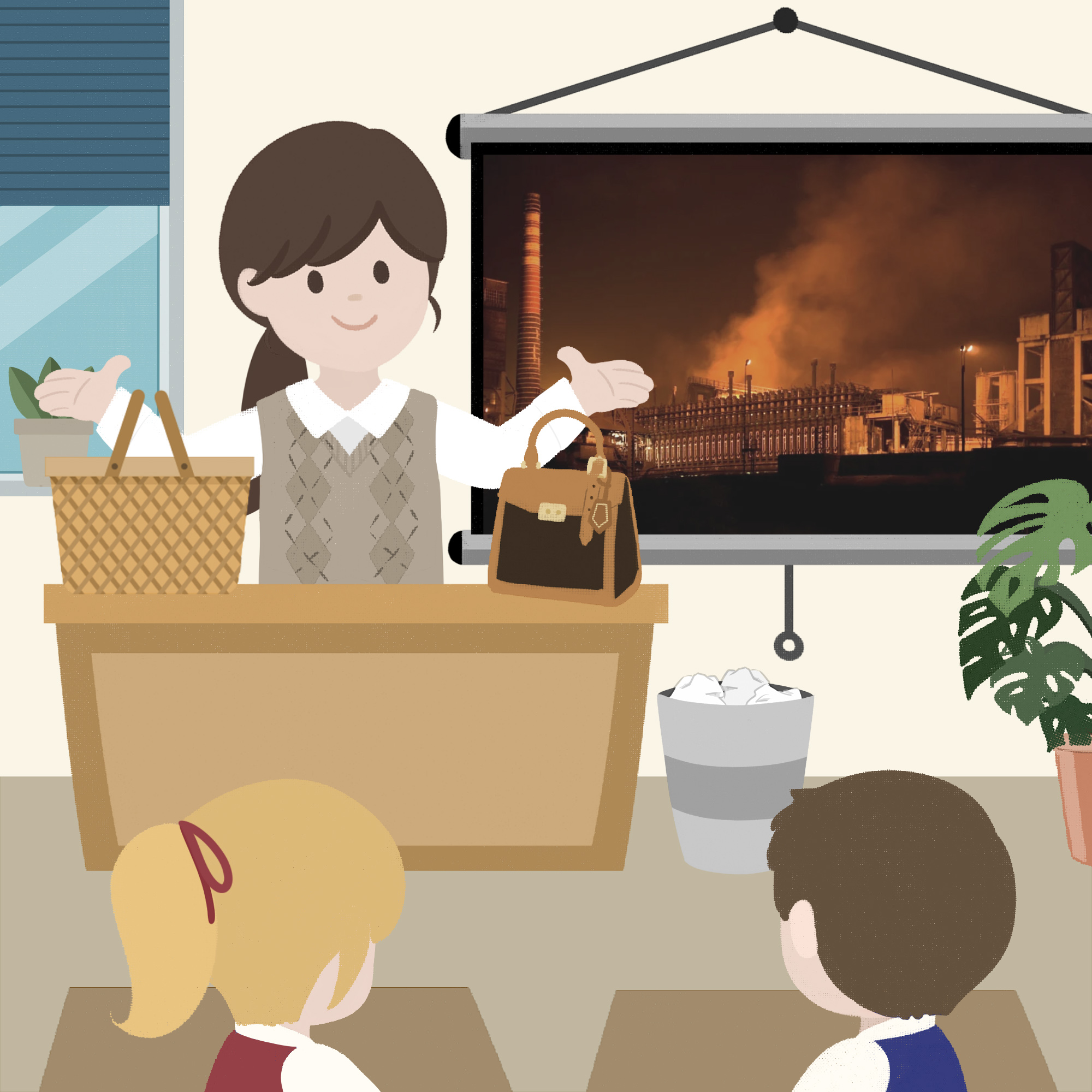
This blog post has been beautifully illustrated by Pop Sutthiya Lertyongphati.
Accompanying podcast episode:
As an educator who’s been living and working in Thailand for almost 20 years, I’ve come to accept something many educators face globally: news of war and conflict walks into our classrooms whether we invite it or not. From the war between Russia and Ukraine to the recent Iran/Israel escalation, rising tensions between China and Taiwan, and the sporadic disputes along the Thai/Cambodian border, these aren’t just geopolitical headlines. For many of our students, they are anxiety-inducing, deeply personal, and inescapable parts of the world they’re growing up in.
And here’s something I’ve learned: you don’t have to be a history or global politics teacher to be asked tough questions about war. I’ve had discussions about current conflicts emerge during maths, science, and even PSHE lessons. The truth is, any high school teacher could be called to respond to these sensitive and complex issues. When that moment comes, how we respond matters more than what subject we teach.
Tip #1: Start by listening, not lecturing
In times of global conflict, students often bring their worries into the classroom unexpectedly. It might stem from what they’ve seen on TikTok, heard at home, or picked up from peers. I always begin these conversations by asking open-ended questions like:
“What have you heard?” or “How are you feeling about that?”

This allows me to assess their emotional state and the accuracy of their information. Research supports this approach: students are more likely to engage meaningfully in civic discourse when they feel safe and heard (Hess & McAvoy, 2014).
Tip #2: All teachers need to be ready for these conversations
Some colleagues have said to me, “That’s a humanities issue.” But I disagree. In today’s hyperconnected world, every teacher is potentially a sounding board for students’ emotional and intellectual processing of conflict.
In my own experience:
- A student once asked me about nuclear war during a chemistry class.
- Another wanted to know if the Middle East would be “dragged into” a wider regional conflict, right before a mathematics starter activity.
- Others have written about conflict in science coursework assignments or referenced it during presentation work.
When we assume that only certain teachers handle these topics, we miss opportunities to support and guide students in the moments they need us most.
Tip #3: Teach civil disagreement across all disciplines
Classroom discussions can become emotionally charged, especially in multicultural settings where students may have personal connections to conflicting regions. Teaching the skill of respectful dialogue is essential.

Even in subjects like science, maths, or business, I’ve found value in short protocols:
- Set clear ground rules for discussion.
- Use sentence stems like “I see it differently because…” or “That’s a good point, but I wonder…”.
- Model calm, balanced responses if/when things get tense.
Respectful disagreement is a skill for life, not just for history class (Levine, 2007).
#4: Use conflict as a lens for interdisciplinary learning
Discussing war doesn’t have to derail your lesson. Instead, it can be an opportunity to connect your subject to real-world relevance. For example:
- In science: Explore the physics behind missile technology or the effects of radiation exposure.
- In ICT: Examine cyber warfare and its implications.
- In maths: Use refugee migration data to teach statistics.
- In business or economics: Analyze the financial impact of sanctions or military spending.
If you are able to think on your feet and get creative with linking the discussion to your content, then this can really assist in facilitating the deep learning process. If you’re bold enough, and if you have time, you could even get groups of students involved in some kind of project that links the conflict topic to your subject area: just be sure to provide some source material and lots of guidance along the way.

This makes learning more engaging while showing students that the world’s problems aren’t siloed into one academic subject.
#5: Equip students to evaluate information critically
In the age of algorithm-driven news feeds, students often encounter emotional and misleading content. As I highlighted in my earlier post on Responding Thoughtfully to Controversial Topics, we need to give students tools to navigate a flood of half-truths and sensationalism.
It’s a good idea to teach the CRAAP Test (Currency, Relevance, Authority, Accuracy, Purpose) in every subject area, not just humanities (Blakeslee, 2004). Using this, we can practice spotting bias in headlines, comparing different media sources, and fact-checking viral claims. Critical thinking belongs everywhere.
Tip #6: Maintain professional distance while being supportive
Sometimes these conversations can take a toll on us as teachers: especially if we feel pressured to take sides or reveal our own opinions. As I outlined in Maintaining Professional Distance as a High School Teacher, we must manage our emotional investment carefully.

We can care deeply about our students without making our classrooms emotionally overwhelming. Set clear boundaries, acknowledge uncertainty, and remind students that the classroom is a place for learning, not for political debate or division.
Tip #7: Always end with hope and human agency
Students need to know that while war is devastating, history is also filled with peacebuilders, diplomats, and communities who choose cooperation over destruction. I try my best to end conversations about conflict with examples of:
- International aid workers
- Diplomats resolving crises
- Youth-led movements promoting peace
Research suggests that when young people feel hopeful and empowered, they are better able to cope with the stress of global challenges (Ojala, 2012). Even simple class projects, like creating awareness posters or writing letters to NGOs, can help foster this sense of agency.
War and conflict are difficult to teach about. They stir up emotion, uncertainty, and fear. But if we shy away from these conversations, we risk leaving students alone with their questions and worries. It’s not about having all the answers. It’s about creating safe spaces to explore difficult topics with honesty, empathy, and intellectual courage.
And remember, you don’t have to be a history teacher to make a lasting impact. You just need to be present, prepared, and willing to guide the conversation with care.
Bibliography and references
Blakeslee, S. (2004). The CRAAP Test. Meriam Library, California State University. Available at: https://library.csuchico.edu/sites/default/files/craap-test.pdf [Accessed 21 Jun. 2025].
Hess, D. and McAvoy, P. (2014). The Political Classroom: Evidence and Ethics in Democratic Education. New York: Routledge.
International Crisis Group (2024). Conflict Watch 2024: Flashpoints to Monitor. Available at: https://www.crisisgroup.org/global/10-conflicts-watch-2024 [Accessed 21 Jun. 2025].
Levine, P. (2007). The Future of Democracy: Developing the Next Generation of American Citizens. Medford: Tufts University Press.
Ojala, M. (2012). Hope and climate change: The importance of hope for environmental engagement among young people. Environmental Education Research, 18(5), pp.625–642.
Wardle, C. and Derakhshan, H. (2017). Information Disorder: Toward an Interdisciplinary Framework for Research and Policymaking. Council of Europe. Available at: https://rm.coe.int/information-disorder-report-version-august-2018/16808c9c77 [Accessed 21 Jun. 2025].

We welcome you to join the Richard Rogers online community. Like our Facebook page and follow us on X for daily updates.


