Using Movement and Action to Enhance Learning (Secret Number 9)

An article by Richard James Rogers (Author of The Quick Guide to Classroom Management).

Illustrated by Sutthiya Lertyongphati and Tikumporn Boonchuaylue

The high school science teacher turns his students into ‘electrons’ and gets them to walk along a prescribed route in the classroom, reinforcing concepts associated with circuit diagrams and electricity. The primary school mathematics teacher gets her students to make funny shapes with their bodies that represent the numbers 0 – 9, creating a fun way to tackle mental arithmetic problems. The ICT teacher creates a variety of ‘human graphs’, getting students to line up in columns based on their chosen answers to assigned questions.

img_0549
“An AMAZING Book!”

What do all of these examples have in common?: The students are using movement to solve problems and, in doing so, are engaging multiple regions of the brain.

Every single day, our experience of the world around us is created by five main sensations or senses, namely:\

Touch: Experiencing the texture of different objects

Taste: Stimulation of various taste receptors on the tongue

Smell: Linked strongly with taste and involves stimulation of olfactory receptors in the nasal passage

Sight: Our perception of light energy through stimulation of cells in the retina

Hearing: The way in which we receive and process longitudinal vibrational energy

The above five senses allow us to perceive the world around us so that we can make decisions effectively. However, what a lot of people forget is that all of the above five senses become obsolete, and can be switched off, if one vital organ is missing: the brain.

5-01

A point I often make with my biology students is that we see, hear, taste, smell and touch with our brains! We don’t see with our eyes, we don’t hear with our ears and we certainly don’t feel touch because of our skin alone. All of these sense receptors just mentioned are tasked with one job only: to send information to the brain to be processed. Once the brain processes the necessary information, we then feel the intended sensation.

Evolution has ensured that our brains are hard-wired to remember information generated by all five senses. It is essential that we can do this, otherwise we would not be able to survive.

img_0448-1

Immanuel Kant, author of Critique of Pure Reason, puts this very eloquently:

All our knowledge begins with the senses, proceeds then to the understanding, and ends with reason. There is nothing higher than reason

When students have a good rapport with their teachers and are genuinely interested in the subject being taught, they acquire the self-confidence and motivation to pursue their learning with hard-work and enthusiasm. ‘Interest’ is a funny human condition because we often make the mistake of thinking that it’s just something that each person has an affinity for, based upon their life experiences or even the way they were born. However, the real truth is that the effective teacher behaviours outlined in this blog and my book can literally change students’ lives as they go from ‘liking’ a subject, to wanting to be the best student in the class!

But what is Spatial Learning?

There are many definitions and interpretations of spatial learning on the web and in various books. Some of this pedagogical mumbo-jumbo can be really confusing, but I believe I’ve nailed it down to one sentence:


Spatial Learning is when students use bodily movements to express themselves, solve problems and model situations. 


Spatial Learning has both general and specific applications. I’ll now go through some great examples that illustrate the power of this excellent teaching tool. 

Here’s a quick video I made about Spatial Learning:

A human graph and true or false?

Do you want to know the opinions of your students on a subject matter? Maybe you’re taking a survey (e.g. which day is the best for canteen food). Maybe you have a list of multiple choice questions and you want a fun way to get the kids through them.

A human graph might be the right tool for you!

What if you just want to quickly check your students’ conceptual understandings (e.g. as a plenary)? You could ask some true/false questions and get the kids to raise their hands, or you could use a way cooler (and more fun) method! 

Choose one wall to be the ‘True’ wall and one to be the ‘False’ wall.  Once you’ve asked the question, get the kids to walk to the correct wall. It’s that simple! Just make sure that the kids walk back to the middle of the classroom before each question. 

This great illustration from Pop shows you the steps to take for each of these activities:

Body numbers

Do your kids need to express numerical answers sometimes? Maybe they need to work out a percentage or a fraction, or translate numbers from one language into another. Maybe they need to express something in Binary Code. Well it’s time to put pen and paper down and get your kids moving!

Turn your students into ‘human numbers’ by following Pop’s beautifully illustrated instructions:

For double and triple-digit numbers you can put students into groups for added fun!

Modelling

The vast majority of the Spatial Learning I do involves modelling a situation, concept or solution. Like the example I gave earlier about the electrons travelling around the circuit, the students actually become the things that you’re teaching about. 

I find that almost everything I teach can be modelled spatially in one form or another. 

I’ll provide some examples to show just how easy it is, with just a little creativity, to turn any monotonous textbook paragraph into a living, breathing, exciting and stimulating task. 

Modelling example one: Diffusion

Textbook definition: Diffusion is the passive movement of liquid or gas particles from a region of high particle concentration to a region of low particle concentration. The speed of diffusion of any given particle is dependent on its molecular mass. This means that a particle of ammonia, for example, will diffuse faster than a particle of hydrogen chloride as ammonia is the lighter of the two particles. 

Modelling activity: As you can see, the textbook definition is rather hard to swallow. So, to jazz things up a little, you can turn the students into ammonia and hydrogen chloride particles and tell them to diffuse! In this activity, the students simply walk across the classroom at different speeds, depending on which molecule they are. Quick, easy to do and a nice break from writing, reading and listening to a lecture. More importantly: it’s really useful as a tool to help kids understand this concept.

See this illustration I drew below (my art work is dire compared to Pop’s, so I hope it’s understandable!):

Modelling example two: A Typical Home Network

In an attempt to show you just how pliable spatial learning is, I’ve designed a task for a subject area I don’t specialise in: ICT

Concept: A typical home network may be wired, wireless or a combination of both. Hardware components process and convey the data message from from part of the network to another.

Spatial learning task: For this task you need moving and stationary students. The stationary students stand at predetermined positions in the classroom (you can put signs on desks or on walls to help). These students represent the hardware. The rest of the students are the ‘data message’, and they move from one component to another. I hope the illustration below helps you to see just how easy this is to implement and how much fun it can be. Students should shout out the name of the hardware component they reach at each stage as they walk around the room. 

Can you think think of ways to use modelling in your subject area?

Further reading

My debut book is filled with great spatial learning and active engagement tips. After the enormous success of that book I’ve decided to work on a new book that will be released mid-2018 which goes into even greater depth and breadth about the range of classroom management tactics available to teachers. Also, if you’re looking for a great book to build up spatial learning skills in small children, then I strongly recommend Julie Dillemuth’s Lucy in the City:

Also, a great manual for designing great spatial-learning activities is Dr. Thomas Armstrong’s Multiple Intelligences in the Classroom (highly recommended):


714symbol

richard-rogers-online

We welcome you to join the Richard Rogers online community. Like our Facebook page and follow us on Twitter for daily updates.

desrypt define delineate

10 Learning Games to Play With Your Students (Secret Number 8)

An article by Richard James Rogers (Award-Winning Author of The Quick Guide to Classroom Management and The Power of Praise: Empowering Students Through Positive Feedback)

Illustrated by Sutthiya Lertyongphati

Follow me on Instagram

One of the fundamental tenets of teaching that I learned years ago was this: kids get bored very easily.

The modern teacher needs to be an excellent entertainer and educator; and that involves bringing variety into each and every lesson.

Over the years I’ve built up a ‘knowledge bank’ of learning games which require little-to-no preparation and which can be applied to any subject area. These games bring variety and ‘fun’ into our lessons, and are definitely very-highly recommended.

img_0413
“An AMAZING book!”

So bring your wallets and purses of learning because I’m about to share this knowledge bank with you.

Game #1: Splat

This quick game is so easy: all you need is a whiteboard, whiteboard markers and class of kids. It’s a great game for consolidating key vocabulary, and is perfect for E.A.L. learners.

Game #2: Mystery Word

Another easy game. This time, students randomly pick out written words from a hat (or cup, beaker, container, etc.), and then they have to explain their word to the class (without saying the word). The students who are listening have to guess what the word is.

Game #3: The Poster Game

Possibly the most fun and competitive game I’ve ever invented for teaching new content. You’ll need space for the kids to walk/run, and the game does take some prep. However, once you (and your students) become used to playing this game you’ll find that it’s a doddle to set up in no time at all.

Game #4: Who am I?

A very simple game. All you need are post-it notes and a class full of energized students! Great fun. Perfect for reinforcing key vocabulary and concepts.

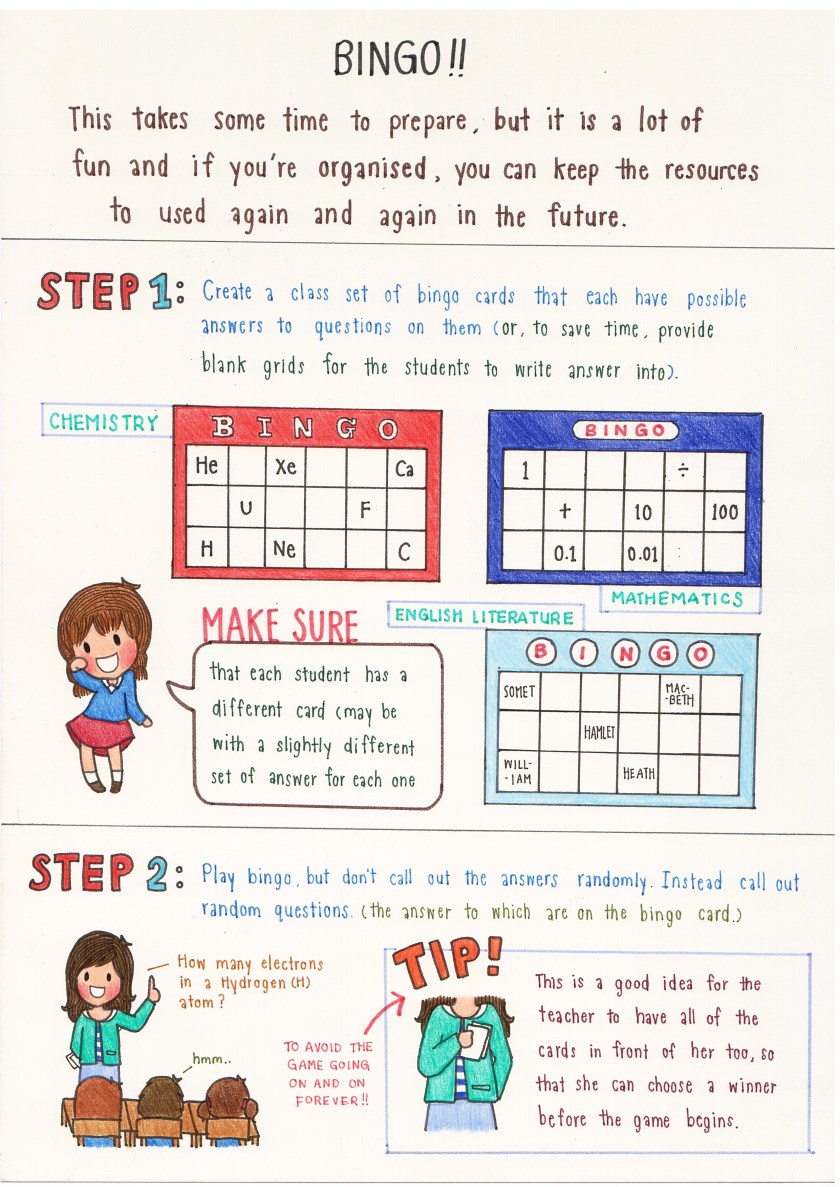
Game #5: Bingo

Got some equation symbols or mathematical problems to teach your kids? Perhaps the symbols of the periodic table is more your thing? Whatever it is, this simple game can be adapted to suit any subject.

Game #6: Vocabulary Musical Chairs

You’ll need a good rapport with you kids to use this one, as it needs to be controlled really well by the teacher (e.g. to avoid kids bumping into each other). However, it is simple, fun and worth the effort!

Game #7: Mystery Picture

This one takes some imagination on the part of the teacher, and some training of the kids beforehand. However, it’s really, really good for encouraging higher order thinking skills.

Games 8 and 9: ‘The Human Graph’ and ‘True or False Walls’

A ‘human graph’ is very simple to set up. Just ask the kids a series of questions and ask them to line up at the position that represents the answer. Hey presto – you’ve formed a human graph! It’s probably best to ask between 5 and 10 questions (forming 5-10 human graphs) in a real plenary and you might want to print and display the answers at different positions in the room. Its a lot of fun!

True or False Walls is another easy activity to implement. Choose one wall to be the ‘true’ wall and one to be the ‘false’ wall. Ask the students a series of true or false questions and get them to walk to the corresponding wall. This works much better than simply getting kids to raise their hands as they’ll be moving around the room. I’ve done this countless times with my students and they never seem to get bored of it. Can be used as a nice break in the middle of a lesson too. 

Game #10: Memory Mind Bender

I first learnt this game at 15 years old when I was an army cadet. My platoon commander was trying to get us to learn the working parts of an L98A1 Cadet GP rifle (Wow – it must have worked if I can remember that 20 years later!). 

Get your kids to sit or stand in a circle. One student starts with a phrase about the topic. The next student then repeats that phrase and one of their own. The chain continues and continues until all of the concepts have been verbalised in sequence. Don’t be afraid to start the chain again if a student forgets a phrase! See below. 

714symbol

richard-rogers-online

We welcome you to join the Richard Rogers online community. Like our Facebook page and follow us on Twitter for daily updates.

desrypt define delineate

News: Warwick University Fudges Exam Timetable

An article by Richard James Rogers (Author of The Quick Guide to Classroom Management).

Illustrated by Pop Sutthiya Lertyongphati

Examinations are stressful for students at all levels of Further and Higher Education: whether it’s GCSEs, end of unit tests, IB Diploma exams, university assessments or any test that carries a significant weighting.

And that’s when the exams are scheduled properly.

Imagine how much more stressful it would be if you found out that you may have to take some of your exams six weeks earlier than you were originally told.

Surprisingly, this is exactly what has happened recently at Warwick University: one of the UK’s most prestigious institutions.

studying with com

According to the BBC report published yesterday, the university said that the provisional timetable had to be scrapped due to “significant” difficulties and students had been told to disregard it.

In some cases exams have been scheduled 42 days earlier than planned.

After scanning Warwick’s press releases page I could not find any official explanation or update from them. The new exam timetable was apparently shared on 17th April, but press releases on that day discuss regional investment and an explosion on a star.

Too much homework

Nothing about the new timetable.

I contacted Warwick for an official explanation and received this reply:

Due to significant, critical and unforeseen difficulties, the earlier provisional timetable was taken down and students informed it was inaccurate and to await updated accurate information.

The examinations team responded to feedback from academic departments and published the final timetable a week earlier than was originally planned.

Boards of Examiners and the Notification of Mitigating Circumstances process will operate as it has in previous years and the details can be found here:
https://warwick.ac.uk/services/academicoffice/examinations/students/mitigatingcircumstances

The ‘tip of the iceberg’

When delving deeper into this story I discovered that the provisional exam timetable, apparently released by Warwick almost two weeks later than expected, was also riddled with issues.

According to this article written by Steph Campbell at The Boar (Warwick University’s Student Newspaper), the provisional timetable showed some final year students’ exams being timetabled in June and early July, when the students were expected to be finished by the end of May.

A game of exam ‘ping pong’?

It seems that students were originally told that they would have exams in June and July, only to be told on April 17th that these exams were being moved to May.

Ping-ponging students like this is not a good idea, especially when so much is at stake (i.e. their entire futures).

work overload
A MOUNTAIN OF REVISION TO DO IN SUCH LITTLE TIME: WARWICK STUDENTS TODAY?

My thoughts on this

Whilst Warwick doesn’t offer a course in Rocket Science (although their degree in Physics with Astrophysics comes close), they really didn’t need to assign this basic task to a rocket scientist.

If schools, colleges and exam boards can arrange exam timetables properly, then why not a top university?

It’s really simple:

Step 1: Find out which rooms are free and when

Step 2: Find out how many students can be comfortably accommodated into each room at once

Step 3: Find out the duration of each exam

Step 4: Match rooms and times with exams

Step 5: Tell your students

Step 6: Assign and hire invigilators

Warwick University may wish to take note of this process for future reference. It’s a tried-and-tested method that has been used successfully by schools and colleges for decades.

I contacted The Boar for an official comment but have so far not received a response.

714symbol

richard-rogers-online

We welcome you to join the Richard Rogers online community. Like our Facebook page and follow us on Twitter for daily updates.

desrypt define delineate

Secret Number 5: Run an ECA (Why, What and How)

An article by Richard James Rogers (Author of The Quick Guide to Classroom Management).

Illustrated by Tikumporn Boonchuaylue

My teenage years were brilliant, and one of the reasons for this is that I was involved in so many active clubs and hobbies. I was an army cadet, I did karate and I even tried hockey and acting for a short while.

Me as an Army Cadet, aged 14

The Extra-Curricular Activities I did as a kid shaped my character more than my lessons in school. I can say that with conviction.

In my ECAs I made new and lasting friendships and learnt cool skills (such as how to start a fire with potassium permanganate, and how to disarm an attacker with a pistol).

I still do karate to this day – it gave me self-discipline and the understanding that life can be painful; but instead of crying in a corner like a little wimp I need to man-up and fight back, and persevere through every storm that comes my way.

Yes: karate, and the Army Cadets, really taught me that.

Now, as a teacher, I warmly reflect on my childhood experiences and the enrichment that was brought to me through these extra dimensions in my life. I try, as best as I can, to offer modern and meaningful ECAs to my students in my current practice.

An AMAZING Book!

Why offer an ECA?

There are numerous benefits which compensate for the extra time it takes to run an ECA:

  • You get to build closer and more meaningful professional relationships with your students, and other students you might not teach
  • You become ‘that cool teacher‘ who goes the extra mile to run good clubs with the kids
  • You learn a few surprising things about the kids in your club – such as skills and abilities they have which you didn’t know about before
  • You will develop new skills along the way (e.g. I currently teach FinTech in one of my ECAs, which is a new area of knowledge that I’m learning about too)
  • You may change lives, literally. One of my former students 10 years ago attended a German language ECA that I ran. She’d never learnt German before, and absolutely loved the club. I later found out that she did a degree in German at university and now works as a translator here in Thailand.

What kind of ECAs can we offer?

Anything that’s:

  • Fun
  • Modern
  • Useful
  • Active

Good ECA types include:

  • Anything involving a sport (e.g. football, hockey, tennis, etc.)
  • Gaming (e.g. retro computer gaming, chess, battleships, etc.)
  • Languages that aren’t offered in the normal curriculum
  • Anything practical and hands-on (e.g. robotics, cookery, Science experiments, etc.)
  • Exam and study support

I tend to go with things I’m interested in that will also be fun and useful for my students.

How can we offer ECAs if our skills are limited?

We don’t have to be experts in the things we want to offer as ECAs. In fact, some of the best clubs I’ve run have been dynamic classes in which I learnt new things with the kids.

Running an ECA can even be a good way for us to skill-up as teachers.

Take a club I’m running at the moment, for example: Platform Building and Money Management. Now, I don’t know an awful lot about these subjects, but I’m learning FinTech with the University of Hong Kong and I’m reading books to learn about digital marketing and personal finance. The good news is this – each week, when I learn something new in my studies, I can then pass this on to my students in the ECA.

It’s a great way to help me with my self-discipline in my learning, and it keeps my ECA modern and relevant. The kids love it!

714symbol

richard-rogers-online

We welcome you to join the Richard Rogers online community. Like our Facebook page and follow us on Twitter for daily updates.

desrypt define delineate

Secret Number 4: Use Positive, Specific Feedback

An article by Richard James Rogers (Author of The Quick Guide to Classroom Management).

Illustrated by Tikumporn Boonchuaylue and Sutthiya Lertyongphati

cropped-Wordpress-Header.jpg

I was fortunate enough to go to a great university to do my bachelor’s degree, and the lecturers were absolutely brilliant. They cared about their students, fundamentally.

However, I look back with mixed emotions on my overall education as I was growing up.

Primary school – not so good (I’m sorry to say)

Secondary school – brilliant overall (but it was hard at first, especially because I was bullied – but that’s another story for another blog post)

University – loved it, but I found it a real challenge to live on my own and be independent

3.1-01

Online learning with the Open University, and later with HKU – just brilliant. Hard work, but brilliant. If you’ve never done a distance learning course, then now is the best time to start as technology has come a long way with MOOCs and online learning platforms. Check out edX for amazing online learning courses (very highly recommended, and affordable).

Why were the best, the best?

There’s a number of reasons why some of my educational experiences were better than others – the quality of teaching, the social setting, my personal maturity, etc. Bangor University stands out as being one of the best educational experiences I had, however, because my lecturers always took the time to give me high-quality feedback in a timely manner.

I commend them for that, because that’s not always easy to do.

img_0413
“An AMAZING book!”

There was that time, for example, when I printed out pictures of molecular models using an old-style Kodak digital photo printer, and glued them onto my assignment. My professor wrote ‘Wow!’ next to the picture with a big, specific explanation of why he liked my essay.

img_0064

Then there was that time when I and my friend just wanted to sit and chat with another professor in his office. Bangor’s lecturers were like that – approachable and happy to chat with students. I could tell he was busy, but he made us both a cup of tea and chatted with us about a range of different scientific issues. Shortly after the meeting has finished, I got an e-mail from him in which read ‘I really appreciate your enthusiasm, Richard. I really enjoyed our discussion about molecular chirality’.

That was powerful.

Then, there was a time when I had a dispute with the answer to one of my questions on a test – I had named a chemical wrong. I asked my professor about it, and he said he liked my answer because (and then proceeded to tell me why), and then he told me why my answer was wrong.

I left feeling dignified and educated.

Specific praise is powerful praise

Last week I wrote about the importance of positivity and praise, and the role that sincerity and collectivism plays in that dynamic. Those are important foundational principles, but in order to ‘turbo-charge’ our praise we must make it as specific as possible.

img_0068

But what does ‘specific’ mean?

I used to think that ‘specific’ praise meant highlighting the positive areas of a student’s work by using subject-specific language.

That’s important, but I’ve since learnt that it’s not enough.

When we praise our students, we need to make it emotional. It needs to stir up thoughts and feelings of achievement and empowerment. To do that, we must acknowledge:

1. The effort that’s gone into the work:

“When I was reading this homework, I could tell that you’d put a lot of time and effort into it, Richard. Well done”

“I really like how you’ve written both the word and symbol equations. That must have taken a lot of time, Well done for having such a good learning attitude”

2. Novel creativity that’s evident: To do this we must give our students the opportunity to be creative, and design tasks which naturally extract creativity from our students.

“You’ve designed the perfect predator here! Just brilliant! I love the sharp teeth and large wings!”

“I love this model of the atom that you’ve build. What a great idea to use different-colored bottle caps to represent the protons and neutrons”

3. The skills used to generate the output: this requires good task-design too, and we must try to capitalize on our students’ interpersonal, problem-solving and critical thinking skills.

“You guys worked together as a great team. John delegated well as a good leader, and I think he made sure that everyone knew what they were doing. Stacey made sure that all of the slides were really clear and presentable, and I know that everyone in the class could read the information properly. And Joe – good use of diagrams to show the processes of crystallization, distillation and filtration”

img_0480

Oh come on, that’ll take ages

You don’t have to write all of this feedback, and you should only give specific praise if a student has earned it.

Consider delineating your praise in the following ways:

  • Written comments
  • Verbally – very memorable and effective
  • Via e-mail
  • Through technology such as VLEs and MOOCs
  • By asking other teachers to also praise the student (collective praise)
  • Certificates and awards
  • Assemblies
  • Merits and points (but make sure the associated reason is made clear to the student)
  • Phone calls and letters/e-mails to parents
  • A discussion with a colleague in front of a student (e.g. when waiting in the lunch queue or if a student walks into the staff room or your office)
  • Showcasing work (e.g. on a noticeboard or just by holding it up to show other students)

Another point of happiness in my childhood was when my karate sensei told my dad, in front of me, that I had a ‘good attitude’. How come I can remember that when it happened 20 years ago? Because it made me feel good.

It made me feel proud.

Emotion goes hand-in-hand with praise, and that’s why all praise must be sincere.

Further reading

img_0405

Secret Number 3: Praise is Power

The Four Rules of Praise

714symbol

richard-rogers-online

We welcome you to join the Richard Rogers online community. Like our Facebook page and follow us on Twitter for daily updates.

Latest hybrid

News: Schoolgirl Put in Isolation 240 Times

An article by Richard James Rogers (Author of The Quick Guide to Classroom Management).

Illustrated by Tikumporn Boonchuaylue and Sutthiya Lertyongphati

I’m experimenting with a new format and schedule for my blog, and I hope that it will make my content even more interesting and useful for my readers (that’s the plan anyway!).

Every mid-week I’ll give my synopsis of a current education-related news story, along with my regular ‘teaching tips’ blog post on a Sunday. That’s two blog posts per week from now on.

This week I want to discuss my thoughts on a BBC News story that broke this week – that a schoolgirl in England had been sent to the ‘isolation room’ at her school at least 240 times since Year 7 (Grade 6).

Colorful classroom without student with board,books and globe - rendering

What’s an ‘isolation room’ anyway?

It’s a place where the naughty kids are sent, basically. If the teacher feels that a student is being so disruptive that their behavior is affecting the learning of other students, then some schools will allow the teacher to send that kid to the isolation room.

Many UK schools have isolation rooms. They’re designed to be quiet places where kids can sit and do work, often supervised by a special ‘isolation room monitor’ (who is normally a fully qualified teacher too).

Many prominent figures in UK education support the idea of isolation rooms. Take Tom Bennet, author of The Behaviour Guru: Behaviour Management Solutions for Teachers, who has stated that using isolation booths is a perfectly normal, useful and compassionate strategy that is so common across the school sector that anyone expressing shock to discover it has, I can only assume, spent very little time actually working in a school.”

mess around in class

Well, Tom, I’ve spent many years working in schools (and yes, I worked in the UK in a school with an isolation room), and I can tell you: I don’t support this strategy at all.

Let me tell you why.

1. They’re too easy to use

I remember working in North Wales at a school with an isolation room over a decade ago. I had a teenage girl in one of my classes who had spent 50% of a previous half-term in the isolation room. She missed a lot of school, and the resources in the isolation room were not designed to match the curriculum she was following.

As a newbie back then I found the isolation room very supportive: if a kid played up I could just send him or her to the room. I filled in a slip and off the kid went.

Problem solved, right?

Wrong.

I found myself giving up on students at the first instance of misbehavior. This was especially true if a kid had a history of being sent out to isolation. If everyone else is sending this kid there, then I can do it too!

It became too easy to send kids out, and I didn’t like who I was becoming. I hated myself for it, to be honest, and I decided ‘no more’.

The next time that girl was chatty in class and a little disruptive was when we were learning about the extraction of chlorophyll from a leaf. Instead of sending her out, I got her involved.

“Come and help me”

She came and used the Bunsen Burner to heat up the solution. Everyone clapped. She felt empowered.

lab girls

I‘ve written tirelessly about the importance of making our students feel important and valued. It’s a core principle of good behavior management and overall student training. Isolation rooms completely subvert this solid fact and principle, and tend to cause more problems than they solve (such as leading to depression and suicidal thoughts in some cases, which we see in this particular case with the girl in the BBC report).

2. When is enough, enough?

After 240 times of being sent to the isolation room, one would have thought that someone in the school with at least two brain cells to rub together would have realized that the isolation room strategy isn’t working for this student.

What about counseling? Discussions with parents? Teacher-meetings to discuss strategies for this student? Extra time to complete homework? Collective praise when this girl did something great?

There are many ways to solve long-term poor behavior. Sending students to an isolation room is not the answer.

3. Since when did UK schools become prisons for kids?

With the advent of compulsory schooling in 1880, followed by fines for parents who didn’t send their kids to school beginning in 2004, and then later the advent of isolation rooms, one sees a rather grim picture emerging.

School is supposed to be a happy place for children. A place where they learn new skills and become better people. A place where they mature into adults.

When schools become like prisons, however, with more and more power being taken away from parents as the years pass, one wonders if home-schooling shouldn’t become more pervasive.

chatting in class

In the UK, parents can home-school their kids provided that they have permission from the school headteacher. However, government inspectors can make an informal visit and can serve a ‘school attendance order’ if they feel that the child is not receiving an adequate education.

Maybe homeschooling would have worked with this girl? Maybe it wasn’t feasible.

4. IEPs need to be considered

Sophie, the schoolgirl mentioned in the BBC article, had selective mutism and didn’t start speaking until she was 8-years-old. She also had autism.

Surely she would have had an IEP in place (an Individual Education Plan). Did this document recommend that she be sent to the isolation room every day from January to mid-March, as the BBC report states?

I very much doubt it.

What we learn from this story is that IEPs need to be well-designed and shared, proactively, with every teacher in the school. That means reading them, discussing them, and coming up with strategies as a team.

Isn’t that what INSET days could be used for?

Q & A

Isolation rooms should be banned

I am of the opinion that isolation rooms should be banned in schools. Put the kids on detention – yes. Send them to a senior manager. Phone home. Allow extra time for homework. Meet with parents. Use collective strategies.

But don’t let a kid spend half a term, each and every day, and all day every day, in an isolation room with poor-quality work to complete (and poor-quality guidance).

Schools are not prisons. Schools are supposed to be happy places where kids learn things.

If schools can’t achieve this, then give the kids back to their parents. They can probably do a better job.

714symbol

richard-rogers-online

We welcome you to join the Richard Rogers online community. Like our Facebook page and follow us on Twitter for daily updates.

Latest hybrid

Secret Number 3: Praise is Power!

An article by Richard James Rogers (Author of The Quick Guide to Classroom Management).

Illustrated by Tikumporn Boonchuaylue and Sutthiya Lertyongphati

cropped-Wordpress-Header.jpg

Getting a handle on how to give sincere praise on a regular basis, and giving it regularly to the same students (i.e. all of our students), is a skill that the very best practitioners have mastered.

Praise is not the cute fluff-ball it appears to be, however. It is complex, dynamic and works effectively through a variety of methods. Let’s begin with a true story that illustrates the massive power of praise in teaching.

Joanne’s story

Joanne had recently qualified as a secondary school science teacher and had just started her new teaching post at an English comprehensive school. She was excited about the new challenges she would face. and was ready to put all of her training into action. She had been given responsibility for a Year 11 (age 15 – 16) general science class. Their previous teacher had left her some handover notes, and had specified that she must be careful when dealing with one student in particular: Damon. This young man was notorious for being argumentative, aggressive and non-cooperative. She was told that she must not con- front him under any circumstances. Naturally, Joanne was more than a little apprehensive when she met this class for the first time.

img_0478

Damon walked into the science lab slightly later than the rest of his peers, and Joanne greeted him with a friendly “Welcome in young man, please take a seat”. This caused a giggle amongst the rest of the students, who were naturally expecting the same reaction that Damon’s other teachers would have given him – a good telling off! Damon sat down as instructed, but, being a feisty young teen ready to push the boundaries and test what he could get away with, he pulled out a can of cola and started to drink it at his desk (something that is generally not allowed in a science lab). Joanne, knowing what she had been told about Damon, decided on a very positive and useful approach: she decided to ignore this misdemeanor at that moment and proceed on with the lesson.

chatting in class

As the lesson proceeded, Joanne set a group work activity and walked around the classroom to see how the students were getting on. As she passed Damon, she noticed that he had a very neat and organized set of felt-tip pens on his desk, arranged in a very nice standalone display case. Joanne praised Damon with a “You’re so organised, Damon. It’s good to see that you’re prepared for your lessons. I wish that every student was as prepared as you are.”

What do you think Damon’s reaction was? – He was absolutely stunned! This was a young kid who was accustomed to being reprimanded, put on detention and confronted on a daily basis. Here was a new teacher who could actually see his worth, and what he could contribute. He lapped up the praise, and responded with an “Umm, err thanks. I always like to be ready for my lessons. I also love art”. This led to a short conversation about Damon’s love of drawing tattoo designs. Joanne subtly drew his attention to the artistic graphics on the cola can, and reminded him he couldn’t drink it in the science lab. He smiled.

Later that lesson, Joanne assigned him the role of ‘Work Presentation Chief’ for the class. Each lesson, from then on in, Joanne made sure that she praised Damon for his work, and allowed him to go around the class and assess the presentation skills of selected students. What was the effect on Damon? – He became Joanne’s best student. He felt empowered, because, like all human beings, he craved a sense of importance and he craved appreciation. When Damon achieved his grade C in GCSE Science that year (a massive accomplishment considering his turbulent history) he said to Joanne “It was all because of you, miss”. Even at that moment, Joanne praised him by responding with “You did all the hard work, Damon”.

Block building

Any fool can criticise, condemn and complain – and most fools do

Dale Carnegie

What do most people do when they are criticized? How do most people respond when their character or judgement is scrutinized? Answer: most people try to justify themselves, and this often leads to resentment felt towards the person doing the complaining. Your students are no different in this respect than you or I. We all love to know that we’re doing a good job, and we all want to feel appreciated and important. Make your students feel appreciated by praising them often, and make sure you mean what you say!

The 4 main rules of praise

Every student we teach is different, and our styles of praise will naturally adapt to suit the personalities of each child. However, there are some fundamental rules that all forms of praise should follow (written rules follow the YouTube video):

Rule #1: Praise must be sincere

If you don’t mean it, then don’t say it. Kids are not easily tricked. Praise is only ever effective when the teacher saying the nice words of encouragement truly means it.

img_0481

Rule #2: Praise must be specific

Does the student know exactly why they’ve done a great job? Does the student know what they did well?

Be specific. Here are some examples:

“Well done, John, for drawing your diagrams with a ruler. They look really neat and tidy, and I can tell that you’ve put time and effort into this work. I am very pleased. Keep it up”

“I’m so pleased with the excellent progress you have made this term, Rosie! Just look at these results: You’ve gone from a level 5 in test 1, then to a level 6 and now you’re working at a level 7. That’s very impressive, Thank you for your hard work and commitment”

Rule #3: Praise must be recorded and remembered by the teacher

Try keeping a professional intelligence journal.

woman-reading

I’ve written about the power of this technique before, but I’ll go through the process again for clarity.

Basically, at the start of every academic year you should purchase a new notebook. Make sure there are enough pages in it for every student. Every student gets a page.

On each page write down and record any significant interactions with the student. Record their birthdays, hobbies they have, times when they were praised, significant achievements in extra-curricular activities, etc.

Once this information has been recorded, it can be effectively reinforced (please see my post on subtle reinforcement for more info about this powerful technique).

Rule #4: Reinforce the praise at significant points in the future

Did you notice that my platoon sergeant praised me the next day? That was powerful, because she wasn’t actually there when I did the signals work, but someone had spoken with her.

poll-everywhere

Praise must be collective if it is to be truly effective. When a student does a great piece of work, tell your colleagues and your line manager. Ask them to reinforce your praise by giving their own praise to the student.

Reinforcement should also be self-driven – remind your students of previous achievements in order to empower their momentum.

“I remember the excellent Chemistry student who built the atomic structure model in Term 1. She said ‘I’ll find a way to suspend the protons in the middle’. Jessica, you’ve already shown me what a hard-working, committed student you are. This is your moment to shine once again. Put your best effort into this, I believe in you. I know you can do this!”

714symbol

richard-rogers-online

We welcome you to join the Richard Rogers online community. Like our Facebook page and follow us on Twitter for daily updates.

Latest hybrid

Secret Number 2: Use humor to enhance learning

An article by Richard James Rogers (Author of The Quick Guide to Classroom Management).

Illustrated by my new illustrator!: Tikumporn Boonchuayluea

NEW: Second Edition of The Quick Guide to Classroom Management’ available on Amazon now! Purchase the book here

John’s Year 10 English class consisted of a cooperative and friendly group of students. One problem persisted though; a problem found in scores of classrooms the world over: low-level disruption.

This class was notorious for doing as they were told but having a lack-luster approach to tasks: often chatting when more ‘work’ should have been done. John, a man from a traditional British family, saw himself as a ‘staunch disciplinarian’, and he would often respond to student chatter and distraction by shouting at the students who he thought were responsible for it. He would hand out scores of detentions, all of which ate into his lunchtimes and his free time after school.

Had this have solved things, John might have been be forgiven for feeling proud of his vigilant approach. However, the problem didn’t go away, and students started to resent going to John’s lessons and they began to dislike him personally. John had effectively created a very negative environment in the classroom and this was not conducive to effective learning or positive behaviour.

img_0009
“An AMAZING book!”

As behavior got worse and worse, and students felt that they were being treated ‘unfairly’, John realized that he needed a radically different approach to his teaching methodology. He decided to attend a professional development course in accelerated learning, and after a day of various workshops his eyes were opened dramatically.

“I had been making fatal mistakes since I started working with this class” said John.

“I hadn’t shown them my human side, and I was too quick to criticize. I didn’t use my personality to generate humor and I created an environment of negativity”.

What do you think John did the next time he heard students chatting in his class? He used humor and his personality to ‘lighten the mood’ whilst, at the same time, getting the students back ontask.

“My student, Billy, was chatting to a girl called Sarah when he should have been listening to another student read a Shakespearean sonnet to the class. Normally, I would have responded to this by reading him the Riot Act and exploding, or putting both students on detention. Knowing that this could cause a backlash, or at least create an unhelpful atmosphere in the class, I decided on a different tactic. I said ‘Billy, please stop flirting with Sarah. You can do that at break time’ and I smiled. The response I got was a giggle from the class and a bit of teenage awkwardness from Sarah as she said ‘Ugh! I don’t think so’. After this, everyone listened attentively to the sonnet, and we proceeded on to our group activity”.

John’s story demonstrates the power that humor can have in making a lesson more palatable for students, and how humor can be used to keep students on-task. Again, it makes our human nature become visible to our students and, if used tactfully, it can even make lesson content more memorable and can help with behavior management. You have to be careful though, as some forms of humor will work with some students but not others. You need to have a good knowledge of your class before you employ the tactic that Josh used in the example above.

You really need to know your students well, as not every student you have will respond in the same way to the humor that you use.

I recall teaching a Biology lesson some years back in which we were studying inherited and environmental traits. One girl in the class asked to be excused to use the facilities and upon leaving she said something to her friend and was replied to with the word “retard!”.

Now I know that some people are going to tally disagree with I did in response to his, but in this particular situation it was definitely the right thing to do. I tackled this spontaneous outburst in a non-confrontational way by jokingly asking “Is that an environmental or inherited trait” and she said “both!”.

The whole class giggled, the situation was forgotten about and the students were back on task in a matter of seconds.

Had I have responded with some form of severe sanction, for what was essentially a typical exchange between two teenagers, then that would have created confrontation and a negative atmosphere in the classroom. This wouldn’t have helped anyone.

Word games: An idea worth exploring

Turn your key vocabulary into silly (bad?) jokes when talking to your students. Here’s an example: “I was sitting the staff room yesterday and Mrs Jones said ‘I like you, Mr Rogers, you’re funny’. I replied with ‘I alkalike you, Mrs. Jones: you are funny too’. This is the life of a Chemistry teacher, hashtag chemistrylife” (For those who don’t get it, I turned the word ‘alkali’ – a chemistry key word – into ‘alkalike’).

As bad as jokes like these are, I’ve found that students really like them, and they help the students to remember the key words they need for their tests and exams.

Suggestions: Ways to use humor in lessons

  • Tackle disruption with light-hearted comments that make the students aware that they need to be on-task, without being antagonistic. Use knowledge about student interests if possible (e.g. “David, I know you must be talking about the next ramp you’re going to fly off on your skateboard, but if you could please listen to me at this moment then I would be most grateful”, or “Simone, I’m sure that Diane already knows what a great dancer you are, so if you could please focus on the task in hand, then that would be great”). Remember, students may respond to this so be ready to be light-hearted and direct the conversation back to the task in-hand.
  • During group activities or short tasks, you can play some silly music (not too loud) to lighten the mood. You can start by saying something like “I’m going to play everyone’s favourite music”, and then proceed to play something funny and upbeat.
  • You can sing to your students. That’s right, I did just say that! You can make up silly songs about whatever the lesson content is and sing or rap them to the class. You can also get the students to do this too.
  • Use your whole physiology to generate laughter. A laugh eases tension and nurtures creativity. Use changes in your voice, funny personal stories, exaggerated facial expressions, dance moves and anything you can think of to raise a smile and a giggle.
  • Use learning games to make the atmosphere more happy and relaxed. If you’re a languages teacher, you may want to make your students formulate silly phrases, or use the vocabulary games mentioned in Chapter 2.
  • Make up rhymes, acronyms and funny mnemonics. For example, MR FAB is an acronym for Mammals, Reptiles, Fish, Amphibians and Birds (vertebrate animals) and “Never Eat Shredded Wheat” is a mnemonic for “North, East, South, West”. Even better: get the kids to make up their own.

Conclusion

In summary, humour increases happiness in the classroom, removes inhibitions, makes the teacher appear more human and can even be used as a behaviour-management tool. To add to this, decades of methodical research have shown that humour can even help students remember key concepts for long periods of time, if it is used to illustrate a concept that has just been taught (Banas et al, 2011).

richard-rogers-online

We welcome you to join the Richard Rogers online community. Like our Facebook page and follow us on Twitter for daily updates.

Latest hybrid

Secret number 1: Have a genuine interest in the lives of your students

An article by Richard James Rogers (Author of The Quick Guide to Classroom Management).

Illustrated by my new illustrator!: Tikumporn Boonchuayluea

NEW: Second Edition of The Quick Guide to Classroom Management’ available on Amazon now! Purchase the book here

Youth is a time when so many things are happening, both positive and negative. Young people at high school are involved in a range of human-relationship dynamics which involve family, school, friends and the people associated with their hobbies or interests.

Humans are full of energy at this time, and the interconnections between the life of a student both inside and outside of the classroom create opportunities for us to channel this energy positively and:

• Build trust
• Use humour within lessons
• Create a sense of importance and empowerment in our students
• Offer guidance and support to students with difficulties
• Create an environment of cooperation and compliance
• Encourage our students to formulate their own learning goals
• Personalise our lessons

2-01

Becky’s story

Becky was an experienced and well-liked teacher of secondary science. She got on very well with her students, and parents would often mention that they appreciated her ‘special attention’ to their children. She was liked by her colleagues, and she enjoyed her work.

One day, her physics student came to school with a broken arm in a plaster cast. Josh, a keen gymnast, mentioned that he had fallen very hard in a training session two days ago. Becky immediately knew that this was golden information for her lesson planning.

3.1-01

In Josh’s next physics lesson, Becky was teaching the class about forces and motion. As Josh entered the class, she presented him with a starter activity revolving around the forces that act upon a gymnast when taking off and landing on a springboard. She also asked Josh how he was doing (and she was sincere in asking). He said he was healing well, and Ms Becky mentioned that “We can use your experience to help the class today, would that be okay?”. Josh said “sure”.

After completing and peer assessing the starter worksheet, Ms Becky asked for Josh to tell the class what had happened to his arm. He gladly told his story, and Ms Becky asked for everyone to clap after he had finished. Using humour and good teaching practice, she said “So using Josh’s story to help you, what do you think one of today’s objectives could be”?

One student mentioned a funny comment about how you should always land on your feet and not on your arm like Josh did, which Ms Becky responded to with a smile and a giggle. After this, and with some prompting from their teacher, some students spoke about the importance of gravity in determining the force upon impact, and the speed of free fall.

At the end of a very interesting and varied lesson, Becky allowed her students the opportunity to sign Josh’s plaster cast, if they hadn’t done so already.

This example demonstrates the power that taking an interest in your students can have on the quality of a lesson.

Let’s examine what Becky did that made this lesson (and her rapport, or relationship with her students, so special):

• Becky used the hobby of her student to generate a lesson activity (the starter worksheet)
• Becky shows a sincere care and concern for her student
• Becky was genuinely interested in the life of her student outside of the classroom (as she was with all of her students)
• Becky uses student experiences and ‘expertise’ to enhance the lesson content (she asks Josh to talk to the class about what had happened)
• Becky is tasteful in her humour, and she makes sure that Josh is happy to share his story before she asks him to do so.
• Becky rewarded the class for their good work by allowing them a few minutes at the end to sign Josh’s plaster cast. Not only did this subtly reveal her caring and ‘human’ nature, but it also bonded the class together as a whole.

Conclusion

It was the great John Steinbeck himself who said that “And, of course, people are only interested in themselves. If a story is not about the hearer he will not listen. And I here make a rule – a great and lasting story is about everyone or it will not last. The strange and foreign is not interesting – only the deeply personal and familiar”. If you and I are to build positive relationships with our students, then we need to try and make our lessons deeply personal and familiar, and show a genuine interest in our students.

Building rapport begins and ends with showing a sincere, professional attentiveness to our students and if we are to be good classroom managers, then the first thing we must do is establish a good rapport with our kids.

Turbo Teaching: 5 Ways to Supercharge Learning

An article by Richard James Rogers (Author of The Quick Guide to Classroom Management). 

Illustrated by  Sutthiya Lertyongphati

Check out the new…………….

Rogers forum

Let’s admit it once and for all: teaching is hard-work! From choosing the right techniques to use and gradually building rapport with your kids over the academic year; to marking and admin – the teaching profession requires of its disciples skills like no other.

But is it possible to distill all the research, experience and mumbo-jumbo into just a few effective strategies that work like a treat?

I believe so: hence this blog and my books.

Here are what I believe to be the most effective ways to ‘squeeze the most juice’ out of each lesson:

Tip 1: Quick starters

Give the kids something to do as soon as they walk through the classroom door (or immediately as the lesson starts). This kickstarts momentum from the outset, making it easier to build up knowledge and understanding later in the lesson.

And that’s another thing – a good starter activity should either introduce a new concept, or build on things (or review things) that were learned last lesson (or recently).

My second most popular blog post ever,7 Starter Activities for PGCE Students and Newly Qualified Teachers‘, is well worth a read as it contains very simple games and activities that can be applied to any subject area.

The Lancashire Grid for Learning describes the successful elements of good starters really well in their online document,Pedagogy and Practice: Teaching and Learning in Secondary Schools‘:

During successful interactive starters:

• pupils engage fully in learning from the outset;

• they gain an understanding of the objectives and purposes of the lesson;

• there is a sense of pace;

• pupils spend most of their time on-task and focused on learning;

• there is an appropriate level of challenge that enables pupils to make good progress in their learning.

Unit 5: Starters and Plenaries, Lancashire Grid for Learning [Online]. Accessed 3rd March 2019

If I were to add anything to the above list, it would be:

  • the teacher exhibits a large amount of energy and enthusiasm
  • the students enjoy what they are doing

Without energy and enjoyment, starter activities are only partially effective.

Tip 2: Quick plenaries

Plenaries give the students a really good chance to review what they’ve learned in a lesson (or sequence of lessons). When used frequently, they can really boost retention of knowledge.

Another very popular blog post of mine is ‘7 Plenary Activites for PGCE Students and Newly Qualified Teachers’. Check it out – simple techniques that require very little prep and resources.

Tip 3: Break-up learning with questions

Some kids can get really switched-off when they are lectured to for a long time. use textbook questions, question banks from exam boards, online questions (e.g. the BBC Bitesize tests), software (e.g. Educake and MyMaths) and even integrated presentation and task technology (e.g. Nearpod) to break up the lesson into sections.

This is important because, contrary to popular belief, the human brain keeps developing well into adulthood. This means that, although teenagers may look like small adults, their brains are still developing and actually resemble closely the brains of smaller children (Source: The Guardian).

So keep students focused with variety. Include various types of questions within lessons to review content (or to develop research skills).

Tip 4: Use Spatial Learning

Turn your kids into the concepts they are learning!

Teaching diffusion? Great – turn the kids into ‘particles’ and get them to move across the room and ‘diffuse’. Teaching maths? – Try getting your kids to make number shapes using their bodies.

Two favorites to get you warmed up are ‘The Human Graph’ and ‘True or False Walls’ (shown below) – again, taking simple concepts and techniques and making spatial.

You can see more spatial learning techniques at my blog post here.

Tip 5: Differentiation

Do you know what the word ‘differentiation’ really means? Most teachers think it means adjusting the difficulty level of tasks in a lesson to meet the needs of the learners. This is wrong.

Modifying difficulty to suit individual learners in lessons implies that those ‘more able’ students will have higher objectives than those deemed ‘less able’.

This philosophy is very damaging in my personal opinion. If you’ve got a group of kids in a class that you teach, then your aim must be that all learners achieve the same objectives, no matter how aspirational those objectives are.

Our job is to get those kids there, no matter what it takes. Normally, it takes a bit of differentiation.

Here’s the very best differentiation definition I have found to date:

Differentiation refers to a wide variety of teaching techniques and lesson adaptations that educators use to instruct a diverse group of students, with diverse learning needs, in the same course, classroom, or learning environment. The basic idea is that the primary educational objectives—making sure all students master essential knowledge, concepts, and skills—remain the same for every student, but teachers may use different instructional methods to help students meet those expectations.

COURTESY OF GREAT SCHOOLS PARTNERSHIP [ONLINE]. AVAILABLE AT HTTP://EDGLOSSARY.ORG/DIFFERENTIATION/ (ACCESSED 21ST APRIL 2017)

So, we now see differentiation clearly defined (finally). All students should master essential skills and knowledge, but we should change our instructional methods to suit the kids’ needs. We shouldn’t make stuff easier for some learners, and harder for others.

It amazes me how slowly education systems all around the world are moving towards this. We must stop ‘boxing’ kids into ability brackets. In the absence of some pre-defined cognitive hindrance, all students are equally capable. We’ve just got to find the ways to inspire them.

You can read more about differentiation (with lots of suggested techniques to use) at my blog post here.

IMG_5938richard-rogers-online

We welcome you to join the Richard Rogers online community. Like our Facebook page and follow us on Twitter for daily updates.

Latest hybrid