One of my favorite apps to use for online learning isNearpod. It’s fun to use, it’s free (but there is a very cool premiumversion ifyou want to really up your game) and it’s very effective.
If you’ve never made a Nearpod lesson before, then this video I made today talks you through the different steps (and shows you the amazing end-result!):
Nearpod overview
Where you can get it and use it: App Store, Google Play Store, Microsoft Store, Chrome Web store and on the web atNearpod.com
Cool Feature #1:You create a slideshow on Nearpod. Your kids login with a code that Nearpod generates (they don’t need to sign up, which saves tons of time) and, boom!: the slideshow will play on every student’s device. When the teacher changes a slide, then the slide will change on the kids’ screens.
You can choose to show the slideshow on a front projector screen/smartboard, or simply walk around the class with your iPad or laptop as you’re instructing the kids.
Cool feature #2:Put polls, questions, quizzes, drawing tasks, videos, 3D objects, web links and audio segments into Nearpod presentations to make the experience fully ‘interactive’.
When I tested Nearpod at Harrow I thought it was super-cool because I could write an answer (as a student) and it would show on the front-screen as a sticky-note with everyone else’s. Chelsea Donaldson shows this excellent image of what I experienced over at herblog:
As you can see, other kids can click ‘like’ and can comment on the responses, making this an ultra-modern, ‘social-media’ style education tool.
Another feature I loved was ‘Draw it’. It’s similar to ‘collaborate’ (the feature above with the sticky-note answers), but this time the students either draw a picture or annotate a drawing you have shared.
I can see this being great for scientific diagrams and mathematical operations.
Students can use a stylus/Apple Pencil, their finger (if it’s a non-stylus tablet or phone they are using) or even a mouse to draw the picture. Once drawn, the pictures will show up on the teacher’s screen together, and this can be projected if the teacher wishes.
Cool feature 3:Virtual reality is embedded into Nearpod (and I need to learn a lot more about it!).
I don’t understand it fully yet, but Nearpod themselves say that over450 ready-to-runVR lessons are ready on their platform, including college tours, mindfulness and meditation lessons and even tours of ancient China!
Now that sounds cool!
My thoughts about Nearpod
I like apps that are quick, useful and free/cheap to use.
Nearpod ticks all of those boxes.
The features that I tested which were super, super cool include:
Kids log in with a code and your presentation appears on their screens. When you change a slide, the slide changes on their devices!
You can put polls, drawing tasks and questions into your slides and it’s all fully interactive. Kids’ answers will appear on the projector screen for all to see (if you wish), or simply on the teacher’s screen (for private viewing).
I love this app and so do my students.
We welcome you to join the Richard James Rogers online community! Join us on Facebook and Twitter for regular updates, giveaways of Richard’s books, special offers, upcoming events and news.
The Fundamentals of Classroom Management: An online course designed by Richard James Rogers in Partnership with UKEd Academy
I’m very excited to announce that I’ve been busy building an online course that covers all of the fundamental concepts in my widely acclaimed debut book: The Quick Guide to Classroom Management, in partnership with my good friends at UKEd Academy. Details are given below:
Price:£30.00(which includes a copy of my book) or£20.00if you’ve already got a copy of my book (you’ll have to enter a discount code found within the book)
Launch date:October 21st 2019(but you can start the course at anytime)
End of course certificate? – Yes, endorsed by UKEd Academy and Richard James Rogers
Course structure:Videos, quizzes, study notes, reflections and activities
Course schedule:Flexible(work at your own pace)
After successful completion of this course you’ll earn a certificate that will look very impressive on your C.V. and you will gain lots of knowledge, new techniques, tools and skills.
I look forward to mentoring and guiding you through the key concepts that make an excellent teacher, well, excellent!
If you have any questions at all about this exciting course, then please e-mail me atinfo@richardjamesrogers.com
We welcome you to join the Richard Rogers online community. Like ourFacebook page and follow us on Twitter for daily updates.
A dangerous culture has quietly found its way into a large number of American and British schools in the past decade. Like a wolf in sheep’s clothing that seems pretty on the surface but harbors malice within; over-rewarding continues to take hold like a malignancy to this day.
Betty Berdan was an American high-school junior at the time of writing thisexcellent opinion piecein the New York Times. She eloquently summarizes her thoughts on over-rewarding as follows:
Like many other kids my age, I grew up receiving trophy after trophy, medal after medal, ribbon after ribbon for every sports season, science fair and spelling bee I participated in. Today the dozens of trophies, ribbons and medals sit in a corner of my room, collecting dust. They do not mean much to me because I know that identical awards sit in other children’s rooms all over town and probably in millions of other homes across the country.
Rewarding kids with trophies, medals and certificates for absolutely everything they do, including participation in a sports event, seems harmless at first glance: what’s wrong with encouraging kids to take part, right?
My thoughts on this are simple:the real-world doesn’t reward mediocrity, and if school’s are designed to prepare kids for the real world, then they shouldn’t be rewarding mediocrity either.
Your boss doesn’t give you a pay-raise or certificate for turning up to a meeting: it’s a basic expectation. You don’t get instant recognition and brand awareness for starting an online business: you have to slog your guts out and make it happen.
The world is cruel, but it’s especially cruel to high-school graduates who’ve been babied right the way through their schooling and come out the other side believing that they’re entitled to everything: that they’ll receive recognition for doing the bare-minimum.
Some teachers may feel that rewarding everyone, but keeping ‘special rewards for winners’ is a good way to go. But what benefits can be extrapolated from removing first, second and third place prizes at a sporting event, or even removing winner’s trophies completely?
According toAlfie Kohn,author of Punished by Rewards:
A key takeaway here is that awards aren’t bad just because the losers are disappointed; everyone (including the winners) ultimately lose when schooling is turned into a scramble to defeat one’s peers
Really, Alfie? So awards are bad because losers and winners feel bitter? I think school culture has got a lot do with that. In school’s where students are encouraged to celebrate each other’s achievements, and aspire to do their best, overall achievement and attainment increases. A massive study by the University of East Tennessee, for example, found that classroom celebrations of achievement enhanced:
Group solidarity
Sense of belonging
Teacher’s ability to find joy and meaning in teaching
I don’t see much about bitterness there, Alfie.
Here’s another one I pulled-up: Ameta-analysis of 96 different studiesconducted by researchers at the University of Alberta found that (look at the last sentence especially):
…….reward does not decrease intrinsic motivation. When interaction effects are examined, findings show that verbal praise produces an increase in intrinsic motivation. The only negative effect appears when expected tangible rewards are given to individuals simply for doing a task.
This confirms what teachers have known for years (at least those with brains in their heads): that awards have no value when they are given to everyone, but have lots of value when they have to be earned. This coincides with the Four Rules of Praise that I wrote about in 2018 (supporting video below).
Conclusion
Teaching profession, some words of wisdom: Awards and rewards only work to improve motivation, attainment and achievement when the students have had to earn them. Foster a school culture of collective celebration when students achieve success (such as using awards assemblies), and articulate the skills and qualities needed to achieve success to those students who sit and watch the winners, hopefully with smiles on their face and pride in knowing that one of their own made it happen, and they can too.
We welcome you to join the Richard Rogers online community. Like ourFacebook page and follow us on Twitter for daily updates.
I’m very happy to announce that my second-book, which has (to my shame) been in the pipeline for many years, has finally been published on the Amazon Kindle store. The paperback will be released in mid-September. If you click on the image below, it’ll take you directly to the Amazon sales page.
My new book is split into three sections:
The philosophy of praise (why praise is important and what its effects can be)
The mechanics of praise (how to actually implement the various tactics available)
Ways to accentuate the efficiency of praise (how to ensure that praise and feedback only takes up the time and effort that it needs to)
From the outset I make the point that praise in the form of marking provides acknowledgement for work completed. This is essential, as every student needs to know that their time and effort has been noticed, is being monitored and has been recognized.
The implication of this statement is that quick turn-around of work is necessary so that students understand the reasons behind their feedback, gain empowerment maximally and receive positive reinforcement of the skills, knowledge and concepts that they are currently learning in class.
Teachers (me included) can find it a challenge to provide high-quality feedback in a timely manner, however. This is where praise mechanics and efficiency come into play.
There are a number of techniques that teachers can employ to save time whilst providing excellent feedback. In this new book, you’ll find sections on:
Peer-assessment
Self-assessment
The effective deployment of verbal feedback
Automated assessment – the use of software to test our students
Live marking
Many others
You can purchase my book here if you’d like a good, deep exploration of of a variety of praise-based techniques. As a little teaser for you, however, I’d like to share a particularly powerful technique with you.
‘Diffusive’ and ‘Absorptive’ live – marking
Diffusive live-marking is when the teacher walks around the classroom when the kids are working on a a task, pen-in-hand, and marks student work in real-time (i.e. ‘diffusing’ through the students).
Absorptive live-marking is when the teacher sits at a designated point in the classroom and calls the students to his or her desk. one-at-a-time, and marks work in real-time (i.e. figuratively ‘absorbing’ the students).
Coupled with verbal feedback, both techniques can be incredibly powerful. If you train the students to write “Mr Rogers said that………….(insert feedback here)” in a different color on their work, then you allow the students to process your feedback on a very deep-level, and this builds long-term memory. Obviously, use your name instead of mine!
Eventually, students will remember key mistakes that are repeating in their work and they will act to rectify those (they won’t like writing the same things over and over again).
We welcome you to join the Richard Rogers online community. Like ourFacebook page and follow us on Twitter for daily updates.
For a long time I’ve been of the opinion that any country that doesn’t offer university for free is basically doing only one thing – punishing people for trying to better themselves.
The UK seems to be an extreme example of how the state punishes those who work hard in life and do the ‘right’ things; and rewards those who drop-out of school and make bad choices in life.
Although this is a very simplistic analysis of the effects of the British welfare system, it’s also understandable why many people would feel this way.
Last week, a large-scale British government review of Higher Education was concluded and from that came a key recommendation: that university fees in the UK should be reduced to £7500 per year. They currently stand at around £9250 per year.
This recommendation doesn’t doesn’t go far enough, in my opinion.
Say, for instance, that you listen to your teachers in school, work hard and, despite all challenges that may come your way as a high-school student (domestic upheaval, working part time jobs, helping with the raising of siblings, etc.), you get good grades on your exams and go to uni (and get the recommended master’s degree, which employers now say isneeded to get higher pay) – well, you’ll probably be saddled withdebts in excess of £50,000, which you could be paying back well into your 60s.
Choose to drop-out of school and become unemployed, however, and here’s some benefits you can expect to receive:
Britain’s welfare system is so good that it even payschild benefitfor almost anyone who raises a child in the UK. The current rate stands at £20.70 per week for an eldest or only child, and £13.70 per additional child.
All of this money, of course, comes from the taxpayer.
Whilst the intentions behind this system are that people who find themselves in difficult financial situations are helped out, some would argue that the system causes more problems than it solves.
Take Amber Rudd, the U.K. Work and Pensions Secretary, who admitted in February that it is the welfare state – created to prevent hunger and destitution – that is now actively causing it, with the shortcomings of the system responsible for increasing the number of Britons who are reliant on food banks to feed their families.
It’s the old ‘learned helplessness’ dogma in action, with devastating consequences. This pattern; of state welfare creating reliance and reinforcing the problem it’s intended to solve, has been noticed in other countries too. In a number of papers, including a large scale June 2008 American study in which the effects of “promoting employment and reducing dependence” on low-income children’s time-use was investigated, for instance, a positive correlation between parental employment and the achievement of low-income children was discovered.
Dependence vs rewards
But if dependence results in more misery for people, then why make students dependent on government grants for their university education?
That’s a good question, and for me I think it can be answered with the argument of rewards vs sanctions.
As teachers, we reward our students for good behaviour, effort and academic achievement, and we know from extensive research thatrewards work better than sanctions when motivating students to achieve.
In other words, if you want a particular behavior to be repeated, then you reward that behaviour.
Whilst the British welfare system is designed to help those in need, it can be exploited rather easily. Take the hypothetical situation of a high school student who chooses to drop out of school and stay unemployed. That young person will probably be entitled to housing benefit, jobseeker’s and child benefit if his/her kids are involved too.
Stay in school and go to uni, however, and you’ll be rewarded with debt, and lots of it. You may even be paying off that debt well into later life.
I believe that if tax pounds were redirected from certain state benefits and funneled into higher education grants for struggling students (including living expenses), we would see a much greater motivation for children and young adults to work hard at school.
Conclusion
Any education system should reward those who put in the necessary time and effort to revise hard and pass their exams. I would argue that forcing students into astronomical amounts of debt is actually a form of punishment for making the ‘right’ choices in life.
Whilst there are ways around the system (my sister recently completed a degree with the Open University for example), one has to sacrifice considerable time to achieve the goal of getting a degree, debt free, in the UK. My sister was 26 when she graduated, for instance.
Technology is supposed to be helpful, but sometimes it makes me mad. When I can’t change the text color on a blog post because the iPad doesn’t support it, or when my PC auto-updates when all I want to do is switch it off, I find myself losing faith in the power of technology.
A bright light of hope was shone my way these past two days, however, when I attended an excellent Science JAWs (Job-alike Workshop) event at Harrow International School, Bangkok.
Learning about EdTech with colleagues at Harrow International School, Bangkok, Thailand. I’m the one in the polo shirt ;-D
I had the chance to rigorously test out the apps I’m about to show you and, I can tell you: they really do make life easier (and they can do some cool things too!).
So here’s my list of what I believe to be the most useful apps I tested during this event. I’ll definitely be using them with my students and in my teaching. Enjoy!
Cool Feature #1:You create a slideshow on Nearpod. Your kids login with a code that Nearpod generates (they don’t need to sign up, which saves tons of time) and, boom!: the slideshow will play on every student’s device. When the teacher changes a slide, then the slide will change on the kids’ screens.
“An AMAZING Book!”
You can choose to show the slideshow on a front projector screen/smartboard, or simply walk around the class with your iPad or laptop as you’re instructing the kids.
Cool feature #2:Put polls, questions, quizzes, drawing tasks, videos, 3D objects, web links and audio segments into Nearpod presentations to make the experience fully ‘interactive’.
When I tested Nearpod at Harrow I thought it was super-cool because I could write an answer (as a student) and it would show on the front-screen as a sticky-note with everyone else’s. Chelsea Donaldson shows this excellent image of what I experienced over at herblog:
As you can see, other kids can click ‘like’ and can comment on the responses, making this an ultra-modern, ‘social-media’ style education tool.
Another feature I loved was ‘Draw it’. It’s similar to ‘collaborate’ (the feature above with the sticky-note answers), but this time the students either draw a picture or annotate a drawing you have shared.
I can see this being great for scientific diagrams and mathematical operations.
Students can use a stylus/Apple Pencil, their finger (if it’s a non-stylus tablet or phone they are using) or even a mouse to draw the picture. Once drawn, the pictures will show up on the teacher’s screen together, and this can be projected if the teacher wishes.
Cool feature 3:Virtual reality is embedded into Nearpod (and I need to learn a lot more about it!).
I don’t understand it fully yet, but Nearpod themselves say that over450 ready-to-runVR lessons are ready on their platform, including college tours, mindfulness and meditation lessons and even tours of ancient China!
Now that sounds cool!
My thoughts about Nearpod
I like apps that are quick, useful and free/cheap to use.
Nearpod ticks all of those boxes.
The features that I tested which were super, super cool include:
Kids log in with a code and your presentation appears on their screens. When you change a slide, the slide changes on their devices!
You can put polls, drawing tasks and questions into your slides and it’s all fully interactive. Kids’ answers will appear on the projector screen for all to see (if you wish), or simply on the teacher’s screen (for private viewing).
I love this app and I look forward to using all of its features with my students.
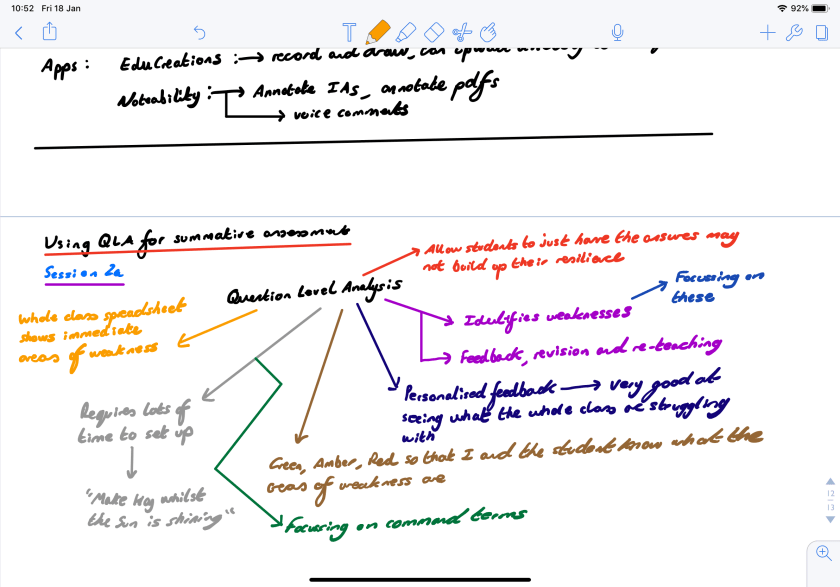
Cool feature #1:Noteability has allowed me to make the most amazing notes and save tons of paper and paper-notebooks in the process. Just look at these beautiful notes I made during my Science JAWs training this weekend:
As you can see, you can select a wide variety of colors and make beautiful notes, Mind-Maps, concept-maps, flow charts, diagrams and more.
I use this feature of Noteability to:
Plan things in my daily life (such as my blog posts, my weekend plans, my fitness plans, etc)
Write shopping lists
Write lesson plans
Take notes in school meetings
Cool feature #2:Noteability allows you to annotate PDFs with the Apple Pencil. This is absolutely brilliant and has allowed me to annotate my IB Diploma Chemistry coursework (Internal Assessment) quickly and clearly before uploading the coursework to the IBIS system.
I can see this feature becoming really useful for schools that want to save paper and for teachers that want to annotate coursework, homework or classwork and then send it back to the student in some way (e.g. by e-mail, through Google Drive or through Google Classroom).
Take a look at this IB Chemistry coursework annotation I recently did with Noteability and the Apple Pencil:
Another way to use this feature is to get the kids to scan their classwork, homework or past-paper answers and then annotate each other’s work with the Apple Pencil. The teacher could also annotate it too:
Cool feature #3:Students can make revision notes, classnotes, homework assignments and submit work all through Noteability. Using the ‘split-screen’ mode on the iPad Pro they can even copy images and charts directly from a web-page they are reading at the same time:
For students, I can see Noteability being using in a range of creative ways:
Making revision notes
Annotating their own work, or each other’s
Creating assignments and presentations (Noteability allows users to copy content from the web seamlessly using ‘split-screen’ mode)
Making notes in class
There is the possibility that tablets may even replace traditional school notebooks in future too – removing the need for 11-year-old kids to carry really heavy bags around school all day (and this has already been linked to back problems).
My thoughts on Noteability
I mentioned this a few blog posts ago but I feel it’s worth a second shout-out.
I like this app because it has basically replaced all of my notebooks, and is an excellent planning, note-taking and annotation tool.
A big drawback of Noteability, at the time of writing, is that it is only compatible with iOS. Not all students use Apple devices, and schools won’t always fork-out money for them. However, I have found that my own personal investment in an iPad Pro, along with Noteability, has enchanced my life in many ways and has benefited some of my students as I have been able to annotate their work better than ever before.
Cool features: Flipgrid is a secure video-commenting/video-conferencing platform. Flipgrid’s mission is to “Empower student voice” and they’ve certainly achieved that with this app.
Basically, the teacher uploads a video of himself/herself asking a question, or posts a question, link, resource or video, and the students respond by taking videos of themselves responding to the material.
It’s super cool!
Once the students have uploaded their videos of themselves, other students can see them and watch them (and comment on them). They can even respond to videos with videos, so it really can get a discussion flowing!
Image courtesy of Flipgrid
Each video a student creates will receive feedback from other students and the class teacher, and the student who made the video can quickly see the feedback they’ve received.
I would recommend all tech-interested educators to check out Jess Bell’s guest blog post over at larryferlazzo.edublogs.org entitled‘Getting Started with Flipgrid’.
My thoughts on Flipgrid
When I tested it this weekend at the conference it took me a while to figure out how to use it, and what its purpose was.
Once I’d signed up, however, the website directed me to lots of great help and resources. There’s a load of pre-made lessons and students can sign in with a simple pre-generated code (like Kahoot! and Nearpod) which saves tons of time.
Once you’ve signed up (it’s free) and you’re in on Flipgrid, your dashboard will look something like this:
As you can see: it has a very user-friendly interface.
Conclusion
EdTech is here, everyone, whether we like it or not.
I’m a big believer in using things that work: things that help. I don’t believe that technology can (or should) replace everything a teacher does traditionally (such as having a one-on-one conversation with a student), but I do believe that these apps I have mentioned have tremendous potential and should be capitalised on fully.
As always, please do be aware of how screen-time affects our students’ health (I wrote a blog-post about this here: Digital Disaster: Screen Time is Destroying Childrens’ Health). I wouldn’t advise that screens be used all lesson, every lesson, but we should use these apps at appropriate times to reinforce, teach and revise key concepts.
We welcome you to join the Richard Rogers online community. Like ourFacebookpage and follow us onTwitterfor daily updates.
It’s a warm mid-summer day in muddy Swynnerton, England. I’m at an army base for Summer Camp. I’m a 15-year-old army cadet.
The Territorial Army had some of their boys in to inspire and help us. They needed a cadet to help with the radio and signals work during night exercises. I can’t remember if I volunteered or if I was chosen, but I very quickly found myself listening in on the radio transmissions, recording the call signs and messages in the log book and taking action where needed to pass on vital information about group movements and conditions, along with any emergencies.
I loved it. It was ace!
I just immersed myself in the process and did the best job I could. I was told what to do by the T.A. lads and I just got on with it.
Later that night, they all shook my hand and told me I had done a good job.
The next day came and I was approached by my home platoon sergeant. I can still remember her words, two decades later: “Corporal Rogers I’m hearing brilliant things about you from the T.A. Keep it up! You’re doing Flint Platoon proud”.
That felt amazing, and it spurred me on to work harder.
“An AMAZING Book!”
Praise only works when it is used properly
The Army Cadets were an excellent model of good teaching. To be honest, I really think they turned my life around. I went from a shy, weak and rather timid boy to a confident and rather ambitious young man in the space of about three years, thanks to their help.
I’m going to summarise what I’ve found to be the very best ways to use praise to empower and push our students forward. They worked for me when I was being taught as a kid, and they’ve worked for thousands of students that I’ve helped in my twelve years as a high school teacher.
Rule #1: Praise must be sincere
If you don’t mean it, then don’t say it. Kids are not easily tricked. Praise is only ever effective when the teacher saying the nice words of encouragement truly means it.
Rule #2: Praise must be specific
Does the student know exactly why they’ve done a great job? Does the student know what they did well?
Be specific. Here are some examples:
“Well done, John, for drawing your diagrams with a ruler. They look really neat and tidy, and I can tell that you’ve put time and effort into this work. I am very pleased. Keep it up”
“I’m so pleased with the excellent progress you have made this term, Rosie! Just look at these results: You’ve gone from a level 5 in test 1, then to a level 6 and now you’re working at a level 7. That’s very impressive, Thank you for your hard work and commitment”
Rule #3: Praise must be recorded and remembered by the teacher
Try keeping a professional intelligence journal.
I’ve written about the power of this techniquebefore, but I’ll go through the process again for clarity.
Basically, at the start of every academic year you should purchase a new notebook. Make sure there are enough pages in it for every student. Every student gets a page.
On each page write down and record any significant interactions with the student. Record their birthdays, hobbies they have, times when they were praised, significant achievements in extra-curricular activities, etc.
Once this information has been recorded, it can be effectively reinforced (please see my post on ‘subtle reinforcement‘ for more info about this powerful technique).
Rule #4: Reinforce the praise at significant points in the future
Did you notice that my platoon sergeant praised me the next day? That was powerful, because she wasn’t actually there when I did the signals work, but someone had spoken with her.
Praise must be collective if it is to be truly effective. When a student does a great piece of work, tell your colleagues and your line manager. Ask them to reinforce your praise by giving their own praise to the student.
Richard’s second book
Reinforcement should also be self-driven – remind your students of previous achievements in order to empower their momentum.
“I remember the excellent Chemistry student who built the atomic structure model in Term 1. She said ‘I’ll find a way to suspend the protons in the middle’. Jessica, you’ve already shown me what a hard-working, committed student you are. This is your moment to shine once again. Put your best effort into this, I believe in you. I know you can do this!”
We welcome you to join the Richard Rogers online community. Like ourFacebook page and follow us on Twitter for daily updates.
Today is a remarkable and unique day. The suspense and the emotion fills the air. It surrounds us. We can even taste it.
A daring and incredibly dangerous rescue mission has been given the green light to go ahead. Today is the day that Royal Thai Navy Seal divers will begin the attempt to rescue the 12 schoolboys and their 25-year-old coach who’ve been trapped in the Tham Luang cave complex, Chiang Rai, for two weeks.
The boys and their coach inside the cave, accompanied by a Thai Navy Seal diver. Image courtesy of the Royal Thai Navy Seal Facebook page.
Being based in Bangkok, Thailand, I have a close association with Thai people from all walks of life. This event has truly gripped the nation, and the world.
Before I talk about today’s subject matter, I’d like to ask all of my readers to please join me and all Thai people by praying for the safe rescue of all 12 boys and their coach (and the safe return of the rescuers).
Humans are natural carers
This cave rescue in Thailand has given me a fresh perspective on the topic of empathy. It’s made me ask the question: do children really need to be taught how to care for one another?
The outpouring of help for these trapped boys and their coach has been truly inspirational. I won’t even begin to attempt to write a list of all of those who have helped because that list would be so huge it would take months, maybe years, to research and collate. But it has been remarkable. People from all over the world have literally sacrificed their time, money, health and energy to do everything possible to help these boys.
One man even sacrificed his life: Petty Officer Saman Gunan, who fell unconscious and died shortly after delivering oxygen tanks in the cave complex.
When times are at their worst, humans will do everything they can to help. Mr Saman Gunan is a true hero who selflessly did the best he could to help people who were in desperate need.
Surely this is our highest and most prized quality as humans – selflessness. Few people, however, are both incredibly brave and selfless, as Mr Gunan was.
He will forever be remembered, and missed.
Teaching kids to care
I personally believe that the vast majority of people are natural carers. We empathise naturally – it’s part of who we are.
According to Samantha Rodman (Clinical Psychologist and Author), however, there are six keys ways in which we can teach kids empathy. This would seem important in a world where youngsters are being increasingly detached from physical interactions with one another by the barriers of mobile technology.
Materialism also doesn’t escape the jury’s verdict.
According to research conducted by psychologists at Northwestern University, materialism is socially destructive. It is associated with depression, anxiety and broken relationships.
To further compound this issue a more startling picture of human empathy is portrayed by the research conducted by Sara H. Konrath and colleagues of the University of Michigan at Ann Arbor and published in Personality and Social Psychology Review. Her team conducted a 30-year study between 1979 and 2009 and discovered that Emphatic Concern and Perspective Talking is declining rapidly in college students.
Maybe we do need to teach kids how to care, after all.
So what are the six ways to teach empathy?
Teach kids about emotions: Children need to know what emotions are, and how to identify them. Once kids have identified those emotions, they can then learn how to manage them. Progress in this area has been heavily fueled by the Mindfulness in Schools strategy, which teaches the importance of observing one’s thoughts and emotions, rather than reacting by reflex-action. Check out their website – it’s well worth a look!
Read and watch TV with your children: I guess this could work in a parent-student, teacher-student and student-student dynamic. The key is to get the kids thinking about and discussing how the characters feel in different parts of the story. It still amazes me when I watch a movie in the cinema and people laugh when some character gets killed or something bad happens. Movies are strange entities because in some cases they play on human emotion positively by creating more empathy, but in some genres repeated watching can lead to desensitization.
After conflicts, have a reflection: This is a classic tried-and-tested technique, and it works well. “How do you think Sarah felt about what you said? How would you feel if someone said that about you?”. Getting young people to reflect on the emotional consequences of their actions can have profound, long-term effects on their character and personality.
Set an example by resolving conflicts in your own life: Probably more applicable to parents than teachers, or teacher-parents, but well-worth mentioning. If you have an argument with your wife in front of your kids, for example, you must also make-up in front of them too. With your students in school, you could get them to shake hands after an argument and get them to say sorry to one another.
Express feelings on behalf of those who cannot speak: Babies, pets and, in some cases, disabled people, cannot express their emotions verbally or through other means. Discuss with your students or children what the feelings of these individuals might be when the opportunity arises.
Be a good role-model of respect and decency: Show courtesy. Be respectful of people who have different opinions or beliefs than you do (unless those beliefs threaten life, health or safety – then you’ll have to take action in a sensible, emotionally-detached way). Let your students see you showing respect for those around you who may have a different religious belief system, or political opinion, than you do. It’s very sad to see politicians arguing on TV, for example, when they should show greater respect for one another.
Conclusion
Research has shown that empathy is decreasing in young people
Materialism is associated with anxiety, depression and the breakdown of relationships
There is a case to be made for the rigorous and broad teaching of empathy to kids in schools
There are ways to deliberately teach empathy to children, and six have been identified here
We welcome you to join the Richard Rogers online community. Like ourFacebook page and follow us on Twitter for daily updates.
I wasn’t a particularly ‘good’ kid in early primary school. I tried to follow instructions, but things didn’t really ‘click’ for me until later in life. One day, however, I must have been a good student because my teacher rewarded me by letting me use the computer.
I was led by hand to a small room adjacent to the classroom. Nestled in the corner on a wheely truck was a BBC Micro computer. It came complete with a huge floppy disk drive and some kind of touch-pad which I didn’t understand how to use.
It all looked very high-tech and cool to me.
For thirty minutes I was allowed to play vocabulary and maths games. The black screen whirled with green text and pong balls as I tried to solve the problems. The bleeps and 8-bit sounds were awesome.
Later that year my family would buy a far-superior computer and a legendary gaming console – the Atari 520 ST.
If I was lucky I’d get an hour to play on that computer each day. The games were aimed at kids and the themes were vivid and colourful. The Atari machine taught me hand-eye coordination and the basics of using a mouse, floppy disk drive and operating a basic computer. I think it also made me a bit of a dreamer and aided my imagination.
‘Double Dragon’ – A game I used to play on the Atari 520 ST back in 1988
My life back then was very-much centred on the outdoors. The Atari was a nice addition to my life, but I still preferred running though streams and burying my toy cars in the garden.
Fast Forward to 2018
I can’t believe that thirty whole years have passed since 1988. My generation has seen so much change in such a short space of time.
An AMAZING Book
Some technological developments over the past three decades have been revolutionary and beneficial to mankind. The creation of the mainstream internet in 1993, for example, opened peoples’ homes, libraries, offices and schools to a whole new era of possibilities and opportunities in learning, business, entertainment, communication, research and e-commerce.
Along with this sudden treasure trove have come some shocking and extreme societal changes which pose new challenges for all of us.
Take a report published by the Telegraph this week, for example. The headline is enough to stun any parent or teacher:
Children spend up to 10 hours a day ‘mindlessly swiping’ their mobiles, study finds
The article summarizes the findings of technological research into what young people actually do online. It’s thought to be the first time that technology has been used to analyse the mobile-device usage habits of children.
The findings are alarming:
Behavior is compulsive, with young people typically spending no longer than one-minute looking at any particular page of content before swiping to something else
Social media takes up hours and hours of teenagers’ free time
Children from ‘low-income’ households seem more prone to compulsive use of social media than others
Many children in the study admitted to falling asleep at night whilst on their phones
Many children admitted that they felt that their compulsions were “mindless” and “pointless”, but felt compelled to use their smartphones on a near-constant basis anyway because there’s a feeling of incompleteness or ‘losing out’ when the phone is not being checked.
Some children in the study felt the need to check their phones whilst actually being interviewed by the research panel
In many cases, children are spending up to 12 hours on their phones per day! Take this shocking example for instance (quoted from the Telegraph article):
Typical was Olympia, aged 17, who in one 24-hour period spent 3.3 hours on Snapchat, 2.5 hours on Instagram, 2 hours on Face Time, 2.4 hours on What’s App and 1.8 hours on Safari – a total of 12 hours.
But I thought that technology was good for kids!
As teachers, we’ve pinned our colours to the ‘Technology Troop’ so much that as soon as people start speaking up about the dangers of widespread and pervasive technological encroachment into peoples’ lives they are often shunned; sometimes disgraced and can be seen as ‘old-fashioned’ or not ‘with the times’.
I once remember a fashionable post and picture from a friend on LinkedIn in which he said “When faced with a steam-rolling technology you either become part of the steam-roller, or part of the road”.
I remember thinking ‘How about you just move out of the way of the steam-roller’?
It didn’t take long before the reflex-action barrage of indignation was fired my way.
But the dangers of compulsive and widespread association with our mobile devices are real – very real:
A Dutch study involving 10,000 participants in Rotterdam concluded that smartphones are causing nearsightedness in children. This has also been backed up by studies and observations in Canada, America and Ireland.
The Harvard T.H. Chan School of Public Health caused shockwaves in 2016 with the conclusion of its study: that smartphone and tablet use correlates strongly with obesity in teens. Similar findings have come from a number of respectable sources, including a massive, global joint study between Stanford University and the American National Institutes of Health which was concluded in 2015.
Sleep-deprivation is a common side-effect of smartphone and tablet addiction. Research from the Division of Cardiology at the University of California (San Francisco), for example, has found that the use of mobile devices near bedtime is connected with low-quality sleep.
Conclusion
As teachers and parents we are facing a global health crisis of epic proportions.
The dangers of excessive mobile-device usage are well-researched, fully-supported and very real. Also: ‘excessive’ has become the new ‘normal’.
If we do not take action now, when this problem is in it’s relative infancy, then who’s imagination can predict the problems that are waiting to manifest?
We must no longer subscribe to the notion that technology is amazing and that anyone who criticizes or questions its value in an educational setting is to be shunned or belittled. There are legitimate reasons for being concerned about the encroachment of screen time into childrens’ lives.
Next week, I’ll be exploring ways in which adults can reduce the screen time of their children and students. We all must help. We all must take action now.
We welcome you to join the Richard Rogers online community. Like ourFacebook page and follow us on Twitter for daily updates.
They stood at the front of the audience: seemingly ready to dazzle us all. They were all 18 years old and in the final term of high school. I was much younger then too – 26 years old and in my third year of teaching.
It was a Biology revision presentation. I’d invited my colleague to come along to watch (also a Biology teacher).
The presenters began their talk.
When it was over, I needed to take a paracetamol tablet. I was rather perplexed.
I let my colleague chirp in with some feedback first, thinking she would cover most of the points I wanted to raise.
“A great presentation. I loved the level of detail and research. Well done”
That was it?
Now I found myself confused and furstrated. I thought back to the late 90s when my dad received a ‘stress reliever’ doll one Christmas. It was basically a squishy, red, head-shaped rubbery thing in a pot that you could squeeze when you got a bit mad. It was joke gift of course: designed to cause a giggle or two; but I wished I had one right now.
“An AMAZING book!”
“Mr. Rogers. What are your thoughts?” Asks my colleague.
After asking a series of questions to which the students responded with nervous looks and blank stares, I decided to give my merciless, but honest, feedback:
“Whilst I agree with my colleague that your research skills were good, there are still a few issues I’d like to address.
I’ll start with the negatives, then share my thoughts on what, if anything, was positive. All of you were reading directly off the slides and not making eye-contact with the audience. We can all read, so your method of presentation was not engaging. There was too much text on each slide. The material had not been properly referenced and the images you did use, though few, were of very low quality. You also superficially skimmed the surface of the topic, and didn’t even touch on issues such as splicing, introns and transposable elements.
On the positive side, you showed us all that you can describe some of the concepts in some detail.
Please speak with me tomorrow morning during registration so that we can arrange a time to do this again”
The ‘respect’ factor
Unfortunately, many of us in the teaching profession have been conditioned to dish out praise all day long for the most minuscule of things. A kid hands in a complete dog’s dinner of a homework and it’s “Well done for handing this in on time. Meeting deadlines is important”.
I could go on with the spectrum of ‘non-confrontational’, politically correct garbage that I was conditioned to spew for another 1000 words, but I think that would be tedious.
I used to be one of those ‘praise everything’ teachers. Guess what I found out:
Praise only works when it is sincere
Praise only works when it recognises significant, meaningful achievements that have taken some work to accomplish
Praise is extra effective when preceded (NOT followed by) points for improvement
And guess what else I’ve found out – students respect us more when we are honest. They respect us when we tell them that they need to improve. They respect us when we are vigilant.
Lots of research supports these findings. Here are two good examples:
A 2016 summary by Vanderbilt University found that praise works well when it is behavior-specific, and that a ratio of 4 praise statements to one reprimand works well for improving performance (if 4 praise statements are available for the work being assessed). Here are some examples of language changes we can make to turn praise into a kind of ‘disguised reprimand’ or ‘behavior enforcer”:
Behavior Specific Praise. Courtesy of Vanderbilt University, 2016. See the publication entitled ‘Behavior Specific Praise in the Classroom’. Tennessee Behavior Supports Project.
Whilst this table is useful, I think it’s important to remember that reprimands must be specific and direct. “We don’t take other people’s property, because that causes suffering to another person. When you’re older, you can also get into big trouble with the police for that. You’ll need to write a letter of apology to Simon for what you did.”
A 2015 blog post by Brian Gatens at the University of Portland made the point that when teachers show honesty and compassion, they build trust with their students. Compassion doesn’t mean making kids feel good all the time – it means letting them know when they’ve under-performed, and caring enough to do something about it! It also involves celebrating and recognising significant progress, performance and attainment.
‘Mediocre’ Versus ‘Vigilant’
Here are some statements I’ve come up with which sum up the ‘Mediocre’ teacher, versus the ‘Vigilant’ teacher. I don’t mean to offend anyone here – I was once the Mediocre Teacher. I share my findings as a means of self-reflection for all of us. I still get a bit ‘mediocre’ at times, but at least I’m aware of how to spot that now:
Mediocre teachers record attainment and progress. Vigilant teachers record attainment and progress, quickly identify under-performance and then intervene to improve that.
Mediocre teachers praise the smallest of things. Vigilant teachers reserve their praise for significant, meaningful displays of effort, attainment and progress.
Mediocre teachers sometimes bring up points for improvement with their students. Vigilant teachers leave ‘no stone unturned’, and relentlessly monitor their students’ weaknesses and do the best they can to improve those.
Mediocre teachers don’t feel the need to be a ‘role-model’ for their students. Vigilant teachers understand that their words, actions and subliminal cues will act as points of reference for their students for many years to come.
Mediocre teachers mark their students work. Vigilant teachers provide feedback that’s meaningful and specific.
We welcome you to join the Richard Rogers online community. Like ourFacebook page and follow us on Twitter for daily updates.